When the Mind Leaves the Battlefield: The Psychological Tragedy of Ukraine’s Soldiers
By Matthew Parish
Sunday 4 October 2026
There is an expression sometimes heard among soldiers in Ukraine that a man has “gone crazy”. It is not a medical expression and it can encompass almost anything: the soldier who suddenly refuses to leave his dugout; the man who drinks himself unconscious whenever he returns from a position; the veteran who cannot sleep unless there is noise outside his window; the foreign volunteer who arrived enthusiastic and articulate but months later has become withdrawn, suspicious and unpredictable; the experienced infantryman who begins trembling uncontrollably before another rotation to the zero line. Sometimes there are hallucinations, explosions of anger or apparently irrational behaviour. Sometimes there is merely silence.
We ought to be careful with the words we use. Most soldiers subjected to prolonged combat do not literally “go mad”, and psychological injury can take many different forms. Post-traumatic stress disorder is only one of them. There are acute stress reactions, depression, anxiety, traumatic grief, substance misuse, sleep disorders and what has come to be called moral injury: the psychological damage associated not merely with fear but with having witnessed, suffered or participated in events that violate one’s deepest assumptions about how human beings ought to behave. Contemporary research into Ukrainian trench warfare identifies prolonged combat stress, traumatic exposure and moral injury as overlapping psychological burdens rather than a single disorder.
Nevertheless, behind the clinical terminology lies a brutal truth. Human beings were not designed to live indefinitely under artillery fire.
The distinctive horror of the contemporary Ukrainian battlefield is its relentlessness. In earlier wars there were terrible bombardments, snipers, mines and aircraft, but there were also stretches of relative invisibility. A soldier might at least imagine himself temporarily concealed from the enemy. Drone warfare has profoundly eroded that psychological sanctuary. Somewhere above the tree line may be a reconnaissance drone; somewhere beyond it an FPV operator may be looking for movement. A vehicle, a cigarette, a journey along a road, the delivery of food or ammunition and even the evacuation of a wounded comrade may attract lethal attention.
The psychological consequence is difficult for civilians to comprehend. Fear ceases to be an event and becomes an environment. The nervous system remains alert because remaining alert is rational. Every unfamiliar buzzing noise matters. Every change in the sound of artillery matters. Every movement across open ground matters. Sleep becomes fragmented because deep sleep may be dangerous. The very characteristics that preserve a soldier at the front — hypervigilance, rapid aggression, suspicion, instantaneous responses to noise — may subsequently become destructive when he returns to ordinary society.
One extraordinary example reported in 2026 was that of Ukrainian soldier Serhii Krynitskyi, who survived 346 days in a small underground position near Chasiv Yar. Drone warfare had dispersed troops into tiny groups because concentration invited detection and attack. He endured freezing conditions, repeated drone and infantry attacks and eventually the death of his remaining companion before leaving the position. Such experiences demonstrate the almost unimaginable duration for which human beings in this war may inhabit conditions of mortal danger.
Then there are the dead.
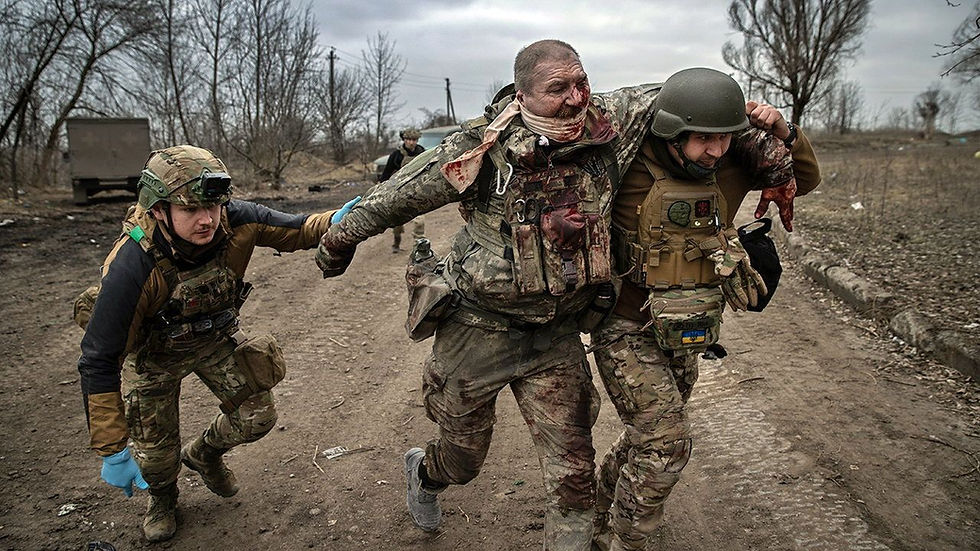
Combat trauma is not simply fear of one’s own death. Soldiers repeatedly lose friends with whom they have eaten, slept, joked and endured terror. A civilian may experience the death of a close friend several times during an entire lifetime. A soldier in an unfortunate frontline unit can experience it repeatedly within months. The normal processes of grief become impossible because there is another position to hold, another rotation to complete and another dead friend whose belongings must be collected.
Survivor’s guilt can compound the damage. Why did the drone strike the other dugout? Why was one man ordered into the vehicle and another told to remain behind? Why did one soldier bend down at precisely the moment fragments crossed the trench? War is filled with arbitrary distinctions between survival and death, yet human beings instinctively search for reasons. A surviving soldier may therefore spend years trying to impose moral logic upon events governed substantially by chance.
There is also the problem of killing. Public discussion of military mental health sometimes concentrates so heavily upon what soldiers suffer that it neglects what soldiers are required to do. Infantry warfare requires human beings to kill other human beings. That may be legally justified, morally necessary and essential to the defence of one’s country, but none of those propositions guarantees that the mind emerges unaffected. A decent human being does not necessarily cease being psychologically disturbed by killing merely because the killing was justified.
This is particularly important in Ukraine because so many members of the Armed Forces were civilians before February 2022. They were engineers, shopkeepers, lawyers, electricians, teachers, drivers, computer programmers and fathers. Professional soldiers at least enter a culture intended to prepare them psychologically for violence, although no training eliminates its effects. A mobilised civilian may undergo an extraordinarily abrupt transformation from ordinary life into an environment in which dismembered bodies, violent death and constant mortal danger become routine.
The tragedy has another dimension because Ukraine’s Armed Forces include foreigners. Ukraine’s Ministry of Defence says that volunteers from more than 50 countries have served alongside Ukrainians since the beginning of the full-scale invasion. Some arrive with extensive military experience. Others are attracted by political conviction, solidarity with Ukraine, personal adventure or complicated mixtures of motives. Whatever their reasons, nationality offers no protection against combat trauma.
Indeed foreign volunteers can encounter an additional problem when their service ends. A 2026 study of British and American veterans who had volunteered in Ukraine found high levels of probable PTSD, common mental-health disorders, alcohol misuse and distress associated with moral injury among its small sample. Participants described extremely intense exposure to combat, including trench and drone warfare, while psychological care was often difficult to obtain both in Ukraine and after returning home. Researchers warned that these veterans could fall between military and civilian systems of care.
That last problem deserves particular attention. A Ukrainian veteran returning to Kyiv, Kharkiv or Lviv at least returns to a society that knows there is a war. Sirens continue, soldiers are everywhere and virtually everybody understands something of bereavement, displacement or fear. A foreign volunteer may return instead to Manchester, Stockholm, Toronto or Houston, where people are discussing mortgages, office politics and what to have for dinner. Yesterday he was watching for drones over a trench. Today somebody is complaining because the train is ten minutes late.
The psychological distance between those worlds can be enormous.
Alcohol provides one obvious bridge, and a dangerous one. It can produce sleep where sleep will not otherwise come, temporarily suppress memories and permit companionship without conversation about what has happened. Other soldiers retreat into isolation. Some seek repeatedly to return to war because war, paradoxically, has become the environment that makes sense. At the front there is a mission, a hierarchy and comrades who understand without explanation. Civilian life may seem trivial, confusing and strangely unreal.
This does not make traumatised soldiers dangerous people. That stereotype should be resisted vigorously. The overwhelming majority of veterans suffering psychological injuries do not become violent criminals or psychiatric caricatures. Many continue working, loving their families and functioning effectively while carrying burdens invisible to everybody around them. Psychological injury may manifest itself less spectacularly through broken relationships, insomnia, inability to concentrate, emotional numbness or a persistent sense that ordinary life has lost its meaning.
Ukraine increasingly recognises the scale of the problem. In October 2025 its Ministry of Defence approved principles and an implementation plan for a comprehensive military mental-health system, including expanded psychological-support structures and qualified military psychologists. International partners have also been developing frontline capacity: Britain, for example, expanded training for Ukrainian personnel in combat mental-health first aid. These are important measures, but the scale and duration of the war mean that psychological rehabilitation cannot sensibly be understood as a peripheral welfare programme. It is becoming one of Ukraine’s central post-war national challenges.
There is also a cultural obstacle. Armies necessarily celebrate endurance. Soldiers must continue functioning when frightened, exhausted, hungry and grieving because otherwise military organisations cease to operate. Yet the same culture can encourage men and women to conceal psychological collapse until concealment becomes impossible. A broken leg is obvious and honourable. A mind that can no longer tolerate another rotation may still be interpreted, by the sufferer as much as anybody else, as weakness.
That distinction is irrational. If a soldier’s hearing can be damaged by repeated explosions, there is no reason to imagine that his nervous system cannot be damaged by repeatedly believing that he is seconds from death. The brain is an organ of the human body. Exposure has consequences.
The problem extends beyond soldiers themselves. Wives and husbands may discover that the person who returns from the front is not quite the person who left. Children may learn not to wake a parent suddenly. Families may live around unpredictable sleeping patterns or emotional withdrawal. Friends may become frustrated because the veteran refuses to talk, while the veteran may be equally frustrated because he cannot explain experiences for which ordinary civilian vocabulary seems inadequate.
Ukraine will therefore need not merely psychiatrists but an entire ecology of reintegration: psychologists, family doctors, veterans’ organisations, rehabilitation centres, peer-support networks, employers prepared to understand former soldiers and communities capable of accepting that recovery may take years. WHO already describes millions of Ukrainians as confronting mental-health challenges amid a health system strained by attacks, displacement and war injuries. When hundreds of thousands of military personnel eventually pass through demobilisation, the psychological consequences of the war will not disappear with their uniforms.
Nor should foreigners who fought for Ukraine simply be forgotten at the border. Their governments may never have asked them to go and their home military establishments may regard them as outside conventional veterans’ systems. Yet if they served lawfully in Ukraine’s Armed Forces and were psychologically injured doing so, there remains a humanitarian problem even where bureaucratic responsibility is unclear. The emerging evidence suggests precisely this gap.
There is a temptation in wartime journalism to write about soldiers exclusively in the language of heroes. Ukraine certainly has extraordinary heroes, and its continued existence has depended upon them. But heroism and psychological collapse are not opposites. A man may have behaved with exceptional courage for two years and then discover that he cannot tolerate one more explosion. A foreign volunteer may cross a continent to defend a country that is not his own and return home unable to sleep. A decorated infantryman may find himself crying uncontrollably in a supermarket because something has made precisely the wrong noise.
None of this diminishes what these people have done. It reveals the price.
The monuments to this war will eventually carry the names of the dead. Hospitals will contain the amputees and the visibly wounded. Yet another population will walk through Ukrainian cities and through cities far beyond Ukraine carrying injuries that cannot be photographed. Some will recover quickly. Some will struggle for decades. A few will never entirely return from the battlefield, even though their bodies came home.
That may prove one of the longest tragedies of the war. The artillery eventually falls silent. The drones eventually disappear from the sky. The trenches gradually collapse back into the earth. But inside the minds of some of the people who lived there, the battle continues.