Organising Against Chaos: Yevhen Koliada and the Humanitarian Machinery of Kharkiv Relief Coordination Centre
By Matthew Parish
Sunday 4 October 2026
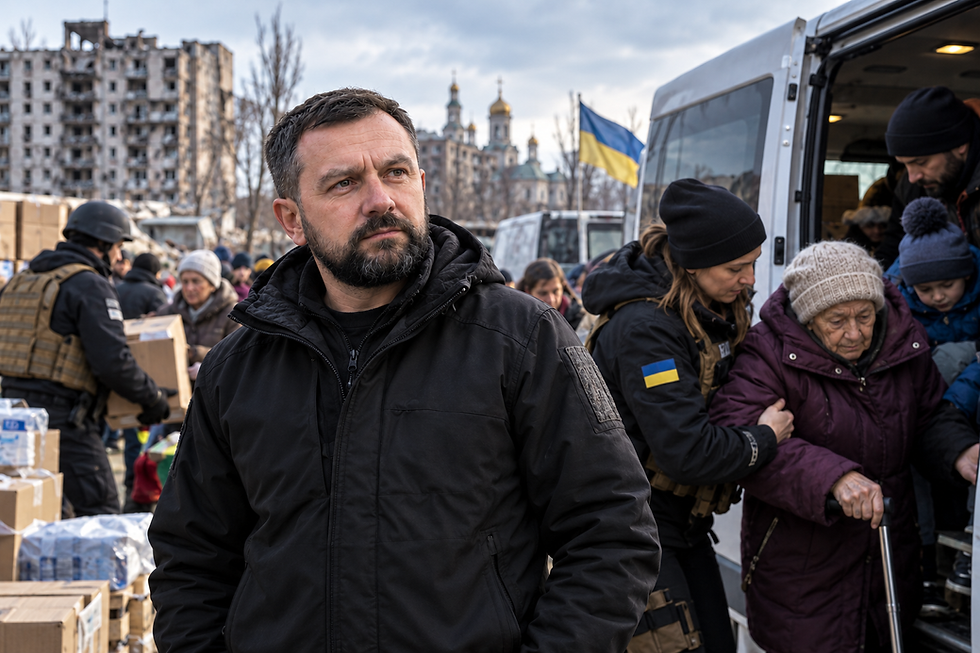
There is a tendency, when thinking about humanitarian work in wartime Ukraine, to imagine the dramatic moment. A van careers down a battered road towards a village under bombardment. An elderly woman carrying a plastic bag containing what remains of her possessions is helped inside. Volunteers wearing body armour slam the doors and the vehicle races back towards Kharkiv. The photographs are compelling because the danger is visible and the moral purpose immediately comprehensible.
Yet Yevhen Koliada, head of the Relief Coordination Centre (RCC), has spent much of the last four years thinking about everything that happens before and after that photograph. Who knows that the elderly woman needs evacuating? Who answers her telephone call? Who decides whether the road remains passable? Who knows whether she can walk, whether she requires medication, whether she has a cat she refuses to abandon, whether there is a bed waiting for her in Kharkiv or Lozova and where she is supposed to go afterwards?
These are administrative questions, but in a war administrative questions can become questions of life and death. RCC emerged from the discovery that courage and goodwill, indispensable though they are, cannot by themselves operate a humanitarian system.
“The main lesson of 2022,” Koliada tells the Lviv Herald, “was the understanding that, in wartime, good intentions are not enough. What is needed is a system that enables rapid decision-making, provides a clear picture of real needs, and allocates resources where they can have the greatest impact.”
Five cars, a dam and the beginnings of a system
The origins of RCC lie in the extraordinary improvisation of the first months following Russia’s full-scale invasion. In spring 2022, Koliada and his colleagues were operating as a volunteer initiative around the Pechenihy Dam in Kharkiv region. It had become one of the few routes available to civilians attempting to escape dangerous territories.
Around 16,000 people were evacuated along the route over several months. But the experience exposed a problem larger than transportation itself. People had to be received after they had been extracted, accommodated, supplied with assistance and helped onwards. Meanwhile numerous organisations were trying to perform overlapping humanitarian functions without necessarily knowing what the others were doing.
The solution was coordination.
By autumn 2022, Koliada and his colleagues had begun creating an organisation intended not simply to conduct humanitarian missions but to organise them as a system. What started as a handful of people and vehicles evolved into something substantially more complicated.
“We were essentially building an institution while simultaneously carrying out operations,” Koliada recalls. “We started with seven volunteers in a basement, with one table and several old computers. Today, RCC works with 800 organizations and operates not only in Kharkiv, but across Ukraine.”
That transition presented a dilemma familiar to successful volunteer organisations across Ukraine. The chaotic ingenuity of 2022 worked precisely because nobody waited for committees, policy documents or elaborate chains of command. If somebody needed rescuing, somebody found a car and went to rescue them. Yet what works amongst seven people cannot necessarily work amongst hundreds of organisations handling thousands of civilians.
Planning, personnel management, financial accountability, data protection, operational security and standardised procedures gradually became unavoidable. Nevertheless, Koliada is wary of confusing professionalisation with bureaucracy. His objective is to preserve the speed of Ukrainian volunteerism while adding “system, predictability, and accountability”.
That distinction is important. Ukraine’s humanitarian sector was born to a significant degree from improvisation. Its future depends upon institutionalising that improvisational brilliance without suffocating it.
A city that rescues others while itself under attack
Kharkiv presents a peculiar humanitarian geography. It is a metropolis containing hospitals, transport infrastructure, government agencies, volunteers and substantial humanitarian resources. Yet it sits extraordinarily close to Russia and to communities where security conditions can deteriorate with alarming speed.
“Kharkiv is simultaneously a major city, a logistical and humanitarian hub, and a territory that remains under constant threat,” Koliada observes. Resources concentrate there while the city itself must remain perpetually prepared for another emergency.
Hence an evacuee may be collected from a front-line community in an armoured vehicle, brought into Kharkiv or Lozova, processed through a transit centre and then continue towards central or western Ukraine. RCC itself now works beyond Kharkiv region, coordinating communities, state institutions, volunteer groups and international humanitarian organisations across Ukraine.
The apparent simplicity of the word evacuation therefore disguises an entire chain of decisions.
“Evacuation begins long before a vehicle leaves to pick someone up,” Koliada explains.
The first task is information. Civilians need to know evacuation is possible, how to request it and what will happen afterwards. RCC uses information campaigns and the nationwide 24-hour 203 hotline. Once a request arrives, staff establish the person’s circumstances: health, family composition, mobility and transport requirements. At the same time somebody must assess the route and determine whether the settlement can safely be reached. In especially dangerous areas, armoured vehicles are used.
Yet removing somebody from danger is only half an evacuation.
After extraction comes the transit centre, where an evacuee may need food, medicine, psychological support, legal advice, financial assistance or replacement identity documents. Then comes accommodation or transportation elsewhere. RCC describes this as a “full evacuation cycle”: information, evacuation, transit, onward accommodation, integration and subsequent monitoring.
This distinction may sound technical. In reality it goes to the heart of why some civilians refuse to leave dangerous places.
“Where will I live?”
From the safety of western Europe, it may appear incomprehensible that somebody would remain in a village being shelled when evacuation is available. The temptation is to imagine stubbornness, fatalism or political sympathies. Koliada offers a more humane explanation.
Often people understand the danger perfectly well. What terrifies them is uncertainty.
“People ask: Where will I live? What will happen to my home? Can I take my pet? Will there be somewhere for my mother to live? Will my child be able to continue their education? Will medical care be available?”
A house in a front-line village may be dangerous, but it remains a house. The alternative may appear to be an unknown journey towards an unknown institution in an unknown city. Hence RCC has tried to turn evacuation into something that people can understand before agreeing to it.
Its Poruch digital system, being piloted in Kharkiv region, allows prospective evacuees to see photographs and information about temporary accommodation, including accessibility for people with limited mobility and whether animals are permitted. Places can then be reserved through the 203 hotline. Instead of telling somebody to leave and promising that matters will somehow be resolved afterwards, Koliada says RCC can show them where they are going and what conditions await them.
Sometimes that is sufficient to change a person’s mind.
This emphasis upon what happens afterwards becomes still more important when one considers who is being evacuated. RCC’s operational data indicate that approximately 30 per cent of evacuees require accommodation. Of those, some 60 per cent are people with reduced mobility or disabilities. A bed somewhere is therefore not necessarily an adequate solution. Housing must match the needs of the person who is supposed to live in it.
“Evacuation cannot end with the words, ‘We have evacuated you; now you are on your own,’” Koliada says.
It is difficult to formulate the humanitarian problem more succinctly.
Data as humanitarian infrastructure
There is another side to RCC’s activities that lacks the emotional power of an evacuation photograph but may ultimately be just as consequential: databases.
Imagine 100 charities attempting to help 100 communities. Without coordination, five organisations may deliver identical assistance to one village while another receives nothing. Every organisation can be behaving generously and competently while the collective outcome remains irrational.
RCC tries to solve this through information rather than command. Koliada stresses that his organisation does not manage its partners. Instead it tries to establish what particular communities need, which organisations are operating there, what resources exist and what has already been provided. Needs can then be matched with capabilities.
Its BRIDGE platform has become central to this process. According to Koliada, it now incorporates 1,064 local organisations, 90 international organisations and 112 communities. Its purpose is to allow participants to understand humanitarian needs and available resources without transforming RCC into a command structure.
“Data is not a technical add-on to humanitarian work,” Koliada tells me. “It is its infrastructure.”
That is perhaps the most revealing sentence in the interview. BRIDGE attempts to provide an overview of organisations, needs, resources and results, while Poruch tackles uncertainty from the opposite direction by giving individual evacuees meaningful information about the choices available to them. Technology, in Koliada’s formulation, should not replace human judgement but allow people to make better decisions.
Of course, humanitarian data can itself become dangerous. Lists of displaced people, accommodation facilities and movements would be of obvious interest to hostile intelligence services. RCC therefore attempts to minimise the personal information available to individual users, restrict sensitive material and use aggregated information where individual identification is unnecessary. Exact addresses of accommodation shown through Poruch are withheld publicly.
Cybersecurity, Koliada argues, must consequently be understood as humanitarian security. In wartime, a compromised database is not merely an IT inconvenience. It may expose vulnerable human beings.
The Ukrainians and the internationals
The relationship between Ukraine’s home-grown humanitarian sector and the enormous international humanitarian machinery that arrived after February 2022 has not always been straightforward. International organisations possess money, institutional experience, sophisticated compliance procedures and global networks. Ukrainian organisations possess something different: knowledge.
A local team may know the village, the roads, the people and whom to telephone. It may make a decision in hours rather than passing a proposal through several layers of approval.
Koliada resists the simplistic conclusion that one model is superior. “International organizations have significant resources, expertise, standards, access to global networks, and the ability to scale solutions. Local organizations have speed, contextual knowledge, and trust.” The answer, he argues, is partnership.
Yet partnership means more than using Ukrainian NGOs as delivery mechanisms for programmes designed elsewhere. Koliada would like Ukrainian organisations to participate in designing those programmes from the outset. International organisations should rely more heavily upon local data and community experience, shorten approval processes when circumstances require rapid action and provide Ukrainian partners with more predictable support.
This is a significant point for the future of humanitarian assistance in Ukraine. The country has now accumulated something nobody would have wished it to acquire: an immense body of indigenous humanitarian expertise. Ukrainians have spent years learning how to evacuate civilians under bombardment, operate transit centres, manage displacement, support damaged communities and improvise logistics near a modern battlefield. Treating those people indefinitely as junior implementing partners would waste knowledge purchased at an appalling price.
Money, accountability and trust
Success nevertheless creates its own risks. A handful of volunteers operating from a basement may run principally upon personal trust. A national organisation dealing with donor funding and hundreds of partners cannot.
Koliada acknowledges that financial accountability has therefore become increasingly important as RCC has expanded. Individual projects must comply with donor requirements governing expenditure, procurement, planning and reporting. RCC also publishes programme and financial reports, including detailed accounts for 2023–2024, while Koliada says the organisation has undergone an external audit through the Philanthropy in Ukraine platform.
The subject deserves attention because wartime humanitarian institutions exercise considerable power. They distribute resources, select partners and accumulate information about extremely vulnerable populations. The greater their importance, the stronger the case for scrutiny becomes.
Koliada’s answer is that transparency itself forms part of humanitarian trust: trust between organisation and donor, between partners and ultimately between the humanitarian system and the person it exists to assist.
A system that cannot depend upon heroes
Perhaps the most thoughtful part of our conversation concerns exhaustion.
The mythology of Ukrainian resistance understandably celebrates extraordinary people doing extraordinary things. Yet an emergency lasting several weeks can be sustained by adrenaline. An emergency lasting years cannot.
“In 2022, many people were working at the limits of their capacity because everyone understood that they needed to get through several months, perhaps a year,” Koliada says. “But when an emergency continues for years, constantly operating in a state of resource mobilisation becomes exhausting.”
His conclusion is striking: “We try not to build the system around the heroism of individual people.”
At the 24-hour transit centre in Lozova, RCC introduced additional rotations so staff could recover. Over four years, Koliada says, the organisation has provided accident and war-risk insurance to 12,000 volunteers while developing training and other duty-of-care measures.
But insurance policies and rotas address only part of the problem. There must also be an institutional culture in which somebody can admit exhaustion without being considered weak.
“The resilience of the humanitarian sector begins with the resilience of the people who work in it,” Koliada says.
Ukraine may need to remember this principle well beyond the humanitarian sector. A country cannot indefinitely operate upon exceptional sacrifice. Heroism is invaluable during catastrophe; functioning institutions are what allow societies to survive catastrophe for years.
From emergency to recovery
Nor is it now possible to draw a neat line between emergency humanitarian assistance and reconstruction. In communities close to the front, both occur simultaneously. A village may require drinking water and emergency medical assistance while at the same time trying to reopen schools, repair electricity infrastructure, create employment and persuade families not to leave permanently.
For Koliada, recovery begins when a community moves from perpetually reacting to catastrophe towards planning its own future. Kharkiv region therefore requires far more than reconstructed buildings. It needs security, housing, healthcare, education, functioning infrastructure, jobs, psychological support, viable businesses and capable local institutions. RCC consequently conducts community needs assessments intended to inform short-, medium- and long-term recovery plans.
This may ultimately be the greatest transition confronting organisations such as RCC. Institutions created because people needed rescuing from immediate danger must eventually help communities reach the point at which they no longer require rescue.
Everyday life inside a war
At the end of our interview, I ask Koliada what outsiders misunderstand about Kharkiv and eastern Ukraine.
His answer returns from organisations, databases and humanitarian systems to individuals.
Ukrainian society, he says, is more resilient than television coverage of the war can convey. Yet resilience must not be confused with fearlessness or inexhaustibility. People who have lived under threat for years still go to work, raise children, care for parents, repair houses and help their neighbours. Some people who themselves have been evacuated eventually become volunteers helping others.
“For a civilian, war is an environment in which they have been living for years,” he says.
That observation explains something about Kharkiv that visitors can find difficult to comprehend. Air-raid warnings, missile attacks and proximity to the Russian border exist alongside coffee shops, offices, families, supermarkets, relationships, quarrels, birthdays and ordinary ambitions. War has not replaced civilian life. It has become the dangerous environment within which civilian life continues.
The same insight explains why some people refuse evacuation. Home is not simply a geographical coordinate situated too close to the front. It represents memory, family, possessions, employment and identity. Leaving may be rational from the perspective of physical security while nevertheless amounting to abandoning almost everything by which a person understands his or her life.
The task of humanitarian organisations, Koliada concludes, is therefore not to condemn people who hesitate. It is to make their choices safer and more dignified.
This brings us back to the elderly woman and the evacuation van. The vehicle matters, as does the volunteer courageous enough to drive it. But so does the telephone operator who received the call, the database showing where accommodation exists, the person who checked whether her wheelchair would fit, the organisation paying for fuel, the transit-centre employee finding her medicine and the person somewhere else in Ukraine preparing the room in which she will sleep.
RCC’s history is in some respects the story of Ukrainian civil society since 2022 compressed into a single organisation: volunteers becoming professionals, improvisation becoming procedure, personal contacts becoming networks and emergency measures becoming institutions. None of this diminishes the human element. Properly understood, it exists to protect it.
Koliada’s final observation is therefore also the simplest. Humanitarian assistance works best, he says, when it sees somebody not merely as “a recipient of aid”, but as an individual possessing “their own agency, experience, fears, and the right to shape their own future”.
Amidst the enormous statistics of wartime Ukraine — casualties, displaced people, destroyed homes, kilometres of front line, billions in assistance — it is an elementary principle that can easily be forgotten. Behind every number is a person deciding whether to stay or leave, what can be saved, whom they can trust and where their life might begin again.
The purpose of humanitarian organisation is ultimately to ensure that, amidst the machinery of war, that person does not disappear.
---
To learn more about Kharkiv's Relief Coordination Centre, please visit https://rcc-ua.org.