Kateryna Kantemyr: Building Humanitarian Partnerships on Ukraine’s Front Line

By Matthew Parish
Sunday 4 October 2026
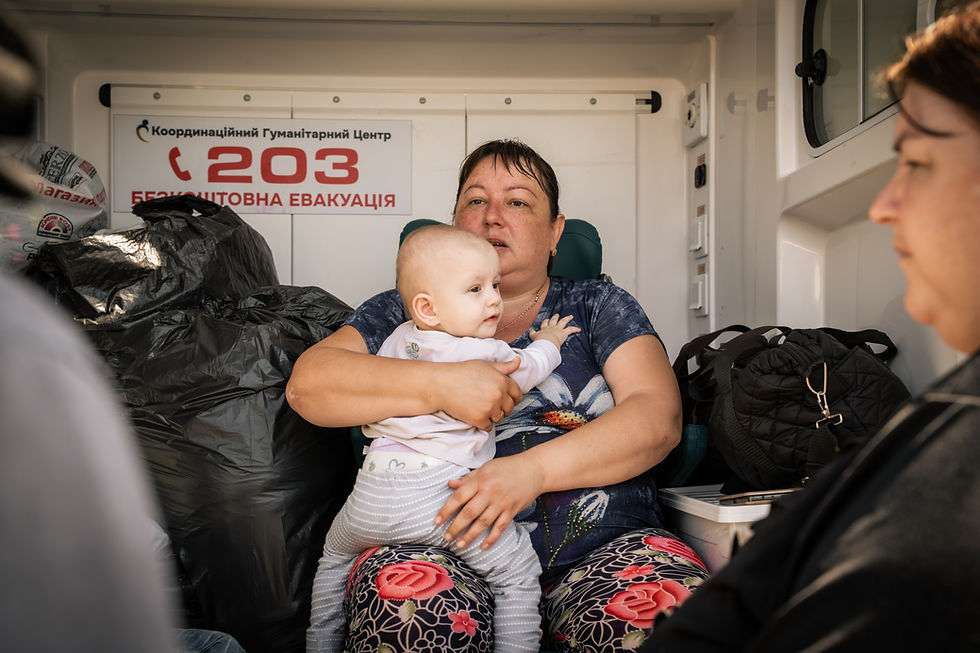
The Peaceful Heaven of Kharkiv charitable foundation emerged from the extraordinary civic mobilisation that followed Russia’s full-scale invasion of Ukraine in February 2022. Established in May of that year, it began with the immediate business of keeping people alive: providing hot meals to civilians affected by the war in Kharkiv. From those beginnings it has developed into one of eastern Ukraine’s substantial humanitarian organisations, working across a range of frontline and war-affected regions.
Today the organisation describes itself as implementing more than 40 projects for international partners and United Nations agencies, with activities encompassing humanitarian distribution, psychosocial support, restoration and reconstruction, economic recovery, cash assistance and mine action. Its work illustrates an increasingly important feature of Ukraine’s humanitarian landscape: local organisations that began as emergency responses to invasion have evolved into sophisticated institutions working alongside some of the world’s largest humanitarian bodies.
I met Kateryna Kantemyr, Partnerships Manager at Peaceful Heaven of Kharkiv, in Kharkiv to discuss how this transformation has taken place, the sometimes complicated relationship between Ukrainian organisations and international donors, the problems of humanitarian bureaucracy and the challenge of persuading the outside world to continue paying attention to a war that has become familiar abroad but remains brutally immediate for the people living through it.
Matthew Parish: Could you begin by telling us about yourself, your role as Partnerships Manager at Peaceful Heaven of Kharkiv and how you came to work in the humanitarian sector?
Kateryna Kantemyr: My role is essentially to connect our organisation with international and national partners and to help turn those relationships into practical cooperation.
My academic background is in international economic relations, so initially I thought my career would be more connected with international trade and economics. But the full-scale invasion changed the situation for everyone in Ukraine, including professionally. That is how I started working in the humanitarian sphere.
MP: Peaceful Heaven was established in the extraordinary circumstances following Russia’s full-scale invasion in 2022. How has the organisation developed from those early emergency efforts into the much more substantial organisation it is today?
KK: We started operating in 2022 by providing hot meals for people affected by the war here in Kharkiv. We then also moved into Kherson. Step by step, we grew from a volunteer initiative into a large, multi-sectoral humanitarian organisation that now implements different humanitarian and social projects.
During 2022 we saw that people’s needs were growing. That is how we moved from distributing hot meals towards much larger projects. Today those include restoration and rehabilitation of buildings, medical assistance, psychosocial assistance and even mine action.
MP: What does being Partnerships Manager actually involve on a day-to-day basis? Who are your principal partners?
KK: There is probably no completely typical day in our partnerships department. Our main responsibilities are communicating with existing partners and developing relationships with new ones. We also try to retain partners with whom contact may have diminished.
But it is not only communication with partners. It includes communication with communities and local authorities, and sometimes we need to coordinate activities between our own departments to ensure that everything is done properly. We might need to check, for example, whether financial reporting has been submitted on time. We make sure everything is done according to our partners’ requirements.
MP: Peaceful Heaven works with international humanitarian organisations as well as Ukrainian institutions and local communities. What can a locally based organisation in Kharkiv provide that a large international NGO cannot easily provide for itself?
KK: The first thing is proximity. Our teams work and live in the same environment as the communities we support. We understand not only the humanitarian indicators but also the context behind them.
We know that the situation differs between Kharkiv city, Derhachi, Izium, Kupiansk and smaller frontline communities. We know which roads are accessible, how security conditions are changing, which local authorities are actively engaged and which community networks people trust. We also know what might be technically possible on paper but unrealistic in reality.
Local knowledge creates speed as well. After an attack, a local organisation can often communicate with the authorities and communities immediately, assess the needs after the strike and mobilise teams very quickly.
There is also the question of trust. Beneficiaries often feel more comfortable communicating openly with people who understand their environment and their experiences.
MP: What, in turn, do international partners bring that would be difficult for a Ukrainian organisation such as Peaceful Heaven to provide independently? Is it principally funding?
KK: Funding is extremely important, but I would definitely not reduce international partnerships to funding. Strong international partners bring technical expertise, established methodologies, safeguarding standards, compliance systems and access to international networks. They can also provide specialised expertise that would be difficult for one organisation to develop independently across every sector.
We work across multiple humanitarian sectors, including shelter and non-food items, food security and livelihoods, cash assistance, health, education, protection, child protection, gender-based violence and mine action. Through international organisations, we can develop our experience in each of these areas.
For example, through working with UNICEF we significantly developed our expertise in child protection. We have also started a project with the HALO Trust, from whom we have learned a great deal about humanitarian mine action. There are many examples in which a partnership with a particular donor has helped us develop expertise in a particular sphere.
Capacity strengthening can be extremely valuable when it is designed properly. I think the strongest model is genuinely complementary: international expertise and resources combined with local knowledge, operational capacity and community access.
MP: How equal are partnerships between Ukrainian NGOs and large international humanitarian organisations in practice? Do Ukrainian organisations have a genuine role in deciding priorities, or are programmes sometimes substantially designed before local partners become involved?
KK: It varies significantly between organisations. There are partnerships in which Ukrainian organisations are genuinely involved from the very beginning. They may discuss needs with the partner, geographical priorities, target groups, activities, budgets and implementation approaches. Those are usually the strongest partnerships.
But there are also situations in which much of the project architecture has already been determined before the local organisation joins the implementation process. Sometimes that comes from donor requirements or very specific calls for proposals.
That is why we try to build long-term, established relationships with partners in which we can communicate and negotiate everything. With existing partners, we can discuss future projects from the very beginning and show them what the needs are, which groups should be targeted and where assistance is required.
MP: International humanitarian funding inevitably entails applications, budgets, audits, monitoring and extensive reporting. Can bureaucracy interfere with the ability of local organisations to respond rapidly?
KK: A significant amount of time goes into these processes. But humanitarian organisations manage donor funds and work with vulnerable communities, so accountability is absolutely necessary. Financial controls, procurement procedures, monitoring and reporting all serve an important purpose.
The challenge is proportionality. Sometimes administrative processes can become extremely detailed, particularly when requirements differ significantly between partners. For a local organisation operating close to the front line, this can create tension between compliance and speed.
If a community experiences an attack or a new displacement movement, operational teams may need to react within hours. That is why our department and our organisation try to negotiate these matters with partners and build relationships that are not simply about obtaining funding but are based upon trust, understanding and support.
MP: How do you explain the realities of Kharkiv and frontline communities to international partners who may be working from Kyiv, Brussels, Geneva, London or elsewhere and have never experienced those conditions themselves?
KK: It is important to make the context as concrete as possible. It is easy to speak in humanitarian terminology — beneficiaries, indicators, target groups — but those words can remove the human reality from the discussion.
We combine data with practical information from our teams: what happened in a particular community, what people are telling us, how security conditions affect access, what infrastructure has been damaged and what families are prioritising at that moment.
Field visits are extremely valuable whenever they can be organised safely. Our teams make field visits very often, and sometimes partners join them so they can see for themselves what is happening in a particular community and how the support provided with their funding can change people’s lives.
When visits are impossible because of the security situation, we rely upon photographs, monitoring indicators, rapid assessments and discussions with people from those communities. The objective is not to dramatise the situation but to make sure decisions are based upon actual operational reality.
MP: Have international donors’ priorities changed since 2022? Is it becoming harder to obtain funding for basic humanitarian needs as the war continues and international attention moves elsewhere?
KK: Priorities have definitely evolved. In 2022, much of the focus was understandably upon emergency assistance: food, hygiene items, education and cash assistance. Those needs still exist, especially in frontline and recently affected communities.
But there is now much greater emphasis upon recovery, livelihoods, localisation and particularly energy resilience as we prepare for another winter that is expected to be harsh.
This transition is necessary, but it also creates a challenge because Ukraine is experiencing emergency and recovery simultaneously. One community may need reconstruction and livelihood support while, at the same time, another missile attack creates immediate requirements for shelter materials, food or cash assistance.
Funding is also more competitive now. There are many humanitarian crises globally and Ukraine cannot assume that the level of international attention that existed in 2022 will continue automatically. That is why we try to provide evidence to our partners, and why communication and strong partnerships are increasingly important.
MP: How does Peaceful Heaven identify what communities actually need? Can beneficiaries influence the design of projects rather than simply receiving assistance designed for them?
KK: We carry out needs assessments, and this process is fundamental for us. Our information comes from different sources, including direct assessments by our teams, local authorities, community organisations and humanitarian coordination mechanisms.
But it is particularly important to speak directly with the people with whom we work. Sometimes what appears most urgent from outside is not actually the priority identified by the community itself.
Beneficiary feedback is therefore an important component of our activities. We gather information before implementation to identify needs, and we continue receiving feedback throughout the process to understand which needs have been covered and which remain unmet.
MP: Your work extends from emergency assistance and evacuation to psychological support, livelihoods, reconstruction and mine-related activities. Where does emergency humanitarian work end and longer-term recovery begin?
KK: In Ukraine, that boundary is increasingly difficult to define because the same community can require emergency assistance, recovery and development interventions simultaneously.
Our approach is therefore based less upon strict categories and more upon actual needs and the trajectory of the community. Immediately after an attack, for example, the priority may be emergency assistance or rapid shelter repairs. Several months later, the same household may require livelihood support to become more self-reliant, psychological assistance or more substantial housing rehabilitation.
We try to build connections between these different forms of assistance whenever possible, which is why many of our projects are multi-sectoral. If our team carries out humanitarian demining in a community, for example, we might later provide livelihood support so that people can resume their activities and become more independent.
MP: After years of war, are you seeing donor fatigue or humanitarian fatigue?
KK: There is certainly a greater challenge in maintaining attention to the problems we have here in Ukraine. We work not only in Kharkiv region but also in other frontline regions, including Sumy, Dnipro, Zaporizhzhia, Kherson and Mykolaiv, and we have also started implementing projects in Odesa. We therefore see the reality that people are facing in these areas.
In 2022, almost every development in Ukraine was international news. Several years later, the war continues but international audiences have become accustomed to hearing about it. Unfortunately, the communities with whom we work do not have the luxury of becoming accustomed to its consequences.
We communicate this through evidence rather than simply saying that needs remain high. We show partners what is happening in specific communities: displacement figures, damaged housing, interruptions to utilities, protection concerns and poor access to healthcare.
At the same time, it is important to demonstrate results. Our partners need to understand both the scale of the need and the fact that their support produces measurable change in those communities.
MP: There is increasing discussion in the humanitarian sector about “localisation”: giving Ukrainian organisations more control over funding and decision-making rather than treating them primarily as implementing partners. Has meaningful localisation actually taken place?
KK: There has definitely been progress. Ukrainian organisations now play a much larger role in humanitarian implementation, coordination and dialogue with international partners than they did at the beginning of the full-scale invasion in 2022.
There is also greater recognition that local organisations are not simply delivery mechanisms. They are organisations with their own expertise, strategies and institutional capacity.
MP: What makes an international partnership successful? Are there mistakes that foreign organisations repeatedly make when they begin working with Ukrainian partners?
KK: The strongest partnerships are based upon communication, trust and transparency. A successful partnership begins with clarity: who is responsible for what, which decisions are shared, how communication will work and what happens if circumstances change.
One mistake international organisations can make is assuming that approaches used successfully in other humanitarian contexts can simply be transferred to Ukraine. Sometimes organisations also underestimate how much operational knowledge already exists within Ukrainian local NGOs.
MP: How important are personal relationships and trust? Can contracts, compliance procedures and reporting systems substitute for knowing that the people in two organisations genuinely trust one another?
KK: Trust is extremely important. Contracts, policies and procedures are necessary because they provide structure, accountability and protection for both sides. But no contract can describe every situation that may arise during a humanitarian project, particularly in an environment as unpredictable as Ukraine.
There will always be moments when something changes quickly and two organisations need to speak openly, share concerns and find a solution together. That requires trust.
At the same time, I would not separate personal trust from institutional systems because a sustainable partnership needs both. Personal relationships make communication faster and more open, while institutional systems ensure that cooperation does not depend entirely upon particular individuals.
MP: What are the greatest unmet humanitarian needs in Kharkiv and Kharkiv region today?
KK: The greatest needs remain concentrated in frontline and heavily affected communities. Shelter is still a major issue because homes continue to be damaged by attacks every day. Families often need both immediate repairs and more substantial rehabilitation, particularly before winter.
From my personal experience, healthcare is another major priority. Access to primary healthcare, medicines and mental healthcare is particularly difficult close to the front line. I have seen communities that do not even have a doctor in their village, so addressing those needs is extremely important.
I would also highlight winterisation and energy resilience. Psychosocial support and child protection remain important as well because many children are affected by the war. Sometimes they need not only psychosocial assistance but more specialised mental-health support from professional specialists.
MP: Suppose an international foundation, company or NGO approached you tomorrow wanting to help Kharkiv. What would you advise it to do — and, equally importantly, what would you advise it not to do?
KK: My first advice would be to speak to local authorities and local organisations before deciding what the intervention should be.
MP: Speaking to local authorities can sometimes be quite difficult, can’t it?
KK: That is why international organisations should use their connections with local organisations that already have established relationships with the authorities. They can benefit from those relationships with local NGOs.
When you arrive with resources and expertise, you should first understand what already exists in the region, where the real gaps are and which needs are already being covered by other organisations.
I would also encourage flexibility because projects may be very active and the situation changes every day.
What I would advise against is arriving with a completely finished solution and then looking for a Ukrainian organisation merely to implement the project. Before a project starts, you need to communicate with that organisation and involve it in the decision-making process because it has local expertise.
MP: Looking beyond the immediate war, what role do you envisage for Peaceful Heaven in Ukraine’s reconstruction? Will humanitarian relief eventually give way to recovery and development?
KK: I think humanitarian response and recovery will continue alongside one another for quite a long time. Even during reconstruction, some communities will need emergency assistance while others will be ready for longer-term programmes focused upon livelihoods, infrastructure, healthcare, education and social services.
For Peaceful Heaven of Kharkiv, I see our role gradually expanding further into recovery and reconstruction while retaining our humanitarian capacity. In our philosophy, we define recovery and reconstruction as the fourth pillar of our activities and a long-term focus for the coming years.
The experience our organisation has gained during the war, particularly our relationships with communities and local authorities, can be very valuable in reconstruction. Rebuilding should not simply mean rebuilding infrastructure. It should also mean rebuilding services, livelihoods and community resilience.
MP: Finally, after working between international partners and communities living through war, what has this experience taught you personally about humanitarian assistance? Has it changed your understanding of what genuinely helps people in a crisis?
KK: It has taught me that what genuinely helps people is not always what looks most impressive on paper. Sometimes relatively simple assistance, delivered quickly and at the right moment, can make a greater difference than a much larger intervention delivered several months later.
It has also taught me the importance of listening. People affected by war are not simply beneficiaries. They understand their own needs and their communities better than anyone else.
Finally, I have learned that humanitarian assistance works best when there is trust between organisations, international donors and local communities. Good systems and funding are essential, but they become truly effective when combined with local knowledge and flexibility.
MP: Kateryna, thank you very much for your time and for your thoughtful answers. I wish you and Peaceful Heaven every success with your work for as long as this terrible war continues, and with the work I am sure the organisation will continue long afterwards.
KK: I am very grateful to you on behalf of the whole organisation. Thank you for taking the time and for your interest in our activities and our work.
---
Peaceful Heaven of Kharkiv
Peaceful Heaven of Kharkiv (Благодійний фонд «Мирне небо Харкова») is a Ukrainian charitable foundation established in May 2022. The organisation says its team now comprises hundreds of employees and volunteers and implements more than 40 projects with international partners and UN agencies, working in areas including humanitarian assistance, psychosocial support, reconstruction, economic recovery, cash assistance and mine action. (mn.org.ua)
Official website: Peaceful Heaven of Kharkiv — Мирне небо Харкова