Trump and Mamdani: An Unusual Double Act?
By Matthew Parish
Thursday 15 October 2026
American politics has acquired one of its more improbable relationships. Donald Trump, Republican President of the United States, property developer, nationalist and scourge of the American left, has developed an unexpectedly cordial working relationship with Zohran Mamdani, the democratic socialist Mayor of New York City. On paper, almost everything ought to separate them. In practice, they keep meeting, talking and apparently finding things upon which they can work together. It is one of the more curious political partnerships in contemporary American public life, and it may tell us something important about the future of democratic government in an increasingly polarised age.
The relationship is particularly remarkable because these are not merely politicians belonging to opposing parties. They represent two apparently irreconcilable political philosophies. Trump embodies a peculiar amalgamation of economic nationalism, cultural conservatism, personal capitalism and populist hostility towards established institutions. Mamdani represents a younger generation of democratic socialists, committed to public intervention in markets, redistribution of wealth, extensive social provision and a conception of multicultural urban life fundamentally at odds with much of Trump’s political rhetoric. If American politics were governed exclusively by ideological consistency, the two men would scarcely be able to remain in the same room together.
Yet they appear to get along rather well.
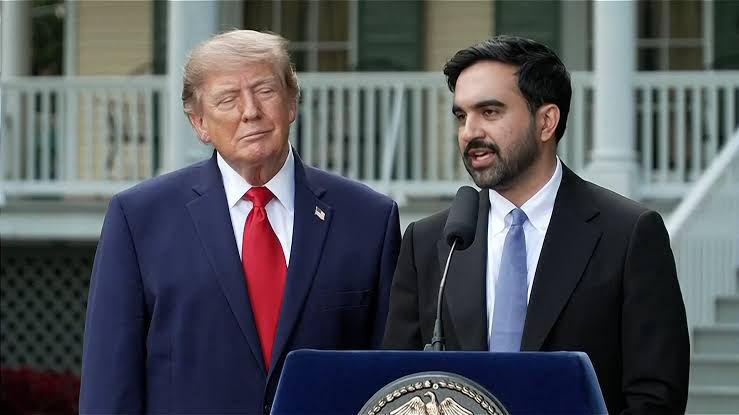
Their latest substantial public encounter took place on 21 September 2026, when Trump visited Mamdani at Gracie Mansion, the official residence of New York’s mayor, during the week of the United Nations General Assembly. It was their third meeting, following earlier encounters at the White House. The atmosphere was remarkably cordial. Trump reminisced about his years in New York, praised the mayor’s potential and expressed the hope that Mamdani would prove successful in office. Mamdani reciprocated by emphasising the importance of working with the federal government to improve the lives of New Yorkers, particularly through measures intended to address the city’s increasingly intolerable housing costs.
The spectacle was sufficiently unusual to invite comparison with a theatrical double act. Here was the Republican President, whose political movement routinely denounces democratic socialism as an existential threat to American civilisation, exchanging pleasantries with perhaps the most prominent elected democratic socialist in the country. Here was the socialist mayor, whose political supporters regard Trump as representing much that is objectionable about contemporary American capitalism, apparently enjoying the company of the billionaire property developer turned President. Neither man appeared especially embarrassed by the incongruity.
There is, however, a substantial explanation for this apparent contradiction. Both men are New Yorkers, and New York politics has always possessed an extraordinary capacity to subordinate ideological abstractions to practical arrangements. The city is too large, too complicated, too expensive and too demanding to be governed exclusively through political slogans. Its municipal authorities must negotiate with property developers, financiers, trade unions, federal agencies, state officials, transport operators and innumerable competing interest groups. Whatever one’s political philosophy, somebody must collect the rubbish, maintain the subway, repair the water mains and construct enough apartments to accommodate a population whose aspirations consistently exceed the available housing stock.
Trump understands this world instinctively. His political personality was formed not in the institutions of the Republican Party but in the intensely competitive environment of New York property development. Long before he entered national politics, he had learned that commercial success often depended upon personal relationships with people whose political opinions were entirely different from his own. A property developer cannot afford to refuse negotiations with a mayor merely because the mayor belongs to the wrong political party. Municipal approvals, planning permissions, infrastructure arrangements and public financing are not ideological abstractions. They are the practical ingredients from which buildings emerge.
Mamdani, notwithstanding his socialist convictions, is discovering something similar from the opposite direction. He may believe that markets produce unacceptable inequalities, but as Mayor of New York he must nevertheless operate within a political and economic system in which private property, federal authority and commercial incentives remain indispensable. His political ambitions require cooperation with institutions he cannot control. The President of the United States is one of those institutions, and refusing to communicate with him would achieve little beyond satisfying the more doctrinaire members of Mamdani’s political constituency.
The most conspicuous manifestation of their emerging cooperation concerns Sunnyside Yard, the enormous railway complex in Queens that has frustrated generations of New York urban planners. Mamdani has proposed constructing approximately 12,000 homes above the railway infrastructure, together with associated facilities and employment opportunities. The project would involve building a platform over an operational railway yard and effectively creating an entirely new urban neighbourhood. Its technical, legal and financial complexity would be formidable, and federal participation would almost certainly be essential.
At their September meeting, the two men agreed to elevate discussions about the project to a more technical level involving their respective housing and operations teams. Trump acknowledged that federal approvals and probably federal money would be required. Mamdani emphasised the possibility of creating approximately 30,000 jobs alongside the new housing. The projected federal contribution has been discussed in figures running into tens of billions of dollars, although no binding federal funding commitment emerged from the meeting.
The irony is delicious. A democratic socialist mayor is seeking assistance from a Republican President to construct an enormous housing development, while the Republican President, whose political identity is inseparable from private property development, is contemplating participation in a project intended to expand affordable housing through substantial public intervention. Both men may have arrived at the same conversation by entirely different ideological routes, but they have nevertheless arrived there.
There is a deeper political affinity beneath these apparently incompatible programmes. Both Trump and Mamdani have built their political careers upon the proposition that established American institutions have failed ordinary citizens. Trump attributes this failure to an assortment of causes, including globalisation, immigration, excessive regulation, political corruption and the indifference of established elites. Mamdani emphasises inequality, corporate power, unaffordable housing, inadequate public services and the concentration of economic resources in private hands. Their diagnoses are different, and their proposed remedies frequently contradictory, but both derive their political energy from dissatisfaction with the economic and institutional arrangements that dominated American public life during the preceding generation.
This makes them representatives of the same political era, even if they stand at opposite ends of its ideological spectrum.
The traditional distinction between centre-right and centre-left politics has become increasingly inadequate to describe the political movements transforming western democracies. Voters are no longer necessarily satisfied by promises of competent administration, gradual economic growth and the careful maintenance of established institutions. They want politicians who promise substantial change, who appear willing to challenge entrenched interests and who speak in language that conveys impatience with the existing order. Trump and Mamdani are both exceptionally effective at presenting themselves as political outsiders, notwithstanding the considerable institutional authority they now exercise.
Both are also accomplished practitioners of contemporary political communication. Trump understands the value of controversy, repetition, personal branding and the deliberate violation of political conventions. Mamdani has demonstrated an equally sophisticated understanding of digital campaigning, direct engagement with voters and the importance of communicating complicated economic arguments through accessible language. Neither man rose to prominence principally through the traditional hierarchies of his political party. Both established distinctive personal political identities that proved capable of disrupting the assumptions of their respective establishments.
Their mutual recognition may therefore be partly psychological. Each understands something about the other’s political technique, even while rejecting the other’s political conclusions.
Yet events since their September meeting have demonstrated how fragile this curious relationship may become when ideological disagreements are translated into the coercive activities of government.
On 8 October 2026, federal immigration agents shot and wounded a Dominican man during an immigration enforcement operation in the Marble Hill neighbourhood of New York City. A five-year-old child was present in the vehicle but was not physically injured. Federal authorities described the incident as involving a targeted enforcement operation, while Mamdani sharply criticised the methods employed by immigration authorities and renewed his opposition to aggressive federal immigration enforcement within the city. The incident attracted national attention and intensified existing tensions between municipal authorities and the Trump administration over immigration policy.
Here the limits of political cordiality become apparent. Mamdani’s political identity is closely associated with the protection of immigrant communities, opposition to discriminatory enforcement practices and the defence of New York’s multicultural character. Trump’s immigration policies, by contrast, have emphasised deportation, federal enforcement authority and the reduction of unlawful immigration. These are not disagreements that can readily be reconciled through the exchange of pleasantries at Gracie Mansion.
The shooting illustrates a more fundamental problem. A mayor may maintain a cordial personal relationship with a President while the President’s administration pursues policies that the mayor regards as deeply objectionable. Indeed the very existence of such a relationship may become politically uncomfortable when federal officials undertake controversial operations within the mayor’s jurisdiction. The mayor’s supporters may begin to ask whether personal diplomacy has produced any meaningful restraint upon federal policy, while the President’s supporters may question why he continues to praise a politician who so vigorously opposes his administration’s activities.
This is the essential tension at the heart of the Trump-Mamdani double act. Personal relationships can facilitate negotiations, but they cannot abolish institutional conflicts or ideological contradictions. A President cannot simply suspend the operation of federal immigration law because he enjoys conversations with a particular mayor. Equally a mayor cannot abandon his political commitments merely because he has discovered that the President is personally agreeable.
The question is whether political maturity consists in recognising that these contradictions must be managed rather than eliminated.
There is something instructive here for European observers. European political culture has traditionally placed considerable emphasis upon coalition-building, negotiation and compromise between parties holding substantially different political positions. Parliamentary systems frequently require political adversaries to cooperate in government, sometimes for years at a time. American presidential politics, by contrast, has increasingly acquired the character of a permanent struggle between competing political identities, in which cooperation with one’s opponents risks being interpreted as ideological surrender.
Trump and Mamdani may be demonstrating that this latter assumption is neither necessary nor particularly useful.
Indeed their relationship has already produced at least some practical consequences beyond public symbolism. Mamdani has said that earlier discussions with Trump contributed to the release of students detained by federal immigration authorities. The September meeting also established a more formal channel for technical discussions about Sunnyside Yard. These are limited achievements, and they should not be exaggerated into evidence of a comprehensive political partnership. Nevertheless they demonstrate that personal communication between ideological opponents can sometimes produce outcomes that would be less likely if the parties refused to speak to one another.
There is also an important distinction between compromise and cooperation. Compromise ordinarily implies that each party modifies its position in order to reach an agreement. Cooperation may require no such modification. Two politicians can maintain entirely different views about the desirable organisation of society while recognising that they share a practical interest in completing a particular infrastructure project. Trump does not need to become a democratic socialist to support additional housing construction in New York. Mamdani does not need to endorse Republican immigration policy to seek federal assistance with urban development.
This distinction is frequently overlooked in contemporary political debate. Ideological disagreement is too often treated as requiring personal hostility, and personal hostility is then permitted to obstruct practical administration. Yet the ordinary business of government requires officials to distinguish between questions upon which agreement is possible and questions upon which disagreement remains unavoidable.
The approaching American midterm elections add another dimension to the relationship. Republicans have sought to portray the Democratic Party as increasingly dominated by radical left-wing ideas, with Mamdani serving as a convenient symbol of this alleged transformation. Yet Trump’s repeated expressions of personal warmth towards the New York mayor complicate that political narrative. It is more difficult to depict a politician as an existential menace when one’s own President publicly expresses the hope that he will succeed.
For Mamdani the political calculations are equally delicate. His willingness to engage with Trump may enhance his reputation among New Yorkers who value practical results over ideological confrontation. But it also exposes him to criticism from those who regard the President’s policies as sufficiently objectionable that even cordial public engagement appears inappropriate. The more controversial federal immigration enforcement becomes, the more difficult this balancing exercise may prove.
Both politicians therefore have incentives to maintain the relationship, but also reasons to preserve a certain distance. The relationship is politically useful precisely because it demonstrates an ability to communicate across ideological divisions. It could become politically damaging if either man’s supporters conclude that communication has developed into acquiescence.
There is another possibility worth considering. Trump’s evident personal warmth towards Mamdani may reflect something more instinctive than strategic calculation. Trump has always displayed an unusual capacity to move rapidly between denunciation and admiration. His political rhetoric frequently treats opponents in uncompromising terms, yet his personal encounters sometimes produce unexpectedly affectionate assessments. He appears to place considerable importance upon personal chemistry, direct conversation and the willingness of other political figures to engage with him on terms he finds congenial.
Mamdani, for his part, appears to understand that the President’s personal political psychology creates opportunities for engagement that might not exist through conventional bureaucratic channels. A politician who can secure an audience with Trump and maintain his attention may achieve practical results that would otherwise become entangled in the machinery of federal administration. Whether this constitutes sophisticated political diplomacy or merely an accommodation to the peculiarities of presidential government is a matter upon which reasonable observers may disagree.
It is nevertheless difficult to deny that both men have found the relationship useful.
What makes their double act especially interesting is that neither appears particularly interested in concealing the contradictions upon which it rests. Mamdani has publicly defended press freedom in Trump’s presence, criticised federal immigration enforcement and maintained his socialist political identity. Trump has continued to pursue his administration’s broader political programme while expressing admiration for the mayor’s energy and potential. Their relationship does not require either man to pretend that their disagreements have disappeared.
This may be its most valuable characteristic.
Democratic politics is not principally a mechanism for producing unanimity. It is a system for managing disagreement within institutions that permit people holding different convictions to coexist and govern together. The legitimacy of democratic government depends partly upon the willingness of political actors to recognise that their opponents possess legitimate institutional authority, even when their policies are considered mistaken or objectionable.
The alternative is a political culture in which every disagreement becomes existential, every opponent becomes an enemy and every act of cooperation becomes a betrayal. Such a culture may be emotionally satisfying to political activists, but it is exceptionally difficult to reconcile with effective administration. Cities cannot be governed through permanent ideological warfare, and federal systems cannot function if their constituent authorities refuse to communicate whenever different parties hold office.
There are limits, of course. Cooperation must not become an excuse for overlooking abuses of public power, abandoning constitutional principles or treating fundamental rights as negotiable conveniences. The events of 8 October demonstrate why these limits matter. Mamdani’s responsibility to the inhabitants of New York may require him to oppose federal policies vigorously, including through litigation and public criticism, even while maintaining a personal channel of communication with the President.
That is not necessarily hypocrisy. It may instead be an appropriate distinction between institutional opposition and personal diplomacy.
The ultimate test of the Trump-Mamdani relationship will not be the number of cordial press conferences they hold or the frequency with which they exchange complimentary remarks. It will be whether their communications produce meaningful improvements in public administration without requiring either man to abandon the principles upon which he was elected.
Sunnyside Yard offers one possible test. The project is enormously ambitious, and New York has a long history of grand urban development schemes that disappear into technical studies, financial disputes and political disagreements. Building thousands of homes above an operational railway complex will require sustained cooperation between multiple public authorities, substantial financing and the resolution of difficult engineering questions. Presidential enthusiasm is useful, but it is not a substitute for appropriations, regulatory approvals and actual construction.
Immigration offers a different and more difficult test. Here the parties are unlikely to agree upon the underlying policies. The question will instead be whether their personal relationship can facilitate communication during disputes, prevent unnecessary escalation and permit the municipal and federal authorities to discharge their respective responsibilities without transforming every disagreement into a constitutional confrontation.
The relationship may ultimately fail. Political circumstances may change, electoral incentives may harden and some future controversy may prove sufficiently divisive to make cordial engagement impossible. Neither man’s personality is especially associated with the patient cultivation of conventional bipartisan relationships. Their apparent friendship is therefore not something upon which anyone should construct an elaborate theory of permanent political reconciliation.
Nevertheless its existence is significant.
Perhaps the most striking feature of the Trump-Mamdani double act is that it exposes the inadequacy of the categories through which contemporary political discourse ordinarily understands its protagonists. Trump is not simply a conventional conservative, any more than Mamdani is simply a conventional socialist. Both are populists of different kinds, both are insurgents against established political arrangements and both possess an instinctive understanding of the emotional frustrations that animate contemporary voters. They disagree about almost everything that matters ideologically, yet they inhabit overlapping political territory in their dissatisfaction with the existing economic order and their desire to demonstrate that government can produce visible change.
They also share something less abstract: an affection for New York City, that extraordinary metropolis whose contradictions have always defied the political theories of those who attempt to govern it. New York is simultaneously a monument to capitalism and a laboratory of public intervention, a city of immense private fortunes and extensive public services, a place of extraordinary ethnic diversity and intense economic competition. It is difficult to imagine a more appropriate setting for an unlikely political relationship between a billionaire Republican President and a democratic socialist mayor.
In the final analysis, the lesson may be a relatively simple one. Political opponents need not become personal enemies, and personal cordiality need not entail ideological surrender. A democratic socialist mayor can oppose the President’s immigration policies while seeking his assistance in constructing affordable housing. A Republican President can disagree with socialism while recognising that a socialist mayor may have worthwhile ideas about urban development. Both can criticise one another and still recognise that the public interest sometimes requires them to sit at the same table.
Whether Trump and Mamdani can sustain this distinction as the American political atmosphere becomes increasingly heated remains uncertain. The events of October have already shown how quickly the realities of government can intrude upon the comfortable theatre of personal diplomacy. Their relationship will undoubtedly be tested again, perhaps more severely, before either man’s political career reaches its conclusion.
For the moment, however, there remains something curiously encouraging about the spectacle of these two extraordinary New Yorkers finding reasons to talk to one another. In an age when ideological hostility increasingly threatens to overwhelm the ordinary courtesies of democratic government, their improbable relationship reminds us that political disagreement need not extinguish the possibility of practical cooperation.
And if the Republican President and the socialist Mayor of New York can eventually agree upon how to build 12,000 apartments above a railway yard in Queens, then perhaps there is still some hope for American democracy.
After all, politics is not merely the art of disagreeing about how the world ought to be. It is also the rather more difficult art of getting something done.