Lviv: City of Spies
By Matthew Parish
Thursday 15 October 2026
There is something about Lviv that lends itself naturally to espionage. Perhaps it is the city’s faded Austro-Hungarian grandeur, its labyrinthine streets, its innumerable cafés, or the peculiar combination of provincial intimacy and international sophistication that characterises this most European of Ukrainian cities. Perhaps it is the fact that everyone seems to know everyone else, while nobody quite knows what anyone else is doing. Or perhaps it is simply that Lviv, situated sufficiently far from the front lines to maintain the appearance of normality but sufficiently close to the greatest European war since 1945 to be strategically indispensable, has become an irresistible attraction for the intelligence services of virtually every interested power.
Whatever the explanation, Lviv is acquiring the characteristics of a city of spies. The evidence of Russian intelligence activity is increasingly substantial, while the concentration of Western diplomatic, humanitarian, military and political interests creates obvious opportunities for intelligence collection and counterintelligence. Not every suspicious encounter is an intelligence operation, and the scale of clandestine Western activity cannot be established from public evidence. Nevertheless the circumstances are conducive to an increasingly elaborate contest of observation, infiltration, manipulation and deception, conducted beneath the reassuring façades of a city whose inhabitants would generally prefer to be left alone with their coffee.
The obvious historical comparison is Vienna in the years immediately following the Second World War. Between 1945 and 1955, the Austrian capital was divided between the four victorious Allied powers, each maintaining its own occupation zone and intelligence apparatus. The Soviet Union, the United States, Britain and France operated within a remarkably confined geographical space, observing one another, recruiting informants, conducting surveillance and occasionally making spectacular mistakes. The circumstances were sufficiently extraordinary to inspire Graham Greene’s The Third Man, a masterpiece of post-war cynicism in which the boundaries between criminality, intelligence and opportunism were almost entirely dissolved.
Vienna’s importance arose not merely from the presence of competing armies but from its position between two emerging political worlds. It was a place where the Soviet Union could observe the West, where Western intelligence could cultivate contacts from behind the Iron Curtain, and where refugees, businessmen, journalists, diplomats and criminals mingled in circumstances that rendered their respective occupations difficult to distinguish. The city became a laboratory for the techniques of the Cold War, many of which were developed through trial, error, improvisation and the occasional catastrophe.
Lviv is not Vienna, and the distinctions are important. Ukraine is a sovereign country fighting an existential war against Russian aggression, rather than an occupied state divided between competing victorious powers. Russian intelligence officers cannot operate openly under the protection of an occupation administration, and Ukrainian counterintelligence has every reason to regard their activities as hostile. Nevertheless the resemblance lies in the concentration of international interests, the abundance of transient populations, and the opportunities for clandestine operations offered by a city that is both strategically important and comparatively accessible.
The result is a modern variation upon an old European phenomenon: a city in which the visible life of commerce, culture and humanitarian activity coexists with an invisible struggle over information, influence and control. In Vienna the contest unfolded amid occupation zones and ruined buildings; in Lviv it takes place amidst encrypted messaging applications, international NGOs, railway stations, hotel bars and the ubiquitous mobile telephone.
The strategic attractions of Lviv
To understand why intelligence services might find Lviv attractive, one must first understand the city’s extraordinary geographical and political position. Located close to the Polish border, Lviv is one of the principal gateways between Ukraine and the European Union. Through western Ukraine pass substantial quantities of humanitarian assistance, commercial goods, military supplies and the people who organise their movement. The city accommodates international organisations, foreign journalists, humanitarian workers, diplomatic visitors, military-related personnel and representatives of an astonishing variety of private and public institutions.
These communities produce an immense quantity of information. Some of it is operationally sensitive, relating to logistics, procurement, infrastructure, military technology or the movement of personnel. Other information is political, concerning the intentions of foreign governments, the internal disagreements of Ukrainian institutions, or the relationships between Western donors and their Ukrainian counterparts. Still more concerns the personal circumstances of individuals who may eventually occupy positions of significance.
For intelligence agencies, this is an unusually rich environment. An officer need not approach a military installation to learn something useful about a war. Information can emerge from conversations with logistics coordinators, contractors, local officials, academics, displaced persons or employees of international organisations. Individually these fragments may appear inconsequential, whereas collectively they can reveal patterns of considerable strategic importance.
Lviv also offers the advantage of relative safety. Although the city and its surrounding region have repeatedly suffered Russian missile and drone attacks, everyday civilian life continues with a degree of normality unimaginable in the devastated settlements of eastern Ukraine. Restaurants remain open, universities teach, conferences are organised, and the city’s social life proceeds with characteristic determination. For those wishing to cultivate professional relationships over extended periods, this continuity is invaluable.
A city constantly under artillery bombardment is an exceptionally difficult environment in which to maintain the ordinary routines of intelligence work. Lviv, by contrast, offers the possibility of sustained relationships, repeated encounters and relatively predictable movements. Its cafés and restaurants provide opportunities for informal conversation that might be impossible closer to the front, and its endless succession of foreign visitors ensures that unfamiliar faces attract rather less attention than they otherwise might.
There is also a psychological dimension. People who have travelled from the eastern regions often experience Lviv as a place of respite, while foreign visitors may feel that they have entered a comparatively secure European environment even though they remain within a country at war. Such perceptions can encourage informality, and informality is often the beginning of indiscretion. People say things over their third drink that they would never place in an email, which is one reason why the ancient technology of buying somebody dinner has survived every revolution in signals intelligence.
The Russians are already here
Russian intelligence activity in western Ukraine is not merely a matter of conjecture. Ukrainian security authorities have disclosed a succession of investigations demonstrating Moscow’s determination to collect information and recruit operatives far from the battlefield. These official allegations must of course be distinguished from judicial findings of guilt, but taken together they reveal the scale and diversity of the counterintelligence problem confronting Ukraine.
In January 2026, the Security Service of Ukraine announced the detention of two alleged agents of Russian military intelligence who had been tasked with examining the consequences of an Oreshnik missile strike in Lviv region. According to the Ukrainian authorities, the suspects were instructed to photograph locations affected by the attack and transmit geographical information to their handlers. The alleged purpose was to assess the effectiveness of the strike and assist the planning of subsequent operations.
Other investigations disclosed by the Ukrainian authorities have involved alleged efforts to identify railway facilities, government buildings, military locations and critical infrastructure. The methods described in such cases are frequently striking for their simplicity: ordinary mobile telephones, digital maps, photographs and remote communications with handlers. Modern espionage may employ satellites, artificial intelligence and extraordinary computational resources, but sometimes somebody still has to stand on a street corner and photograph a building.
Such cases illustrate the diversity of contemporary Russian intelligence activity. Some operations appear directed towards immediate military objectives, including target identification and assessment of battle damage. Others concern communications infrastructure, industrial production or the cultivation of individuals with access to restricted information. Their common characteristic is the exploitation of the ordinary social and technological infrastructure of civilian life.
There is a tendency to imagine Russian intelligence as an organisation of sinister professionals, trained in obscure institutions and dispatched across Europe with elaborate false identities. Such individuals undoubtedly belong to the historical tradition of Russian espionage, but contemporary operations increasingly appear to rely upon considerably less glamorous methods. Recruitment through messaging applications, promises of modest financial rewards, and the exploitation of vulnerable or opportunistic individuals have become recurring features of cases disclosed by Ukrainian authorities.
This amounts to a sort of democratisation of espionage, although not one that any sensible democrat should welcome. One need no longer possess the professional qualifications of a Cold War intelligence officer to become an instrument of a foreign intelligence service. A mobile telephone, an internet connection and a willingness to perform apparently straightforward tasks may suffice, while the person performing them may possess only the vaguest understanding of the organisation ultimately receiving the information.
The consequences are occasionally absurd, although the underlying purposes are deadly serious. A person recruited to photograph a building may have little understanding of the wider operation in which he is participating. His handler may be thousands of kilometres away, and his information may pass through several intermediaries before reaching those who ultimately decide what to do with it. The intelligence services have discovered that the digital age permits the recruitment of people who might once have been considered wholly unsuitable for espionage, but it has not necessarily made those people any more competent.
The Western intelligence presence
If Russian intelligence regards Lviv as an attractive operational environment, Western intelligence services have equally compelling reasons to take an interest in the city. The United States, Britain, Poland, France, Germany and other European countries possess substantial interests in Ukraine’s military resilience, political stability and eventual reconstruction. Their governments need information concerning Russian intentions, Ukrainian capabilities, the effectiveness of assistance programmes, and the changing political circumstances of a country undergoing profound social transformation.
It would be astonishing if these interests did not generate substantial intelligence collection, liaison and analytical activity. Nevertheless the distinction between reasonable inference and established fact must be preserved. Publicly available evidence does not permit a reliable estimate of the number of Western intelligence officers operating in Lviv, nor does it establish that particular humanitarian organisations are being used as intelligence fronts. The very nature of intelligence work means that the most interesting assertions about it are frequently those least susceptible to public verification.
Much Western intelligence cooperation with Ukraine is conducted through official channels, and intelligence work is not synonymous with clandestine infiltration. Liaison between allied security services, the analysis of publicly available information, and the assessment of military and political developments are all legitimate components of international security cooperation. Yet the broader environment inevitably presents opportunities for less visible activities, including the cultivation of sources, the assessment of institutional vulnerabilities and the detection of Russian penetration attempts.
Western intelligence agencies also have a powerful interest in counterintelligence. Russia’s efforts to identify military infrastructure, penetrate defence-related organisations and recruit local operatives threaten not only Ukraine but potentially the security of Western assistance programmes. An individual who compromises Ukrainian logistical information may simultaneously expose the activities of foreign governments and private contractors, making counterintelligence a shared rather than exclusively Ukrainian concern.
There is therefore a natural convergence of interests between Ukrainian counterintelligence and its Western partners. Both wish to identify hostile networks, protect sensitive information and understand the methods through which Russian services operate. The war has consequently created opportunities for an intensity of intelligence cooperation between Ukraine and Western governments that would have been difficult to imagine before February 2022.
Yet cooperation does not eliminate competition. Intelligence services are not charitable organisations, even when they represent friendly states. Governments may disagree over military priorities, diplomatic strategy, economic reconstruction, corruption investigations or the terms upon which a future settlement might be negotiated. Information that is valuable to one ally may be inconvenient to another, and intelligence organisations exist in part because governments dislike relying entirely upon what even their friends choose to tell them.
The history of espionage demonstrates that intelligence collection among allies is hardly unknown. Indeed it is sometimes precisely because governments cooperate closely that they become especially interested in understanding one another’s private intentions. Lviv consequently offers the possibility of several overlapping intelligence contests: the obvious struggle between Russia and Ukraine, the broader confrontation between Russia and Western governments, and the more discreet collection of information among countries whose interests generally coincide but whose priorities may occasionally diverge.
The resulting picture is considerably more complicated than a simple contest between two opposing camps. That complexity is precisely what makes the city interesting from an intelligence perspective, because espionage flourishes wherever alliances are strong enough to create access but imperfect enough to leave uncertainty.
The humanitarian sector and the problem of infiltration
Perhaps the most delicate aspect of Lviv’s evolving intelligence environment concerns the extraordinary proliferation of humanitarian organisations and civil society institutions since February 2022. Ukraine’s response to the Russian invasion has depended in substantial measure upon the mobilisation of volunteers, charitable foundations, international non-governmental organisations and informal networks of individuals undertaking tasks that the state could not perform alone.
Lviv has become one of the principal centres of this activity. Its geographical position, transport connections and concentration of international visitors have made it an attractive location for organisations coordinating assistance throughout Ukraine. Some are large institutions with elaborate compliance procedures and established relationships with foreign governments, while others are small foundations created by individuals responding spontaneously to the catastrophe unfolding around them. This diversity is one of the great strengths of Ukrainian civil society, but it is also a potential vulnerability.
Humanitarian organisations frequently possess information that would interest foreign intelligence services. They may know the locations of vulnerable populations, the movement of vehicles and supplies, the identities of local officials, or the operational difficulties encountered by organisations working in contested areas. They may employ individuals who travel regularly between regions, maintain international contacts and enjoy relationships of trust with people who would otherwise be difficult to approach.
None of these characteristics makes a humanitarian organisation suspicious. They are simply the ordinary consequences of performing humanitarian work in a country at war. Nevertheless they create opportunities that a hostile intelligence service might seek to exploit, particularly because humanitarian organisations necessarily depend upon trust and frequently need to make decisions quickly.
Infiltration need not involve the dramatic insertion of a professional spy into an unsuspecting organisation. It may consist of the recruitment of an existing employee, the manipulation of a volunteer, the cultivation of a donor relationship, or the exploitation of disagreements between members of an organisation. Equally, an intelligence service may seek information through external contractors or individuals whose legitimate work brings them into contact with several different institutions.
Such vulnerabilities are not confined in principle to Russian operations. Intelligence agencies belonging to friendly countries may also seek to understand humanitarian networks, particularly where those networks intersect with political influence, security assistance or the distribution of substantial financial resources. The existence of such incentives, however, is not evidence that any particular Western service has infiltrated a named organisation, and responsible analysis requires maintaining that distinction.
The distinction matters because the accusation of espionage is itself a potentially devastating instrument of political manipulation. A charitable foundation whose reputation is damaged by unfounded allegations may lose donors, employees and access to vulnerable communities. A volunteer accused without evidence of working for a foreign intelligence service may face consequences far beyond the ordinary disputes of civil society. One of the most effective methods of undermining a society is to persuade its members that nobody can be trusted, because suspicion can accomplish things that infiltration alone cannot.
Russian information operations have long sought to exploit divisions within Ukrainian society, and accusations concerning the integrity of humanitarian organisations can serve this purpose whether or not any underlying espionage exists. The mere possibility of infiltration can be used to encourage suspicion, fragment professional relationships and discredit institutions that perform indispensable work. Ukraine must therefore guard against hostile penetration without allowing counterintelligence anxiety to destroy the civic trust upon which much of its wartime resilience has depended.
The challenge for Ukrainian civil society is particularly difficult. Organisations must take security seriously without allowing themselves to become consumed by paranoia, and they must protect sensitive information while preserving the openness and flexibility that make voluntary humanitarian work possible. A society in which every volunteer is suspected of being a spy will eventually cease to have volunteers, which would constitute a considerable victory for Russia without a single Russian intelligence officer having to leave his desk.
Lviv as an intelligence laboratory
There is another reason why Lviv may be particularly attractive to contemporary intelligence services. The city offers opportunities to develop, evaluate and refine new methods of intelligence collection and counterintelligence under the pressures of a real war. It combines a sophisticated technological environment with a large international population and the immediate operational demands created by Russian aggression.
The conflict in Ukraine has already transformed military technology, particularly in the fields of unmanned systems, electronic warfare, satellite communications and the rapid integration of civilian technologies into military operations. Intelligence work is undergoing a comparable transformation, although its developments are necessarily less visible. The distinction between civilian and military technologies has become increasingly porous, and intelligence agencies on both sides have had to adapt accordingly.
Artificial intelligence can assist with the analysis of large quantities of publicly available information, the identification of patterns within complex datasets and the processing of material collected from numerous sources. Digital communications permit relationships to be established and maintained across international boundaries without the physical presence of a handler. Social media generates information concerning personal associations, professional activities and political opinions on a scale that earlier generations of intelligence officers could scarcely have imagined.
These technologies also create new opportunities for counterintelligence. Digital activity can leave traces, communications can be reconstructed, and patterns of behaviour may reveal relationships that participants believed were concealed. The same technological systems that facilitate clandestine recruitment may assist investigators in identifying those responsible, producing an accelerating competition between concealment and detection.
Lviv is well positioned to become a testing environment for these developments, although the extent to which intelligence agencies deliberately use the city for experimentation remains unknown. Its combination of international connectivity, active civil society, technical expertise and proximity to a major war creates conditions in which new methods may emerge organically. Intelligence officers learn from wars just as soldiers do, and the lessons learned in Ukraine will eventually be carried elsewhere.
Some of these experiments will be sophisticated, whereas others will be spectacularly incompetent. The history of intelligence is filled with operations that failed because those responsible misunderstood human behaviour. Elaborate surveillance systems have been defeated by ordinary carelessness, while carefully cultivated agents have exposed themselves through vanity, greed or the irresistible desire to tell somebody what they were doing.
The digital age has not abolished these weaknesses; it has merely provided them with more expensive equipment. An intelligence officer may possess extraordinary technological resources and nevertheless misunderstand the motives of the person he is attempting to recruit. An informant may exaggerate his access to important information because he wishes to be paid more, while a counterintelligence investigator may mistake an eccentric personality for a suspicious one as an actual hostile operative escapes attention precisely because he appears so unremarkable.
There is no reason to suppose that Lviv will be exempt from these universal features of clandestine activity. Indeed the city’s mixture of genuine danger, international intrigue and a certain Central European taste for eccentricity may make separating the sinister from the merely peculiar unusually difficult.
The return of the amateur spy
One of the more curious consequences of contemporary intelligence competition is the increasing importance of amateurs. During the Cold War, espionage was popularly associated with carefully selected officers, elaborate training programmes and long-term operations involving agents whose identities were protected with extraordinary care. Such methods have not disappeared, but they now coexist with a much less disciplined world of opportunistic recruitment.
Contemporary society is filled with individuals who collect information about subjects that interest them. Railway enthusiasts photograph trains, amateur researchers examine satellite imagery, journalists investigate public institutions, and humanitarian volunteers document the consequences of military attacks. These activities are generally lawful and often socially valuable, while the enormous growth of open-source intelligence has demonstrated how much can be learned without access to a single classified document.
The difficulty arises when information is collected or transmitted on behalf of a hostile intelligence service, particularly where it concerns sensitive military operations. The distinction between innocent curiosity and deliberate espionage may depend upon relationships and intentions that are invisible to an ordinary observer. For the counterintelligence services, this creates an exceptionally demanding task because they must identify genuinely hostile activity without criminalising the ordinary intellectual curiosity upon which an open society depends.
For the Russians, meanwhile, the temptation to recruit large numbers of inexpensive and expendable operatives is obvious. Some will provide useful information, while others will misunderstand their instructions, invent their results or attract the attention of the authorities almost immediately. The economics of such operations may nevertheless remain attractive because failure is inexpensive and successful recruits can potentially produce information of considerable value.
The result is a clandestine world in which professional competence and extraordinary foolishness exist side by side. Lviv, with its combination of universities, international visitors, displaced populations and innumerable informal social networks, provides a particularly rich environment for this strange mixture of sophistication and amateurism.
The ghosts of Vienna
The comparison with post-war Vienna becomes increasingly compelling when one considers the social consequences of espionage. The Vienna of Graham Greene was a city in which the great ideological struggles of the twentieth century were reflected in the smallest human transactions. Personal loyalties became entangled with political allegiances, and the distinction between friendship and exploitation was frequently uncertain.
Lviv possesses some of the same atmospheric qualities. Its architecture recalls an earlier European order, while its contemporary inhabitants live amid the consequences of a geopolitical struggle that may determine the future of the continent. The city’s restaurants and cafés accommodate conversations in Ukrainian, Polish, English, German and numerous other languages, while foreign visitors arrive for purposes ranging from humanitarian assistance to journalism, commerce, diplomacy and personal adventure.
The resulting cosmopolitanism is attractive precisely because it is unpredictable. One may encounter a university professor, a volunteer ambulance driver, a foreign diplomat, a displaced entrepreneur or an international consultant in the course of an entirely ordinary evening. The city encourages conversation between people whose lives would otherwise never intersect, and intelligence work has always flourished at precisely these intersections.
Yet so do exaggeration and fantasy. The presence of an unusual foreigner in a café is not evidence of espionage, and the fact that somebody asks questions about Ukraine does not make him an intelligence officer. Journalists, academics and humanitarian workers ask questions because that is what their professions require, while curious foreigners have been asking impertinent questions in Lviv for several centuries without necessarily being employed by anybody interesting.
Indeed one of the more entertaining features of cities associated with espionage is that people frequently begin to imagine intelligence operations where none exist. The businessman who speaks mysteriously into his telephone may simply be concealing an affair, while the foreign consultant who refuses to explain his occupation may merely be unemployed. The man who claims to know important people in several governments may be telling the truth, but he may equally be an enthusiastic fantasist who has mistaken the acquaintance of a deputy minister’s former chauffeur for a position of geopolitical significance.
In a city of spies, the greatest concentration of imaginary intelligence officers may be found among those who most insistently advertise their familiarity with the profession. This is not merely a source of amusement, because the mythology of espionage can itself become a form of social currency. Individuals may cultivate an appearance of mystery because it makes them seem important, while others may exploit the atmosphere of suspicion to settle personal scores or obtain influence.
The genuine intelligence professional, by contrast, generally has little incentive to attract unnecessary attention. One suspects that the most competent spies in Lviv are considerably less interesting dinner companions than those who loudly claim to know everything about the secret war, because professional discretion and entertaining conversation are not always natural companions.
The counterintelligence dilemma
For Ukraine, the proliferation of intelligence threats presents a difficult problem of democratic governance. A country fighting for its survival must protect military information, critical infrastructure and the integrity of its institutions. It must also preserve the civil liberties and political freedoms that distinguish it from the authoritarian state seeking to destroy it.
These objectives are not necessarily contradictory, but they require careful balancing. Effective counterintelligence depends upon secrecy, surveillance and the ability to investigate conduct that may initially appear innocuous. Democratic society depends upon legal safeguards, institutional accountability and the presumption that individuals are entitled to conduct their ordinary affairs without arbitrary interference. The danger is that a permanent atmosphere of suspicion may gradually erode the openness that Ukraine is fighting to defend.
Foreign intelligence services may seek to exploit corruption, personal ambition or institutional weaknesses, but those vulnerabilities cannot be eliminated merely by expanding surveillance. They are also addressed through transparent governance, reliable judicial institutions, professional public administration and the development of public trust. A state that is trusted by its citizens is intrinsically harder for a hostile intelligence service to manipulate than one in which everybody assumes that every institution is corrupt.
A humanitarian organisation with clear financial procedures and responsible management is likewise more resilient against manipulation than one governed by personal rivalries and opaque decision-making. A public institution whose employees are treated fairly may be less vulnerable to hostile recruitment than one characterised by arbitrary authority and resentment. Counterintelligence is therefore not solely the responsibility of intelligence agencies; it is also a question of institutional culture.
The same applies to Western governments supporting Ukraine. Their intelligence cooperation must be sufficiently effective to address genuine threats, but sufficiently disciplined to avoid undermining the legitimacy of the institutions they seek to protect. Intelligence collection pursued without regard for its political consequences can become self-defeating, particularly where it encourages precisely the distrust that Russian influence operations seek to cultivate.
There is an important difference between protecting a society against hostile infiltration and treating that society as an object of permanent clandestine manipulation. The distinction will become increasingly significant as Ukraine moves towards eventual reconstruction and deeper integration with European institutions, when the exceptional necessities of wartime will have to be reconciled with the ordinary expectations of democratic government.
The spies who will remain after the war
One of the lessons of Vienna is that espionage does not necessarily disappear when military hostilities cease. Austria regained her sovereignty in 1955, but Vienna continued to serve as a major international intelligence centre throughout the Cold War and beyond. Its neutrality, international organisations and position between competing political systems preserved many of the conditions that had originally made it attractive to foreign intelligence services.
Lviv may experience a comparable persistence of intelligence activity after the war in Ukraine eventually ends. Indeed a ceasefire or negotiated settlement might generate new forms of clandestine competition rather than eliminating existing ones. Russia would retain an interest in Ukraine’s military capabilities, political institutions and relationships with Western governments, while Western states would wish to understand the durability of any settlement, the prospects of renewed Russian aggression and the political direction of post-war Ukraine.
The reconstruction of the country would introduce additional considerations. Enormous financial resources may be committed to infrastructure, housing, energy and industrial development. Foreign companies and governments will compete for contracts and influence, while Ukrainian institutions will face difficult decisions concerning economic priorities and international partnerships. Wherever vast sums of money intersect with strategic industries and geopolitical competition, intelligence services are unlikely to remain entirely uninterested.
Economic intelligence, political influence and the cultivation of relationships with emerging elites are longstanding features of international competition. Lviv’s position near the European Union, its educational institutions and its established international networks may therefore make it an important centre of these activities for decades to come.
The city could emerge from the war not merely as a cultural and commercial gateway to Ukraine but as a permanent meeting place for the intelligence interests of competing states. Whether that development would be desirable is another question, although cities seldom receive the opportunity to vote upon whether they wish to become centres of espionage.
The price of knowing too much
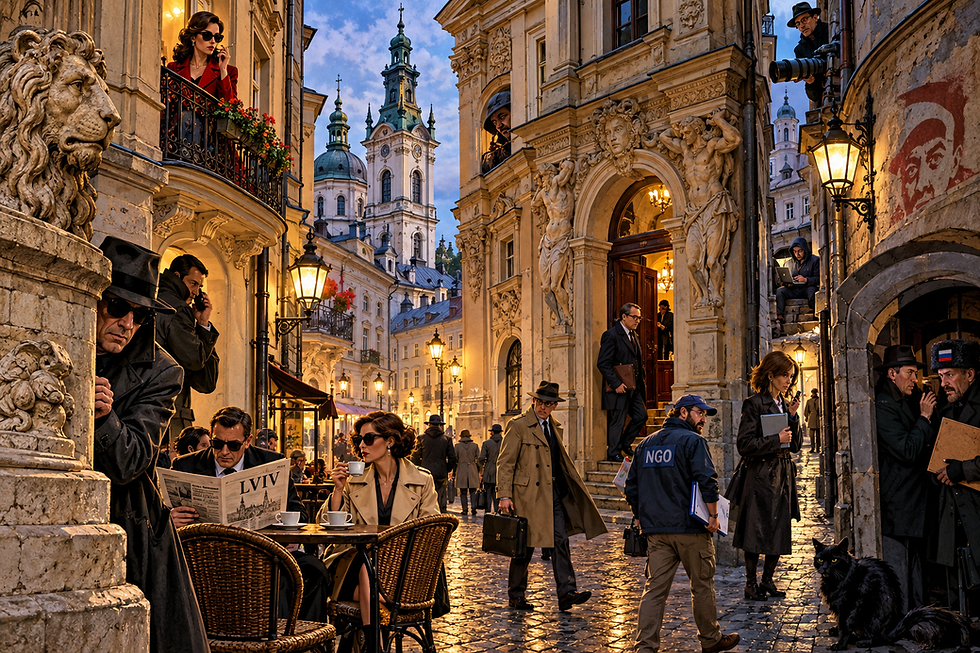
There is a temptation to romanticise espionage, particularly in a city as beautiful as Lviv. The imagination readily supplies mysterious strangers in dark coats, discreet conversations beneath the vaulted ceilings of ancient restaurants, and coded messages exchanged across candlelit tables. The architecture positively encourages such fantasies, and a rainy November evening in the old town can make almost anyone feel that he has wandered inadvertently into the opening chapter of a spy novel.
Yet the reality is frequently less elegant. Espionage involves the exploitation of human weaknesses, the manipulation of trust and the acquisition of information that individuals or institutions have legitimate reasons to protect. In wartime, the consequences can be fatal, and the glamour disappears rapidly when intelligence ceases to be an abstraction.
The person who provides the location of a military facility may never witness the missile strike that follows. The individual who betrays the movements of humanitarian personnel may never meet the people whose safety has been compromised. The intelligence officer who recruits a vulnerable young person through an online messaging service may regard the resulting operation as a minor professional achievement, even though the recruit faces imprisonment or death. There is very little romance in any of these transactions.
Nor should one assume that every intelligence operation is conducted with the extraordinary competence attributed to secret services in popular fiction. Bureaucratic rivalries, inaccurate information, excessive ambition and elementary human stupidity are as common in intelligence organisations as in any other institutions. Indeed secrecy can sometimes make these weaknesses worse, because failures are concealed and institutional reputations protected from external scrutiny.
The history of espionage is therefore not merely a history of brilliant deception. It is also a history of people believing things that were untrue, trusting individuals who were unreliable and undertaking elaborate operations whose objectives were never entirely clear. Lviv may well become a place in which these enduring features of human nature are displayed with unusual intensity.
The irony is that the city itself has survived successive empires, occupations, political transformations and ideological catastrophes. Its inhabitants have learned, through centuries of often painful experience, that governments change, allegiances shift and the people who claim to possess secret knowledge are not always as clever as they imagine. The intelligence services now gathering information about Ukraine may eventually discover that Lviv is a more complicated city than their analytical reports suggest.
A city that watches itself
Lviv’s emerging identity as a centre of espionage is ultimately a consequence of its importance. Cities that attract intelligence services are generally places where significant political, economic or military interests intersect. Their apparent tranquillity conceals the fact that decisions made elsewhere depend upon information collected within them, and wartime Lviv possesses precisely this combination of surface normality and strategic significance.
The publicly disclosed Russian intelligence investigations in western Ukraine demonstrate that the threat is real. The substantial Western presence and the intensity of international cooperation create additional intelligence and counterintelligence interests, although much of their clandestine dimension necessarily remains beyond public scrutiny. The opportunities for infiltration of civil society are obvious, but allegations against particular organisations require evidence rather than insinuation.
What may be emerging is a peculiarly twenty-first-century version of post-war Vienna: not a city divided between occupation armies, but one in which the conflict between Russia and the West is reflected through digital surveillance, humanitarian networks, informal recruitment, technological experimentation and the innumerable ambiguities of civilian life. Instead of four-power checkpoints there are encrypted applications; instead of dead-letter boxes there are anonymous accounts; and instead of the shadow of the Iron Curtain there is the electronic fog of a war being fought simultaneously on the battlefield and across global information networks.
Some of the participants will be exceptionally competent, while others will be extraordinarily foolish. A few may imagine themselves to be characters in a John le Carré novel, while their actual activities more closely resemble an unsuccessful amateur theatrical production. This combination of danger and absurdity has always accompanied espionage, because secret services employ human beings and human beings remain stubbornly resistant to perfection.
Meanwhile the citizens of Lviv will continue doing what they have always done. They will attend university, operate businesses, volunteer for humanitarian causes, argue about politics, complain about the weather and spend rather longer in cafés than the demands of economic productivity might strictly justify. Around them, unseen by most, information will be collected, relationships assessed, suspicions investigated and elaborate theories constructed concerning the significance of apparently ordinary events.
The danger is that the invisible world of espionage may eventually contaminate the visible world of ordinary human relationships. A city cannot function if every conversation becomes a potential interrogation, every friendship a suspected recruitment exercise and every charitable institution an imagined instrument of foreign influence. Intelligence activity may be an unavoidable consequence of Lviv’s strategic importance, but universal suspicion need not be.
Lviv’s greatest defence against such a future is not merely the competence of its counterintelligence services. It is the resilience of its civic institutions and the determination of its inhabitants to preserve the habits of an open European society, even while confronting the extraordinary dangers of war. For all the clandestine activity that may take place within its ancient streets, Lviv remains a city of human beings rather than intelligence assets.
Its value lies in its culture, its intellectual life, its generosity and the remarkable persistence of its inhabitants in maintaining civilisation under the most difficult circumstances. The spies may come and go, the empires that employ them may rise and fall, and the intelligence reports will eventually be forgotten, misfiled or declassified to the embarrassment of those who wrote them.
The cafés of Lviv, however, will remain. Somewhere within them an elderly gentleman will continue reading his newspaper, entirely indifferent to the possibility that the person at the next table is employed by a foreign intelligence service; he may even know perfectly well who that person is, but he has better things to do.