The Doctor Who Came to Kharkiv

By Matthew Parish
Wednesday 30 September 2026
A conversation with Dr Maria Teplova about medicine, old age and caring for the people whom war leaves behind
There is a kind of medicine that attracts cameras. It takes place in ambulances and stabilisation points, beneath fluorescent lights and amidst the controlled urgency of trauma teams. Ukraine has produced an extraordinary generation of doctors, nurses and paramedics who practise this medicine, often in circumstances their counterparts elsewhere in Europe would find almost unimaginable.
Then there is another kind of wartime medicine. An elderly woman has diabetes but her doctor has left the city. A pensioner cannot afford a private consultation. Someone’s blood-pressure tablets have run out. The pharmacy does not have the prescribed medicine. A patient suffering several chronic conditions needs not heroic surgery but somebody who will examine her carefully, listen to her and make sure she has the medicines necessary to get through another month.
This is also frontline medicine.
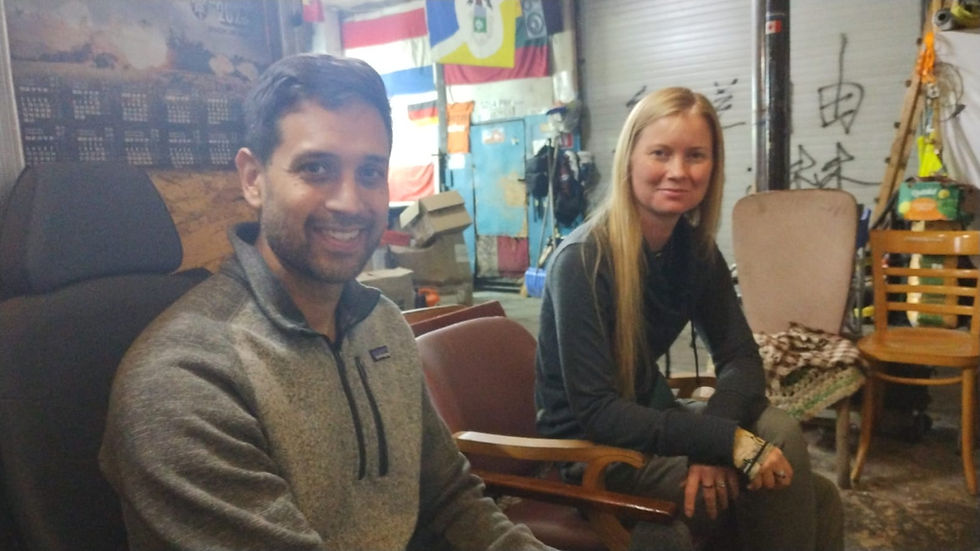
Dr Maria Teplova has been doing it in Kharkiv since the first year of the full-scale invasion. She came originally from Odesa, where she studied medicine and completed her internship in family medicine. Rather than beginning the conventional career of a newly qualified Ukrainian doctor, she went looking for somewhere she could volunteer. Her search took her through Uzhhorod, Lviv and Kyiv before a Canadian volunteer organisation brought her to Kharkiv in October 2022.
By December of that year, Suspilne Kharkiv found her running a consulting room providing patients with medical examinations and medicines without charge. Her particular concern was older people with several simultaneous illnesses, including patients suffering from diabetes and its complications.
One patient explained the importance of something that, on paper, sounded so modest. Her regular family doctor was no longer in Kharkiv. Other free medical services were difficult to reach and private healthcare was beyond her means. Even medicines previously prescribed to her had not always been available. Maria and her colleagues were filling one of the innumerable small holes that war tears in a functioning society.
Years later, Maria remains engaged in humanitarian medicine in Kharkiv and is now associated with Frontline Medics. I met her to talk not principally about explosions or battlefield trauma, but about doctors, elderly people and the strange professional life of a young physician whose career has developed almost entirely against the background of Europe’s largest war since 1945.
Matthew Parish: Maria, you are from Odesa and trained there as a doctor. Why medicine?
Maria Teplova: I was always interested in science, particularly biology, but medicine appealed to me because science becomes something intensely practical when there is another person sitting in front of you who needs help. Family medicine interested me because you do not treat a disease in isolation. You treat a person, often over many years, and you have to understand their circumstances as well as their symptoms.
I could hardly have imagined at university what practising medicine in Ukraine would eventually mean. By the time I completed my internship, the country was at war on a scale that changed everybody’s plans. It became difficult for me to imagine simply starting a conventional medical career while there were people elsewhere who could not see a doctor at all.
MP: You actually went looking for somewhere to volunteer. You travelled through Uzhhorod, Lviv and Kyiv before coming to Kharkiv. Why?
MT: I wanted to be useful. That sounds very simple, but at the time there was enormous confusion. There were volunteers everywhere and tremendous goodwill, but finding the place where your particular skills were actually needed was not necessarily straightforward.
I kept looking. Eventually I was invited to Kharkiv and arrived in October 2022. It was obviously not the safest place in Ukraine, but that was partly the point. There were people here who needed medical care and there were gaps in the ordinary healthcare system. I was a doctor. It seemed to me that I should be somewhere my training could make a difference.
MP: Were you frightened?
MT: Of course. Being a doctor does not make you immune to fear. Kharkiv had already experienced terrible things and everybody understood that the danger had not disappeared.
But fear becomes part of ordinary life remarkably quickly. You learn what the sounds mean, where you should go and what you should do. More importantly, you meet patients who have been living with the same danger every day. When an elderly person comes to see you because she cannot obtain her diabetes medication, your own anxiety becomes less important for a while.
MP: You concentrated particularly upon older patients from quite early in your work here. Why?
MT: Because they were among the people most likely to fall through the gaps. Older patients frequently have several conditions at once. Someone may have diabetes, hypertension, heart disease and arthritis. None of those necessarily constitutes an emergency today, but if treatment is interrupted for weeks or months the consequences can become extremely serious.
War makes all the ordinary obstacles harder. The doctor may have left. Public transport may not work properly. The patient may have very little money. Their children may be somewhere else in Ukraine or abroad. A pharmacy may not have the medicine. Something that would be a straightforward problem in peacetime can become a serious medical problem because every part of the chain has been disrupted.
MP: So the medical consequences of war extend considerably beyond people actually injured by weapons?
MT: Absolutely. Trauma medicine is essential and the people doing it perform extraordinary work. But a war also causes illness indirectly.
If somebody’s hypertension is uncontrolled for a long period, the missile did not cause their stroke in the conventional sense. Yet the war may be the reason they could not see their doctor or obtain their medication. The same applies to diabetes, cardiovascular disease and many other chronic conditions. These consequences are quieter and therefore easier to overlook.
MP: What is different about treating elderly people?
MT: You have to listen. Very often the medical problem is only one part of what is happening in their lives.
Some people are lonely. Some have relatives who have left. Some have very little money. Some are frightened and exhausted after years of alarms and explosions. Sometimes an elderly person needs medication and sometimes that person also needs twenty minutes in which somebody pays attention to them and treats their worries seriously.
That is one reason I like family medicine. The patient is not simply a blood-pressure measurement or a glucose level.
MP: Why do elderly people remain in dangerous places when everybody tells them to leave?
MT: Because “just leave” is much easier to say when it is not your life that has to be abandoned.
An elderly person may have lived in the same home for forty or fifty years. Their husband or wife may be buried nearby. They may have animals. Their entire social world may consist of a few neighbours. They may not know where they would go, how they would pay for things or whether anybody would be there to help them.
From outside, evacuation can look like the obvious rational decision. From the perspective of an elderly patient, leaving can mean surrendering everything familiar at the moment when familiarity matters most.
MP: Does loneliness become a medical issue?
MT: Very much so. Mental and physical health are connected, particularly in older people. Isolation affects whether people eat properly, take their medication and look after themselves. Depression and anxiety can make existing illnesses worse.
Doctors cannot solve loneliness. But we should notice it. Sometimes simply returning, remembering the patient and asking how they are can matter.
MP: Has practising medicine during the war changed you as a doctor?
MT: Completely. In one sense I do not know what the alternative version of me would have been like, because almost all my independent professional life has taken place during this war.
It has taught me to improvise and to distinguish what is essential from what is merely desirable. In an ideal medical system you have every investigation available and every specialist nearby. In humanitarian medicine you sometimes have to ask: what can I establish here, what can I safely treat and which patient absolutely needs to be moved somewhere with more resources?
It has also made me appreciate kindness as a medical skill. Technical knowledge matters enormously, but frightened and vulnerable people need to trust you before that knowledge becomes useful.
MP: You work alongside international volunteers. What should foreign doctors understand before coming to Ukraine?
MT: They should come ready to listen rather than assuming that Ukraine needs to be taught how medicine works. Ukraine has extremely capable doctors and nurses. What we often lack in wartime is not knowledge but resources, personnel in the right places and continuity.
International colleagues can bring valuable experience, equipment and different perspectives. The best cooperation happens when everybody respects what the other side knows.
MP: What have your patients taught you?
MT: Patience, certainly. Also that people can adapt to circumstances that should never become normal.
I am sometimes cautious about the word “resilience”. Ukrainians are constantly praised for being resilient, but nobody should have to become resilient enough to live indefinitely through war. Nevertheless, I see elderly people who have experienced extraordinary upheaval and who still make jokes, care for their neighbours and ask me whether I have eaten lunch. That stays with you.
MP: What does this work demand from you personally?
MT: You have to learn boundaries without becoming indifferent. If you carried every patient’s suffering home in exactly the same way, eventually you could not function. But if you stop caring altogether, you should probably not be doing this work.
Finding the point between those things is difficult. Some patients remain in your thoughts. Some days are harder than others. Having good colleagues matters enormously.
MP: What sort of doctor do you think these years have made you?
MT: I hope a practical one and a compassionate one. I have learned that good medicine does not always require something dramatic. Sometimes doing something small reliably is enormously important.
Giving somebody the correct medicine, explaining how to take it, noticing a dangerous symptom early or arranging further care may not make the news. For that individual patient, however, it can change everything.
MP: If you could speak to the newly qualified Maria who was travelling around Ukraine looking for somewhere to volunteer, what would you tell her?
MT: Probably that she has no idea what she is getting herself into.
But I would also tell her to go. There will be difficult days and situations she cannot fix. She will meet extraordinary people. She will learn more about medicine and about human beings than she expects.
And I would tell her not to lose her curiosity. Medicine changes, people are complicated and there is always more to learn.
MP: Would you make the same decision again?
MT: Yes. I might make some individual decisions differently with what I know now, but I would still choose to help.
MP: Why are you still doing it?
MT: Because the need has not disappeared. The headlines change much faster than people’s lives do.
There are still elderly people who need doctors. There are still families living with the consequences of war. There are still people for whom something as ordinary as a consultation or a supply of medicine is difficult to obtain. As long as I can be useful, that is a good reason to continue.
There is something particularly attractive about Maria Teplova’s conception of medicine, at least as it emerges from the work she has publicly described. It is not medicine as theatre. It is medicine as persistence.
A doctor cannot stop a missile. She cannot reverse demographic collapse in a village, return somebody’s children from abroad or reconstruct a healthcare system single-handedly. She can nevertheless arrive, open her bag, examine the patient, find the medicine and come back again.
That modest sequence of acts acquires a peculiar dignity during war. Ukraine’s survival has depended not only upon spectacular acts of courage but upon thousands of people continuing to perform the ordinary functions of a civilised society in circumstances in which ordinary life ought to have become impossible.
Maria finished medical training and went looking for somewhere to help. She eventually found Kharkiv. Kharkiv, in turn, found another doctor.