Never Alone: Breaking Bread on Ukraine’s Front Line
By Matthew Parish
Wednesday 30 September 2026
There is a particular sort of humanitarianism that emerges in Ukraine once one moves beyond the conference rooms, institutional logos and carefully drafted project descriptions of the international aid industry. It tends to involve an old vehicle, a few gas burners, an improvised kitchen, people who have forgotten what a normal night’s sleep feels like and an apparently unreasonable determination to go somewhere that everybody sensible is trying to leave.
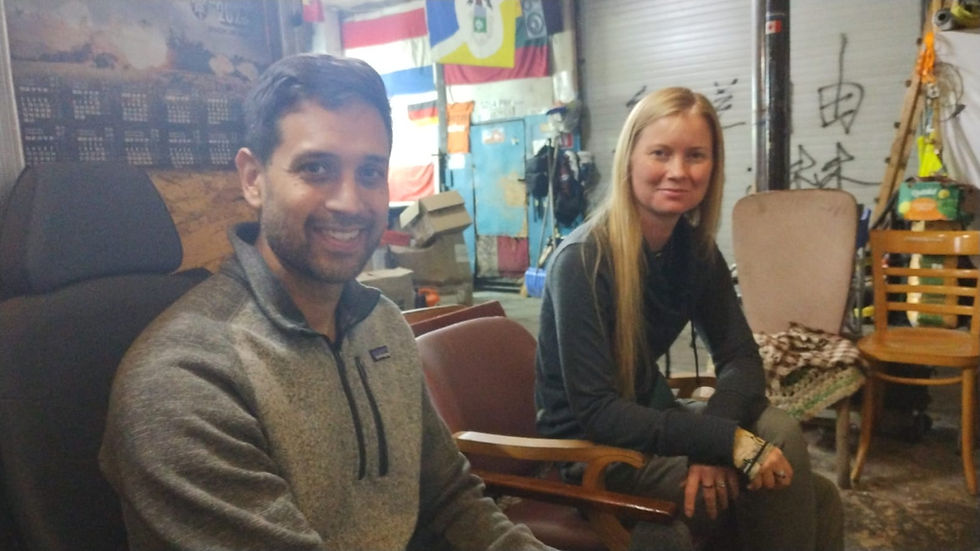
Never Alone – Humanitarian Kitchen belongs firmly in this tradition. It is the creation of Jason Zan, an American archaeologist with experience in search-and-rescue, backcountry logistics and drone imaging, and Amy Campbell, a New Zealander whose background lies in cooking, hospitality and a family café. They are an unlikely combination, perhaps, but Ukraine specialises in creating unlikely combinations.
The organisation began with a simple idea: cook good food and take it to people who need it. Yet after thousands of meals, repeated journeys into eastern Ukraine and encounters with communities living close to the front, Jason and Amy have discovered that the food is only part of what they are delivering.
Never Alone has served more than 5,000 meals over previous deployments, according to New Zealand reporting, supplying frontline settlements, internally displaced people, children’s programmes and soldiers in remote positions. The organisation has also supplied hygiene products and equipment, while more recently its work has increasingly involved children and family-type children’s homes. A Ukrainian children’s organisation reported this month that Never Alone had been visiting such homes in Dnipropetrovsk Oblast, cooking with children, spending time with them and bringing food and gifts.
Yet statistics do not really explain Never Alone. To understand the organisation, one has to understand why two people from opposite sides of the world repeatedly return to a country at war.
I met Jason and Amy in Kharkiv and asked them.
Coming to Ukraine
Matthew Parish: Before we talk about Never Alone, could you each tell me briefly about your lives before Ukraine, and what first made you decide that watching this war from abroad was not enough?
Jason: I was watching the war unfold from home in 2022 and it felt like something that shouldn’t be happening, especially in this day and age. Clearly another country was invading what would otherwise have been a free democratic country, imposing its will upon it and people were dying.
My family is originally from Myanmar, so I’ve been aware of their struggle for a long time. I’ve seen Myanmar come in and out of the news consciousness. People pay attention for a couple of news cycles and then it gets lost for a few years. I didn’t want to see the same thing happen here.
Amy: I was in a very different situation in 2022. My family and I owned a café in New Zealand. We’d had it for eleven years and everybody was pretty tired and looking to get rid of it.
It’s always difficult to explain exactly what made me want to come here. I watched what happened when Ukraine was invaded by what should have been a brother country — this enormous country coming into their land and killing their people — and then I saw how Ukrainians reacted to it. It was incredible and really inspiring.
So we were waiting to sell our café and I just took a flight over. I ended up in Lviv.
Their paths crossed through something rather different from cooking. Amy was raising money in New Zealand to purchase CAT Gen 7 tourniquets for Ukraine but faced a logistical problem: she could buy the particular tourniquets she wanted in the United States, but needed somebody there who could receive them and arrange their onward journey to Ukraine.
She appealed for help online. Jason answered.
Jason: We later met in person while working at an animal shelter in October 2022. Then we crossed paths again in 2023. Amy was working with Razom for Ukraine, packing individual first-aid kits and managing that for a while.
We enjoyed working together. It seemed to work well. Eventually we started thinking about how we could do this more full-time.
I asked her, “What is it that you would like to do here?” My imagination only went as far as getting a vehicle and moving supplies around.
She said, “I want to cook for people.”
My job back home basically involves getting a bunch of twenty-something new graduates into the middle of nowhere, into backcountry areas, and getting them to complete a job effectively and on time without anybody getting injured or dying. So I knew backcountry logistics.
I figured: if you cook it, I can get it there.
And that’s what we ran with.
When a box of rice is useless
The insight behind Never Alone is almost embarrassingly simple. Humanitarian aid is useful only if its recipients can actually use it.
Boxes of rice and beans look admirable on a spreadsheet. They are less impressive when delivered to somebody without electricity, clean water or a functioning stove.
Matthew: What had you seen in Ukraine that convinced you that hot, freshly cooked meals could provide something boxes of humanitarian supplies could not?
Amy: We saw cases where boxes of humanitarian supplies were being sent back from frontline areas because people simply couldn’t use them. They didn’t have the resources. They couldn’t create a heat source. They didn’t have water to cook the rice or beans they were being sent.
So the supplies were completely impractical for the places they were going.
We also saw people who were starting to feel really forgotten. We felt that was somewhere we could step in. Even if it was only one meal, they could know there were still people out there working for them and remembering them.
Jason: We’re a small group. There’s only so much we can do, so we can’t replace people’s dietary needs. What we can provide is a morale boost.
A lot of the villages we visit are frontline villages, but often they’re the ones just a little behind the front that larger aid organisations may overlook because they’re concentrating on places receiving the most attention.
For people there to see somebody come from another country, from somewhere perfectly safe, and take the time and effort to serve them a hot and delicious meal — that means something. People let us know that.
That philosophy eventually supplied the organisation’s name.
Matthew: The name Never Alone seems to express something broader than feeding people. What does it mean?
Jason: When we first launched the project and started putting the groundwork together in January 2024, we had an idea but we weren’t sure whether it would work in reality.
Then we tried it. It seemed that in every village we visited, every IDP shelter, at least one person would tell us something like: “You make us feel like we’re not alone. Seeing you here, standing here with us in this crazy world, means a lot.”
That really stuck with us. It’s one of the most important things anybody has ever told us. Every year we’re out here, we get that response.
The woman who cried
Humanitarian organisations naturally count things. Meals distributed, kilometres travelled, boxes delivered and dollars raised all provide measurable evidence that donors’ money is achieving something.
But the most important measure of Never Alone’s work may be impossible to quantify.
Matthew: Is there one particular person or encounter that made you realise Never Alone was genuinely making a difference?
Amy: There are a lot of encounters, but there’s one that comes back to me quite often, and it actually had nothing to do with the food.
We were in the Donetsk region, in an almost entirely evacuated village. We were delivering food there and the guide we were with went around collecting the few people who were still living in their houses.
He brought one lady to us to collect her package of food. Before we could even give her anything, he told her where we were from — that I was from New Zealand and Jason was from America.
She just started crying.
That was a moment when I realised that sometimes it isn’t even really about the food. It’s just about being there.
This story has also appeared in recent New Zealand reporting on their work: the elderly woman in an almost deserted village who burst into tears upon discovering that somebody had travelled from New Zealand to help people like her.
Perhaps this explains Never Alone better than any mission statement could.
Food maths
The romance of humanitarian volunteering evaporates rapidly when one has to feed a hundred people.
Never Alone’s kitchen is not an industrial operation. Its work has involved cooking substantial quantities of food using little more than gas burners, tables and whatever facilities happen to be available. Air-raid alerts complicate even the apparently mundane business of buying groceries.
Matthew: What does an ordinary working day look like, from buying the ingredients to putting a meal in somebody’s hands?
Amy: It’s usually a two-day process. Here in Kharkiv we have air alerts many times a day, so it can be very difficult to collect the ingredients we need from the wholesaler.
Usually we buy everything the day before the cook. Then we get up early the following morning and start preparing everything.
If we’re delivering to soldiers, we might package everything that evening and take it out to them. If we’re going to a village close to the front, we’ll get everything ready to travel the following day. So it can become a three-day process if we’re going further away.
Jason: Sometimes we’ll get a call with eighteen hours’ notice. A church might ask, “Can you feed eighty people?”
I’ll look at Amy. She’ll do what I call “food maths”.
Then she’ll look at me and say yes.
At that point I know it’s go time.
Amy generally resists attempting Ukrainian cuisine on the reasonable ground that Ukrainians are better at cooking Ukrainian food than she is. Instead she makes the sort of food she knows: soups, stews, rice, pasta and salads. One successful experiment was a New Zealand-style kumara, or sweet potato, cream soup with pork.
“I cook the food my mum would usually cook for me,” she says, “because that is what makes me feel happier.”
There is a wisdom in this. Comfort food is not necessarily the food of the country in which it is served. It is food prepared with the intention of comforting somebody.
Knowing when not to go
The war has meanwhile changed.
For much of the full-scale invasion, volunteers have developed informal calculations about acceptable risk. A village seven or twelve kilometres behind the front might once have been somewhere an experienced team could enter, establish itself briefly, distribute aid and depart before Russian forces could identify the gathering and respond.
The proliferation of FPV drones is destroying those calculations.
Matthew: How do you balance the desire to reach isolated communities against the responsibility not to take unreasonable risks yourselves or create additional risks for the people you’re helping?
Jason: That’s something we’ve talked about a lot.
One of our main principles is that we don’t want to go somewhere if our presence is going to bring danger to the people we’re trying to help. We also don’t want to encourage people to stay in situations where they shouldn’t remain.
If it’s an area where aid organisations have difficulty getting in, where even the military has difficulty helping people, we don’t want to incentivise civilians to stay and exacerbate their own humanitarian crisis.
We actually developed a rubric for assessing situations. How well do we understand the security situation? How closely do we know our local contacts? How are conditions changing?
Last year and the year before, we could go into a village seven to twelve kilometres from the front line. We could set up the kitchen, heat the food, have the local council gather people, serve them and then pack everything up and leave before the Russians had time to spot us and bring artillery down.
This year that’s no longer possible because of the proliferation of FPV drones. They’re even in Kharkiv now.
So we’re having to change what we do. We’re focusing more on IDP and refugee shelters further away from those areas. We’ve had meetings with regional administrative centres trying to find ways of reaching some villages.
The answer we keep getting is: those aren’t places you can go anymore.
This may prove to be the most important transformation in Never Alone’s history. A humanitarian organisation born to carry meals towards the front is discovering that the front can now reach out towards the humanitarian organisation.
The kitchen must therefore move.
Faith and food
Never Alone is also interesting because its founders arrive at essentially the same moral conclusion from different philosophical starting points.
Matthew: Is faith a large part of what motivates you?
Jason: Yes and no. I come from a faith background. Amy does not.
Faith has influenced my ethics, the way I see things here, my sense of justice and, I think, my empathy for people.
Amy: I’m not a person of any particular faith. I’ll bring food to anybody, no matter what they believe or who they are.
I know faith is very important in Ukraine, so we often deal with churches and we’re very happy to do that. But for me, it’s simply about getting food to whoever needs it.
There is something characteristically Ukrainian about this arrangement as well. Churches, charities, soldiers, foreign volunteers, municipal officials and informal networks frequently overlap in the practical business of keeping people alive. The theological questions can wait until after dinner.
The children
As frontline access becomes more dangerous, another aspect of Never Alone’s work is assuming greater importance.
The organisation has already run a children’s camp in the Carpathians and plans another. It is also working increasingly with orphanages and family-type children’s homes, providing food, supplies and gifts as well as something less tangible: attention.
That development is independently reflected in recent Ukrainian reporting on Never Alone’s work with children’s homes in Dnipropetrovsk Oblast.
Matthew: Is Never Alone gradually becoming something broader than a humanitarian kitchen, using food as a starting point for companionship, children’s activities and longer-term relationships?
Amy: Definitely. We ran a children’s camp last year in the Carpathians, which was incredibly successful, and we’ve got another one planned.
We’re also including many more orphanages in our programme. We cook for them, but if the opportunity is there we also bring supplies they need for their homes and, of course, gifts for the children.
That’s one way we’re beginning to pivot what we do.
The word pivot is one heard rather too often in business presentations. Here it has a more serious meaning. Never Alone is adapting because the battlefield is adapting.
What foreigners misunderstand about Ukraine
Both Jason and Amy have now spent enough time in Ukraine to have moved beyond the superficial impressions of the first-time visitor. They have also returned often enough to observe the growing distance between the lived reality of Ukraine and the declining prominence of the war in Western public consciousness.
Matthew: What have Ukrainians taught you, and are there things about Ukrainian society that people in the United States and New Zealand fundamentally misunderstand?
Amy: In New Zealand, I think some people imagine Ukraine as a very backward country. They think it has a lot of corruption — and to some degree it does — and that this somehow makes it a country not worth helping.
I think they’re completely unaware of how motivated and driven the Ukrainian population, especially the younger population, is to create a better future for itself: a fairer and brighter future that isn’t under the foot of Russia anymore.
That’s something New Zealanders have a really hard time understanding.
Jason: The simplest way I can answer is that Ukrainians have taught me that they’re people just like anyone else. That’s something I would love Americans to understand about this society.
There is this barrier created by distance and by not getting outside our own bubbles that makes Ukrainians seem very separate from us.
A lot of American volunteers who come here say that Ukrainians embody the qualities we like to associate with ourselves: rugged individualism and independence. We actually see those qualities in the way people live here, whereas back home they’re often things we just talk about.
I wish we didn’t feel that divide. I wish we recognised that these children have the same rights and values as our children. They have the same right to a childhood and to grow up in safety, and that we would fight for justice for our fellow humans.
The disappearing war
Amy encounters another problem whenever she returns to New Zealand.
People ask whether the war is still going on.
Amy: Compassion fatigue and Ukraine fatigue are massive. I get people back home saying, “Oh, is the war still on?”
It’s completely out of our news. It’s out of people’s lives.
There is a part of the New Zealand population that remains incredibly supportive of Ukraine and wants to keep it in their minds and hearts. But in general, it has definitely slipped.
Never Alone’s small scale may paradoxically offer some protection from this phenomenon. Jason and Amy do not require the budgets of a large international organisation. Their donors can see a relatively direct relationship between a modest contribution and somebody receiving a meal.
Jason: We have a very small set of donors, but they seem to recognise that their small donations go a long way with us.
When we started, the cost was about 80 US cents per meal for the meal programme. Working directly with villages and communities removes a lot of the overhead you might have elsewhere. We can get aid directly to the places where it’s needed.
We’ve seen attention fluctuate a lot and it’s frustrating. But being a smaller organisation means Amy has a community in New Zealand that knows her, either through the news or personally. For me, there are a couple of churches in the States that have consistently supported me.
We don’t make huge amounts of money. But so far it has always been enough to keep us going.
Published reporting similarly illustrates the economics of their model: in 2025 Campbell estimated that feeding approximately 100 people could cost only US$100–150, including meat, bread and biscuits.
What happens next?
This is where our conversation took an unexpected turn.
Never Alone’s continued existence is not guaranteed.
Matthew: If you had the funding, equipment and support you needed over the next twelve months, what would you like Never Alone to be doing?
Jason: That’s literally the question we’ve been discussing over the last few days, because so much has changed.
There’s no assurance right now that we’re going to have funding for next year. So we’re looking at whether we have to shrink the mission or whether this might be the last one.
We can’t keep feeding frontline villages in the same way because the situation has changed.
Amy: There would always be more support for the army if we had the funds. But there would also be more support for children, especially education.
I feel education is how Ukraine’s younger population is going to work itself towards a better future and stay away from the propaganda that floods the country from Russia.
If we had good funding, we’d have a very long sit-down and work out what we could do.
Jason believes that the answer may increasingly lie with children.
Jason: I think we’d probably end up leaning more into children’s programmes, which is interesting because neither of us wanted to get into that at the beginning. It was simply an opportunity we had, we saw the need and as we continued the need kept growing.
That’s important because they’re the future of Ukraine.
My grandparents experienced trauma from the Japanese invasion of Burma during the Second World War and from their own government’s ethnic cleansing of their ethnic minority. I saw how they dealt with that trauma, how they grew from it and how they tried to pass on the light and love rather than the darkness.
I want that for the children going through similar things in their childhoods here.
Our original methods aren’t going to last as the war continues to change. But we can continue supporting communities, because that’s what this has always been about.
You asked whether food was just the starting point. It’s the most important thing, but it’s also always been just the starting point.
When you break bread with somebody, you break down barriers. When those barriers come down, you form a relationship. Then people tell you what they really need.
And whether we can provide it ourselves, or bring in one of our friends, partners or colleagues who can, we’re all working together for something better.
Never alone
There is an important lesson here about humanitarian assistance in Ukraine.
The needs created by this war are enormous. No two-person organisation can feed eastern Ukraine. Never Alone cannot reverse displacement, stop Russian drones, rebuild destroyed villages or restore the childhoods being consumed by years of air-raid alarms, underground classrooms and separation from parents serving at the front.
Jason and Amy know this perfectly well.
The significance of their work lies precisely in its refusal to be paralysed by the scale of the problem. If you cannot feed a country, feed a village. If the village has become too dangerous to reach, feed the displaced people who have left it. If a hot meal creates a conversation, listen to what people say they need next. If children cannot have a normal childhood, give them a few days in the Carpathians when they can approximate one.
And if an elderly woman in an almost abandoned Donetsk village starts crying before you have even handed her the food because she has just discovered that two strangers have travelled from New Zealand and the United States to stand beside her, then perhaps the most important thing delivered that day was not contained in the food package at all.
The name Never Alone was not really invented by Jason and Amy.
Ukraine gave it to them.
---
Supporting Never Alone
Never Alone – Humanitarian Kitchen is currently seeking support to continue its work in Ukraine. Recent published information gives the following routes for people wishing to contribute:
Givealittle: Never Alone – Hot Meals for Humanity fundraiser
United States:Never Alone also has a fundraising campaign through Sooner Hope Inc. on Givebutter. (Givebutter)
Contact / newsletter: neveralone.ua@gmail.com
For readers considering making a substantial contribution, the Lviv Herald recommends contacting Never Alone directly to confirm the most appropriate current donation method and the programme for which funds are most urgently required.
Feel free to contact the Lviv Herald directly if you would like to assist, and your message will be passed on to Jason and Amy.