


Staying warm in Lviv
- Feb 8
- 3 min read
Sunday 8 February 2026
By February the cold in Lviv is no longer a visitor; she has taken the spare room and unpacked. The apartment block in which I live holds its breath when the power goes, as if the walls themselves are listening for the thud of the next transformer surrendering somewhere beyond the ring road. The blackout arrives without ceremony. A click, a soft mechanical sigh, and the city is returned to an older century.
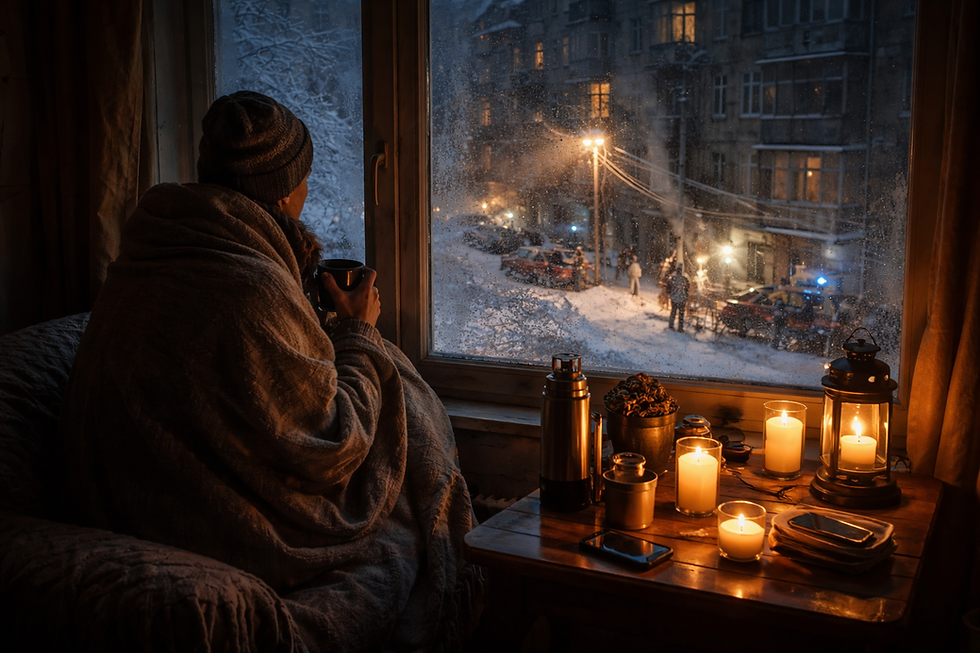
The flat cools with a patience that feels deliberate. Radiators lose their voice first, then the sockets become ornamental, and finally the lights concede. I have learned the order by heart. There is a small choreography to staying warm that I now perform without thinking. Layers first — wool, then the heavier coat I once reserved for the street. Curtains drawn early to keep the windows from conspiring with the frost. Candles set where they cannot be knocked, their flames a stubborn punctuation in rooms that suddenly look larger and less forgiving.
The cold has a way of finding the unguarded places. It pools on the tiles, climbs the legs of the table, settles into the bones. I boil water when I can, pour it into a flask, cradle it like a hand. Tea becomes less a drink than a tactic. When the kettle is silent, there are other rituals. I pace. I do small, ridiculous exercises — squats by the sink, stretches by the door — anything to persuade the blood to remember its job.
Outside, the engineers are working again. You hear them before you see them — the diesel cough of generators, the metallic clatter of ladders, voices lifted not in anger but in instruction. They arrive with the calm competence of people who have done this too many times and will do it again before dawn. Somewhere to the east, a missile has torn at the grid, and here in the centre of the city the consequences arrive as darkness and cold. The repairs are ceaseless because the damage is almost nightly. The grid is wounded, stitched, wounded again.
From the window, the city looks like a constellation rearranged by hand. One building glows while the next stands black, then another flickers to life and goes dark. It is not chaos; it is triage. We learn to read it. We message one another when a circuit comes back — not out of excitement, but as a courtesy. There is a shared grammar now, a quiet etiquette of endurance.
Sleep is negotiated rather than assumed. I pile blankets until the bed becomes a small fortification. I leave the coat on. The cold makes sounds of its own — a tick from the pipes, a creak from the floorboards — and each noise carries the echo of the question everyone asks themselves in the small hours: is this normal, or is this something else? When the power returns, sometimes briefly, the lights feel too bright, almost intrusive, like an interrogation lamp. I savour the hum, the warmth beginning its slow, cautious return, and then prepare for it to go again.
What sustains me is not bravado. It is the ordinary stubbornness of a city that refuses to be instructed into despair. In the stairwell, neighbours swap batteries and jokes. In the street, the engineers work with a concentration that borders on tenderness, coaxing light back into cables that have been bruised but not broken. The frost tightens its grip, the blackouts continue, and still the repairs go on.
By morning, if the grid has held, the radiators whisper and the apartment breathes again. I step outside into air sharp enough to make the eyes water, and the city looks unchanged, almost serene. It is not. It is working — all of us are — at the unglamorous business of staying warm, staying awake, staying human, while the night tries once more to teach us the cost of light.


