Kharkiv: Mad Max with Coffee Shops
By Matthew Parish
Thursday 1 October 2026
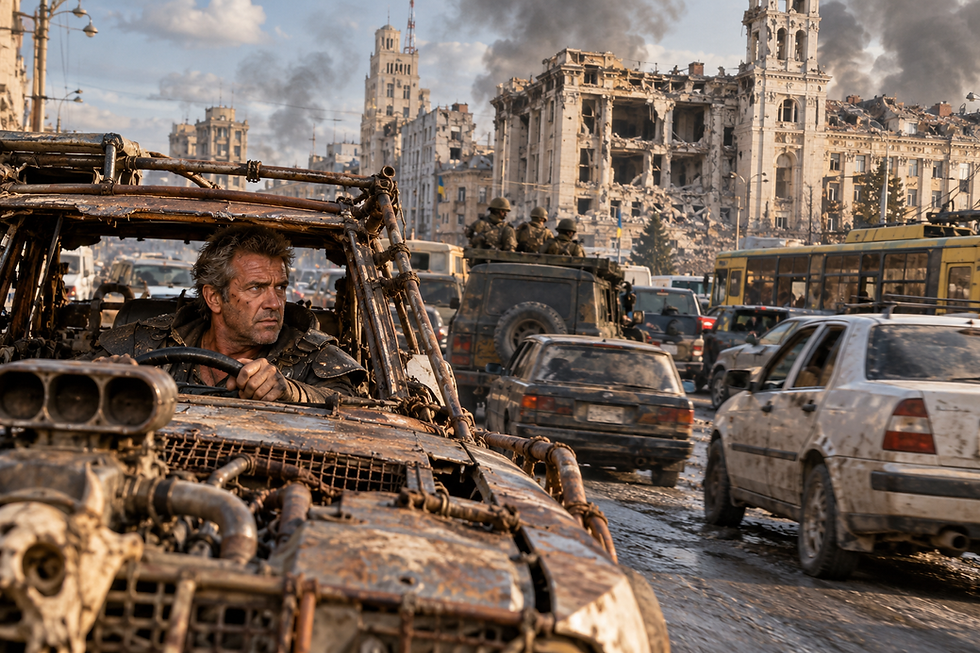
There are moments in Kharkiv when one half expects Mel Gibson to appear at the wheel of a battered Australian muscle car, pursued down Sumska Street by a gang of marauders wearing motorcycle helmets, animal skins and inexplicably elaborate shoulder pads. The comparison would be unfair to Kharkiv, of course. Kharkiv has better coffee, considerably more attractive architecture and rather fewer people fighting one another over the last remaining supplies of petrol. Nevertheless, after several years of full-scale war, there are occasions when Ukraine’s great eastern metropolis feels disconcertingly like a particularly sophisticated instalment of Mad Max.
The resemblance is not principally physical. Kharkiv remains a beautiful city, although one must increasingly qualify that observation with sorrowful clauses about shattered windows, boarded façades, damaged apartment blocks and buildings struck by Russian missiles, drones and glide bombs. The city has not become a desert wasteland. Its parks remain green, its immense streets retain their imperial scale and the extraordinary constructivist architecture around Derzhprom still looks more like a vision of the future than something approaching its centenary. Yet the psychological atmosphere sometimes has something of the post-apocalyptic about it: civilisation continues while everyone has become accustomed to things that, elsewhere in Europe, would be considered signs that civilisation had ended.
This is the essential Kharkiv paradox. The apocalypse happened, but everybody still has appointments.
You may be sitting in a café drinking an excellent cappuccino when an air-raid siren begins. Nobody necessarily moves. The waiter continues carrying plates. Somebody at the next table continues discussing a business transaction. A young woman keeps typing on her laptop. Your telephone announces, with the impersonal confidence peculiar to modern technology, that missiles or drones may be travelling in your general direction. Five minutes later somebody orders cheesecake.
In Mad Max, society has collapsed and the survivors reinvent themselves as tribes. In Kharkiv, society has been attacked repeatedly and has responded by becoming peculiarly determined to remain society. The distinction is important. The Russians have attempted to create an apocalypse; Kharkiv has insisted upon maintaining opening hours.
That produces a strange aesthetic. Military vehicles travel along roads beside ordinary family cars. Soldiers carrying weapons stand in queues for coffee. Sandbags and concrete barriers coexist with advertising signs, flower shops and beauty salons. Buildings bearing scars of explosions may have functioning restaurants on their ground floors. A shopkeeper replaces a window, it is damaged again and somebody replaces it again. The underlying philosophy seems to be that Vladimir Putin may possess an enormous arsenal of missiles, but this does not entitle him to determine whether a hairdresser opens at nine o’clock.
The motor vehicles reinforce the Mad Max impression. Wartime Ukraine has produced an automotive ecosystem that would delight a production designer. There are enormous four-wheel-drive vehicles, battered vans, military pickups, ambulances of uncertain provenance and elderly European cars that appear to have survived several previous civilisations. Vehicles are repaired, improvised, adapted and driven for distances that their manufacturers probably never contemplated. Mud, camouflage paint and mysterious pieces of equipment are common accessories.
Yet Kharkiv traffic remains unmistakably urban. There are traffic lights, taxis, delivery drivers and people becoming irritated because somebody has parked badly. This may be the ultimate proof that civilisation survives: even under bombardment, human beings retain the capacity to become furious about parking.
The city’s underground world adds another cinematic dimension. Kharkiv’s Metro, built in the Soviet period partly with civil-defence considerations in mind, has become one of the symbols of the city’s endurance. During the worst periods of bombardment, underground stations became shelters, bedrooms, meeting places and refuges. Children attended lessons underground. Families spent nights beneath the city while explosions shook the world above them.
One can imagine the inhabitants of a Mad Max settlement descending into subterranean chambers to escape marauders. In Kharkiv, however, they emerge again in the morning and go to university, open pharmacies, repair cars, practise law and complain about bureaucracy. The Ukrainian version of the apocalypse contains paperwork.
There is also something distinctly cinematic about darkness. Wartime electricity interruptions can transform familiar streets with astonishing speed. A modern European city illuminated by shops, street lamps and apartment windows suddenly becomes patches of blackness punctuated by headlights and generators. Restaurants continue operating beneath emergency lamps. Mobile telephones become torches. Generators cough outside businesses, producing the background soundtrack of wartime commerce.
Then the electricity returns and everybody carries on.
This adaptability is perhaps the characteristic that most separates Kharkiv from the dystopian universe of Mad Max. Dystopian fiction generally assumes that civilisation is fragile. Remove electricity, government or physical security and humanity rapidly descends into barbarism. Wartime Kharkiv suggests almost the opposite. Civilisation can be astonishingly stubborn. People continue observing social conventions long after circumstances have rendered them objectively absurd.
They dress well. They arrange dates. They walk dogs. They buy flowers. They argue about restaurants. Teenagers behave like teenagers, which may be among the strongest possible pieces of evidence that normal human existence persists. People make plans for next month while knowing perfectly well that tonight may involve several hours listening to explosions.
This should not be romanticised. There is nothing amusing about the reasons Kharkiv has acquired these characteristics. People have been killed, wounded, displaced and traumatised. Homes have been destroyed and families divided. The proximity of the Russian border gives the city extraordinarily short warning times for some forms of attack. Behind the black humour lies accumulated exhaustion, and behind the apparent indifference to air-raid warnings often lies not fearlessness but familiarity with fear.
Nevertheless, humour becomes one of the mechanisms by which familiarity is made tolerable. Ukrainians possess an extraordinary capacity to reduce catastrophe to a joke, preferably an extremely dark one. This is another respect in which Kharkiv resembles a dystopian film, except that the inhabitants are simultaneously the characters and the critics. They know perfectly well how absurd their surroundings have become.
Someone hears an explosion and identifies approximately what it was from the sound. Someone else checks a Telegram channel. A third person continues eating dinner. Conversation resumes. What would constitute the climactic scene of an action film has become an interruption between the soup and the main course.
Foreign visitors sometimes find this bewildering. Their instinct is to treat every siren as an extraordinary event because, in their lives, it would be. Kharkiv residents have had to develop a more complicated calculus involving the type of warning, the suspected weapon, the direction from which it is travelling, the reliability of available information and the distance to shelter. This is not recklessness so much as the uncomfortable expertise that develops when danger becomes routine.
That expertise permeates ordinary conversation. People who once knew nothing about military technology can distinguish drones from missiles and discuss air defence with alarming fluency. Civilians learn the geography of explosions. Everyone appears to know somebody serving in the Armed Forces. War ceases to be an abstract subject discussed on television and becomes part of the practical knowledge required to inhabit a city.
This is where the Mad Max comparison becomes simultaneously most powerful and least accurate. Kharkiv possesses many of the visual ingredients of dystopia: damaged buildings, military vehicles, improvised machinery, darkness, sudden explosions and people carrying on amid circumstances that would once have seemed unimaginable. What it lacks is dystopia’s central premise, namely that catastrophe destroys the social order.
Kharkiv’s experience suggests that catastrophe can instead reveal how deeply people value ordinary social order. The café matters precisely because missiles exist. The theatre matters because people have tried to destroy the city. A freshly repaired window becomes an act of defiance. A restaurant reopening after an attack is not merely a commercial decision but an assertion that tomorrow exists.
Perhaps the most extraordinary thing about Kharkiv is therefore how unextraordinary its residents attempt to make it. The city does not spend every waking hour announcing its heroism. People have jobs to do. They have bills, relationships, troublesome relatives, broken cars and dentists’ appointments. They are living through one of Europe’s greatest catastrophes since 1945 while simultaneously experiencing all the tedious inconveniences that constituted life before it.
That is why the image of Mad Max eventually breaks down. In the films, the old world has disappeared and people struggle amongst its ruins. In Kharkiv, the old world is damaged but stubbornly refuses to disappear. There are ruins, but there are also espresso machines. There are soldiers, but there are also accountants. There are missile alerts, but there are also restaurant reservations. The city inhabits the peculiar frontier between catastrophe and normality and refuses to surrender entirely to either.
If Hollywood ever made the Kharkiv version of Mad Max, audiences might complain that the screenplay lacked credibility. The hero would wake to an air-raid warning, discover that electricity had disappeared, drink coffee made from a generator, drive past a missile-damaged building, have his suspension repaired by an ingenious mechanic, conduct three business meetings, eat Georgian food and return home while drones buzzed somewhere in the darkness.
Nothing much would happen by cinematic standards.