New Forest For Ukraine: Community to Community
By Matthew Parish
Thursday 1 October 2026
There is something wonderfully improbable about the origins of New Forest For Ukraine. In February 2022, as Russian troops poured across Ukraine’s borders and millions of people began fleeing their homes, a handful of people in a quiet corner of southern England decided that they ought to do something. They had no grand humanitarian infrastructure, no fleet of lorries and no particular idea that they were creating an organisation that would still be operating more than four years later. For the first couple of months, they worked from half of a coffee shop.
“It was absolutely manic,” recalls Mandy, Lead Trustee and one of the people involved in New Forest For Ukraine from the beginning. “A very small group of people came together who had never worked together before, let alone volunteered for something on this scale, but we all shared the same passion and a real longing to help whoever we could, and wherever we could.”
That modest beginning has turned into something extraordinary. New Forest For Ukraine has now sent more than 950 tonnes of humanitarian assistance to Ukraine. What began with cars developed into vans and eventually articulated lorries crossing Europe loaded with pallets of food, medical equipment, generators, clothing, toiletries and the innumerable ordinary things that become extraordinarily important when a country is at war.
Yet numbers alone do not explain New Forest For Ukraine. The more interesting story is how a collection of people in Hampshire created a human chain extending across Europe, and how the relationships forged along that chain have survived long after the initial shock of February 2022 subsided. New Forest For Ukraine has a phrase for this: “Community to Community”. It is more than a motto because it describes quite accurately how the organisation works.
Half a coffee shop
Nobody appears to have decided deliberately to create a long-term charity. The organisation evolved because the emergency refused to end. During those first weeks donations began arriving from people across the New Forest and the volunteers sent medical equipment, food and other essential supplies eastwards. Some went to Poznań in Poland, where Ukrainians who had escaped across the border needed assistance.
One of the important figures in those early days was a Polish man called Marcin, who helped move supplies across the Polish-Ukrainian border and deliver them where they were required. His requests also taught the volunteers an important lesson: humanitarian assistance works best when the people receiving it say what they need.
Mandy remembers one request in particular. Following the destruction of the Karachun Dam, Marcin asked whether New Forest For Ukraine could obtain boats and water purification tablets for people facing flooding and shortages of clean water. The public responded and two boats and 230,000 water purification tablets were eventually dispatched.
For Mandy, this episode illustrated the principle upon which the organisation would subsequently develop. “We weren’t simply collecting whatever we could and sending it somewhere,” she says. “We were being told what was needed, and people in the New Forest were determined to find a way to help.”
There was no moment at which everybody sat down and decided that their improvised relief effort should become permanent. Weeks became months and months became years. The needs continued and relationships with Ukrainians deepened. Cars and vans were no longer sufficient, articulated lorries began travelling east and eventually New Forest For Ukraine became a registered charity.
“We didn’t set out to create a long-term organisation,” Mandy says. “We simply saw people who needed help, came together, and wanted to do something.” The principle, she explains, remains essentially unchanged: “people in the New Forest helping people in Ukraine — Community to Community.”
The journey of a bag
The phrase makes more sense if one follows the journey of a single donation. Somebody walks into a collection point in Hampshire carrying a bag. Perhaps it contains toiletries, tins of food, warm clothes or blankets. The donor will probably never meet the person who ultimately receives these things and may have little idea where in Ukraine they will end up.
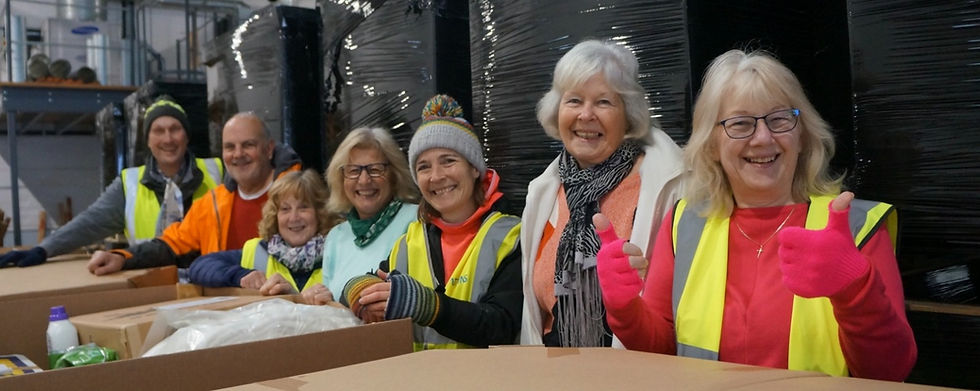
The bag makes its way to New Forest For Ukraine’s hub in Lymington. There volunteers sort everything that arrives. This is not simply a matter of putting British generosity into boxes. Items have to be checked, categorised and matched against requests from Ukrainian partners.
Graham Allen, one of the charity’s trustees, explains that the Ukrainian organisations provide lists of the things they require. Each partner is allocated a number of pallets from a shipment and a packing list is attached to a pallet box during the sorting process. Volunteers then work through the donated goods, packing individual pallets according to those requests.
Sometimes the needs are unexpected. Graham recalls that pots, pans and basic household goods were amongst the requests that surprised the British volunteers. They are not necessarily the first things somebody in Britain imagines when contemplating humanitarian assistance to a country at war. Yet people who have fled their homes frequently have to reconstruct ordinary domestic existence from nothing.
Gradually the pallets accumulate and one articulated lorry carries 52 of them. Before it can leave Lymington there is paperwork to complete, destinations to establish and recipients to identify. Then the lorry crosses Europe and enters Ukraine, where trusted local organisations assume responsibility for distribution.
The final destination might be a hospital, rehabilitation centre, school, community centre or care home. It might equally be one person. Mandy asks us to imagine an elderly Ukrainian woman living alone. Perhaps her house has been damaged, perhaps her family has left, and winter has arrived while electricity and heating are unreliable. She receives some food, toiletries, a warm blanket or clothing distributed by one of New Forest For Ukraine’s Ukrainian partners.
She will never know the person in Hampshire who originally donated those things. She will not meet the volunteer who sorted them, the person who packed the box or the driver who transported the pallet across Europe. Yet all those people are connected, even though they will probably never know one another’s names.
“To us, it is one tiny part of a shipment,” Mandy says, “but to her, it can mean that somebody, somewhere, has remembered her.” That may be the best explanation of New Forest For Ukraine: the organisation turns a collection of otherwise disconnected acts of generosity into a chain ending with somebody who needs help.
A network across Ukraine
The charity has developed a network of trusted organisations inside Ukraine. Two have played particularly important roles as distribution hubs: the Veselyi Family Charitable Foundation in Drohobych, near Lviv, and HUGS — Help Ukraine Grassroots Support — in Kharkiv. Supplies arriving in Ukraine can then cascade through networks of smaller organisations towards the communities that require them.
This arrangement reflects the geography of the country. Ukraine is enormous and humanitarian needs vary considerably from region to region. An internally displaced family living in western Ukraine may require household equipment and clothing. A community close to the fighting may have quite different priorities. A hospital has different requirements from a care home, while a mother with a newborn child has different needs from an elderly person living alone.
Amongst the organisations supported by the network is Caritas in Sokal, which helps internally displaced people and members of the local community and operates a free shop. The Andriy Kvyatkovsky Charitable Foundation in Sheptytskyi, north of Lviv, supports the local population as well as a collection of small voluntary enterprises assisting the Ukrainian war effort.
There groups of predominantly female volunteers dehydrate vegetables to create borscht mixes for soldiers, weave camouflage nets and make bags, pouches and clothing. The latter include the splendidly named “Sewing Bees of Sheptytskyi”, another example of how much of Ukraine’s wartime resilience consists not of spectacular gestures but of people repeatedly undertaking small and useful tasks.
Elsewhere, Eleon in Korosten supports sick children, low-income households and families in crisis. Give Good, near Dnipro, assists internally displaced people and members of the surrounding community, while Machok works in Kropyvnytskyi. The network is diverse because the consequences of war are themselves diverse.
Then there is Kharkiv, a city whose proximity to the Russian border has subjected it to repeated missile, drone and glide-bomb attacks throughout the full-scale war. Dreams Together operates a free shop there for local residents and internally displaced people. Suveren supports families across the region, while Little Hearts works with pregnant women and families with young children.
Another organisation, Through The War, runs a care home for elderly people and people suffering from dementia. That example is worth dwelling upon because it illustrates something easily forgotten when war is reduced to maps showing coloured arrows and moving front lines.
Dementia does not stop because there is a war. Neither do pregnancy, childhood, disability, diabetes or old age. Babies still require food, elderly people still need warmth and people with limited mobility cannot necessarily descend into underground shelters every time an air-raid siren sounds. War destroys ordinary life, and humanitarian work consists in trying, piece by piece, to put some of it back together.
The generators
Few objects demonstrate this better than generators. New Forest For Ukraine has sent hundreds of them eastwards. Once a generator reaches Ukraine, Graham explains, the partner organisation decides where it should go and carries out its own checks to ensure that the recipient genuinely needs it.
Where circumstances permit, photographs are sent back showing the handover. This is partly practical accountability because donors ought to know that expensive equipment has arrived where it was intended to go. Yet there is also a more personal ritual associated with the generators.
Every generator bought and sent from Lymington carries a message from the person who donated it. The message may say where the donor lives or contain a few words of support for whoever eventually receives the machine. Thus an object designed to produce electricity carries something else across Europe as well.
“The generator arrives with more than just practical help,” Mandy explains. “It carries a message from one community to another, reminding people in Ukraine that they have not been forgotten.” A generator may keep a family functioning during a blackout or provide electricity to a community facility when the grid fails. In practical terms it is machinery, fuel and electrical current; in human terms it represents somebody thousands of miles away having decided that the people sitting in darkness matter.
Trust
Charitable work in a war zone inevitably raises another question: how does anybody know where the aid actually goes? Graham’s answer is straightforward. The organisations with which New Forest For Ukraine works are registered with the Ukrainian authorities and complete the appropriate paperwork when receiving assistance. Each has been visited personally by one of the charity’s trustees.
“We have seen first-hand how each group operates and the care taken to make sure the aid we send goes to people that need it,” he says. Some partner organisations came through recommendations from other volunteers who could vouch for them. Once the aid has been transferred, decisions about final distribution rest with those local organisations. This necessarily involves trust, but it is informed trust built through personal relationships.
That distinction matters because a small charity cannot supervise every tin of soup from Hampshire to a Ukrainian kitchen table. Nor should people thousands of miles away pretend to understand local needs better than Ukrainians themselves. What New Forest For Ukraine can do is choose its partners carefully, visit them, maintain records and establish a chain of accountability.
Over time those institutional relationships have become personal ones. “The people behind each of the groups we support are now friends,” Graham says. That simple observation may explain as much as anything else why an emergency initiative established in early 2022 has endured.
When the headlines move on
Perhaps the greatest challenge now is not logistics but attention. In February and March 2022, Ukraine dominated the news. Europeans watched cities being attacked and millions of refugees crossing borders, while donations flowed towards Ukrainian causes with extraordinary speed. More than four years later, the psychological landscape is different.
“Yes, I think it has become harder,” Mandy says of maintaining public interest. “There is a danger that people become tired of hearing about the war, particularly when there are so many pressures here in Britain as well.”
The problem, of course, is that the news cycle and humanitarian need operate according to different clocks. A subject can become less prominent on television without becoming less important to the people experiencing it. “The reality for the people of Ukraine has not changed,” Mandy says. “The war has not become less difficult for them simply because it appears less often on our television screens.”
People continue to experience damaged infrastructure, displacement, power cuts and uncertainty. New Forest for Ukraine therefore spends part of its time simply reminding people that these circumstances continue. It organises events, attends those organised by others and gives talks and presentations.
The organisation does not insist that helping requires grand gestures. Ten or twenty pounds can contribute towards a generator or the cost of moving a lorry across Europe. Somebody can knit something warm. A child can fill a Christmas tote bag. Somebody else can donate a camping stove, put five pounds into a collection tin or bring a few tins of food.
There are knitting groups scattered around the country and three separate “bandage brigades” producing bandages. Businesses host collection boxes, groups hold coffee mornings and fundraising events, while people living hundreds of miles from the New Forest have found the organisation and become regular supporters.
The Soup and Soap campaign, appeals for camping stoves and generators and collections of warm clothing all rely upon the same principle: define a concrete need and allow lots of people to contribute a manageable part of the solution. Small acts accumulate and, eventually, they fill 52 pallets.
Resilience
When asked what has surprised her most over these years, Mandy points first to the persistence of the British public. Volunteers who joined years ago are still there. People continue donating goods and money and asking what else they can do. What began as an emotional response to the shocking events of early 2022 has, for some, become part of ordinary life.
Her answer about Ukrainians is equally revealing. “What has surprised me most is their resilience and determination,” she says. The people running partner organisations may themselves be living through exceptionally difficult circumstances, yet they remain occupied with finding assistance for other people.
This is perhaps where the relationship ceases to resemble the conventional image of charity, in which a donor gives and a passive recipient receives. The Ukrainian partners are doing much of the difficult work: identifying needs, organising distribution, checking recipients and maintaining communities under wartime conditions.
New Forest For Ukraine supplies resources and logistics, while Ukrainians supply knowledge, organisation and their own formidable networks of volunteers. Between them sits a relationship that neither side expected to build.
“I think that is probably the biggest surprise of all,” Mandy says, “how something that started as a response to an immediate crisis has developed into such a strong community-to-community relationship.” Four and a half years after those first chaotic weeks in half a coffee shop, this is no longer merely a system for moving goods from one country to another. It is a relationship between communities.
What can I do?
There is an obvious question for anybody who reaches the end of this story: what can I actually do? Mandy’s answer is refreshingly uncomplicated: “Whatever you can do, do it.”
Money is particularly useful because it allows New Forest For Ukraine to purchase items that cannot readily be obtained through donations and helps pay the considerable cost of transporting humanitarian aid across Europe. The organisation also issues appeals for particular things: generators, camping stoves, power banks, food, toiletries, pet supplies, warm clothing, medical supplies and mobility equipment have all been requested at different times.
Specificity matters. The charity does not want people buying objects that cannot be used or transported. The objective is not to collect as much stuff as possible but to send what Ukrainians actually need.
Time is valuable too. Every lorry leaving Lymington represents hours of sorting, checking, packing, pallet-building, collection, paperwork, fundraising and organisation. Even somebody unable to volunteer regularly can contribute occasionally.
Then there is the simplest contribution of all: telling somebody else. “Share our appeals, come along to one of our events, tell a friend, or invite us to give a presentation or talk to your group,” Mandy says. After four and a half years, keeping Ukraine in people’s minds has itself become a form of humanitarian work.
There is a temptation to describe organisations such as New Forest For Ukraine as heroic. Perhaps that misses the point. Heroism suggests extraordinary people doing extraordinary things, whereas the real significance of this organisation lies in ordinary people deciding repeatedly to do useful things. Someone brings a few tins of food into a collection point, somebody else knits a blanket, another person repairs a generator and a volunteer checks a packing list. Fifty-two pallets gradually appear inside a warehouse in Lymington and, eventually, a lorry leaves.
Thousands of miles away, Ukrainians unload it. The contents divide and travel onwards, perhaps towards Drohobych, Sheptytskyi, Kharkiv, Korosten or another community altogether. Eventually the chain ends with an individual human being. Perhaps it is the elderly woman Mandy imagined, opening a box containing food, toiletries and something warm. Perhaps it is a mother with a small child. Perhaps it is a care home trying to look after somebody with dementia during another blackout. Perhaps a generator starts and the lights come back on.
The donor and recipient will almost certainly never meet, but nevertheless they are connected. New Forest For Ukraine began in half a coffee shop because a few people in Hampshire watched something terrible happening in another European country and wanted to help. More than four years and 950 tonnes of humanitarian aid later, they are still doing it.
“The news cycle may move on,” Mandy says, “but the need hasn’t.” That sentence is probably the most important one in this story, because the continuation of humanitarian need long after international attention has begun to wander is precisely why organisations such as New Forest For Ukraine remain important.
Ukraine has no shortage of speeches made on its behalf. What it also needs are generators, bandages, blankets, pots and pans, soap, food, medical equipment and people willing to put all these things onto pallets and drive them across Europe. The road from the New Forest to Ukraine is a long one, and the volunteers of New Forest For Ukraine keep driving down it.
---
Readers wishing to support New Forest For Ukraine can find the organisation at newforestforukraine.org. Financial donations can be made through its donation page, including one-off contributions, regular monthly donations and sponsorship of individual pallets or entire lorry shipments. The charity also accepts requested goods through its network of drop-off points across the New Forest and surrounding area, while those wishing to contribute their time can volunteer to sort and pack aid, collect donations, help with fundraising and events or assist with administration and communications. Current appeals and the goods most urgently required in Ukraine are published on the charity’s website, so prospective donors are encouraged to check what is needed before purchasing or delivering items.