Forging Ukraine: Fire, Steel and Friendship in Kharkiv

By Matthew Parish
Thursday 1 October 2026
There is something almost anachronistic about a blacksmith’s forge in a twenty-first-century war. Ukraine’s battlefields are crowded with technologies that would have appeared fantastical even a decade ago: fibre-optic drones, electronic warfare systems, thermal cameras, satellite communications, precision missiles and increasingly sophisticated autonomous weapons. Yet in a workshop in Kharkiv, not very far from the front, one of the things Ukrainian soldiers need is being manufactured using a technology that has barely changed in thousands of years.
Fire heats the steel. A hammer strikes it. A blacksmith bends and shapes the glowing metal upon an anvil. The finished object is neither glamorous nor technologically sophisticated. It is a large steel staple, sometimes called a “log dog”, and its purpose is to hold together the timbers from which soldiers construct trenches, bunkers and defensive positions.
“It’s a bit like the glue of the front, really,” says Rhod, the Welsh blacksmith behind Forging Ukraine, when I visit his workshop in Kharkiv.
That description captures rather well the peculiar importance of what is being made here. Wars may change beyond recognition, but soldiers still require protection from the things being fired at them. A drone costing thousands of dollars may identify a position using technologies developed in the twenty-first century, but the people beneath it may survive because they are sheltering underneath logs held together by pieces of bent steel.
Rhod comes originally from South Wales. His relationship with Ukraine began long before the full-scale Russian invasion and, as with many foreigners who have found themselves unexpectedly entwined with this country, his journey here was not entirely planned.
“I first came to Ukraine about ten years ago, in 2015, when I was doing a degree in blacksmithing,” he recalls. “They sent me out to a blacksmithing festival in Ukraine, and I just absolutely loved the place and loved the country, so I came back again year after year.”
There was also a family connection. Rhod’s grandfather was Ukrainian, and Ukraine had been an important part of his family’s identity while he was growing up in Wales. The end of the Cold War suddenly transformed something that had existed largely as family history into a living connection.
“When I was a kid, the Berlin Wall came down, so my grandfather was able to go back to Ukraine and family was able to come visit us for the first time,” he says. His own journey to the blacksmithing festival in 2015 subsequently allowed him to meet members of his extended Ukrainian family for the first time.
By the beginning of Russia’s full-scale invasion in February 2022, however, Rhod’s professional life was far removed from Ukraine’s battlefields. He was working for Britain’s National Health Service as a hospital porter. He began volunteering for a charity carrying out humanitarian work in eastern Ukraine and decided to take a sabbatical from the NHS so that he could come here and help.
Then the plan collapsed. The charity he had intended to work with fell through and Rhod found himself in the unusual position of having taken a year away from his employment, travelled to a country at war and discovered that the organisation for which he had intended to volunteer was no longer an option.
He could have gone home. Instead, he came to Kharkiv and started looking for something useful to do.
The glue of the front
Blacksmiths tend to know other blacksmiths, and Rhod already belonged to networks of people practising the craft in Britain and Ukraine. Through them and through social media, he had noticed that blacksmiths were producing large quantities of staples for military fortifications. He knew immediately that this was something he could do.
“I knew they existed, and I knew I had the ability to make them,” he says. “So it just went from there, really.”
Thus began Forging Ukraine.
The staple itself could hardly be simpler. Reinforcing bar is heated, bent and forged so that its ends become enormous nails. The finished piece can then be hammered across two adjacent logs, binding them together. Multiply this elementary object hundreds or thousands of times and it becomes part of the physical infrastructure of a defensive line.
There is an intriguing contrast between the simplicity of Rhod’s work and the extraordinary technological sophistication of the war taking place around him. The Ukrainian battlefield has become a laboratory for some of the most rapidly developing military technologies in the world, particularly drones and electronic warfare. Nevertheless, the requirement to place something solid between a human being and an explosion has not disappeared.
“I think there’s always going to be a mixture of the very old and the very new in war,” Rhod observes. “Modern drones with autonomous systems in them, and then there’s machine guns that are 100 years old.”
Blacksmithing belongs at the extreme end of this historical spectrum. Humans have been heating and hammering metal for millennia, and the fundamental principles remain recognisable. Indeed, that primitiveness can itself be an advantage in wartime.
“The elemental nature of it has never changed in 5,000 years,” Rhod says. “It’s useful when you don’t have electricity, to work in the old way.”
A forge does not need a software update. An anvil cannot be jammed by electronic warfare. A hammer does not lose its satellite connection.
Three hundred a day
Forging Ukraine can produce roughly 300 staples in a day, although output varies considerably because Rhod is not running a conventional factory. Much of his workforce consists of volunteers who have to be taught the craft, often from scratch.
“If you’ve held a hammer, if you’ve ever used one, you’ve got a good chance of being able to, within a day or two days, produce something reasonable,” he explains. For complete novices it may take longer, but Rhod is convinced that virtually anybody can learn: “I think anyone’s capable of it, but you’ve got to have your heart really in it.”
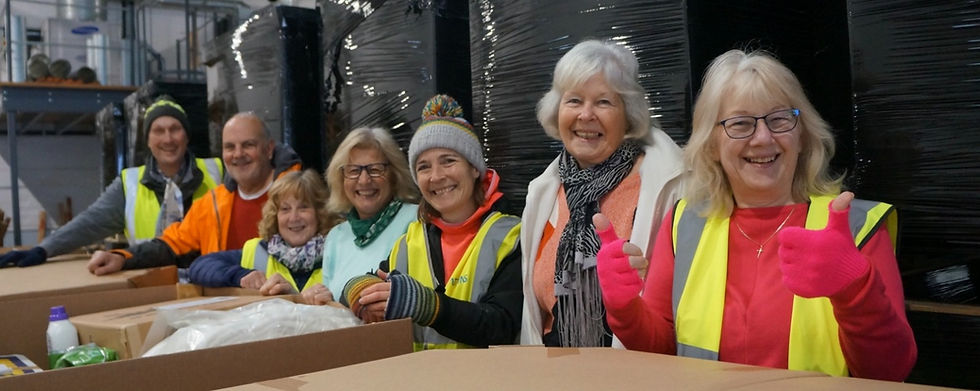
That observation explains something important about the workshop. Forging Ukraine does not merely manufacture pieces of steel. It provides foreigners who want to help Ukraine with a particularly direct form of volunteering. There is no abstraction between the volunteer’s labour and its ultimate purpose. A person arrives, learns to heat and hammer steel, produces an object with his or her own hands and that object may shortly afterwards be incorporated into a Ukrainian defensive position.
The volunteers form part of the substantial international community that has developed in Ukraine since the full-scale invasion. Their backgrounds and nationalities vary, but Rhod sees a common motivation amongst them: they are people who would rather participate than watch events unfold from afar.
There is little bureaucracy involved in distributing what they make. Kharkiv is sufficiently close to active defensive lines that the journey from forge to fortification can be remarkably short.
“We do post them sometimes, or it’s through a volunteer network,” Rhod explains. “But a lot of it is just guys straight from position or returning to position, who just pick it up, you know, straight from us, just soldiers.”
There is something characteristically Ukrainian about this informal logistical chain. A soldier needs something. A volunteer makes it. Somebody drives it where it needs to go. Problems that in other countries might acquire committees, procurement procedures and several layers of paperwork are sometimes resolved in wartime Ukraine through telephone calls, personal relationships and the boot of a car.
“It’s not — it doesn’t go through logistics,” Rhod says. “It’s just straight from us to the guys who are going to use it.”
Living beneath the sirens
Kharkiv is not an easy city in which to run any enterprise, much less one involving furnaces, heavy steel and a constantly changing collection of inexperienced volunteers. Russian missiles, drones and glide bombs remain facts of everyday existence, and explosions are familiar sounds.
Yet Forging Ukraine has so far been fortunate. Rhod says that no strike has directly interrupted the workshop’s operations, although munitions have landed uncomfortably close. His description of this is delivered with the matter-of-factness familiar to anyone who has spent substantial time in Ukraine’s eastern cities.
“You hear the air-raid siren going off 20 times a day,” he says. “It just becomes background noise, essentially.”
That may be one of the strangest psychological transformations produced by prolonged war. A sound specifically designed to communicate mortal danger gradually becomes part of the acoustic landscape. People continue conversations, drink coffee, repair cars, answer emails and, in Rhod’s case, hammer glowing pieces of reinforcing bar into enormous nails.
Nevertheless, something more profound has changed in him since his arrival. When Rhod first came to wartime Ukraine, his motivation was broad and idealistic. He describes it as a kind of “save Ukraine” impulse: an understandable desire to help a country he cared about without necessarily understanding much about the granular realities of the conflict.
Living here changed that.
“Now I do what I do because I’m friends with those guys,” he says of the Ukrainians with whom he works and for whom the workshop produces its equipment. “And I can’t let those guys down.”
This may be the most important thing Rhod says during our conversation. Grand political causes motivate people from afar, but friendship motivates them from close up. “Ukraine” can be an abstraction when viewed from Britain, France, Canada or the United States. After months or years spent here, Ukraine becomes particular people: the soldier who collects staples from the workshop, the volunteer standing beside you at the forge and the friend who returns to a position near the front.
“We’re great friends, all of us,” Rhod says.
Roses from war
Not everything emerging from the forge is destined for a trench. Rhod also makes what he calls “Forever Roses”: flowers fashioned from steel. Some of the material he and his colleagues transform has an even more direct connection with the war. They have made rose heads from parts of spent military objects, turning material associated with destruction into decorative objects.
The symbolism is deliberate.
“It’s just a chance to make something that looks nice in a situation that is not so much,” Rhod explains. The transformation of military debris is particularly meaningful to him: “It’s just a symbol of turning something that’s designed to kill us into something that’s kind of beautiful.”
Blacksmithing has always occupied a peculiar position between utility and art. The same fire, hammer and anvil can make a nail, a horseshoe, a gate or a sculpture. At Forging Ukraine they can make objects for trenches in the morning and roses afterwards. The difference lies principally in what the blacksmith decides the hot metal ought to become.
There is something appealingly defiant about turning the detritus of war into flowers. Russia sends metal towards Ukraine for one purpose; Ukrainians and their friends occasionally find ways of giving it another.

What comes afterwards
When asked what Forging Ukraine currently needs, Rhod’s answer is admirably concise. Does it need steel, tools, money, skilled volunteers, transport or simply people prepared to spend hours swinging hammers?
“All of the above,” he replies, laughing. “All of the above.”
The longer-term question is more complicated. Wars eventually end, although nobody standing in Kharkiv today can sensibly say precisely when or under what circumstances this one will. Even after active hostilities cease, Ukraine will remain a country with formidable defence requirements and an enormous reconstruction task.
Rhod therefore expects that his forge will still have work to do. Defensive construction is unlikely to disappear immediately, whatever settlement ultimately emerges, and the skills and networks accumulated during the war may prove useful in rebuilding afterwards.
But his ambition for peace is revealingly modest. He would like to continue blacksmithing in Ukraine without everything he makes being determined by military necessity.
“I’d like to — I don’t know — just make something nice here,” he says. “Make some art or make some sculptures, you know, in peace. That would be good.”
Perhaps that is the natural conclusion to the story of Forging Ukraine. In wartime, the forge produces what the circumstances demand: steel staples hammered by hand, carried directly to soldiers and driven into the timbers above their heads. It is difficult to imagine a more elementary technology existing alongside the drones, algorithms and electronic systems that increasingly define modern warfare.
Yet the purpose of the forge is ultimately not war. Like so much of Ukraine’s immense volunteer movement, it exists because ordinary people have looked at an extraordinary situation and asked themselves what useful thing they know how to do. Rhod knows how to work steel, and so that is what he does.
One day, one hopes, the last urgently needed bundle of trench staples will leave Forging Ukraine. The furnace will remain hot, the hammers will still fall and the ancient business of turning one shape of metal into another will continue. But perhaps the steel on Rhod’s anvil will become roses, gates and sculptures rather than the glue holding together the front.
After thousands of years of blacksmithing, that would hardly represent a technological revolution. In Kharkiv, however, it would mean something considerably more important: peace.
---
Supporting Forging Ukraine. Readers who would like to support Rhod and the volunteers at Forging Ukraine can contribute through the project’s Forging Ukraine donation page. Donations are used to help purchase the steel, tools, gas and other consumable materials required to manufacture trench staples, as well as to assist with transporting the finished equipment to those who need it. Forging Ukraine also maintains an online presence under the name @forgingukraine, where readers can see the forge at work and examples of the staples being produced for Ukrainian defensive positions. The project’s handmade “Forever Roses”, forged from Ukrainian steel, can also be seen through HUGS Ukraine’s Forever Roses page. As Rhod told the Lviv Herald when asked whether the forge most needed steel, tools, money, transport, skilled volunteers or simply more people prepared to swing a hammer: “All of the above.” (buymeacoffee.com)