Dreams Together: The Little Humanitarian Hub That Grew from a Kharkiv Garden

By Matthew Parish
Wednesday 30 September 2026
There are two different versions of humanitarian assistance in wartime Ukraine. The first is the institutional version: international organisations, white vehicles, warehouses, project managers, budgets, grant applications, monitoring procedures and reports. All of these things have their place, and Ukraine could scarcely have endured the consequences of the full-scale Russian invasion without the enormous international humanitarian effort that followed February 2022.
Then there is the other version. It begins when a woman notices that the elderly people living on her street are frightened, cannot easily reach a supermarket and do not know where their next meal is coming from. It develops when somebody finds a source of hot food, puts the word around the neighbourhood and starts distributing it. Then displaced people arrive with no winter clothes, neighbours bring bags of unwanted garments, somebody puts a notice on a local internet group and, before anybody quite realises what has happened, a humanitarian organisation has grown underneath a tree outside a private house.
That is approximately how Dream Together, a small humanitarian organisation in Kharkiv run by Yuliya, came into existence.
Its story is instructive because it tells us something about the way Ukraine survived 2022 and continues to survive in 2026. The country’s resilience has depended not merely upon institutions but upon countless people who looked around them during an emergency and decided that somebody had to do something. Frequently there was no budget, no organisation and no plan. There was simply a problem and a person willing to address it.
Yuliya was one of those people.
From a Basement to a Humanitarian Hub
When Russia began its full-scale invasion, Yuliya did not leave Kharkiv. She remained with her family and, like countless Kharkiv residents, spent periods living in a basement while Russian forces attempted to seize or destroy the city.
She remembers being frightened. She also remembers looking at the people around her and realising that some of them were even more frightened and considerably less able to look after themselves.
Many were pensioners. Some could not easily get to a supermarket. Others did not know where humanitarian assistance was being distributed or how to reach it. So Yuliya began helping people on her own street and neighbouring streets.
By May 2022 she was cooperating with a charitable foundation that supplied hot meals. At first these were distributed locally, then across Kharkiv’s Kyivskyi district. That arrangement continued until August, when the foundation closed. Yuliya and those working with her then moved to distributing food parcels supplied by volunteers and larger Kharkiv charitable organisations.
Meanwhile another problem had appeared. Large numbers of internally displaced people had arrived in the Kharkiv region. Winter was approaching and some had virtually nothing to wear.
Yuliya posted appeals in Kharkiv groups asking residents for clothes. What arrived was a thoroughly Ukrainian wartime assortment: possessions from local residents, clothes recovered from damaged homes and belongings left behind by people who had gone abroad and did not expect to return. Volunteers sorted everything and took usable items to displaced people.
When the immediate request had been satisfied, clothes remained. So the volunteers put them outside the house, beneath a tree, announced that clothes were available and invited people to come and take what they needed.
Something unexpected happened. Some people came to collect clothes; others arrived bringing more.
By November 2022 an improvised clothes distribution point had become a permanent humanitarian hub. People brought clothing themselves or contacted Yuliya and asked whether somebody could collect it. The operation grew organically, without grants or a grand strategy.
Later, as relationships developed with foreign humanitarian organisations, a formal organisation became necessary. Yuliya registered Dream Together and the informal neighbourhood initiative acquired a legal identity.
Yet its underlying philosophy remained much the same: obtain whatever useful assistance is available and put it into the hands of people who actually need it.
Today those people include internally displaced Ukrainians, low-income families, pensioners, children, large families and people whose homes or livelihoods have been damaged or destroyed by the war.
Dream Together has accumulated a remarkable community around it. Its online chat has approximately 5,200 members. Yuliya says she no longer needs to find people requiring assistance.
They find her.
The Geography of Need
Dream Together has also carried aid beyond Kharkiv itself. Its volunteers have worked across Kharkiv Oblast, including towards Lyptsi, Ruski Tyshky, Cherkaski Tyshky, Chuhuiv and Izium, as well as in the Bohodukhiv direction.
The geography of humanitarian work has changed with the geography of the war.
Some of those journeys have now become too dangerous. FPV drones have transformed roads that were once difficult into roads upon which an ordinary humanitarian vehicle can become a target with little or no warning. Yuliya no longer considers it responsible to take volunteers into some of the areas she previously served.
She remembers one distribution near Ruska Lozova and Cherkaski Tyshky when shelling began after they arrived. The volunteers had to seek a safer location. Eventually Dream Together stopped travelling there altogether.
The organisation now concentrates more upon the directions towards Merefa and Nova Vodolaha, where the roads remain comparatively safer. The need has not disappeared merely because an area is farther from the immediate front. Villages contain displaced people and pensioners who cannot readily travel into Kharkiv, while organised humanitarian assistance may be scarce or absent.
In such places, assistance exists only when somebody is prepared to put it in a vehicle and drive it there.
What People Need in 2026
One of the most interesting aspects of Yuliya’s experience is the way humanitarian demand has changed.
In 2022, people needed almost everything. Displaced families would accept clothes in virtually any reasonable condition because they had arrived with little or nothing. Children had grown out of their shoes. Winter clothes were desperately required. People who had expected an ordinary change from winter to spring wardrobes suddenly found themselves living through an invasion instead.
Four years later the problem is different.
Many displaced people who have remained in Kharkiv have gradually assembled basic possessions. Their accommodation is often small, so accumulating unnecessary clothes is itself impractical. People increasingly take only what they genuinely require.
Consumable necessities are another matter. Food disappears when it is eaten; soap disappears when it is used. These things have to be replaced continuously.
Hence Yuliya says the greatest need in 2026 is no longer clothing. It is food and hygiene products.
This is where foreign assistance has become particularly important. Dream Together has developed relationships with organisations abroad that send humanitarian consignments to Kharkiv. Yuliya distinguishes sharply between donated clothing collected casually from wardrobes and assistance assembled specifically with Ukrainian recipients in mind. Foreign consignments, she says, frequently contain items selected because somebody in Ukraine can actually use them.
The distinction matters. Humanitarian assistance should not be a convenient means of disposing of things nobody wants. The object is to send useful things to people who need them.
Food is now particularly difficult to obtain in sufficient quantities. At the same time donor fatigue is an increasingly serious concern. In 2022 Ukraine attracted an extraordinary wave of international generosity. By 2026, Yuliya observes, resources everywhere have been stretched.
The war has lasted for years. Donors are not inexhaustible, nor are the people who support those donors. Yet the strange cruelty of a prolonged war is that humanitarian need does not decline at the same rate as international attention.
In some respects, the longer the war continues, the greater the accumulated need becomes.
An Interview with Yuliya of Dream Together
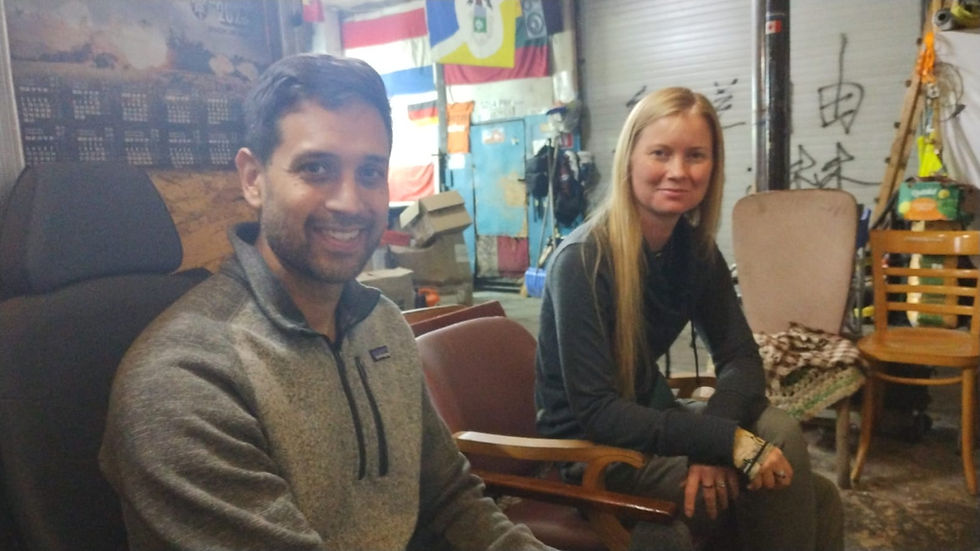
The following interview was conducted by Matthew Parish in Kharkiv in Russian. It has been translated into English and lightly edited for clarity, concision and readability while preserving the substance of Yuliya’s answers.
Matthew Parish: How did you first become involved in humanitarian work?
Yuliya: In March 2022, after the war began, I started doing humanitarian work because I had not left Kharkiv. I stayed here with my family. It was frightening and we lived in a basement, but some of the people around us were even more frightened.
There were pensioners and people who were not really able to go to a supermarket, buy what they needed or find humanitarian assistance that would allow them to survive. So I began by helping people who lived nearby, on our street and neighbouring streets.
By about May I began cooperating with a charitable foundation that provided hot food. Initially we distributed it to people living on the nearby streets and later throughout our Kyivskyi district. We continued distributing hot meals until August 2022.
When that foundation closed, we began distributing humanitarian food parcels provided by volunteers and some of the larger foundations in Kharkiv.
Matthew Parish: How did that develop into what is now Dream Together?
Yuliya: At the same time, we received another request. Many displaced people had arrived and winter was approaching. They had nothing suitable to wear and needed warm clothes.
I posted announcements in different Kharkiv groups asking people to donate clothes. We received ordinary clothes from local residents, from damaged apartments and from people who had gone abroad and did not intend to return. They were in different conditions, so we sorted them and took them to the people who needed them.
After we had met that particular need, we still had clothes left. We started distributing the remainder outside our house, underneath this tree. We would announce that clothes were available and tell people to come and take them.
Some people came and took clothes, but other people came and brought more clothes. So in November 2022 we effectively created a clothing hub here.
Later, probably in 2024, I became acquainted with foreign organisations that began supplying humanitarian assistance to us. To cooperate with those organisations we needed a formally registered organisation, so I registered Dream Together. That is how it appeared.
Matthew Parish: Whom do you help today?
Yuliya: We help internally displaced people, people affected by the war, low-income people, children, large families and pensioners.
We have our own chat with about 5,000 or 5,200 people in it. So I do not really find the people anymore. They find me. People who need help approach us and receive it.
Matthew Parish: How have people’s needs changed since 2022?
Yuliya: In spring 2022 people needed everything. They would take almost any clothes, in almost any condition, because they had absolutely nothing. Either they had lost everything or what they had was wearing out.
Nobody had prepared for war. Children grew out of their shoes and clothes. People needed children’s clothes, adult clothes, warm clothes, lighter clothes and larger sizes.
Today it is completely different. Internally displaced people who arrived in Kharkiv in 2022 have been here for a long time. They have acquired some possessions. They often live in small homes, so they cannot simply accumulate things and they take only what they need.
The greatest need today is food. Clothing needs can often be met, but food and hygiene products are consumed and constantly have to be replaced. Those are always needed.
Matthew Parish: You have delivered humanitarian assistance outside Kharkiv as well. Where have you worked?
Yuliya: We have delivered humanitarian assistance throughout Kharkiv Oblast. We covered the direction towards Lyptsi, Tyshky, Ruski Tyshky and Cherkaski Tyshky. We also worked in the Chuhuiv direction as far as Izium and in the Bohodukhiv direction.
Today it is very frightening to travel to some of those places. We have stopped going there this year because FPV drones are flying there and it is simply too dangerous. I do not want to endanger people’s lives.
Now I distribute humanitarian assistance more in the directions of Merefa and Nova Vodolaha. Those roads are safer and FPV drones do not yet reach them. People in the villages there still need assistance. There are many internally displaced people and pensioners who cannot travel to the city.
Unfortunately there may be no humanitarian assistance in those areas. They receive it only from people, foundations or hubs that are able to bring it to them.
Matthew Parish: Was there a particular journey when you realised that some routes had become too dangerous?
Yuliya: Yes. Last year we travelled towards Ruska Lozova and Cherkaski Tyshky. It was already very loud there. We arrived for a distribution and shelling began, so we had to move somewhere safer.
After that experience we eventually stopped going there.
Matthew Parish: How important is assistance from foreign partners?
Yuliya: It is very important. Some of the clothes donated locally are simply things people have cleared out of their wardrobes. They may not be in particularly good condition. Ideally some would need washing, ironing and preparing before distribution, but we do not have the capacity to do all that.
The assistance from foreign partners is often on a completely different level. People are not simply giving away something they no longer want. They are giving things that Ukrainians actually need and can wear and enjoy.
The same applies to food. Food assistance is very important now and increasingly difficult to obtain. People understand that there may come a point when they do not have enough to eat. So assistance from foreign partners is extremely important and necessary.
Matthew Parish: What happens when a humanitarian shipment arrives in Kharkiv?
Yuliya: We receive it here at the hub. It may arrive on a pallet or be sent through Nova Poshta. We then divide the humanitarian assistance between different locations.
Depending upon what has arrived, we plan a distribution, make an announcement and identify the category of people for whom that particular assistance is intended. They then come and receive it.
Matthew Parish: People abroad may imagine humanitarian aid as something conducted by enormous international organisations with warehouses and very large budgets. How does Dream Together compare with that image?
Yuliya: There are large foundations in Kharkiv that receive big lorries from Europe and distribute the assistance themselves. I cannot really speak about them because I do not know the details of how they work.
Dream Together is different. It began at my house, in a private residential area, using our own resources, and it continues to work using our own resources.
We do not receive financial subsidies. We do not write grant applications. We do not receive funding. We distribute what people bring to us and what humanitarian assistance we are able to obtain.
That is how our hub functions.
Matthew Parish: Is there one family you have helped whose story particularly remains with you?
Yuliya: Last year there was very heavy shelling and a missile hit an apartment building in Saltivka, in northern Saltivka.
There was a grandmother and a young family with a child living in an apartment there. The grandmother and her grandchild had been sitting in the room that was struck. Two minutes before the strike, the child said she wanted some water, so they went into another room.
When the missile hit, the room they had just left completely disappeared.
The son-in-law had been standing in the doorway. He survived by a miracle because the blast threw him into the corridor. The kitchen was completely destroyed. Essentially the apartment ceased to exist.
Within a minute, the family had happened to move into the place that allowed them to survive. Their cat did not survive and their possessions were destroyed when part of the building collapsed.
The family came to us for help and we have continued helping them for more than a year. The younger members of the family have now moved to Kyiv, but the grandmother stayed here and periodically comes back to us.
Matthew Parish: After so many years of war, do you see fatigue among Ukrainian volunteers and foreign donors?
Yuliya: We have never really looked for money. We look for food and clothes.
Food is very difficult now because there is very little available for humanitarian distribution. Clothes are easier to find. But yes, everything has become more difficult.
This is now the fourth or fifth year of the war and nobody’s resources are infinite. Foreign donors do not have unlimited resources and neither do the people who support those foreign donors. There is an entire chain of assistance and at some point parts of that chain can become exhausted.
Yet the assistance is still needed. In fact it is needed particularly badly now, because the longer this continues the more difficult everything becomes.
There was enormous assistance in 2022 because the war had just begun. By 2026 it is decreasing and everybody’s resources are being consumed.
Matthew Parish: What do foreigners most often misunderstand about everyday life and humanitarian needs in Kharkiv?
Yuliya: I think that is individual. I cannot say what foreigners understand or do not understand because everybody has a different mentality.
What I can say is that foreigners have supported Ukraine enormously. Every form of assistance matters and is important. I am personally extremely grateful to everybody who helps us.
I receive that assistance with gratitude and try to make sure it reaches the categories of people who genuinely need it.
Matthew Parish: What gives you the strength to continue after so many years?
Yuliya: Probably the belief that what I am doing is right, and the belief that one day the war will end.
I want to help people. Sometimes different kinds of people come here. Some people come simply because something is free. Some come because they have heard about us and want to see what is available. But then there are people who genuinely need help.
When you give something to somebody who truly needs it and you feel their response, you know that the assistance has reached the right person. That gives you the strength to continue.
Burnout is always present. When you feel that assistance is not being distributed effectively, you can become exhausted. But when somebody arrives who really needs something and you are able to help them, the energy comes back.
Matthew Parish: Finally, if Lviv Herald readers outside Ukraine wanted to help Dream Together, what do you need most?
Yuliya: The most useful assistance is food.
We also need large-sized shoes and seasonal clothes in larger sizes. Large men’s clothing is particularly useful as well.
But above everything else, what we need most today is food.
The Humanitarianism of the Ordinary
There is something almost misleading about calling Dream Together an organisation. The word suggests offices, employees and administrative machinery. What Yuliya describes is closer to a community that gradually organised itself around a private home because war had created needs that somebody had to meet.
This may also explain why small organisations of this sort matter disproportionately. Their organisers know their communities. They encounter the same people repeatedly. They learn who has lost a home, who has moved away, who cannot travel into Kharkiv and who really needs the contents of the next humanitarian pallet.
There are obvious limitations to this model. A woman working from her home cannot replace an international humanitarian system, nor should she be expected to. Small volunteer organisations may lack the purchasing power, logistics networks and financial resources of the international agencies.
Yet the relationship works in the other direction as well. A warehouse full of humanitarian assistance is of little use unless somebody knows where it should go. International donors can supply the resources; local networks provide the final kilometres of knowledge, trust and distribution.
Dream Together occupies precisely that space.
Its history also captures something essential about Kharkiv. This is a city that was expected
by many outsiders to fall in the opening days of the invasion. Instead its residents fought, improvised, endured and organised themselves. Some joined the Armed Forces. Some repaired vehicles, evacuated civilians or delivered medicine. Others made soup, sorted second-hand clothes and checked whether the pensioner down the street had anything to eat.
Heroism is an overused word in wartime. Most people engaged in this work would probably reject it. What they do is less theatrical and more useful.
They see something that needs doing, and they do it.
Four years later, Yuliya is still doing it. The clothes are still being sorted, the messages are still arriving, pallets are still being unloaded and humanitarian supplies are still travelling from foreign donors through Kharkiv to people who need them.
But the resources are thinner now, while the war continues. That is perhaps the most important part of her account for readers outside Ukraine. The great emergency of February 2022 has not ended. It has merely become ordinary.
And ordinary emergencies are the easiest ones for the rest of the world to forget.