Budynok Slovo: The House Where Ukraine’s Renaissance Was Murdered

By Matthew Parish
Wednesday 30 September 2026
There is an apartment building in Kharkiv that ought to be counted amongst the most important literary monuments in Europe. It has none of the architectural grandeur of an Oxford college, a Parisian palace or one of Vienna’s imperial buildings, and at first sight there is little about it to detain the casual visitor. Yet within its walls once lived an extraordinary concentration of writers, poets, playwrights, directors, artists and intellectuals who, for a brief and brilliant period, represented something close to the intellectual capital of Ukrainian culture.
The building is called Budynok Slovo, the House of the Word. Its history is inseparable from one of the greatest crimes committed by the Soviet Union against Ukrainian culture: the destruction of the generation subsequently known as the Executed Renaissance. The story is especially disturbing because Budynok Slovo did not begin as a prison, a place of surveillance or a monument to terror; it began as an optimistic experiment in giving writers somewhere decent to live and work.
Kharkiv, capital of a cultural revolution
To understand Budynok Slovo, one must first forget something about Ukraine that now appears natural: Kyiv was not always the capital of Soviet Ukraine. From 1919 until 1934 Kharkiv performed that role and, during the 1920s, the city became one of the most exciting cultural centres in Eastern Europe. Writers, artists and intellectuals poured into a rapidly expanding metropolis in which revolutionary politics, industrialisation and extraordinary artistic experimentation existed side by side.
Ukrainian literature was undergoing an astonishing period of development. Futurism, modernism, experimental theatre, poetry and new forms of prose flourished alongside the constructivist architecture for which interwar Kharkiv remains famous. The Soviet policy of Ukrainisation, whatever cynical calculations lay behind it and however catastrophically it would later be reversed, temporarily gave the Ukrainian language and Ukrainian culture substantially greater institutional space.
There was nevertheless a mundane problem: Kharkiv did not have enough housing. Writers arriving in the new capital often found themselves living in offices, cramped rooms and improvised accommodation, and the conditions were scarcely conducive to the creation of a national literature. During the middle of the 1920s, Ukrainian writers therefore established a cooperative to construct a proper residential building in which members of their profession could live and work.
The immensely popular humourist Ostap Vyshnia became chairman of the cooperative, while the architect Mytrofan Dashkevych designed the building. Construction began during the latter half of the decade, and by around 1930 writers and their families were moving into their new apartments. Seen from above, the building resembled the Cyrillic letter С, the first letter of слово, meaning “word”, and hence arose one of the most famous addresses in Ukrainian literary history.
A palace for writers
For intellectuals accustomed to cramped rooms and chronic shortages, Budynok Slovo must initially have seemed luxurious. Its more than sixty apartments offered comparatively spacious rooms, large windows, high ceilings and sufficient space for libraries and studies, while writers who had previously worked wherever they could now possessed places in which intellectual life and domestic life might coexist.
More important than the amenities was the extraordinary community that gathered inside. Mykola Khvylovyi lived there, as did Pavlo Tychyna, Ostap Vyshnia, Mykola Kulish, Mykhailo Semenko, Maik Yohansen, Ivan Bahrianyi, Yurii Yanovskyi and numerous other writers, editors and artists associated with the Ukrainian cultural flowering of the period. The revolutionary theatre director Les Kurbas belonged to the same extraordinary Kharkiv cultural milieu.
It is difficult to devise a precise Western European comparison. Literary communities ordinarily gather around universities, publishing houses, cafés or particular neighbourhoods, whereas in Kharkiv a substantial part of a national cultural renaissance was concentrated within a single apartment building. People borrowed books, exchanged manuscripts, quarrelled about politics, discussed literary movements and inevitably became involved in one another’s private lives.
Foreign intellectuals also travelled through the cultural world of Soviet Kharkiv. International writers attended conferences and encountered the remarkable Ukrainian literary scene that had developed in the Soviet republic’s capital, while the Soviet authorities were initially happy to display this apparent cultural vitality to sympathetic foreign visitors. The Ukrainians living in Budynok Slovo could therefore reasonably have imagined themselves participants in a European cultural movement rather than inhabitants of an intellectual province controlled from Moscow.
The cruel irony was that precisely the feature that made the building so attractive to writers also made it useful to the security services. An extraordinary proportion of Ukraine’s leading literary figures had conveniently assembled themselves under one roof.
From writers’ house to surveillance system
Stalinist terror did not descend upon Budynok Slovo in a single moment. The transformation was gradual, and that was part of what made it so psychologically destructive: a building conceived to encourage intellectual exchange became an environment in which conversation itself might prove dangerous.
The same corridors that facilitated friendship and collaboration could facilitate observation. Informers operated throughout Soviet society, acquaintances could be induced or intimidated into reporting conversations and residents became increasingly aware that opinions expressed privately might subsequently appear in security files. The architecture of literary community was slowly transformed into an architecture of suspicion.
Beyond the walls of the building, events were becoming still more terrible. During 1932 and 1933 Ukraine endured the Holodomor, as catastrophic famine accompanied Stalin’s collectivisation policies and grain requisitions. At the same time, the possibilities created by Ukrainisation were rapidly closing and expressions of autonomous Ukrainian cultural identity were increasingly interpreted through the paranoid categories of nationalism, conspiracy and political disloyalty.
The writers could see what was happening. They were intelligent people living at the centre of Soviet Ukrainian public life, and the idea that they remained oblivious to the catastrophe surrounding them is implausible. The essential question was no longer whether the cultural freedom of the 1920s would survive, but what would happen to the people who had made use of it.
The black car arrives
One date occupies a particularly sinister place in the history of Budynok Slovo: 12 May 1933. That night the Soviet security services arrested Mykhailo Yalovyi, a writer, poet and former president of the influential literary organisation VAPLITE, and removed him from the building.
The significance of the arrest was immediately understood by his friends. Yalovyi was not an obscure figure who had accidentally become entangled with the authorities; he stood close to the centre of the Ukrainian literary movement. His arrest therefore suggested that the state was turning decisively against the very cultural milieu it had previously permitted to flourish.
The following day, 13 May 1933, Mykola Khvylovyi gathered several friends in his apartment. Khvylovyi was one of the towering figures of the Ukrainian literary renaissance and had argued for a modern Ukrainian culture intellectually oriented towards Europe rather than subordinated to Moscow. His famous slogan commonly rendered as “Away from Moscow!” represented not crude geographical hostility but the idea that Ukrainian culture might participate independently in European civilisation.
Yalovyi’s arrest demonstrated where such aspirations were leading under Stalin. Khvylovyi shot himself in his apartment, and his death became one of the great symbolic dividing lines in twentieth-century Ukrainian cultural history. The optimism of the 1920s was over; the period of arrests, denunciations, interrogations, camps and executions had begun.
Apartment by apartment
Budynok Slovo thereafter acquired a different rhythm. The security services came for a resident, an apartment became empty and the remaining inhabitants understood perfectly well what had happened, even if prudence required them to say little about it.
Repression ultimately affected a remarkable proportion of the building’s residents. Precise totals vary depending upon whether one counts temporary inhabitants, family members and different forms of persecution, but the broader picture is beyond serious dispute: a large part of this concentrated community of Ukrainian cultural figures was arrested, imprisoned, exiled or killed.
The names include some of the most important figures in modern Ukrainian culture. Mykola Kulish, one of Ukraine’s greatest dramatists, was arrested; Les Kurbas, whose Berezil theatre transformed Ukrainian drama, was arrested; the futurist poet Mykhailo Semenko was arrested; and Maik Yohansen, writer, linguist and one of the most inventive literary personalities of his generation, was arrested. Ostap Vyshnia was sent into the Gulag and survived, although many of his friends and neighbours did not.
The climax came during the Great Terror of 1937. Kulish, Kurbas, Yalovyi and numerous other Ukrainian intellectuals were amongst those murdered at Sandarmokh in Karelia, where the NKVD carried out mass executions of prisoners during the autumn of that year. The killings coincided grotesquely with celebrations of the twentieth anniversary of the Bolshevik Revolution: a revolution that claimed to have liberated culture was commemorating itself by shooting poets, playwrights and theatre directors.
The Executed Renaissance
The expression “Executed Renaissance” came later and is particularly associated with the literary critic Yurii Lavrinenko, whose anthology of Ukrainian literature was published in Paris in 1959. Few historical expressions have been more tragically accurate, because there really had been a renaissance and a substantial part of the generation responsible for it really was executed.
Ukrainian literature during the 1920s was not merely producing respectable provincial Soviet writing. It was participating in the great European artistic experiments of its age, embracing modernism, futurism, expressionism, avant-garde theatre and radical experimentation with language and narrative. Ukrainian writers were asking what a modern Ukrainian culture might look like if it were permitted to develop according to its own intellectual instincts.
The Soviet assault upon this generation therefore amounted to substantially more than censorship. Censorship suppresses books, whereas Stalinism suppressed the people capable of writing them, while simultaneously teaching the survivors which subjects, styles and ideas might result in imprisonment or death. Families concealed the histories of murdered relatives, books disappeared from libraries and names vanished from official accounts of literary history.
A culture was being taught to forget itself. Budynok Slovo became an almost perfect architectural expression of that process because the Soviet system had first permitted Ukrainian writers to gather together and create, and then watched, frightened, arrested and in many cases murdered them.
Foreigners could leave
The presence of foreign intellectuals in interwar Kharkiv adds another uncomfortable dimension to the story. Western writers travelled through the Soviet Union, attended conferences and encountered what appeared to be an extraordinary cultural experiment, and some were impressed by what Soviet officials chose to show them.
Foreign visitors possessed one advantage that their Ukrainian counterparts did not: they could go home. The Ukrainian writers remained behind, subject to a political system whose attitude towards their cultural independence was changing with terrifying speed. Within only a few years, people who had participated in Kharkiv’s cosmopolitan literary environment were disappearing into prisons, camps and execution grounds.
There is a broader lesson here about authoritarian societies. Dictatorships can sometimes tolerate visiting intellectuals precisely because their impressions may be managed and because they eventually leave, whereas domestic intellectuals possess languages, memories, audiences and cultural roots that governments cannot so easily control. Writers can describe their own societies without waiting for official permission to explain what those societies mean.
The writers of Kharkiv presented precisely this danger. They were creating a Ukrainian cultural vocabulary independent of Moscow, and under Stalin that increasingly became intolerable.
A building that survived its executioners
Budynok Slovo survived Stalin, even though so many of its inhabitants did not. After the Second World War it gradually became a more ordinary residential building, but the memories attached to it could never entirely disappear, and as Soviet censorship weakened historians and literary scholars began reconstructing the extraordinary community that had once lived there.
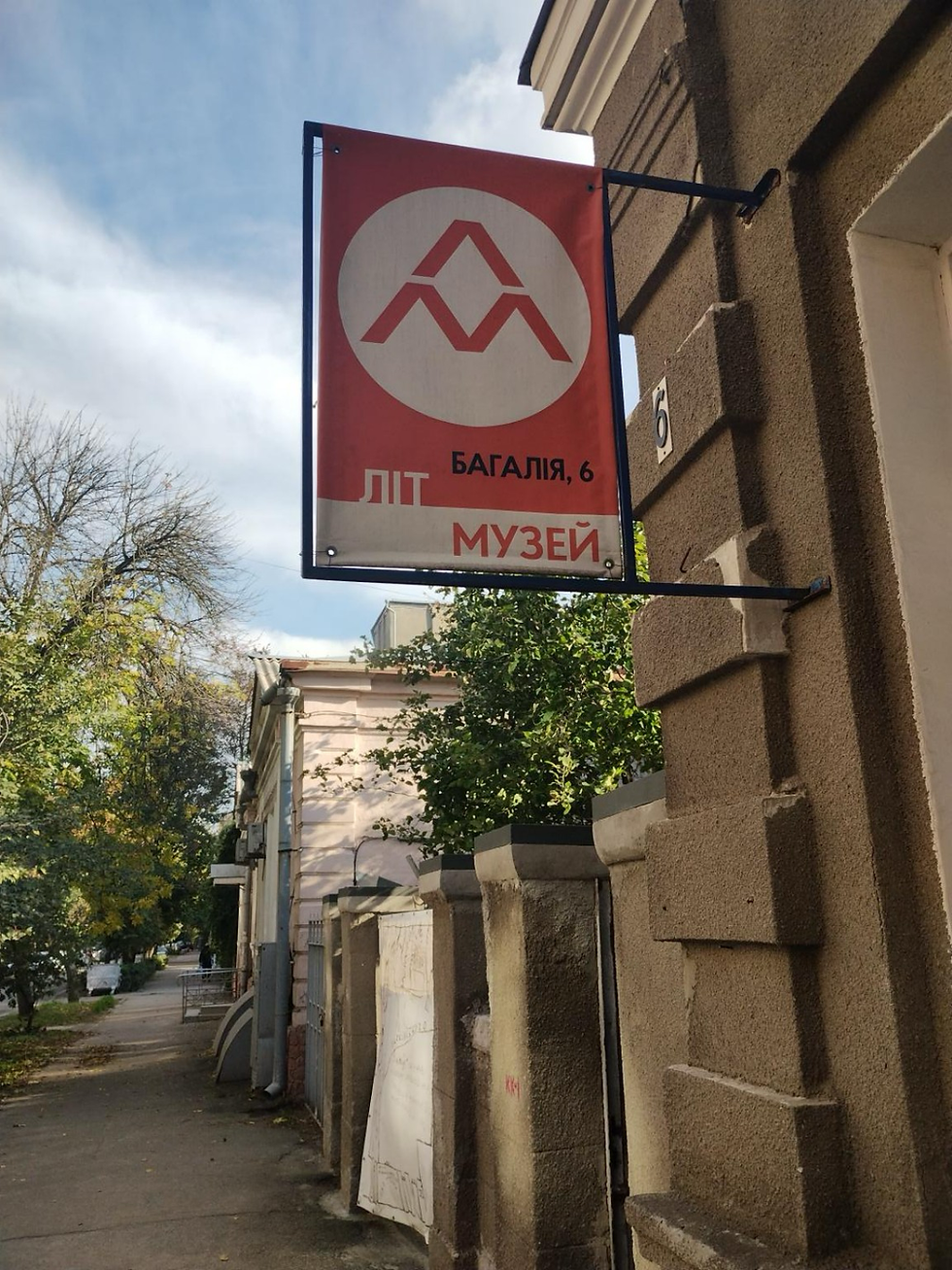
Independent Ukraine went further by deliberately returning literature to the building. The Kharkiv Literary Museum established the Slovo residency, allowing contemporary writers to work in a place from which an earlier generation of writers had effectively been removed by terror. It was an elegant act of cultural restoration: the appropriate answer to a state that had tried to silence a writers’ house was to fill it with writers again.
Amongst those associated with the modern residency was the Ukrainian novelist and war-crimes researcher Victoria Amelina. She was mortally wounded by a Russian missile strike upon the Ria Lounge restaurant in Kramatorsk in June 2023 and died several days later. The coincidence is grim enough that one might reject it as excessively contrived if encountered in a novel.
History in Ukraine has an uncomfortable habit of rhyming.
Moscow returns to Kharkiv
On 7 March 2022, less than two weeks after Russia began her full-scale invasion of Ukraine, Budynok Slovo was itself damaged during Russian attacks upon Kharkiv. The historical symbolism was impossible to overlook: almost ninety years after a Soviet regime centred in Moscow had destroyed many of the Ukrainian writers associated with this building, Russian forces were again attacking the city and the physical monument to that destroyed generation was itself struck.
One should nevertheless resist making history too neat. Vladimir Putin’s Russia is not Joseph Stalin’s Soviet Union, and the institutions, ideology and methods of the two systems are not identical. Yet Ukrainians can hardly be expected to overlook the historical continuity represented by repeated efforts from Moscow to deny the autonomous character of Ukrainian national culture.
That is why Budynok Slovo matters beyond literary history. It embodies an argument that has persisted for more than a century: whether Ukrainian culture is entitled to define itself, in its own language and according to its own intellectual traditions, without requiring validation or supervision from Moscow.
Why dictators fear writers
There is something almost absurd about the degree of fear the Soviet state displayed towards writers. Mykola Kulish commanded no army, Les Kurbas possessed no artillery and Khvylovyi’s principal weapons were sentences, yet the Soviet security apparatus devoted enormous resources to monitoring, interrogating and eventually eliminating people whose profession consisted principally of arranging words on paper.
Totalitarian governments understand something about literature that comfortable societies occasionally forget. Stories create communities, language preserves memories and writers provide people with ways of understanding themselves that governments cannot completely control. A state capable of controlling newspapers, political parties and public meetings may still be frightened by a novel because the private relationship between a reader and a book is unusually difficult to police.
Ukraine in the 1920s was discovering precisely this cultural power. Its writers were asking what it meant to be simultaneously Ukrainian, European and modern, and many rejected the assumption that Ukrainian culture must forever define itself through its relationship with Russia. They looked towards the wider European avant-garde, experimented extravagantly and sometimes failed spectacularly, because cultural renaissances are supposed to be disorderly.
The Soviet state eventually supplied its answer to this exuberance. Instead of winning the intellectual argument, it arrested the people conducting it.
The house still speaks
Today one can stand outside Budynok Slovo and see what appears to be an apartment building. People live there, cars pass along the surrounding streets and Kharkiv continues with the peculiar mixture of ordinary urban life and wartime danger that has characterised the city since February 2022.
Knowledge of the building’s history nevertheless transforms what one sees. Behind one window Khvylovyi once wrote; elsewhere writers argued about literature, communism, Europe and Ukraine; somewhere a manuscript was completed that might subsequently be prohibited; and in another apartment somebody may have sat awake wondering whether footsteps on the staircase were approaching his door.
That is why Budynok Slovo deserves to be understood not merely as a Ukrainian memorial but as a European one. A generation gathered there because its members believed that literature mattered, and Stalin’s regime ultimately agreed with them; the difference was that the Soviet authorities drew the opposite conclusion about what should be done with the people who wrote it.
The Soviet state could murder Kulish, Kurbas, Yalovyi, Semenko, Yohansen and many others. It could frighten survivors into silence, remove books from libraries, manufacture confessions, invent conspiracies and attempt to erase the memory that this extraordinary Ukrainian cultural renaissance had ever existed. Yet it could not complete the task, because buildings remain, archives reopen and forbidden books have an inconvenient habit of being rediscovered.
Nearly a century later, Ukrainians once again read the writers whom the Soviet Union tried to erase. Their books are republished, their lives are reconstructed, films tell the story of their house and contemporary writers once again work within its walls. Kharkiv, despite everything that has happened to it, remains a city of writers.
That may ultimately be the most important fact about Budynok Slovo. The men with guns succeeded in killing many of the people who lived there, but they failed to kill what those people had created, and the House of the Word therefore survives as both a monument to an atrocity and evidence of the limits of political terror: writers can be murdered, but words are considerably harder to execute.