


When Propaganda Turns Deadly
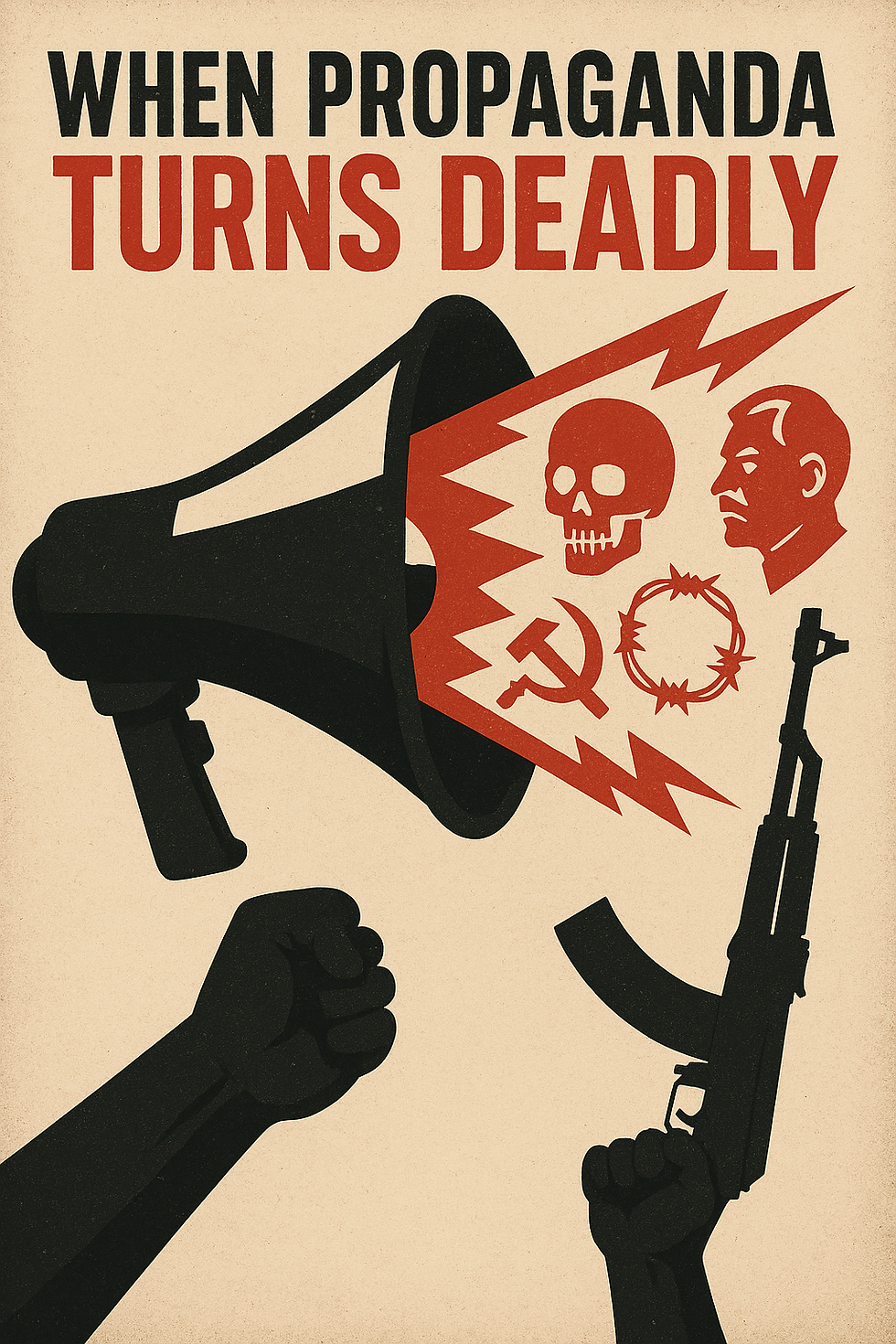
By Robert Harris
Within the past week, most people who follow news related to Russia's war against Ukraine have heard the words “Derek Huffman, a Texan fighting for Russia.” For those who have not, the back-of-the-book synopsis is this. Derek Huffman was an American Conservative who felt, like many of the American Right do, that America's traditionally Judeo-Christian cultural ethos is under attack by the rather formidable triumvirate of academe, Hollywood, and the news media, turning those who still hold to such values into pariahs in their own land. While he is not by any means alone in harboring this view (indeed, this is practically the core tenet of contemporary American conservatism), his actions resulting from it were, to say the least, a bit more unique. And frankly, more than a bit extreme.
Huffman sold his house, packed his bags and moved his wife and three daughters to Russia, believing that it was a bastion of what he called “traditional family values.” He settled in a village outside of Moscow set aside specifically for American emigres, and financially backed by American expat and Russian residency holder Tim Kirby (the same Tim Kirby who is employed by RT and who is the source of the “US bioweapons labs in Ukraine” conspiracy theory, a theory which he claimed he knew to be true because an unnamed and unnameable “friend on the inside” allegedly told him about it). When finding gainful employment proved -unsurprisingly to most readers- more difficult than he thought, he was informed that there was an easy way to make plenty of money and fast-track his family's paths to Russian citizenship: joining the Russian Army.
From here the story gets rather familiar. Huffman was told he'd be working a support position in the rear, as either a welder or a journalist, posted a Youtube video telling how proud he was to help fight what he called the “Nazis” and “globalists,” and then found out that he had been sold a false bill of goods when not only did his family not receive a single ruble of his enlistment bonus or salary, but he actually had to borrow money from relatives in America to buy his own equipment. According to Youtube videos from Huffman's wife, after two weeks of abbreviated training (all of which was in Russian), Huffman found himself on the front lines and while this writer has not been able to independently confirm it, an ever-growing list of sources now claims he was killed in action this past week, and his wife's emphatic insistence that she has been assured he is fine but cannot communicate for safety reasons, serves only to deepen this suspicion.
One would not be out of line for asking, “how did this man go from 'I feel like I'm under attack for being a practicing Christian' to 'I'm going to join an army that has bombed more churches and murdered more priests in three years than ISIS has in ten so I can help kill women and children and die as a war criminal for a dictator's ambitions, leaving my widow and three orphaned daughters to starve?'” If one wanted to ask this question in more than a rhetorical sense, with a goal of actually finding an answer, we'd find a clue in the same week's news from another American emigre to Russia: Francine Villa.
Francine Villa, a US citizen of African lineage, moved to Russia in 2020 because she believed she would be safe from racial discrimination there – an explanation which must have come as quite a shock to the 137 known Russia-based Neo-Nazi and White-Supremacist organizations currently under watch by Interpol. For several years, Villa's podcast, bearing the Beatles callback title “Black in the USSR,” has been filled with such open praise of Russia that segments of it were broadcast on RT. This changed earlier this week when Villa and her two-year-old child (who, by the way, was born in Russia) were both assaulted and brutally beaten by neighbors shouting racial slurs. To make matters worse, Villa claims that when she contacted the police they told her to quit making a fuss, and demanded bribes to stop them from taking her to jail, though no investigation was made to find her captors. As a final twist, Villa claims that she didn't call the police by phone, but the two officers she spoke to were watching the entire chain of events from a nearby car.
At the time of this writing I have not been able to ascertain if Villa, or Huffman's surviving family, have made any attempt to return to the United States, but one can surmise that any of them would be in grave danger if they publicly admitted having such plans.
For readers who are familiar with America's rather binary political system, the elephant in this room is that Huffman and Villa each represent such extreme examples of that spectrum's opposite ends that their stories feel almost like cartoon caricatures. Yet they both decided America was no longer what they wished it to be, and they both arrived at the same conclusion, namely, that Russia was more in line with what they wanted from society. And while there has been no shortage of social media posts mocking both of them for this admittedly dubious conclusion, there has been an apparent dearth of attempts to answer “how did we get to this point?”
The answer, with all the colloquial patois this writer would have used explaining it to Huffman if we'd ever discussed it over a couple of beers in our shared home state of Texas, is “when it comes to propaganda, this ain't the Kremlin's first rodeo.”
The plain truth is Russia (which has always had an overabundance of territory and a shortage of people to make it productive) has been in the business of targeting disaffected or disillusioned groups in Western society and making them think Russia was their “Land of Milk and Honey,” not for decades, but for centuries. In recent years we've seen multiple “social affairs experts” on Vladimir Solovyov's state-funded talk show describe how, after “the inevitable collapse of the United States,” the only place for Americans who want to live under “Biblical values” will be Russia, the same narrative which has been fed to Western Conservatives. In their dealings with nations in Africa, Russia latches onto anti-colonial resentment, leveraging its reputation as the long-time rival of the US and UK (who it repeatedly refers to as “the Anglo-Saxon colonizers” for added emotional sting) and reminding viewers that Russia never had colonies in Africa while carefully admitting any mention of its colonial holdings in Eastern Europe or Central Asia.
In the Soviet Era, there was Stalin's mass recruitment of American farmers fleeing the Great Depression, as well as the “Return Home” media blitz of the 1930's, both of which brought millions of foreigners to Russia, most of whom died in the gulags. And, though most people's idea of Russian propaganda mistakenly believes this tactic was a Communist invention, this pattern of begging Westerners to come to Russia only for the same to die there in obscurity or poverty can be traced much farther back. It runs through Tsar Alexander's efforts to recruit defeated Napoleonic officers, and Catherine II's letter-writing campaign to the French “philosophes” portraying Russia as a land of “Enlightenment values” as she stripped rights away from serfs, while simultaneously wooing German farmers to move entire villages to the Volga region so they could be part of a “land of hard work and Godly virtue,” and be added to the ranks of the aforementioned serfs.
Bottom line: Russia has always, always been skilled at finding groups in the West who see themselves (accurately or inaccurately) as marginalized, discerning what these groups wished society looked like, and portraying Russia as a land where it does. And yes, most of these pilgrims throughout the centuries have arrived in Russia and learned all-too-late -typically at the cost of their own lives- that they'd been deceived. We've all heard the adage about leopards not changing their spots, and in Russia's case they have even less reason to do so, since the spots appear to be working. The question then becomes “what can Ukraine and the West do about it?”
Educating the public about Russian disinformation is certainly part of the answer, but it is not a silver bullet. In fact, efforts to publicly debunk propaganda often backfire among the very people most susceptible to it. Those already inclined to distrust institutions will see such campaigns as just another form of manipulation — more “globalist lies from media and government elites.” When Russia's narrative is baited with promises of dignity, purpose, and belonging to those who feel culturally discarded, simply telling them it’s false is rarely enough to break the spell. If anything, it only reinforces their belief that someone, somewhere, is trying to silence what they see as an inconvenient truth.
The harder, but more lasting solution lies not in trying to out-propagandize the Kremlin, but in denying it the raw material it needs. When societies allow large segments of their population to feel voiceless, humiliated, or irrelevant, they become ripe for exploitation. This is as true of refugees feeling unwelcome in the country they fled to as it is of natives feeling squeezed out by refugees; as true of small-town churchgoers who endure sneers and jeers because they cling to old creeds as LGBTQ's who endure condemnation by the former. Whether it's rural conservatives feeling mocked by pop-culture, marginalized racial groups being told “go back where you came from,” or anyone who feels exiled from their own national identity -or denied one in their own homeland- the most effective way to protect them from foreign manipulation is to make sure they aren't left feeling like refugees in their own countries. The nation that fails to apply this, or only applies it in one direction, is doing Russia a greater favor than Iran or North Korea ever has.
A society confident in its own pluralism (including views considered “old-fashioned” or “outdated”), where people feel heard even when they lose, is far less likely to watch its citizens go chasing illusions in Moscow — or die for Vladimir Putin on a Ukrainian battlefield.
---
Robert Harris is a teacher in Lviv and the author of Smells Like Bull-shevik to ME! - A Conservative Talks to Conservatives About Russian Lies.


