Vladimir Putin and Hobbes: Fear, Sovereignty and the Russian State
By Matthew Parish
Tuesday 6 October 2026
Thomas Hobbes wrote Leviathan in 1651 in the shadow of the English Civil War. Vladimir Putin has spent much of his political career invoking, explicitly or otherwise, the shadow of another period of disorder: the collapse of the Soviet Union and the chaotic decade that followed it. The two men are separated by more than three centuries, entirely different intellectual traditions and radically different historical circumstances. Nevertheless, there is something distinctly Hobbesian about the political philosophy that has developed around the contemporary Russian state.
Hobbes began with fear. Human beings, he thought, were sufficiently competitive, suspicious and ambitious that in the absence of a common authority capable of restraining them they would fall into a condition of permanent insecurity. The famous Hobbesian state of nature was not necessarily one in which everybody was fighting everybody else at every moment. It was a condition in which nobody could be confident that violence would not suddenly erupt. The possibility of violence was enough. Life became organised around anticipation of danger. Fear therefore preceded sovereignty because people accepted the sovereign precisely to escape fear.
This distinction is important because Putinism has constructed a remarkably similar account of Russian political history. The Kremlin’s political mythology does not present Russia’s principal alternative to Putin as a prosperous Scandinavian democracy. The imagined alternative is chaos. It is the Russia of the 1990s: oligarchs fighting over assets, organised crime, unpaid salaries, separatism, terrorism, collapsing institutions, humiliation abroad and uncertainty at home. Whatever the historical merits of this picture — and the 1990s were considerably more complicated than the caricature — its political purpose is obvious. Russians are invited to compare the existing sovereign not with an ideal government but with the absence of effective government.
That is an extraordinarily Hobbesian comparison.
Hobbes’s great political insight was that the strongest argument for authority is not that authority is good but that the alternative may be worse. Political liberty looks rather less attractive if its imagined consequence is civil war. Hence Hobbes concluded that people have powerful reasons to submit to an authority capable of imposing order. The sovereign must possess sufficient coercive power to make promises reliable, property secure and social cooperation possible. Divided sovereignty was particularly dangerous because competing centres of authority might eventually return society to conflict.
Putin’s Russia has pursued precisely the destruction of competing centres of sovereignty. The oligarchs were permitted to retain enormous wealth provided that they did not convert wealth into autonomous political authority. Regional governors were brought progressively under central control. Independent national television ceased to constitute an alternative political centre. Parliament became increasingly subordinate to the executive. The security agencies remained powerful, but none was permitted to become an independent sovereign within the sovereign. Contemporary analyses of the Russian elite describe a system in which loyalty to Putin has become more important than autonomous institutional authority and in which no component of the security apparatus is permitted to emerge as a separate centre of power.
This is the logic of the Leviathan. There cannot ultimately be two final authorities because, once there are two, the question arises as to which of them decides when they disagree. Hobbes’s answer was uncompromising: somewhere in the political system the argument must stop. Somebody must possess the final power to decide.
Yet there is an important difference between Hobbes and Putinism. Hobbes’s sovereign is terrifyingly powerful, but the purpose of that power is protection. People surrender their freedom to the Leviathan because the Leviathan saves them from something worse. Political obligation and protection are therefore connected. Indeed Hobbes’s theory allows political obligation to disappear where effective protection disappears. Sovereignty is not merely domination. It is an exchange: obedience in return for security.
The Russian system has gradually distorted this bargain. Fear is no longer merely the condition from which the sovereign promises protection. Fear has increasingly become something the sovereign itself produces.
This is one of the central paradoxes of modern authoritarian government. The ruler requires threats because threats justify the ruler. A population permanently convinced that hostile forces surround it will tolerate powers that a population confident of its security may question. Foreign enemies, internal traitors, terrorists, extremists, foreign agents, saboteurs, spies and fifth columnists therefore acquire an indispensable political function. They populate the imagined state of nature beyond the Kremlin walls.
The Russian state consequently speaks the language of insecurity with extraordinary frequency. NATO threatens Russia. Ukraine threatens Russia. Western intelligence services threaten Russia. Cultural decadence threatens Russia. Political opposition may be represented not merely as disagreement but as subversion assisted by foreign powers. Once politics is translated into security, compromise becomes suspicious. One does not compromise with an existential threat; one neutralises it.
This helps explain why Putin’s political system has become increasingly personalised. Russia formally possesses a constitution, courts, a parliament, ministers and the elaborate institutional machinery of a modern state. Yet the political centre of gravity lies elsewhere. Longstanding analysis of the Russian constitutional structure has observed its tendency towards concentrated presidential authority and personalised power, while more recent assessments describe increasingly routine personal intervention by Putin in decisions that nominal institutions subsequently formalise.
The distinction between the office and the individual consequently becomes blurred. The state protects Russia; Putin controls the state; therefore Putin protects Russia. Criticism of Putin may then be reframed as criticism of Russia itself. This is one of the oldest manoeuvres of personalised sovereignty: the ruler gradually ceases to appear as the temporary occupant of an institution and becomes the human embodiment of the institution.
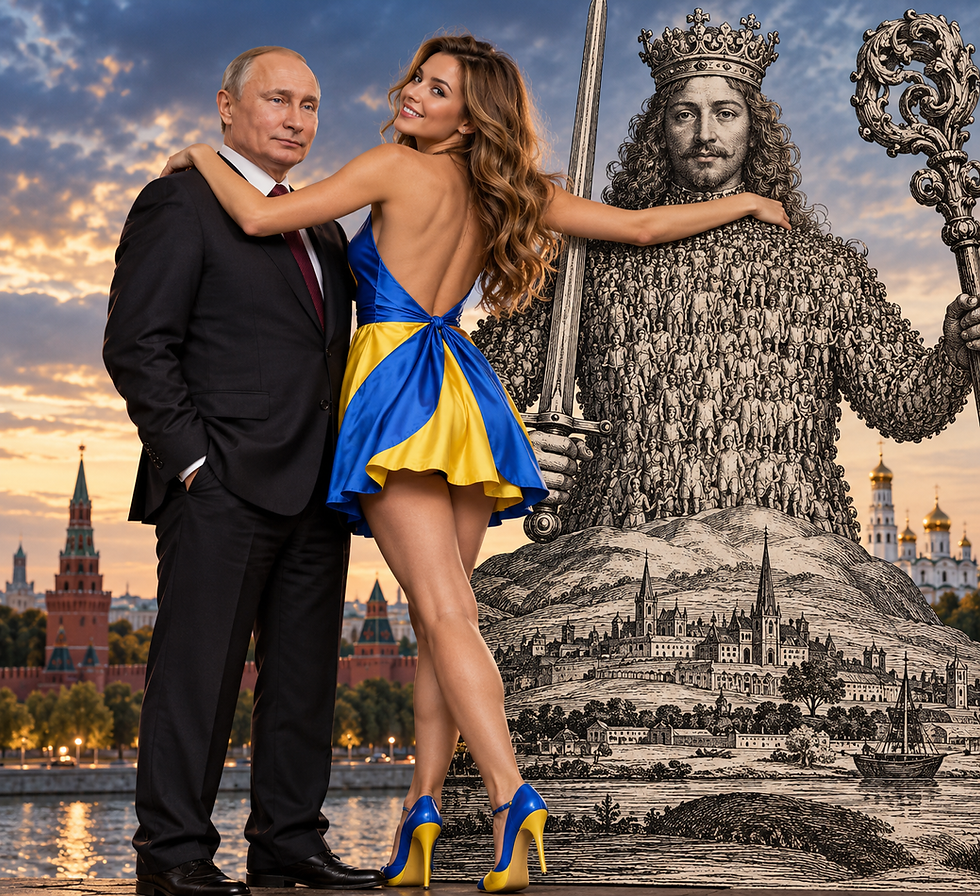
Hobbes would have recognised the temptation. His famous frontispiece to Leviathan depicts an enormous sovereign whose body is composed of thousands of individual people. The image captures an extraordinary proposition: the sovereign is simultaneously distinct from the population and constituted by it. Individual wills are absorbed into an artificial political person possessing powers vastly greater than any individual could exercise alone.
Yet Putin’s Russia introduces another dimension that Hobbes might have found troubling. The Russian Leviathan does not merely suppress the state of nature domestically. It increasingly appears to reproduce a Hobbesian state of nature internationally.
Hobbes observed that sovereign states exist towards one another without a superior common sovereign. International politics therefore retains characteristics of the state of nature: distrust, armament, competition and the possibility of anticipatory violence. Later realist traditions of international relations found much to admire in this observation. States cannot ultimately rely upon goodwill because there is no universal police officer standing above them capable of guaranteeing their survival.
This way of seeing international affairs bears striking similarities to the worldview of the contemporary Kremlin. International law exists, treaties exist, institutions exist and diplomacy exists, but beneath them lies power. States survive because they possess the means to protect themselves. Great powers insist upon spheres of influence. Military strength commands respect. Weakness invites intervention. Alliances are instruments of interest rather than manifestations of universal morality.
There is nevertheless a profound irony here. Hobbes’s political philosophy was designed to explain how fear might be overcome. The state of nature was the problem and sovereignty was the solution. Putin’s foreign policy risks reversing the sequence. Sovereignty becomes the instrument through which the state of nature is recreated.
The invasion of Ukraine illustrates the contradiction with exceptional clarity. From the Kremlin’s perspective, the war can be presented in Hobbesian language as anticipatory self-defence: Russia allegedly faced an expanding Western security architecture, an increasingly Western-aligned Ukraine and a strategic environment that would eventually become intolerable. Within this conception of international relations, waiting might merely allow an adversary to become stronger. The temptation towards preventive violence follows directly from fear.
But this is precisely the mechanism through which Hobbes’s state of nature perpetuates itself. If one actor arms because it fears another, the second actor observes the armament and becomes more frightened. It arms in response. The first actor interprets this response as confirmation that its original suspicions were justified. Fear becomes self-validating.
Russia’s invasion therefore produced many of the consequences that Russian security doctrine purported to fear. Ukraine became vastly more militarised and profoundly more hostile towards Moscow. European states increased defence expenditure. NATO acquired new members. Western military forces and infrastructure received renewed political importance. The Russian search for security generated additional insecurity.
This is the security dilemma in its most brutal form, but it also reveals something fundamental about fear as a political instrument. Fear is extraordinarily useful for constructing political authority, yet exceptionally difficult to control once it becomes the organising principle of government. A state that continually searches for dangers will continually discover them.
The same problem operates domestically. If legitimacy depends upon the sovereign protecting society from chaos, then the disappearance of chaos creates a political difficulty. Successful protection makes the protector appear less necessary. Hence authoritarian systems founded upon security often require the periodic rediscovery of insecurity. New dangers must emerge as old ones recede.
This distinguishes liberal constitutionalism from the Putinist conception of sovereignty. Liberal government attempts, however imperfectly, to make political authority mundane. Governments change without the state collapsing. Presidents leave office. Prime ministers lose elections. Judges rule against ministers. Newspapers insult governments. Political parties alternate in power. The entire achievement of constitutional government lies in making these events boring.
Putinism cannot easily permit politics to become boring because its deepest justification is existential. The Kremlin is not merely administering taxation, healthcare, railways and pensions. It is presented as defending the Russian civilisation against catastrophe. Political succession therefore becomes frightening because replacing the ruler appears potentially equivalent to destabilising the state.
Here the Leviathan begins to devour its own logic. Hobbes wanted sovereignty to solve the problem of uncertainty. Personalised authoritarianism ultimately recreates uncertainty at the very centre of sovereignty because no individual ruler is immortal. The more institutions are weakened in favour of personal authority, the greater the question of what happens when the person disappears.
This may prove to be the most important Hobbesian problem confronting Russia after Putin. A genuinely powerful state is not necessarily one with a powerful ruler. It is one whose institutions remain authoritative when rulers change. If political stability depends excessively upon a single individual arbitrating between security agencies, economic interests, regional elites and bureaucratic factions, then personal power may conceal institutional weakness.
There is another respect in which Hobbes provides an unexpectedly sharp criticism of Putinism. Hobbes was an absolutist, but he was not an enthusiast for arbitrary suffering. The purpose of political authority was peace. People submitted because security made ordinary human activity possible: commerce, agriculture, knowledge, society and civilisation. The Leviathan existed so that people could cease thinking constantly about survival.
A state that demands endless sacrifice for endless confrontation has therefore departed from the fundamental purpose for which Hobbes justified absolute sovereignty. If citizens surrender liberty for protection but receive instead mobilisation, casualties, repression and permanent geopolitical anxiety, then the bargain has changed. Fear is no longer being extinguished by sovereignty. Fear is being recycled to sustain it.
This is why the comparison between Hobbes and Putin ultimately becomes less flattering to the Kremlin than it first appears. Putin has constructed a political order that understands one half of Hobbes exceptionally well. It understands that frightened people value order, that competing sources of political authority threaten central power, that security can justify coercion and that sovereignty becomes strongest when it presents itself as the barrier between civilisation and chaos.
But Hobbes understood something else. The sovereign must deliver.
The Russian state cannot indefinitely justify itself merely by pointing towards catastrophe beyond its borders if its own policies contribute to producing that catastrophe. Nor can a system designed around the indispensability of one man permanently solve the problem of political order, because eventually that man must disappear. The ultimate test of Putin’s state will therefore come not while Vladimir Putin commands it but when Russia must discover whether sovereignty exists independently of him.
Hobbes called the state a mortal god. The phrase contains both halves of the problem. The Leviathan may possess extraordinary power, but it remains mortal. Institutions endure only if authority can survive the people who temporarily embody it.
Putin has spent more than a quarter of a century persuading Russians that without strong sovereignty they risk disorder, humiliation and danger. In doing so he has appealed, consciously or otherwise, to one of the most powerful arguments in the history of political philosophy. Yet the final Hobbesian question for Russia is not whether Vladimir Putin has accumulated sufficient power to become sovereign.
It is whether, by concentrating sovereignty so completely around himself, he has created a Russian state capable of surviving him.