The Russian Language After the War: What Place Will It Have in Ukraine?

By Matthew Parish
Wednesday 7 October 2026
One of the stranger consequences of Russia’s invasion of Ukraine is that Vladimir Putin may ultimately have inflicted more damage upon the Russian language than almost any Ukrainian nationalist could have imagined possible. For centuries Russian governments sought to persuade Ukrainians that Russian was the natural language of civilisation, administration, education and urban life, while Ukrainian was something provincial or rustic. In the space of a few catastrophic years, the Kremlin has associated the Russian language in the minds of many Ukrainians with missiles, occupation, propaganda, interrogation rooms and the television broadcasts of an enemy state.
Yet this presents post-war Ukraine with a difficult question. Russian is also the language of millions of Ukrainian citizens, including people who have fought against Russia, lost relatives to Russian bombardment, volunteered for the Ukrainian Armed Forces and defended Ukrainian independence with extraordinary courage. If Ukraine emerges from the war as a confident European democracy, what place should the Russian language occupy within it?
The question is more complicated than either Moscow or the more uncompromising varieties of Ukrainian nationalism sometimes suggest. The Russian language does not belong to Vladimir Putin. Nor does speaking Russian make a person Russian, still less politically sympathetic to the Russian Federation. Anyone who has spent time in Kharkiv, Odesa, Dnipro, Zaporizhzhia or among military units recruited from eastern Ukraine understands this immediately. Russian-speaking Ukrainians have been killing Russian soldiers in defence of their country since 2014 and, on an incomparably greater scale, since February 2022.
Nevertheless the linguistic transformation of Ukraine is real, and it is unlikely to be reversed when the war ends. Ukrainian has become not merely the official language of the state but one of the principal symbols through which Ukrainians distinguish their political and cultural community from the imperial power seeking to destroy it. This process was already under way before the full-scale invasion. The war accelerated it enormously.
There is an important historical reason for this. The predominance of Russian across substantial parts of Ukraine did not arise entirely through the spontaneous preferences of individuals exercising free cultural choice. It was also the consequence of imperial policy. Ukrainian was periodically suppressed under the Russian Empire, while Soviet policies promoted Russian as the language of political advancement, higher education, administration and much urban professional life. The Constitutional Court of Ukraine has itself described modern language policy partly as an attempt to overcome the consequences of prolonged Russification under imperial and Soviet rule.
This history explains why the superficially attractive proposition that the state should simply be “neutral” between Ukrainian and Russian is more complicated than it appears. A language weakened for generations by state policy may require active institutional support if it is to recover. A government insisting upon Ukrainian in schools, courts, government offices and other areas of public administration is therefore not necessarily suppressing Russian. It may instead be establishing the conditions in which Ukrainian can function normally as the common language of a sovereign Ukrainian state.
That, broadly speaking, is already the constitutional architecture. Article 10 of the Constitution declares Ukrainian to be the state language and requires the state to ensure its comprehensive development and functioning throughout Ukraine. Yet the same article expressly guarantees the free development, use and protection of Russian and the other languages of Ukraine’s national minorities.
The distinction between a state language and a private language is therefore crucial. There is nothing inherently contradictory about insisting that a police officer, judge, civil servant or government department conduct official business in Ukrainian while permitting citizens to speak Russian amongst themselves whenever they wish. Indeed this distinction may eventually provide the foundation for a relatively uncomplicated post-war linguistic settlement.
The Constitutional Court upheld the 2019 state-language legislation in 2021 and emphasised precisely this difference. Ukrainian occupies the constitutional position of the sole state language, while Russian is protected but does not thereby acquire a privileged status over Ukraine’s other minority languages. The Court also rejected the proposition that the legislation amounted to a comprehensive prohibition upon Russian, noting numerous circumstances in which other languages may continue to be used.
Post-war Ukraine is therefore unlikely to return to the linguistic politics of the decades immediately following independence. The idea of Ukrainian and Russian operating as effectively interchangeable languages of government is increasingly difficult to imagine. Ukrainian will almost certainly remain the language of central government, the Armed Forces, public administration and the principal institutions of national political life. The more interesting disputes will concern education, broadcasting, publishing, entertainment and the innumerable informal transactions that constitute everyday life.
Education may prove the most sensitive area. A state has an obvious interest in ensuring that every child leaving a Ukrainian school possesses complete command of Ukrainian. Without that, equality of citizenship becomes difficult because linguistic divisions may reproduce differences in employment, geography and political participation. At the same time, knowledge of Russian does not disappear merely because Russia has become an enemy state. Russian remains one of the world’s major languages, the language of an enormous literature and the native or habitual language of substantial numbers of Ukrainian families.
There is therefore a distinction between teaching in Russian and teaching Russian. A post-war Ukrainian state might maintain Ukrainian as the normal language of public education while allowing Russian to be studied as a language, just as pupils may study Polish, German, French or English. Existing Ukrainian law already reflects aspects of this distinction, and the Constitutional Court has recognised possibilities for minority-language study within an educational system centred upon the state language.
Culture raises still more interesting questions because governments cannot legislate people’s imaginations. A novelist from Kharkiv may think in Russian. A Ukrainian soldier may swear in Russian, write love letters in Russian and give orders in Ukrainian. Families may move effortlessly between the two languages in the course of a single conversation. Surzhyk complicates the picture further, reminding everyone that languages in actual human societies refuse to observe the tidy boundaries politicians sometimes draw around them.
There is also a specifically Ukrainian tradition of Russian-language culture that cannot sensibly be reduced to Russian state culture. Ukraine has produced Russian-language writers, journalists, musicians, comedians and intellectuals whose identities and loyalties are Ukrainian. Some Russian-speaking Ukrainians have deliberately switched to Ukrainian since 2022; others have not. These decisions carry emotional significance, but they do not provide a reliable test of patriotism.
This point matters enormously. One of Russia’s central propaganda propositions has been that Russian speakers outside the Russian Federation somehow belong to a transnational “Russian world” over which Moscow possesses cultural or even political guardianship. Ukraine has disproved this proposition on the battlefield. Russian-speaking Ukrainian soldiers defending Kharkiv against Russian-speaking Russian soldiers demonstrate more powerfully than any academic treatise that language and political nationality are different things.
It would therefore be paradoxical if Ukraine were ever to accept the Kremlin’s premise in reverse: that speaking Russian somehow makes a Ukrainian less Ukrainian. The democratic answer to Russian imperialism need not be to concede Moscow’s assumption that language determines political identity. It can instead reject that assumption altogether.
None of this means that Russian is likely to recover the extraordinary cultural dominance it once possessed in Ukraine. Russian books, Russian television, Russian popular culture and Russian internet content once entered Ukraine through an enormous cultural marketplace centred upon Moscow. That relationship has been shattered. Even after hostilities cease, distrust of Russian state-produced culture is likely to persist for generations.
Something different may nevertheless emerge: Russian-language Ukrainian culture separated consciously from Russia itself. There is no logical reason why a Russian-language newspaper published in Kharkiv must possess greater cultural affinity with Moscow than an English-language newspaper published in Dublin possesses with London. Languages travel beyond states. English belongs neither exclusively to England nor to the British government; Spanish is not the property of Madrid. Russian need not forever remain the property of the Kremlin.
This may become particularly important in the liberated territories. Crimea and parts of Donetsk and Luhansk regions have experienced prolonged Russian occupation, accompanied by Russian educational programmes, media systems and administrative structures. Reintegration would necessarily involve restoration of Ukrainian public institutions and Ukrainian-language education. Yet treating ordinary linguistic habits as evidence of collaboration would raise a quite different set of problems from dismantling institutions imposed by occupation.
A person who has lived under occupation for years may speak Russian because that is the language he has always spoken. Another may have been educated almost entirely within Russian-controlled institutions because he was a child when occupation began. Post-war Ukraine will have to distinguish political responsibility from cultural inheritance. Otherwise language risks becoming a crude proxy for loyalty precisely when national reconstruction requires the opposite.
There is a European dimension as well. Ukraine’s future lies within European institutions in which protection of minority cultures forms part of the broader discussion of democratic governance. That does not require Russian to become Ukraine’s second state language, nor does it erase the historical circumstances that created Russian linguistic predominance. It does mean that the eventual settlement will be scrutinised through two principles that need not be incompatible: Ukraine’s legitimate interest in securing Ukrainian as the universal language of the state and the liberties of citizens who use other languages in their personal and cultural lives.
The most durable post-war arrangement may therefore be understood less as a territorial division between “Ukrainian-speaking” and “Russian-speaking” Ukraine than as a distinction between spheres of life. The state is Ukrainian-speaking. Citizens need not always be.
Under such a model, Ukrainian would remain indispensable in government, public administration and the common civic institutions through which Ukrainians encounter their state. Every Ukrainian citizen would be entitled to learn it properly and expected to possess sufficient command of it for participation in public life. Russian, meanwhile, would survive wherever Ukrainians themselves continued to use it: in homes, friendships, literature, theatre, private media, religious life and ordinary conversation, subject to the same democratic laws governing other languages.
Different Ukrainians will draw the boundary between those spheres differently. Some favour more extensive Ukrainian-language requirements as a necessary continuation of decolonisation after centuries of Russification. Others place greater weight upon linguistic liberty and upon the contribution Russian-speaking citizens have made to Ukraine’s defence. The post-war political debate will have to negotiate between those concerns rather than pretending that either disappears with the final artillery shot.
There is, however, a deeper cultural possibility. Russian may gradually cease to be politically important in Ukraine at all.
That would be an extraordinary historical reversal. For decades Ukrainian elections were analysed according to maps showing supposedly Ukrainian-speaking and Russian-speaking regions. Political consultants built parties around linguistic anxieties. Moscow exploited them relentlessly, claiming that it possessed some special responsibility towards Ukraine’s Russian speakers. Then Russia invaded the very cities it claimed to be protecting.
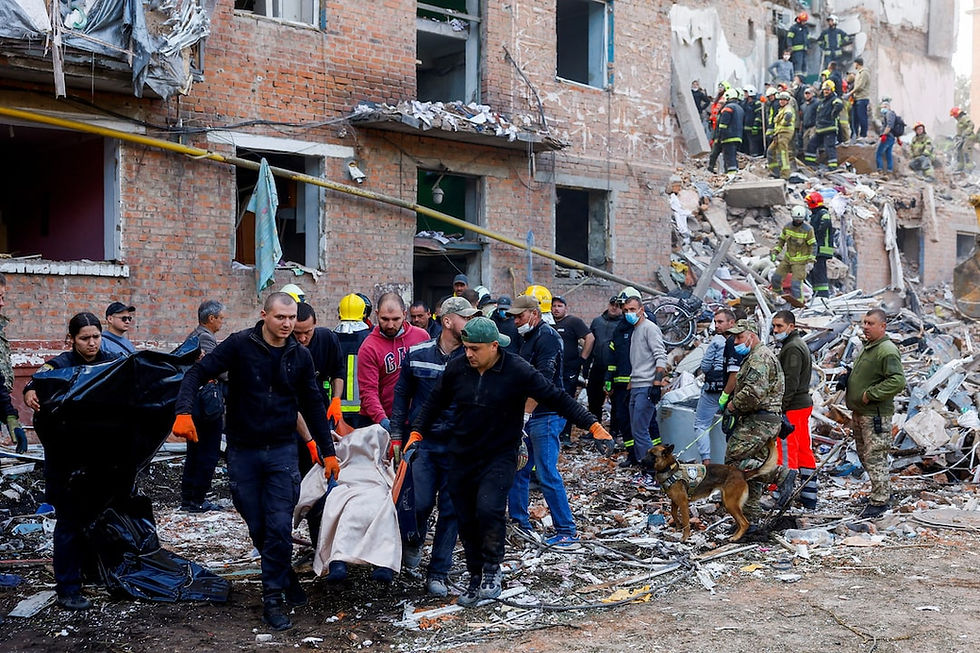
Mariupol was overwhelmingly Russian-speaking. Russia destroyed it. Kharkiv was predominantly Russian-speaking in everyday life. Russia bombarded it. Russian missiles did not ask which language the inhabitants of apartment buildings preferred before striking them.
The war has therefore exposed the intellectual emptiness at the heart of the old linguistic division. The fundamental political distinction in contemporary Ukraine is not between people who speak Ukrainian and people who speak Russian. It is between those who believe Ukraine should exist as an independent political community and those who seek its subordination to Moscow.
If Ukraine emerges from this war secure and sovereign, Ukrainian will almost certainly occupy a stronger position than at any point in modern history. That transformation need not require the disappearance of Russian from Ukrainian life. Languages do not have armies, governments or moral responsibility. States do.
The greatest victory for Ukrainian language policy may consequently arrive when nobody feels particularly threatened by hearing Russian in a café in Kharkiv, because nobody any longer imagines that the language being spoken determines which country the café belongs to. Ukrainian would then possess what generations of Ukrainians were denied: not merely legal protection but the unquestioned status of the common language of their state.
And Russian, stripped of its imperial political significance, could become simply one of the languages that some Ukrainians happen to speak.
That would represent something more profound than prohibition. It would mean that Moscow had finally lost the power to decide what the Russian language means in Ukraine.