Pryluky: The War Comes to the Sleeping
By Matthew Parish
Wednesday 7 October 2026
There is something particularly terrible about a missile striking an apartment building in the early morning. War ordinarily announces itself through the vocabulary of military affairs: offensives, brigades, logistics, front lines, air defence systems and territorial gains measured in kilometres. Yet at approximately six o’clock on the morning of 7 October, the reality of Russia’s war against Ukraine was expressed in altogether simpler terms. People were asleep in their homes in Pryluky, a city in Chernihiv Oblast, when Russian missiles arrived.
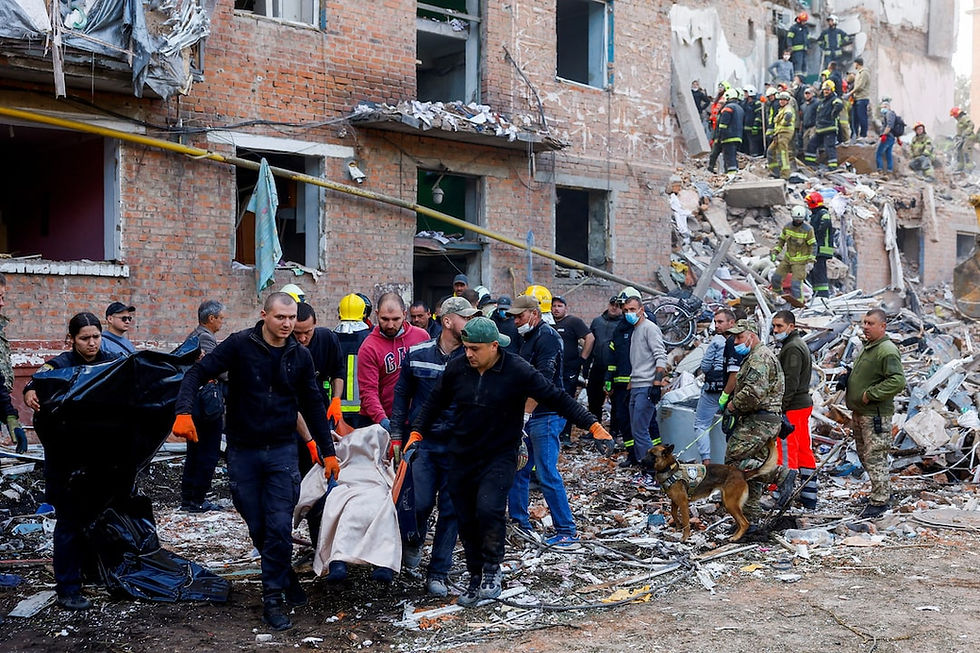
One of them struck a five-storey residential building. An entire section of the building was destroyed, leaving rescuers, police officers and local residents searching through concrete and twisted metal for those trapped beneath it. Russian strikes also hit a children’s and youth creativity centre and an enterprise in the city, while damage to a medium-pressure gas pipeline left more than 18,000 residents temporarily without gas.
The figures have risen horribly quickly during the course of the morning and early afternoon. Initial reports spoke of two dead, then four, then nine. By early afternoon, Chernihiv regional governor Viacheslav Chaus said that thirteen people had been killed, including four children, while fifty had been injured. Other Ukrainian reporting subsequently put the toll at fourteen dead. Rescue operations have continued, and therefore any numbers written while the rubble is still being cleared must necessarily be regarded as provisional.
The horror of Pryluky lies partly in its ordinariness. This is not one of the names that foreigners have learned to associate instinctively with the front line. It is not Pokrovsk, Kupiansk, Chasiv Yar or one of the devastated settlements running along the eastern battlefield. Pryluky lies well to the north, in Chernihiv Oblast, amidst the immense geography of Ukrainian towns in which people continue doing all the ordinary things of life despite the war. Children go to school. People go to work. Families buy groceries, repair their homes, complain about municipal services and arrange what they will do at the weekend.
Then, in a few seconds, an apartment block becomes a ruin.
That is one of the defining characteristics of Russia’s contemporary campaign against Ukraine. The distinction between front and rear has become progressively less meaningful. A Ukrainian city does not have to be within artillery range to be a battlefield. Ballistic missiles, cruise missiles and long-range drones have transformed virtually the entire country into a potential target area. The front may lie hundreds of kilometres away, but the war can nevertheless arrive through a bedroom ceiling before breakfast.
Pryluky was not attacked in isolation. The strike formed part of a large Russian aerial assault across Ukraine overnight and into the morning of 7 October. Russia launched missiles and drones against numerous regions, including Kyiv, Poltava, Kirovohrad, Dnipropetrovsk and Chernihiv. President Volodymyr Zelensky reported that some 70 missiles were launched, while Russian attacks also involved dozens of drones. Residential areas, industrial sites, transport facilities and energy infrastructure were struck.
The timing carried an inevitably macabre symbolism. The attack took place on Vladimir Putin’s 74th birthday. Ukrainian officials and commentators have accordingly described the barrage as a grotesque birthday present for the Russian President. Whether the precise date carried operational significance inside the Kremlin is impossible to establish from the evidence presently available, and there is little value in pretending to know the psychology behind military decisions taken in Moscow. Nevertheless, the coincidence will not be forgotten easily in Ukraine.
Yet the more important point is not symbolism but strategy. Russia continues to demonstrate that it possesses both the means and the willingness to impose violence far beyond the immediate battlefield. The purpose of such attacks cannot sensibly be understood only by drawing circles around individual alleged military targets. A nationwide missile campaign has broader consequences. It exhausts air-defence ammunition, forces Ukraine to disperse sophisticated defensive systems, damages electricity and gas networks, disrupts industry and transport and, above all, maintains a permanent condition of insecurity among the civilian population.
This last objective is easily underestimated by observers sitting safely elsewhere in Europe. An air-raid siren is not simply a warning that something may explode. Repeated night after night, it becomes a mechanism for disrupting human existence. People wake, check their telephones, dress children, move into corridors or shelters, listen for explosions and then attempt to return to sleep. They go to work exhausted. Parents calculate whether the school shelter is adequate. Families learn the difference between the sounds of drones, missiles and air-defence interceptions. The abnormal becomes routine, but it never becomes entirely normal.
Pryluky illustrates the limits of adaptation. One may grow accustomed to sirens. One may acquire power banks, water reserves and an instinctive understanding of where the strongest walls in an apartment are located. One may learn to sleep through distant explosions. None of these adaptations provides much comfort when a missile lands directly upon a residential building.
There is also an uncomfortable military lesson in what happened. Ukrainian air defence has become extraordinarily capable under circumstances few countries have ever experienced. During the wider attack of 7 October, Ukrainian forces reportedly intercepted a substantial proportion of the incoming drones and missiles. Yet no air-defence architecture can guarantee the interception of everything, particularly during large mixed attacks involving weapons travelling at different speeds and along different trajectories. Ballistic missiles remain especially difficult to defeat, while sophisticated systems such as Patriot batteries and their interceptors exist only in limited numbers.
This creates the cruel arithmetic of modern aerial warfare. An interception rate that might appear impressive on a military briefing slide can still mean catastrophe for the family living beneath the missile that gets through. Air defence is measured statistically by militaries but experienced individually by civilians. Ninety successful interceptions cannot resurrect the occupants of the building destroyed by the ninety-first weapon.
That is why debates in European capitals about additional air-defence systems for Ukraine can sometimes seem strangely detached from their consequences. Patriot batteries, interceptors, radar systems and other components of layered air defence are discussed in the language of budgets, procurement cycles and alliance politics. In Pryluky, these abstractions acquire a different meaning. Air defence is not merely military assistance to Ukraine’s armed forces. It is an attempt to ensure that somebody’s five-storey apartment building is still standing tomorrow morning.
There will inevitably be investigations into precisely what weapons struck Pryluky and what Russia intended to hit. Such investigations matter, particularly for the painstaking accumulation of evidence concerning possible violations of international humanitarian law. But one should not allow technical debates about targeting to obscure the physical facts visible on the ground. A residential building has been devastated. Children are among the dead. Dozens of people have been injured. Emergency workers have spent the day searching through the remains of homes.
And amidst all this destruction, the familiar Ukrainian machinery of survival has once again appeared. Firefighters, paramedics and police officers arrived. Neighbours helped neighbours. Municipal authorities began recording damaged property. Gas engineers started inspecting damaged networks. Somewhere, relatives began telephoning hospitals. Somewhere else, people stood beside the rubble waiting for news they desperately did not want to receive.
These scenes have been repeated so many times across Ukraine that there is a danger of their becoming another genre of wartime imagery. We have seen the rescuers standing upon shattered concrete, the elderly woman wrapped in a blanket, the burned cars, the windows blown out across an entire street and the exhausted emergency worker carrying somebody from a ruin. Repetition dulls the sensibilities of distant audiences. It does not dull the experience of the people to whom it happens.
Every destroyed apartment contained a private universe. There were photographs, clothes, medicines, children’s toys, unfinished meals, documents, books and all the accumulated clutter by which human beings turn concrete rooms into homes. War reporting inevitably compresses these worlds into numbers: thirteen dead, fourteen dead, fifty injured. Numbers are necessary, but they conceal almost as much as they reveal.
The strike on Pryluky therefore deserves to be remembered not because it is unique but because it is not. It belongs to the continuing pattern of a war in which geographical distance from the trenches provides no guarantee of safety and in which civilians across an enormous country live beneath the possibility of sudden aerial attack.
Russia may describe her nationwide barrages in the terminology of military necessity and precision weaponry. Ukraine will describe them as terror. Lawyers will eventually catalogue individual incidents, investigators will reconstruct trajectories and historians will debate the strategic purposes of the campaign. Those arguments will continue for years.
For the inhabitants of Pryluky, however, the meaning of 7 October 2026 requires no elaborate theory. A city went to sleep. Missiles came before breakfast. By lunchtime, families were standing beside the ruins of their homes, rescuers were digging for the missing and parents were mourning children who should have awakened that morning to another ordinary autumn day.
That is what this war means when all the geopolitics are stripped away.
It means somebody did not wake up.