


The Origins and Endurance of Totalitarianism
- Sep 7, 2025
- 6 min read
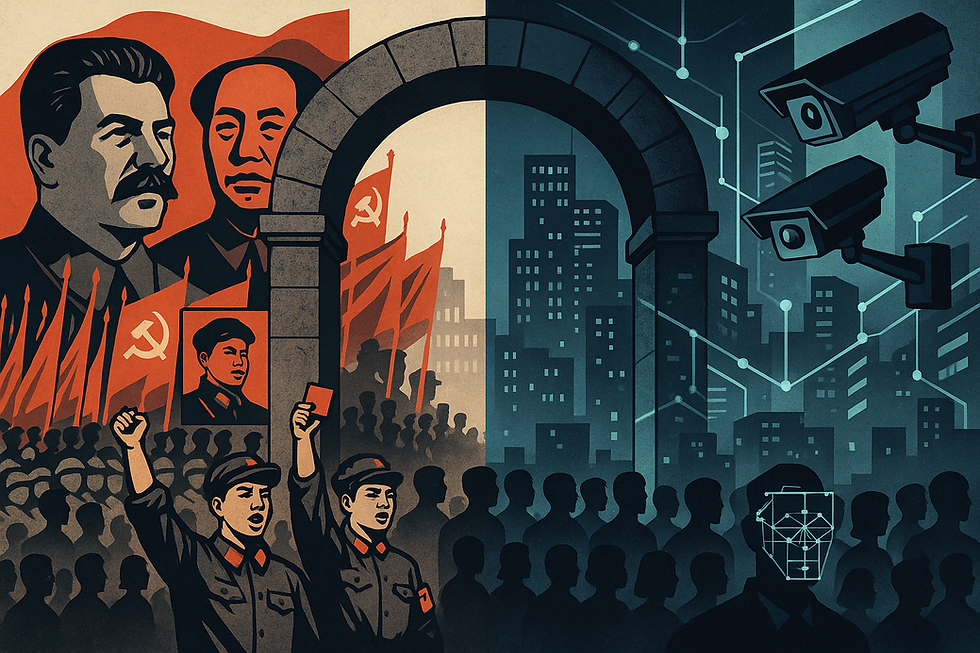
The word “totalitarianism” emerged in the twentieth century interwar period, as political theorists struggled to describe a novel form of state power that appeared to transcend the categories of earlier autocracy or dictatorship. Unlike mere tyranny, which rested upon the dominance of a ruler over subjects, totalitarianism sought to remake the entirety of society in accordance with an ideology. The state aspired not only to command obedience but to dictate thought, reshape culture and determine the destiny of individuals.
The Italian origin of the term is significant. Giovanni Amendola, a liberal politician, used “totalitario” in the 1920s to denounce Benito Mussolini’s Fascist regime, which proclaimed itself as total in its ambition to control society. Mussolini himself embraced the word in a boastful sense, declaring the Fascist state as one that would leave “nothing outside the state.” By the 1930s political scientists and commentators in Europe and North America had developed the concept more fully. They identified a set of features: a monopoly of ideology, a single mass party, centralised control of the economy, use of terror, and the subordination of all aspects of life to state objectives. It was in this conceptual framework that the systems of Soviet Russia and later Communist China came to be understood.
Soviet Russia and the Totalitarian Prototype
The Soviet Union under Joseph Stalin embodied the totalitarian prototype. The Bolshevik revolution had already installed a one-party state, but it was the late 1920s and 1930s that revealed the ambition to achieve total control. The state sought to suppress private property, subordinate religion and eradicate independent civil institutions.
What distinguished Stalin’s rule from earlier autocracies was not merely repression but the systematic mobilisation of ideology. Marxism-Leninism was declared the scientific truth, and deviation from it became treason. The Great Terror of 1937–38 was as much about eliminating alternative ways of thinking as it was about eliminating rivals. Even the arts were subordinated through socialist realism, while education became a tool for shaping the “new Soviet man”. The command economy, with its central plans and collective farms, exemplified the state’s attempt to reconfigure society from top to bottom.
Historical examples illustrate the depth of this ambition. Children were encouraged to denounce their parents if they spoke critically of the Party. Churches were converted into warehouses or museums of atheism. In 1935, a 13-year-old boy named Pavlik Morozov was hailed as a model youth after informing on his father, who was later executed; the boy himself was killed in revenge by relatives, but the Soviet press turned him into a martyr for loyalty to the state. Such stories demonstrate how the private realm was deliberately penetrated by political ideology.
The idea of the total state was reinforced by Stalin’s cult of personality, in which loyalty to the leader became a test of political and moral worth. Stalin’s portrait hung in schools, factories and homes, and even casual jokes about him could result in imprisonment or death. This combination of ideological rigidity, political terror and all-encompassing mobilisation marked out Soviet Russia as a model case of totalitarianism.
Communist China and the Expansion of the Model
In China, Mao Zedong’s Communist Party adopted similar methods, though with a distinct cultural dimension. The Chinese Revolution was not merely political but social, designed to overturn traditions and mould citizens into revolutionary subjects.
The Great Leap Forward of 1958–62 exemplified totalitarian ambition in its attempt to transform the countryside into communes, abolishing private plots of land and even family kitchens. Families were compelled to eat in communal dining halls, a symbolic gesture intended to break old habits of domestic life. The results were catastrophic: agricultural mismanagement, coupled with inflated production figures to satisfy Party demands, led to one of the worst famines in history, with tens of millions of deaths.
The Cultural Revolution, launched in 1966, went even further in politicising everyday life. The Red Guards, mostly teenagers, were encouraged to smash temples, burn books, humiliate teachers and assault officials. Even friendships and marriages became suspect if they were thought insufficiently revolutionary. Millions of people were sent to labour camps or subjected to “struggle sessions” in which they were forced to confess supposed ideological crimes before jeering crowds.
The cult of Mao, comparable in intensity to Stalin’s cult of personality, fused ideology with quasi-religious devotion. Citizens carried the “Little Red Book” of Mao’s quotations, reciting passages with fervour. Propaganda posters depicted Mao as the “red sun in our hearts”, a father figure surpassing family ties. During the Cultural Revolution, loyalty to Mao could justify attacks upon one’s own parents or spouse. China’s experiment showed that totalitarianism was not confined to a European setting but could be exported to different cultural contexts, adapting to local traditions while retaining the same ambition of comprehensive domination.
Hannah Arendt and the Theory of Totalitarianism
The most influential theorist of totalitarianism was Hannah Arendt. Her seminal work, The Origins of Totalitarianism (1951), argued that both Nazism and Stalinism represented unprecedented forms of political rule. Arendt’s insight was that totalitarianism did not merely suppress freedom but sought to annihilate the very conditions of individuality. By dismantling institutions, atomising society and replacing spontaneous human interaction with an ideology enforced by terror, totalitarian systems aspired to make people superfluous.
Arendt emphasised the novelty of totalitarianism compared to traditional tyranny. Where earlier despots ruled through fear and patronage, totalitarian leaders created a self-perpetuating machinery of domination, combining propaganda, terror and ideology in ways that penetrated every sphere of life. For Arendt, the defining feature was the attempt to eliminate the unpredictable element of human freedom, turning society into a predictable, manipulable mass.
Her analysis provoked debate. Some critics argued that her conflation of Nazism and Stalinism overlooked important differences in their goals and ideologies. Others suggested that the concept was too blunt an instrument, unable to account for shifts and nuances within communist states over time. Yet Arendt’s insistence on the radical novelty of totalitarianism shaped Cold War discourse and still influences political analysis today.
Debates and Revisions of the Concept
During the Cold War, the concept of totalitarianism became a central tool of western political science. Thinkers such as Carl J. Friedrich and Zbigniew Brzezinski developed models that identified a fixed set of characteristics: a guiding ideology, a single mass party, secret police, monopoly over communications, control of weapons and central direction of the economy.
By the 1970s scholars studying the Soviet Union and Eastern Europe noted that these regimes displayed not only repression but also institutional complexity, bureaucratic bargaining and occasional spaces for limited dissent. Terms such as “post-totalitarianism” were introduced to capture systems that retained authoritarian control but had lost the mobilising zeal of the Stalinist era.
Nevertheless the totalitarian framework remained important for understanding the aspirations of such regimes, even when reality proved more ambiguous. It highlighted their tendency to collapse distinctions between public and private, political and personal, thereby reminding observers of the stakes involved when ideology becomes the organising principle of an entire society.
The Continuing Relevance of Totalitarianism
Some have argued that “totalitarianism” is a relic of Cold War polemics. But the concept retains relevance because it captures the ambition of certain contemporary regimes to eliminate pluralism and impose a monopoly on truth. While Stalin’s Soviet Union and Mao’s China represented the most extreme examples, states in the current era continue to display totalitarian tendencies.
North Korea, with her dynastic cult, central planning and systematic indoctrination, remains a textbook case. China under Xi Jinping has revived elements of Maoist control, combining digital surveillance, party loyalty campaigns and ideological education with advanced technology. Russia under Vladimir Putin does not fully fit the totalitarian model but demonstrates how authoritarian regimes can borrow selectively from its methods—using state propaganda, monopolising media, suppressing dissent and increasingly intruding into private life through legislation and patriotic education.
The contemporary relevance of the term also lies in warning against the misuse of technology for purposes of comprehensive control. Digital surveillance, artificial intelligence and large data analytics may equip modern states with tools to monitor and shape behaviour far more effectively than their twentieth-century predecessors. In China’s Xinjiang region, for example, mass surveillance of the Uyghur population has been combined with ideological “re-education” camps. The danger of “soft totalitarianism”—control achieved not by mass terror but by pervasive surveillance and manipulation—means that the concept remains vital in political analysis.
Totalitarianism in the Twenty-First Century
The origins of the term totalitarianism lay in the need to capture a new political phenomenon: regimes that aspired not merely to govern but to dominate the entirety of life. Soviet Russia and Communist China demonstrated this model with unprecedented force. Hannah Arendt’s theoretical contributions ensured that the concept was understood as something historically novel, a break from earlier forms of tyranny.
Although the term has been debated and revised, its enduring significance in the twenty-first century lies in its capacity to illuminate how certain states, past and present, aspire to eradicate pluralism and subordinate individuals to the collective will of an ideology. Even in the digital age, where control may be subtler, the spectre of totalitarianism endures, a reminder of the fragility of liberty when power seeks to extend itself without limit.


