


The demise of Sora and the monetisation of artificial intelligence
Thursday 2 April 2026
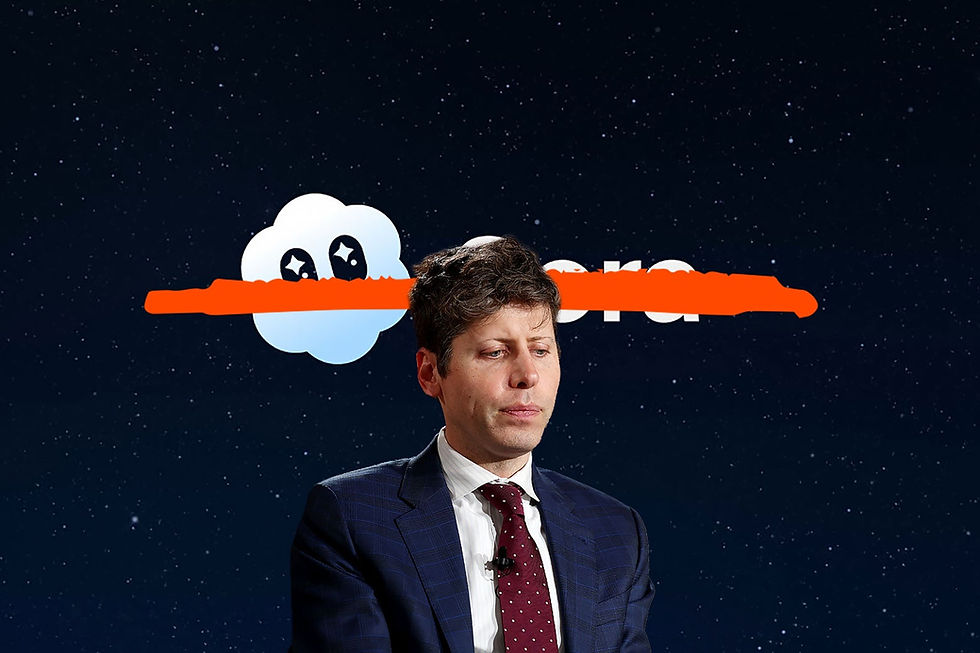
The abrupt shuttering of OpenAI’s Sora platform, scarcely months after its triumphal arrival, is not an isolated corporate decision but rather a revealing moment in the political economy of artificial intelligence. What appeared to be a dazzling consumer experiment in cinematic video generation from pure text prompts has, in short order, been sacrificed upon the altar of capital discipline, computational scarcity and strategic consolidation. In its rise and fall one may observe the emerging contours of an industry in which spectacle yields to infrastructure, and creativity is subordinated to systems capable of governing the physical world.
Sora’s initial success was undeniable. Launched as a text-to-video generator capable of producing startlingly realistic moving images, she captured public imagination and achieved rapid adoption, reaching mass downloads within days of release. Yet this very success concealed structural weaknesses. The platform’s popularity masked a steep decline in user engagement within months, as novelty waned and monetisation proved elusive. Sora was not merely expensive to build; it was expensive to sustain.
At the heart of the decision to close the platform lies the question of computational cost. Video generation, particularly at the level of realism Sora promised, demands orders of magnitude more processing power than text or even static images. OpenAI’s leadership has acknowledged that Sora consumed disproportionate computational resources relative to its economic return. In an era in which access to advanced chips and data centre capacity is itself a strategic constraint, such inefficiency is intolerable. Artificial intelligence firms now operate not unlike energy-intensive industries of the twentieth century, where resource allocation dictates strategic direction.
Closely intertwined with this is a shift in corporate priorities. OpenAI, facing intensifying competition from firms such as Google and Anthropic, has chosen to reallocate capital towards enterprise products, coding tools and what might be termed infrastructural intelligence systems. These are domains in which recurring revenue, contractual relationships and predictable demand replace the volatility of consumer applications. The closure of Sora therefore reflects a broader movement away from experimental consumer-facing products towards vertically integrated, business-oriented platforms.
Legal and ethical pressures have also played a decisive role. Sora’s capacity to generate hyper-realistic video exposed her to controversies surrounding copyright infringement, deepfakes and the unauthorised use of likenesses. Reports indicate that the platform enabled the creation of misleading, offensive and legally questionable content, including the use of protected characters and fabricated public figures. These issues are not merely reputational; they threaten litigation, regulatory intervention and the erosion of trust amongst commercial partners. The collapse of a high-profile collaboration with Disney underscores the fragility of such arrangements in the absence of robust intellectual property safeguards.
A further, more subtle factor is strategic reorientation towards what OpenAI terms “world simulation” and robotics. The company has indicated that the underlying research behind Sora will not be abandoned but redirected towards models capable of understanding and interacting with the physical world. Sora has been less a failed product than a prototype—an intermediate stage in the development of systems that may eventually control machines, vehicles and industrial processes. The cinematic illusion of motion thus gives way to the practical necessity of modelling reality itself.
The closure also reflects an impending financial milestone. As OpenAI positions herself for a potential public offering, the imperative to demonstrate profitability and operational discipline becomes acute. Projects that generate attention but not revenue are liabilities in such a context. Sora’s demise may therefore be read as a signal to investors: a declaration that the company is willing to abandon even its most celebrated innovations in pursuit of sustainable growth.
If Sora’s disappearance marks the end of one phase in generative media, what then may replace her? The marketplace is unlikely to remain vacant. Rather it is already fragmenting into several distinct trajectories.
First, integrated multimodal platforms will absorb much of Sora’s functionality. OpenAI herself has already explored incorporating video generation into broader systems such as ChatGPT, rather than maintaining a standalone application. This reflects a wider trend: users increasingly prefer unified environments in which text, image, audio and video generation coexist. The era of single-purpose creative tools may be giving way to general-purpose artificial intelligence interfaces.
Secondly, competitors are advancing rapidly. Firms such as Google and Meta are investing heavily in their own text-to-video technologies, often embedding them within larger networks of productivity software, social media or cloud services. These companies possess structural advantages in distribution and data, enabling them to deploy video generation not as a standalone product but as a feature within existing platforms. The result is likely to be a diffusion of capability rather than the dominance of any single application.
Thirdly, specialised enterprise solutions will proliferate. Rather than targeting consumers, future video-generation systems may be tailored for industries such as advertising, film production, training and simulation. In these contexts legal compliance, intellectual property control and predictable output are paramount. By constraining creative freedom, such systems may achieve commercial viability.
Fourthly, open-source and decentralised alternatives may emerge as a counterweight. As proprietary platforms retreat from high-risk domains such as unrestricted video synthesis, smaller actors may fill the gap with less regulated tools. This raises profound questions about governance, as the most powerful capabilities may migrate beyond the reach of corporate or state control.
Finally, one must consider the possibility that video generation itself will be subsumed within a larger technological paradigm. If the future lies in “world models” capable of simulating physical environments, then cinematic output becomes merely one manifestation of a deeper capability. In such a world, the distinction between generating a video and controlling a robot collapses; both are expressions of the same underlying (artificial) intelligence.
Sora’s fate therefore is not simply that of a discontinued application. It is emblematic of a transitional moment in artificial intelligence, in which the exuberance of early generative tools encounters the constraints of economics, law and strategy. Its disappearance signals the end of an era of experimentation and the beginning of one of consolidation. What replaces it will not necessarily be more imaginative, but it will be more durable, more controlled and, above all, more aligned with the twin imperatives of power and finance.


