


Steak, Vodka and a Missile Launcher: A Night Out in Kharkiv
By Matthew Parish
Saturday 3 October 2026
There are certain evenings in Ukraine that begin normally enough and then, without any obvious moment of transition, become completely insane. The peculiar thing is that nobody else seems particularly surprised. You look around the room expecting somebody to summon the police, an ambulance, the military authorities or possibly an exorcist, only to discover that everybody else is continuing with their dinner. So it was on a recent night in Kharkiv.
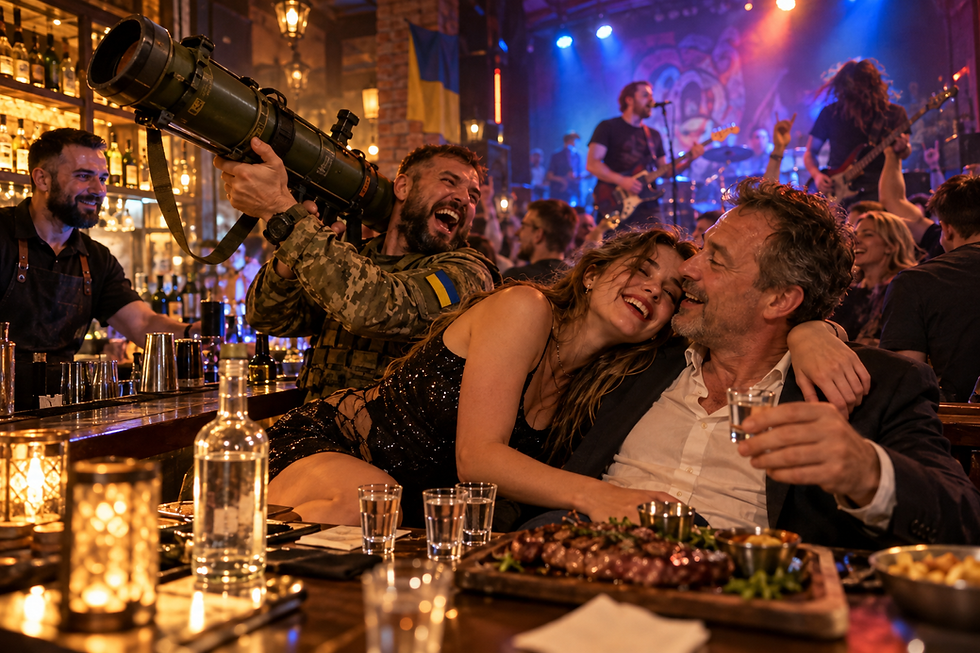
I had gone out for a steak. This was my first mistake, if mistake is the right word, because in wartime Kharkiv the decision to have a quiet dinner can apparently set in motion a chain of events culminating in your drinking repeated shots of vodka with a Ukrainian soldier while a shoulder-launched missile weapon circulates behind the bar and an exceptionally attractive drunken woman uses you as an improvised chaise longue. The steak, however, was excellent, and this deserves emphasis because throughout everything that followed I remained strangely preoccupied with it.
It was beautifully cooked, substantial and accompanied by all the appropriate trimmings. Whatever else one might say about life in Kharkiv, the city has not forgotten how to feed people. Russian missiles may fall upon the outskirts, Shahed drones may buzz overhead and air-raid alerts may interrupt the night, but somebody in a kitchen will still ask whether you would like your beef medium rare. This, in its own modest but important way, is civilisation.
Unfortunately, civilisation had also hired a live band. The band was positioned sufficiently close to the dining area that its principal function appeared to be preventing communication between human beings. They were not necessarily bad musicians; I cannot reliably express an opinion because once the amplification reached approximately the level of a jet engine being tested inside a railway tunnel, conventional aesthetic distinctions became irrelevant. They were simply phenomenally loud, and they seemed determined to become louder still.
Then the soldier arrived, or perhaps he was already there; events subsequently became somewhat difficult to reconstruct, for reasons that will become apparent. He was friendly, cheerful and drinking vodka. More importantly, he decided that I should also be drinking vodka. This conclusion appeared to have been reached without consultation with me, but I rapidly understood that consultation was unnecessary. A glass was placed in front of me and the ritual began.
“Slava Ukraini!” he cried, and naturally I replied, “Slava Ukraini!” We drank. Another glass appeared, the patriotic exchange was repeated and we drank again. I should explain that refusing vodka from a Ukrainian soldier during a war is psychologically difficult. There are all sorts of sensible reasons to refuse vodka: you may be tired, you may have work the following morning or you may have reached an age at which your liver has begun sending formal written complaints to management. None of these excuses seems terribly impressive when addressed to somebody who may shortly be returning to a battlefield.
So another glass appeared, another “Slava Ukraini!” was exchanged and down it went. At this point I returned urgently to my steak, having discovered that beef is an excellent defensive weapon against Ukrainian hospitality. Unfortunately, while I was concentrating upon the steak, the barman apparently decided that the evening required additional equipment.
He produced a shoulder-launched missile weapon. There are moments when one’s mind refuses to process what one’s eyes are reporting, and this was one of them. I looked at the object, then at the barman, then at the soldier and finally back at the object. Somewhere inside my increasingly vodka-saturated brain, the lawyer in me began drafting a risk assessment whose executive summary would have read: this is an extremely bad idea.
The barman handed the weapon to the soldier, an exchange that cannot reasonably be described as standard bar service. I have visited drinking establishments in many countries, and barmen have handed me beer, wine, whisky, receipts, menus, change, bowls of peanuts and occasionally telephone numbers written on pieces of paper. Until Kharkiv, none had ever produced what appeared to be infantry anti-armour equipment from behind the counter.
The soldier seemed delighted and began brandishing it towards the other customers. I would like to say that everybody immediately dived underneath the tables, that the music stopped or that a stern-looking manager appeared and explained that shoulder-fired weapons were prohibited under the establishment’s terms and conditions. Nobody did anything of the kind. People carried on drinking, the band carried on playing and I carried on eating my steak.
At approximately this point, an extremely attractive and extremely drunk young woman entered my immediate sphere of operations. She was dressed for a night out with admirable enthusiasm but rather less fabric, and she had reached that stage of intoxication at which the distinction between another human being and a convenient item of furniture becomes largely academic. She draped herself across me, then across the bar and then partially across both, while I continued trying to eat.
This required some dexterity. By now I was simultaneously managing a steak knife, repeated glasses of vodka, an affectionate stranger and the knowledge that somewhere within a few metres of me a Ukrainian soldier had recently been waving around a shoulder-launched missile weapon. The band, apparently dissatisfied with the degree of sensory overload already achieved, increased the volume.
This should not have been possible because there must surely be physical limits imposed by acoustics, architecture and the structural integrity of human eardrums. Nevertheless, the musicians found another setting on the amplifier. Conversation disappeared altogether. The soldier could have been explaining the complete operational doctrine of the Ukrainian Armed Forces to me and I would have heard approximately three words, one of which would inevitably have been “vodka”.
Another shot appeared and by now shouting was mandatory because normal speech had ceased to exist. “SLAVA UKRAINI!” came the cry, and I shouted “SLAVA UKRAINI!” in reply. We drank, I ate more steak, the young woman rearranged herself, the weapon fortunately remained unfired and the band attempted to kill everybody by acoustic means. Amidst all this, I experienced an extraordinary sensation of peace.
That is perhaps the part of the evening that most requires explanation. By every conventional measure the situation was ridiculous, and parts of it were objectively alarming. Alcohol and military weapons should never mix, and nobody should treat the casual brandishing of military hardware in a crowded bar as harmless entertainment. Yet there I sat, extraordinarily relaxed, enjoying an excellent steak while the whole improbable theatre of wartime Kharkiv unfolded around me. Perhaps this is what happens after spending enough time in Ukraine during a war: your standards for what constitutes an unusual evening become recalibrated.
There is nevertheless something more serious behind the comedy. Kharkiv lives under conditions that would overwhelm most European cities. Russia is close, the explosions are real, soldiers disappear to the front and sometimes do not return, families have been divided and homes destroyed, while ordinary expectations of personal security have been shattered. The possibility of death is not an abstraction discussed on television but something incorporated into the rhythms of everyday life. Under those circumstances, people do not necessarily become solemn; often they become louder.
They drink more enthusiastically, dance more energetically, dress more extravagantly and play music at volumes prohibited by several international conventions. They order another steak and another round. The intensity of life increases because everybody understands, even if nobody says so aloud, that normality has become precious and that the mundane pleasures of an ordinary evening are no longer things to be taken entirely for granted.
This is one of the paradoxes of wartime Ukraine that foreign observers frequently misunderstand. They expect a country at war to look continuously miserable. When they discover restaurants full of people, bars crowded late into the evening and women dressed beautifully for a night out, they sometimes imagine that the war cannot really be as serious as they have been told. Yet the opposite may be true: people go out precisely because the war is serious, and they celebrate precisely because tomorrow is uncertain.
They wear their best clothes because Russian missiles do not deserve the privilege of deciding what Ukrainians wear. Soldiers drink with strangers because for one evening they want to be men in bars rather than coordinates on a military map. Civilians eat steaks, flirt, laugh and listen to absurdly loud music because these are ordinary human activities, and maintaining ordinary human activities has itself acquired a peculiar importance in a society in which an invading army has attempted to make ordinary life impossible.
There are dangers in this psychology. Trauma cannot indefinitely be drowned in vodka, familiarity with weapons should not produce casualness about them and the behaviour I witnessed with the launcher was reckless irrespective of whether the object was operational, unloaded, disabled or something else entirely. War inevitably erodes boundaries, and some boundaries deserve to be vigorously restored. Yet human beings are complicated creatures, and the same evening can contain irresponsibility and courage, absurdity and sadness, recklessness and an overwhelming appetite for life.
Eventually I finished the steak, which by then felt like an achievement of some significance. The young woman remained alive, beautiful and spectacularly drunk. The soldier remained cheerful, while the barman remained, for reasons known only to himself, a man from whom military equipment might apparently emerge without warning. The band remained committed to eliminating the possibility of human hearing throughout eastern Ukraine, and another vodka appeared.
By now I knew the procedure. “SLAVA UKRAINI!” the soldier shouted above the music, and “SLAVA UKRAINI!” I replied. Down it went, although by this stage the distinctions between successive vodkas were becoming increasingly philosophical.
Somewhere outside, Kharkiv remained a frontline city. Air-raid alerts would come again, Russian drones would come again and soldiers would return to their units. Civilians would return to apartments where windows had been blown out, electricity might disappear and another night might be interrupted by explosions. But for these few hours, none of that was permitted to own the room.
The room belonged instead to the soldier, the drunken woman, the homicidally enthusiastic musicians, the inexplicable missile launcher, the excellent cook responsible for my steak and everybody else determined to spend an evening behaving as though life were something to be lived rather than merely survived. That determination is not quite heroism, and it should not be romanticised as such, but it is one of the quieter forms of resilience that keeps a city functioning after years of war.
There are quieter ways of understanding Ukraine, and there are probably more sensible ones. One can study military maps, read diplomatic communiqués, analyse casualty figures and debate the geopolitical intentions of Moscow, Washington and Brussels. Yet sometimes the reality of a country at war is revealed more vividly in the chaotic details of an ordinary evening: a good steak, far too much vodka, an affectionate stranger, an exuberant soldier and a band playing at a volume that seemed capable of competing with Russian artillery.
Kharkiv was still alive. On this particular evening, it was very, very loud.


