Potatoes for Donetsk Airport
By Matthew Parish
Thursday 8 October 2026
There are grand ways of describing patriotism, and there are potatoes. The history of Ukraine’s war is full of speeches about sovereignty, national identity, European values and the defence of the state. Yet some of the most revealing stories of the country’s resistance are considerably less sophisticated. They concern ordinary people putting ordinary things into ordinary cars and driving towards places from which every sensible instinct tells them to stay away.
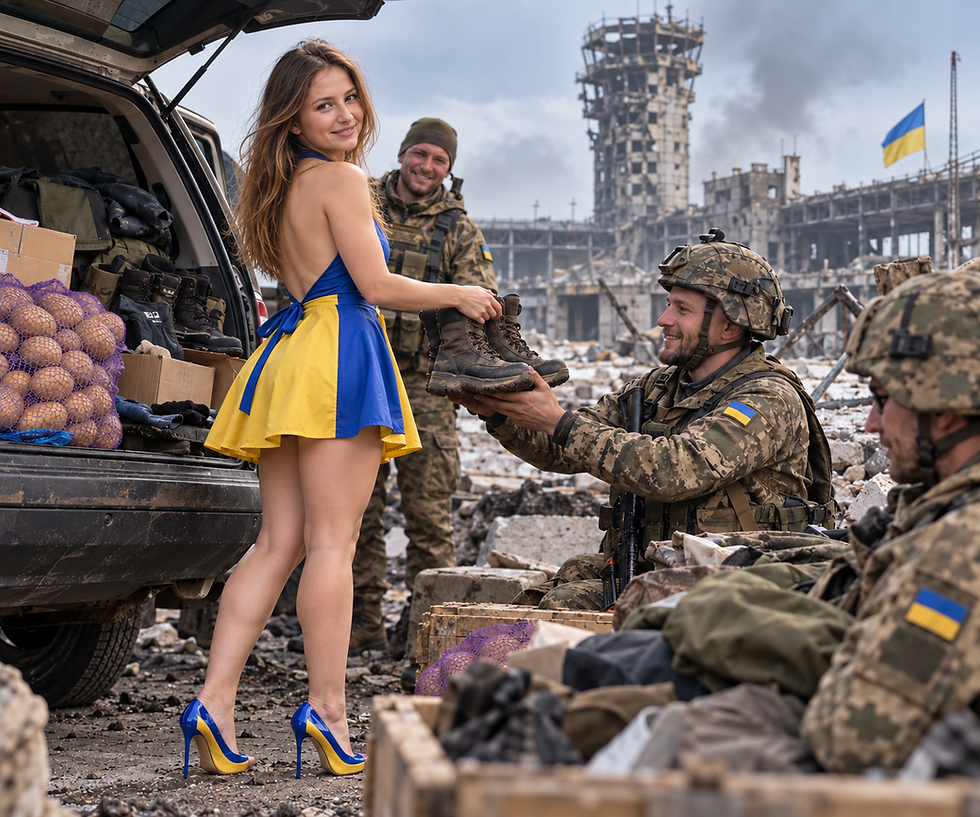
One such story belongs to a Ukrainian woman from Kharkiv whose name we shall not publish. During the battle for Donetsk airport, she travelled south-east from Kharkiv carrying clothes and potatoes for Ukrainian soldiers. There was nothing glamorous about what she was taking them. There were no sophisticated military supplies, no expensive pieces of equipment and none of the paraphernalia that we have subsequently come to associate with Ukraine’s extraordinarily developed volunteer movement. There were clothes, because soldiers become cold, wet and dirty, and potatoes, because soldiers need to eat.
That apparent banality is precisely what makes the story important. Wars are remembered through battles, generals, destroyed buildings and political decisions. They are experienced rather differently by the people who fight them. A soldier defending an exposed position does not live principally in the world of geopolitical theory. He lives in a world of hunger, cold, exhaustion, ammunition, socks, cigarettes, batteries, hot drinks and the prospect that somebody might bring him something to eat.
The fighting for Donetsk airport became one of the defining episodes of the earlier stages of Russia’s war against Ukraine. The Ukrainian defenders became known as the “Cyborgs”, a name intended to convey their apparently superhuman capacity to endure conditions that seemed impossible. Yet the name can also obscure something important. They were not cyborgs. They were human beings. They became hungry. Their clothes became filthy. They were frightened, tired and cold. Their survival depended not merely upon courage and military organisation but upon an immense network of people behind them who understood that armies require societies to sustain them.
Our anonymous woman from Kharkiv was one of those people. She was not obliged to make the journey. Nobody had conscripted her into transporting vegetables towards a battlefield. She could have remained at home, watched the news and expressed sympathy with the soldiers fighting farther south. Instead she gathered together things they needed and travelled towards them.
Today it is difficult to reconstruct psychologically just how extraordinary such journeys were at the time. The Ukraine of those years had not yet acquired the vast wartime experience it possesses now. The routines of volunteering, military fundraising and civilian logistical support that have become familiar since the full-scale invasion of February 2022 were then being improvised. People learned what soldiers needed by asking them, finding the goods, filling vehicles and driving.
Kharkiv occupied a particularly complicated position in this emerging geography of resistance. It was a predominantly Russian-speaking city close to the Russian frontier, with profound historical, commercial and family connections across the border. Moscow’s political mythology repeatedly assumed that cities such as Kharkiv would naturally fall into a Russian sphere of allegiance. The behaviour of countless Kharkiv residents demonstrated how crude that assumption was.
Language was not loyalty. Cultural proximity was not political submission. A person could speak Russian, have Russian friends or relatives, consume Russian culture and nevertheless regard Ukraine as unequivocally her country. The woman driving potatoes towards Ukrainian soldiers outside Donetsk represented this distinction rather better than any political scientist could have done.
She was also participating in the creation of something that would later prove indispensable to Ukraine’s survival: the civilian logistics of resistance. Long before international governments were sending weapons to Ukraine on the scale familiar today, Ukrainians were supporting their own armed forces through informal networks. Volunteers bought clothing, food, medical equipment and vehicles. They collected money from friends and neighbours.
They drove supplies across enormous distances, frequently towards dangerous areas and sometimes without any particularly sophisticated understanding of what awaited them.
This system was necessarily chaotic. It was also extraordinarily resilient because there was no single centre that could be destroyed. Thousands of people independently decided that somebody had to do something and that the somebody in question might as well be them. A woman with a carload of clothes and potatoes was a tiny component of this structure, but structures of national resistance are made from thousands upon thousands of precisely such tiny components.
There is something peculiarly Ukrainian about the potatoes as well. This was not the polished humanitarianism of international conferences, branded aid packages and carefully photographed distributions. Potatoes are heavy, dirty and inexpensive. They are also useful. They can feed a large number of people, they keep reasonably well and they form part of the ordinary culinary landscape of this part of Europe. Taking potatoes to soldiers was therefore an intensely practical gesture: here is food; eat it.
The clothes carried a similarly direct message. A person somewhere away from the front had thought about the physical discomfort of people she did not necessarily know. She understood that they needed something clean and warm to wear. She obtained it and took it to them. In war, compassion frequently assumes this strangely prosaic form.
The journey itself matters because the direction of travel was wrong according to every ordinary human instinct. Civilians flee wars. They travel away from artillery, checkpoints, armed men and ruined buildings. The roads around a conflict are filled with people trying to reach somewhere safer. Volunteers invert this logic. Having no military obligation to do so, they drive towards danger carrying whatever the people already there require.
That does not necessarily mean they are fearless. Indeed courage is an unhelpful concept if it implies the absence of fear. People who undertake such journeys may be acutely aware of what can happen to them. Roads can be shelled. Checkpoints can change hands. Vehicles break down. Information becomes unreliable. A route believed safe in the morning may be dangerous by the afternoon. Courage consists in understanding these things and nevertheless deciding that the journey has sufficient purpose to justify making it.
The battle for Donetsk airport eventually acquired a legendary status in Ukrainian national memory. Legends, however, have a habit of simplifying the people within them. They transform frightened and exhausted human beings into statues. They turn complex events into symbols. Symbols are useful for nations, particularly nations at war, but they can make us forget the mundane infrastructure upon which heroism depends.
Behind every celebrated defender there must be somebody bringing food. Behind every unit holding a position there are mechanics, medics, drivers, relatives and strangers collecting whatever is required. Behind the photographs of soldiers standing amongst concrete ruins there are innumerable journeys that were never photographed at all.
Our anonymous woman’s journey belongs to this second history of the war. It is not the history that appears prominently on military maps. No arrow indicates the movement of a civilian vehicle from Kharkiv carrying clothes and potatoes. No communique announces its arrival. There is unlikely to be a monument erected to it.
Yet Ukraine’s survival has depended upon precisely this relationship between the people carrying weapons and the people carrying everything else. The distinction between the front and the rear has repeatedly become blurred because Ukrainian society has treated its armed forces not as an isolated institution but as something embedded within families, friendships, businesses, charities and communities. Soldiers fight, but societies sustain soldiers.
The story also provides continuity between the Ukraine that defended Donetsk airport and the Ukraine fighting the vastly larger war that followed. Many practices now regarded as normal were learned during those earlier years: volunteer procurement, private fundraising, civilian transport, rapid improvisation and the habit of responding to shortages without waiting for the state bureaucracy to solve them. The extraordinary volunteer mobilisation after February 2022 did not emerge from nowhere. Its institutional memory had been developing for years.
There is consequently a temptation to describe the woman’s journey as heroic. Perhaps it was. But that word may be too grand for the spirit of the act itself. The most striking quality of Ukrainian civilian volunteering is often its refusal to regard extraordinary behaviour as extraordinary. Somebody needed potatoes. Somebody needed clothes. Therefore somebody took them.
This matter-of-fact attitude may tell us more about Ukraine than many elaborate theories of national identity. Nations are not held together exclusively by flags, constitutions or historical narratives. They are also sustained by countless acts of reciprocal obligation: the conviction that strangers are nevertheless your people, and that their difficulties therefore impose some responsibility upon you.
A woman left Kharkiv and drove towards a battle carrying clothes and potatoes. The soldiers at Donetsk airport were fighting over territory, sovereignty and the future political existence of their country. She was participating in precisely the same struggle, although she carried no weapon.
Years later, amid a war incomparably larger and more destructive, that distinction remains worth remembering. Ukraine has survived not only because people have been prepared to fight for it, but because other people have been prepared to feed those who fight, clothe them, transport supplies to them and travel down dangerous roads simply because something is needed at the other end.
Sometimes the history of a nation can be contained in something as humble as a sack of potatoes.