Artificial Intelligence and the Limitless Imagination
By Matthew Parish
Thursday 8 October 2026
Artificial intelligence is often described as a threat to human creativity. The more interesting possibility is that it may prove to be one of its greatest accelerants. Every substantial enlargement of humanity’s capacity to create has been accompanied by a comparable anxiety, usually expressed with great confidence by people whose assumptions about creativity were formed by the preceding technology.
Photography was supposed to destroy painting. Recorded music threatened the livelihood and perhaps even the purpose of the performing musician. Cinema seemed, for a while, to reduce theatre to an antiquarian curiosity, while television was going to destroy cinema, electronic synthesisers were going to destroy musicianship and the internet was going to destroy literature. None of these things happened. The arts changed, sometimes violently, but the human appetite for imagination proved remarkably difficult to extinguish.
Artificial intelligence represents something considerably more profound than most of these earlier technological changes because it does not merely provide another medium in which an artist may work. It provides something closer to an interlocutor for the imagination. A person may describe something that has never existed, refine it through conversation, reject what has been produced, introduce another idea and gradually move towards an artefact that previously existed only in an indistinct corner of the mind.
This can be done with words, images, music, moving pictures and increasingly with combinations of all of them. The consequences may be extraordinary, but they may also force us to reconsider what we mean when we talk about creativity in the first place.
The prison of technique
Human imagination has always been larger than the technical capacities available to express it. A child may imagine an entire civilisation but cannot paint it. A novelist may conceive perfectly the appearance of a fictional city but cannot compose the orchestral score that ought to accompany it, while a musician may have an exquisite visual imagination but no ability whatsoever to draw. A painter may conceive a dramatic story but lack the literary discipline necessary to turn it into a novel.
We have traditionally accepted these limitations as an inevitable feature of artistic life. The artist spends years acquiring the technical skills necessary to narrow the distance between imagination and execution. Indeed, mastery of technique has often been treated as almost synonymous with artistic achievement: the pianist practises scales, the painter studies perspective and anatomy, the novelist writes a million unsuccessful words and the film director assembles an expensive collection of actors, technicians, cameras, sets and editing facilities.
There is great value in such disciplines and artificial intelligence does not abolish it. Yet we should distinguish technical difficulty from imagination because they are not the same thing. The ability to paint a horse accurately is not identical to having something interesting to say about horses, just as the ability to write grammatically perfect prose is not identical to possessing a story worth telling.
Artificial intelligence begins to separate these things. It reduces the technical price of admission to forms of artistic expression that previously required years of specialised training. This can understandably alarm those who have paid that price, but from the perspective of human civilisation as a whole, the democratisation of expressive capacity ought to be regarded as an astonishing opportunity.
A person who cannot draw can now begin creating visual worlds. Someone unable to play a musical instrument may nevertheless experiment with composition, while a writer can begin imagining cinematic adaptations without commanding a film studio. A small theatre company may create scenery that would once have required the resources of a national institution, and independent game designers can populate imaginary universes that previously demanded teams of hundreds.
The gates surrounding the arts are beginning to open. What lies beyond them may be chaotic, vulgar, brilliant and frequently ridiculous, but that is true of virtually every period in which the means of cultural production have suddenly become available to more people.
Imagination without budgets
The history of artistic production is partly a history of money. Marble costs money, orchestras cost money and film sets cost money. Actors, costumes, recording studios, printing presses, galleries, distribution networks and advertising campaigns all cost money as well. Consequently there has always been an enormous difference between what a human being can imagine and what he or she can afford to create.
Cinema provides perhaps the most obvious example. A novelist can destroy a city with a sentence, whereas a filmmaker wishing to accomplish the same thing may require tens of millions of dollars. Hence the curious relationship between imagination and capital that developed in twentieth-century cinema: the more spectacular the imaginary world, the greater the financial resources necessary to bring it to the screen.
Artificial intelligence has the potential radically to compress this relationship. We are moving towards a world in which a single person may be able to create increasingly sophisticated films, animations, musical compositions and interactive environments from an ordinary computer. What once required a studio may eventually require little more than a desk and an unusually fertile imagination.
This will not necessarily make great art easier. It will make making art easier, which is a quite different proposition. When everyone possesses the capacity to produce technically impressive work, judgement, taste, originality and imagination become more important rather than less.
If a machine can produce a beautiful sunset on command, the important artistic question is no longer whether one possesses the technical skill to depict a beautiful sunset. The question becomes why the sunset belongs in the work at all. This distinction may become central to the arts of the artificial intelligence era: technical competence will become abundant, while meaning will remain scarce.
The machine as collaborator
There is another way of thinking about generative artificial intelligence that moves beyond the idea of the machine merely executing instructions. Interaction with an AI system can itself become part of the creative process. This is less alien to traditional artistic practice than it might initially appear.
Writers have always talked to themselves. Painters sketch alternatives, composers improvise and architects produce models that they subsequently discard. Creativity seldom proceeds in a straight line from conception to completion. It consists of innumerable acts of experimentation in which the creator encounters the consequences of an idea and then changes his or her mind.
Artificial intelligence enormously increases the speed at which this dialogue can occur. Ask for an imaginary building combining Byzantine architecture with twenty-second-century engineering and one can inspect the result almost immediately. Make it taller, put it beside the sea, imagine that the civilisation constructing it had never discovered the arch, move it to another planet and then show what it looks like after five hundred years of abandonment.
Each result generates another idea. The process becomes a conversation between intention and accident in which the machine continuously presents possibilities that provoke the human imagination into making further choices.
This is important because human imagination is stimulated by things it encounters. We do not create exclusively from some mysterious internal reservoir; we respond to landscapes, conversations, books, mistakes, memories, dreams and the works of other people. A generative machine can produce an endless sequence of intellectual provocations against which the human mind reacts, and the artist therefore does not necessarily disappear. The artist may become increasingly a director of possibilities.
The infinity problem
This creates a paradox because the scarcity that characterised earlier artistic production imposed discipline. A photographer with thirty-six exposures on a roll of film thought carefully before pressing the shutter. A filmmaker shooting expensive celluloid could not generate ten thousand versions of every scene, while an author could revise indefinitely in principle but the labour involved placed practical limits upon experimentation.
Artificial intelligence removes many of these constraints. A person can generate fifty images and dislike all of them, then generate fifty more. A musical passage can be rearranged endlessly, a story can be rewritten in a hundred voices and characters can be added, removed, resurrected and transformed. Entire imaginary worlds can proliferate faster than their creator can properly examine them.
The problem of artistic creation may therefore invert. For most of history, artists struggled to realise possibilities; the AI artist may struggle to choose between them. The challenge will no longer always be how to make something but how to decide which of a thousand things capable of being made deserves to exist.
Selection consequently becomes an artistic faculty of the highest importance. When almost anything can be generated, the decisive creative act becomes saying: this. Not the other nine hundred possibilities, but this image, this sentence, this sequence and this silence. Taste becomes a form of authorship, and restraint may become one of the most valuable artistic skills in an age of infinite production.
The rediscovery of the impossible
The most exciting artistic uses of artificial intelligence are unlikely to consist in reproducing things we already know how to make. There is limited cultural significance in asking a machine to produce another competent landscape painting, another conventional pop song or another derivative detective story. Such things may be entertaining, but they barely scratch the surface of what happens when the costs of exploring imaginary possibilities collapse.
The greater possibilities lie in asking what could not previously be created at all. Imagine novels that transform themselves according to the reader’s questions while retaining thematic coherence, or paintings that evolve over years in response to the environment around them. Imagine virtual cities with histories extending backwards for centuries, populated by characters whose biographies intertwine in ways no single novelist could completely anticipate.
We might equally imagine symphonies that respond to the architecture in which they are performed or interactive historical reconstructions in which one can walk through ancient Alexandria, Renaissance Florence or nineteenth-century Odesa and converse with plausible inhabitants. Some of these things will be gimmicks and some will be dreadful. A tiny proportion may constitute entirely new artistic forms for which we do not yet possess names.
That is usually how technological changes in culture work. The earliest cinema borrowed heavily from theatre because nobody initially understood what a moving-picture camera was uniquely capable of doing. Early television borrowed from radio and theatre, while early websites resembled printed pages. New media begin by imitating old ones until artists discover the peculiar grammar of the new technology.
We are presently at this primitive stage with artificial intelligence. We are making pictures, songs, essays and films because these are categories we already understand. The genuinely interesting question is what forms of art become possible when artificial intelligence stops imitating the categories inherited from the twentieth century and starts enabling forms of creative expression that previously could not have existed.
The human residue
There remains the objection that if machines eventually become extraordinarily good at producing artistic objects, the human contribution will become redundant. This depends upon what we believe art is for. If art is merely the production of aesthetically pleasing objects, machines may indeed become formidably successful artists, but human beings have seldom cared about art exclusively because of the formal qualities of the objects produced.
We care about who made works of art, why they made them, what happened to their creators, what they were trying to communicate and what their work tells us about the human condition. A technically perfect imitation of a Van Gogh is not another Van Gogh. The significance of Van Gogh’s paintings cannot be separated entirely from the human being who painted them, the historical world in which he lived and the extraordinary sensibility through which he perceived it.
Likewise, a love poem acquires part of its meaning from the fact that somebody loved somebody else enough to write it. Artificial intelligence therefore presents us with an intriguing distinction between content and expression. Machines may become capable of extraordinary expression, but humans remain the creatures for whom things matter.
A machine can generate a lament, but a human being has lost someone. A machine can construct an image of home, but a refugee knows what it means to lose one. A machine can describe a battlefield, but a soldier remembers one. These distinctions do not imply that machine-generated works are intrinsically worthless; rather, they remind us that art is embedded in human life in ways that cannot be reduced to technical production.
Ukraine and the imaginative machine
This distinction has particular resonance in contemporary Ukraine. War is an assault not merely upon territory and human life but upon imagination. It attempts to reduce the future to a narrow range of brutal possibilities: survival, destruction, occupation, victory or defeat. Yet societies enduring war invariably respond by imagining beyond it, because imagination itself becomes one means of refusing to accept the permanence of catastrophe.
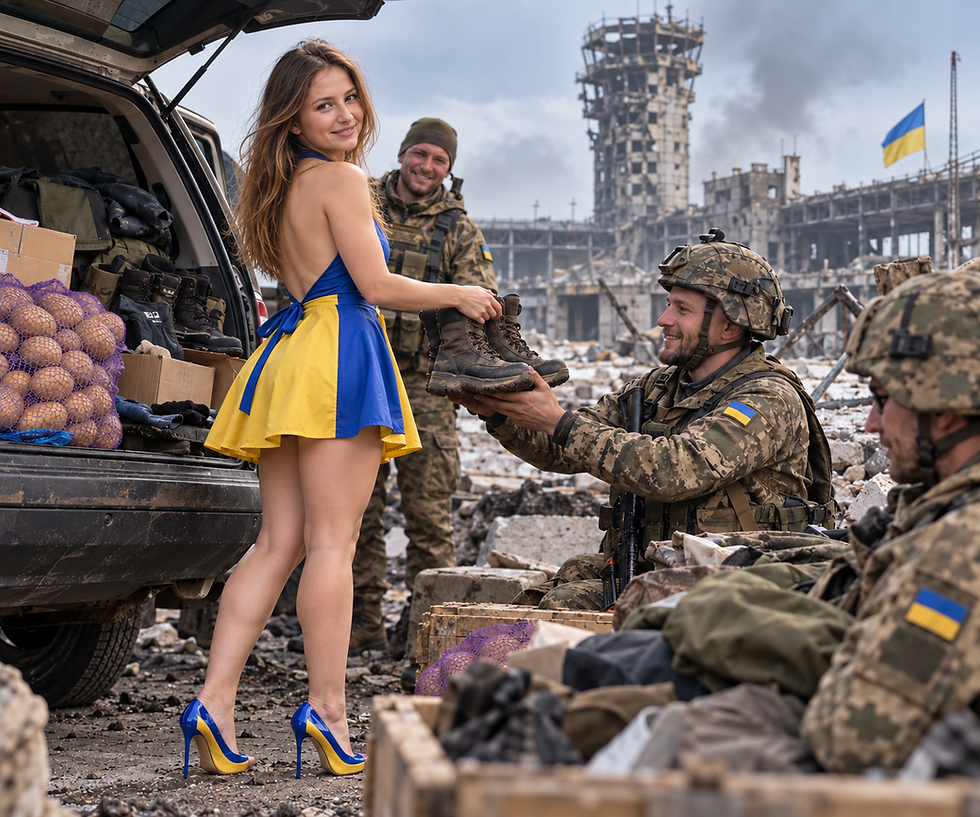
Ukraine has produced an extraordinary visual culture since February 2022. Murals, digital illustrations, music, photography, poetry, jokes, memes and countless improvised forms of popular art have become part of the country’s psychological resistance. Some are beautiful, some absurd and some deliberately grotesque, but together they represent a refusal to permit war to monopolise the imagination.
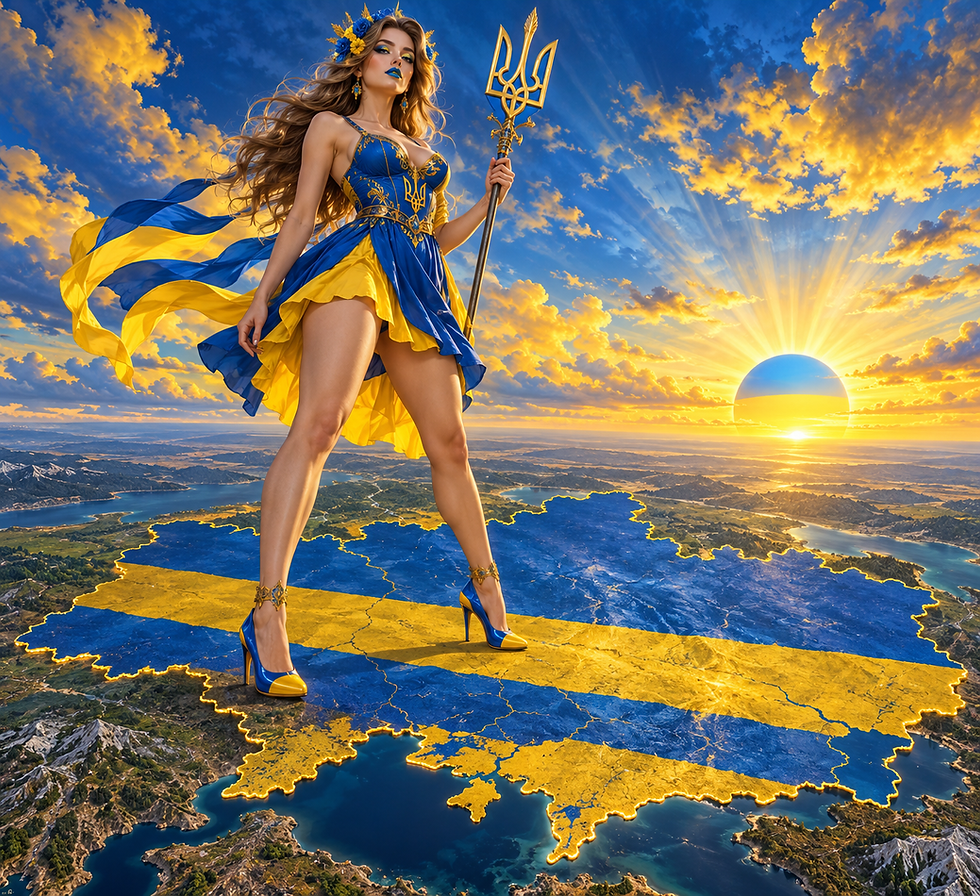
Artificial intelligence can become another instrument in this process. It allows people living amid destruction to imagine reconstruction, preserve memories, experiment with impossible landscapes and turn the surreal circumstances of wartime existence into equally surreal artistic forms. A damaged city can be imagined restored, a drone can become a mythological creature and a railway station can become the setting for a fairy tale.
The grim furniture of war can thereby be rearranged by imagination until it ceases, momentarily at least, to dictate the terms upon which reality must be understood. There is something profoundly human about this because tyranny attempts to restrict the imaginable, whereas art expands it.
A civilisation of creators
The deeper transformation may therefore be cultural rather than technological. For most of history, societies have maintained a practical distinction between creators and audiences. A minority wrote the books, composed the music, painted the pictures and made the films, while everyone else consumed them.
That distinction may gradually weaken. A child growing up with generative artificial intelligence may find it perfectly natural to create an illustrated story in the morning, compose music for it after lunch and transform it into an animated film in the evening. He or she may not regard any of these activities as requiring membership of a professional artistic caste. Creation may become an ordinary component of literacy.
This does not mean that everybody will become Shakespeare, Mozart or Picasso. The invention of cheap pencils did not turn everybody into Leonardo da Vinci, universal literacy did not make everybody a great novelist and cameras in billions of mobile telephones have not made everybody a great photographer. Nevertheless, all these technologies allowed billions of people to express things that would otherwise have remained unexpressed.
Artificial intelligence may multiply this phenomenon on an unprecedented scale. Countless images that previously existed only momentarily in somebody’s imagination may acquire visible form. Stories that would never have been written may be told, music that nobody possessed the technical training to perform may be heard and entire imaginary worlds may emerge from people who would never previously have considered themselves artists.
Most of this material will vanish, just as most human conversation vanishes. That does not make it worthless because creativity does not acquire value only when museums preserve it. A picture made for one friend, a song created for one evening or an imaginary world shared between a parent and a child can possess value without requiring the approval of critics, galleries or posterity.
The limitless horizon
We should therefore be cautious about describing artificial intelligence principally as a competitor with human artists. Competition will certainly occur, professions will change and some commercial forms of artistic labour will undoubtedly come under severe pressure. Questions concerning copyright, attribution, training data and the economic position of professional creators are genuine and difficult, and romantic declarations about technological progress should not be allowed to obscure them.
Yet these controversies concern the organisation of artistic industries. They do not exhaust the philosophical significance of what is happening. Something considerably stranger is taking place beneath the arguments about copyright and employment: the boundary between imagining something and giving it perceptible form is becoming thinner.
For the first time, humanity is constructing machines capable of responding to imagination with imagination-like outputs. We can describe things that do not exist and watch versions of them appear before us. We can reject them and try again, combine concepts separated by centuries, continents or artistic disciplines and explore counterfactual worlds with an ease that would have seemed magical within living memory.
The machine does not therefore have to replace the imagination. It can enlarge the territory through which imagination travels, while human beings remain responsible for deciding which destinations are interesting, beautiful, disturbing, funny, moving or worth pursuing at all.
Perhaps the most consequential artistic effect of artificial intelligence will ultimately be not what machines create but what human beings discover that they wanted to create once the practical barriers began to disappear. We have spent thousands of years living with the assumption that imagination must eventually surrender to the limitations of technique, money, time and physical materials. That assumption is beginning, however imperfectly, to weaken.
Human imagination has never suffered from a shortage of worlds; the difficulty has always been getting them out of our heads. Artificial intelligence may be opening the door, and we have barely begun to discover what lies on the other side.