Inside Putin’s Secret War, Part II: The Machinery of Russian Intelligence
By Matthew Parish
Saturday 3 October 2026
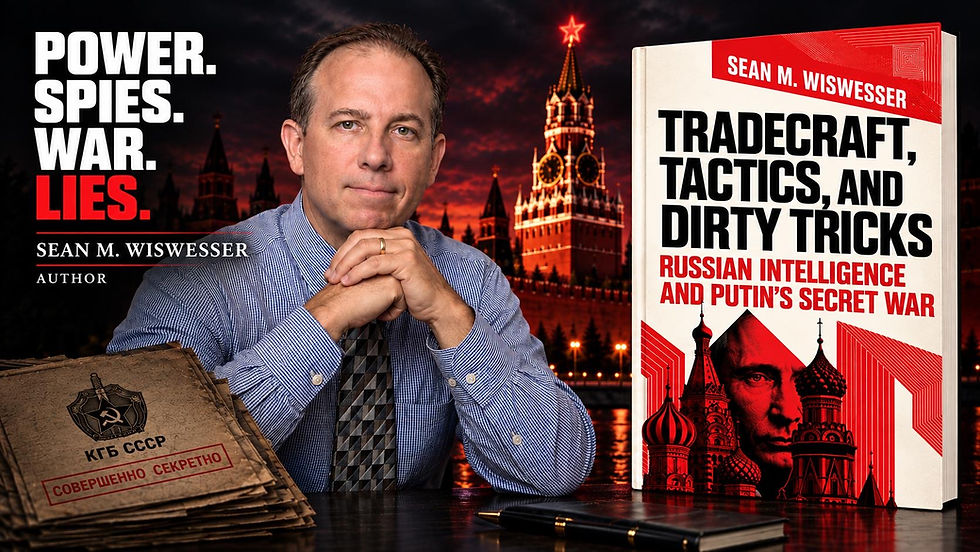
Matthew Parish, Editor-in-Chief of the Lviv Herald, continues his conversation with former CIA Chief of Station Sean M. Wiswesser, author ofTradecraft, Tactics, and Dirty Tricks: Russian Intelligence and Putin’s Secret War, about the relationships between espionage, business and organised crime, the meaning of Russian “active measures”, attacks upon public trust and the peculiar combination of sophistication and recklessness that characterises Russian intelligence operations.
In the first part of my conversation with Sean M. Wiswesser, we explored the intensely human dimensions of espionage. Wiswesser, who spent almost three decades in the CIA and the broader United States intelligence community, explained why recruitment is ordinarily a process rather than an event: relationships develop, boundaries move and a person who imagines that he is accepting nothing more consequential than an invitation to dinner may discover much later that the relationship has acquired an entirely different character.
That discussion had a particular resonance for me because some of these themes appear in my forthcoming book, The Spy: A Memoir. My perspective, however, is necessarily different from Sean’s. He spent his professional career practising intelligence work and countering Russian intelligence services; my experiences were those of somebody who found himself encountering this peculiar world from outside it. The intersection between those perspectives was one of the reasons for this extended conversation.
Yet espionage is not only about the relationship between an intelligence officer and a potential source. The Russian intelligence system described in Wiswesser’s book extends into a far larger ecosystem. Business, money, organised crime, journalism, political influence and information warfare may all become components of intelligence activity. One of the difficulties Westerners encounter in understanding contemporary Russia is that institutional distinctions we take for granted are not necessarily replicated there.
In Part II, therefore, our conversation moves outwards. We begin with what happens when a recruitment fails and then examine the porous boundaries between Russian intelligence, commerce, organised crime and political power. From there we turn to one of the most frequently misunderstood concepts in contemporary discussion of Russia — the “active measure” — and finally to the mixture of formidable capability, institutional corruption, occasional incompetence and increasing brazenness that Wiswesser identifies in Russian intelligence operations.
Matthew Parish: Sean, at the end of Part I we discussed the gradual nature of intelligence recruitment. Somebody might begin with an introduction, an apparently innocuous piece of information or an ordinary professional relationship and travel considerably further than he originally anticipated. But let us consider the opposite situation. What happens when the target recognises what is happening and simply says no? Does a failed recruitment end the matter, or does the refusal itself become useful intelligence?
Sean Wiswesser: A refusal itself tells an intelligence officer something. A failed recruitment today does not necessarily mean someone will never be approached again.
Circumstances change. Careers change. Financial circumstances change. People become angry, isolated, ambitious or disappointed.
For the Russian intelligence services they often prefer the “stick”, as I always say, so they move from persuasion towards intimidation or coercion where circumstances permit. But professional services generally prefer a willing source when they can get one because a willing source is usually easier to manage.
Matthew Parish: This brings us to something that has interested me throughout my own dealings with Russia and the former Soviet world: the relationship between intelligence and commerce. In Western countries we tend to draw fairly clear conceptual distinctions between a businessman, a government official and an intelligence officer. In Russia, those distinctions can sometimes appear less straightforward. How extensively do the Russian intelligence services use the commercial world, whether for access, operational cover, financing or relationships?
Sean Wiswesser: Extensively, because commerce provides access, legitimacy, money and relationships. The SVR in particular invested in companies in the 1990s, or more specifically — they required companies to invest in them, Russian intelligence. The FSB did the same thing. All the RIS are deeply embedded with and among companies and corporations in Russia. This is why they have no analogous services in the West.
In terms of krisha, or operational cover for intelligence officers: not every Russian businessman is an intelligence operative, nor is every suspect foreign businessman with other passports a Russian nelegal, or illegal. We should absolutely resist that type of simplistic thinking.
But Russia’s system makes the dividing lines difficult. Political power, intelligence services, oligarchic wealth, corruption and business networks have been interconnected for decades under Putin.
That is one reason Westerners sometimes struggle to understand the system. We attempt to impose institutional distinctions that make sense in Washington, London or Brussels onto a Russian system where those boundaries are much more porous.
Matthew Parish: That qualification seems particularly important. There is an obvious danger that once somebody becomes aware of the extent to which intelligence services can use commercial networks, he starts seeing an intelligence officer behind every Russian businessman. But there is another shadow world here as well: organised crime. Popular culture has long portrayed Russian gangsters and Russian spies as inhabiting overlapping universes. How separate in reality are the Russian state, its intelligence services and organised crime?
Sean Wiswesser: They are separate institutions — but the boundaries between them can be extraordinarily porous. They collaborate actively, meaning the FSB in particular extorts organised crime to service their — Russian intelligence — needs.
Russian intelligence has used criminal intermediaries for decades. That is not new. The KGB also extorted organised crime. There was no real vori v zakone — “thieves in law” — when it came to collaborating with the KGB: you either did, or you ended up with longer prison terms or in prison; you died a quiet death. So despite what the movies say, these relationships go back a long way.
What Putin’s system adds is a political structure in which corruption itself has become systemic. Russia is a vast kleptocracy. Those in power ARE the greatest organised crime figures in Russia — for real.
Intelligence and security officials wield political and economic power, businessmen require political protection and organised crime can provide useful deniable capabilities.
That does not mean every criminal is controlled by the Kremlin. But it means the relationships among intelligence, state power, business and criminality can be considerably more fluid than Westerners are accustomed to.
Matthew Parish: I want to turn now to a term that appears constantly in discussions of Russian intelligence but is frequently used to describe almost anything Russia does covertly: “active measures”. You have been quite insistent that assassination and sabotage, for example, should not simply be described as active measures. What does the expression actually mean in the Russian intelligence tradition?
Sean Wiswesser: This is a distinction I feel strongly about because the term is constantly misused.
Assassination and sabotage are not active measures. Those are direct actions.
Active measures traditionally involve information and influence operations designed to affect another country’s politics, policies or population — ideally while hiding Moscow’s hand. Information warfare for the Russians and their traditions goes back far before social media.
What technology has done is magnify it enormously. Activities that once required intelligence officers, recruited journalists, front organisations and enormous amounts of human effort — like the 2016 hack of US Democratic Party servers by “Fancy Bear”, a GRU group — can increasingly be conducted through social media, trolling, automated systems and AI.
The methodology is old. The scale is revolutionary.
Matthew Parish: That last distinction strikes me as essential. We often talk about disinformation as though its purpose must be to make somebody believe a particular falsehood. Yet there seems to be another possibility, potentially much more corrosive. Perhaps I do not need to persuade you that my version of events is true. Perhaps it is sufficient for me to persuade you that nobody can know what is true. Is the destruction of confidence itself one of the objectives of Russian information operations?
Sean Wiswesser: Absolutely, and active measures — also now called “measures of support” by the SVR — are meant to sow confusion, discord, create dissent. That is essential to understanding Russian information warfare.
The Russians do not necessarily need you to believe Moscow’s version of events.
They can win simply by getting you to believe that nobody’s version can be trusted.
If citizens lose confidence in elections, journalism, courts, governments and ultimately one another, democratic institutions become weaker.
That is why I repeatedly say the ultimate enemy is not one politician or political party. It is democracy itself.
The Russians win when we begin doing their work for them — when democratic societies become so divided and cynical that citizens conclude their own system is illegitimate.
Matthew Parish: This raises a subject particularly close to home for the Lviv Herald: journalism. Journalists cultivate sources, protect confidences, travel, meet government officials and ask questions that governments sometimes find inconvenient. Superficially, at least, some of those activities resemble things intelligence officers also do. How have Russian and Soviet services historically exploited journalists, and where should we insist upon the distinction between journalism and espionage?
Sean Wiswesser: Journalism is naturally attractive to an intelligence service because journalists have access. They cultivate sources, meet government officials, travel widely and collect information.
Historically Russian and Soviet services have used journalists in active measures and influence operations, including recruited journalists and media channels. Sometimes they refer to them, if willing participants, as “useful idiots”, to borrow Lenin’s term. On other occasions they are paid agents of Russian intelligence meant to spread disinformation.
But the distinction is essential: legitimate journalism is not espionage. There is very little of that left in Russia, though, due to the murderous reprisals and assassinations against heroic journalists like Anna Politkovskaya.
Matthew Parish: My own experiences have taken me through rather different environments — Moscow and Geneva, the Balkans and now wartime Ukraine — and one thing that interests me is how intelligence methods adapt to place. An FSB officer in Moscow operates within an entirely different legal and political environment from an SVR officer working under diplomatic cover in London. How portable is Russian tradecraft? Do the techniques change fundamentally as the environment changes, or do recognisable habits persist?
Sean Wiswesser: If you mean it is used in a variety of environments then yes, very “portable”, although the operational environment changes dramatically.
An FSB officer operating inside Russia has authorities and resources that an SVR officer under diplomatic cover in London or Washington obviously does not.
Inside Russia the security services have enormous surveillance capabilities and essentially no meaningful political oversight. They often mistake that level of control when they operate abroad, witnessed by the number of Russians rolled up in bungled operations. I detail this in Chapter 8 of my book on Russian special operations, and many of their failures.
Abroad the RIS must operate within someone else’s counter-intelligence environment.
But certain traditions persist: deception, cultivation, patience, exploiting human vulnerabilities, the use of intermediaries and what Russians call maskirovka.
Technology and geography change. Many fundamentals of HUMINT do not.
Matthew Parish: There is a curious contradiction here. Western discussion of Russian intelligence sometimes veers between two extremes. In one version, Russian intelligence officers are omniscient chess grandmasters capable of manipulating events around the world. In the other, we read about botched operations, exposed agents and embarrassingly elementary mistakes. Having spent so much of your career working against these services, which picture is right? Are they formidable, or are they sloppy?
Sean Wiswesser: Both. And Western analysis makes a serious mistake when it insists upon choosing one of those descriptions. I get this question a lot.
Russian intelligence services have suffered spectacular failures. Their illegals have been caught. Their officers have made mistakes. Their operations have been exposed.
But they only need one operation to succeed.
I use the example of the Anschlag illegals in Germany. They were eventually caught — but before that they had recruited an agent and penetrated NATO.
Karl Koecher was ultimately exposed as well — but not before penetrating the CIA.
So we should neither mythologise Russian intelligence as ten-foot-tall chess masters nor dismiss them as incompetent.
They are formidable adversaries who also make mistakes.
Matthew Parish: That brings us to what may be the most unsettling paradox of all. Western intelligence services ordinarily regard attribution as a failure: if everybody discovers who conducted a clandestine operation, then the operation was not very clandestine. Yet Russian operations sometimes appear extraordinarily brazen. Can brazenness itself have operational value? If an operation communicates the message, “We can find you anywhere”, does exposure sometimes reinforce rather than destroy its psychological effect?
Sean Wiswesser: Yes. Western intelligence services tend to view attribution as failure because clandestine operations are supposed to remain clandestine.
But intimidation can change the calculation.
If Moscow wants defectors or opponents to believe, “We can find you anywhere”, then an operation may deliver a psychological message even after Russia’s role becomes apparent.
That does not mean every exposed Russian operation was deliberately designed to be exposed. Sometimes poor tradecraft is simply poor tradecraft. But the Russians don’t mind when a high-profile failure like the Skripal attempted assassination in the UK showed their reach and their brazenness. It also shows, like their escalation today, just how reckless the RIS have become.
And this all demonstrates why we in the West, and our services, need to hit back against Russian escalation, and to support Ukraine more fully and comprehensively in their valiant fight for their freedom. The stakes could not be higher.
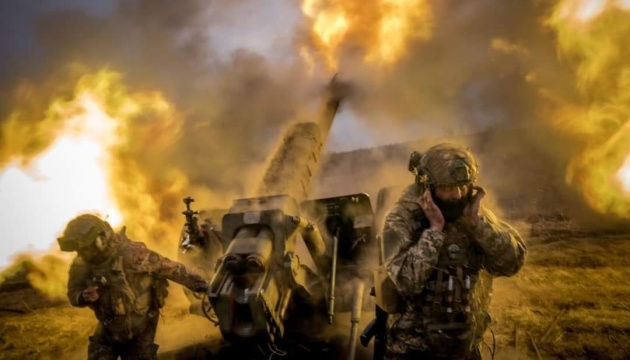
Sean’s final observation brings this second part of our conversation back to Ukraine. The intelligence contest he describes is not confined to secret meetings, diplomatic missions or the imaginary world of espionage fiction. In Ukraine, intelligence, influence operations, sabotage and conventional warfare have converged. What elsewhere may remain a contest conducted quietly between intelligence services here forms part of a war whose consequences are measured in destroyed buildings and human lives.
There is nevertheless a useful warning in Wiswesser’s account against imagining Russian intelligence as either omnipotent or incompetent. His argument is more uncomfortable than either caricature. Russian services make mistakes, sometimes spectacular ones, but an intelligence service does not need every operation to succeed. An adversary capable of failure remains an adversary capable of success.
Perhaps the most important theme running through this instalment is therefore ambiguity. The boundaries between commerce and state power can be ambiguous; those between organised crime and intelligence can be porous; an information operation may succeed without persuading anybody of the truth of the proposition it advances; and an intelligence operation may retain psychological value even after the identity of those responsible has become apparent.
In Part III, Sean and I will continue our discussion with the still darker aspects of Russian intelligence activity and with the questions raised by Ukraine: assassination and “wet work”, what Russian intelligence misunderstood before the full-scale invasion, the changing nature of espionage in wartime and the peculiar psychological consequences of spending years in a profession constructed around secrecy, deception and uncertainty.
---
Sean M. Wiswesser is a former CIA Chief of Station and the author of Tradecraft, Tactics, and Dirty Tricks: Russian Intelligence and Putin’s Secret War, published by Naval Institute Press. The book examines Russian intelligence tradecraft and Wiswesser’s experiences working against the Russian intelligence services. The views and opinions expressed by Sean Wiswesser in this interview and in his book are his own and do not represent the views of the Central Intelligence Agency or any other agency of the United States Government.
Publisher’s book page: https://www.usni.org/press/books/tradecraft-tactics-and-dirty-tricks