


From Folk Embroidery to Front Line Flags: The Evolution of Ukrainian Symbols

Symbols are the visual grammar of national identity. They carry emotion, memory and aspiration in ways that speeches and laws cannot. In Ukraine, a country whose history is woven with repression, renaissance and resistance, symbols have always mattered. From the red-and-black banners of the Partisan struggle to the quiet threads of Vyshyvanka shirts, Ukrainians have cultivated a symbolic language as enduring as their will to remain sovereign. But since the outbreak of full-scale war in February 2022, this language has undergone a transformation. What was once folk art or cultural heritage has become a lexicon of defiance — etched in skin, hoisted in battle, and memorialised in ruin.
The journey from traditional embroidery to the flags flying on the front lines today is not just an aesthetic evolution. It is the story of a nation reasserting itself in blood and thread.
The Vyshyvanka: Ancestral Code in Thread
The Vyshyvanka — Ukraine’s traditional embroidered shirt — is more than a costume. It is a textile manuscript. Each region of Ukraine developed its own intricate patterns, stitched in red and black or blue and white, carrying meanings tied to fertility, protection and historical continuity. In the Soviet period, when expressions of national distinction were viewed with suspicion, the Vyshyvanka became a quiet act of resistance — a signal, often hidden under jackets or reserved for private moments, of cultural survival.
With independence in 1991, the Vyshyvanka re-emerged as a proud national symbol. It was worn in parliaments, on school holidays, and in diaspora communities. But the full re-politicisation of the Vyshyvanka began during the Revolution of Dignity in 2013–14, when protesters in Kyiv wore embroidered shirts beneath layers of winter armour. Stitch by stitch, the old patterns were reinterpreted as modern armour.
Today, soldiers wear digital camouflage embedded with stylised Vyshyvanka motifs. Bulletproof vests are adorned with embroidered patches. For many, the act of wearing or tattooing these patterns is a way of drawing on ancestral strength in the face of mechanised terror. Tradition has become a talisman.

The Tryzub: From Royal Emblem to National Beacon
The Tryzub, or trident, is the official coat of arms of Ukraine. Its origins lie in the seal of the Kyivan Rus’ ruler Volodymyr the Great, who reigned over a vast East Slavic domain from the 10th century. Reintroduced in 1918 during the brief Ukrainian People’s Republic and again after 1991, the trident represents both sovereignty and continuity.
Under war, the Tryzub has taken on new life. It is everywhere: on passports, uniforms, sandbags, shoulder patches, and protest graffiti in occupied towns. It has been stylised in fire, in floral motifs, even with crossed rifles. It is tattooed on the bodies of both soldiers and civilians as a permanent declaration of loyalty.
In Moscow’s propaganda, the Tryzub is often depicted as a symbol of extremism. But in Ukraine, it has become a secular sacred icon — a compact expression of statehood that cannot be confiscated.

Blue and Yellow: A Palette of Resistance
The Ukrainian flag — two equal bands of blue over yellow — is deceptively simple. It originates from the colours of the sky over golden wheat fields, an image of agrarian peace. But over the past decade, the flag has shed its pastoral associations and become a frontline emblem.
The first protests in the Donbas in 2014 saw civilians waving the blue-and-yellow flag in defiance of separatists. After the 2022 invasion, the flag was used not only on government buildings, but painted onto barricades, car doors, drone wings, and the walls of destroyed homes. In towns like Kherson and Izium, its re-hoisting after liberation became moments of national catharsis.
In occupied zones, carrying or displaying the flag can be a death sentence. In that repression, its meaning has only grown. What was once a national identifier is now a symbol of survival.

Red and Black: The Colours of Struggle
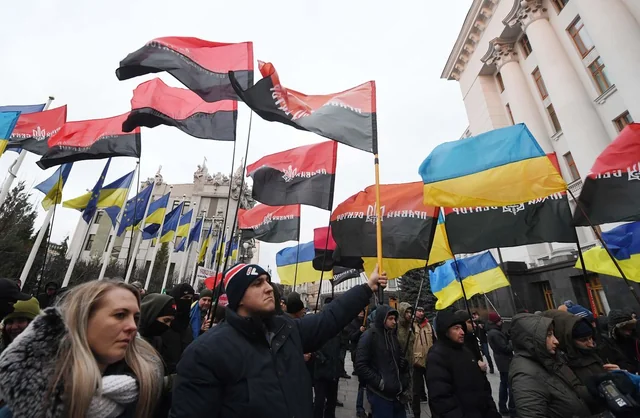
For some, especially in western Ukraine, the red and black flag — symbolising blood and soil — remains an enduring marker of anti-colonial resistance. Popularised by the Ukrainian Insurgent Army (UPA) in the 1940s, it later became associated with the Organisation of Ukrainian Nationalists and remains politically contentious.
Nevertheless the red-and-black banner has resurfaced in the current war, especially among volunteer battalions and partisan networks. In these contexts, it often represents not ideology, but a visceral commitment to fight for Ukrainian soil at all costs.
Front Line Icons: Saints, Drones, and Stencils
The symbolic landscape of Ukraine’s war has also been enriched with newer emblems. The Archangel Michael (featured in the image at the beginning of this article), protector of Kyiv, is frequently depicted on battlefield flags and posters, often brandishing a flaming sword over a map of Ukraine. He is joined by saints, Cossacks, and — strikingly — drones.
The drone, once a symbol of technological novelty, has become an icon of asymmetric resistance. Soldiers give them names, paint them with slogans, and feature them in unit insignia. A Saint Javelin meme — depicting the Virgin Mary clutching an anti-tank missile — has gained international traction as a blend of reverence and irony.

Meanwhile, in urban spaces, stencil graffiti has become a means of marking territory, memory, and mockery. In Mykolaïv, Lviv and Kharkiv you can find stencils of Putin with crosshairs, slogans like “Welcome to Hell”, or improvised unit logos declare that the war is everywhere — and so too is resistance.
Memorials and Material Memory
Symbols have also migrated into funerary culture. Crosses at soldiers’ graves are often carved with Tryzubs, while headstones bear personal flags and unit insignia. Temporary roadside shrines use embroidered cloth, toy figures, and national ribbons — mixing personal and public grief. The meaning of the symbols is renewed with every loss.

Even among the displaced and the diaspora, symbols persist. Ukrainian children in Berlin or Toronto wear blue-and-yellow hairbands. Artists weave traditional patterns into avant-garde protest work. The nation’s iconography is not just preserved but adapted.
A Living Lexicon
In wartime Ukraine, symbols are not relics. They are tools of cohesion, declarations of intent, and emotional armour. From the coded language of folk embroidery to the blazing flags of battlefield units, Ukrainians have reimagined their visual identity not by abandoning tradition, but by weaponising it for a modern struggle.
This evolution is not simply aesthetic. It is civilisational. In the face of an invading empire that seeks to erase Ukrainian nationhood, every Tryzub, every thread of Vyshyvanka, every blue-and-yellow ribbon is a line drawn against oblivion. Symbols, in Ukraine, are how a nation writes her name — in ink, in fire, and in freedom.


