


Fortress Ukraine: Building a Defensive State in the Heart of Europe
- Aug 2, 2025
- 5 min read
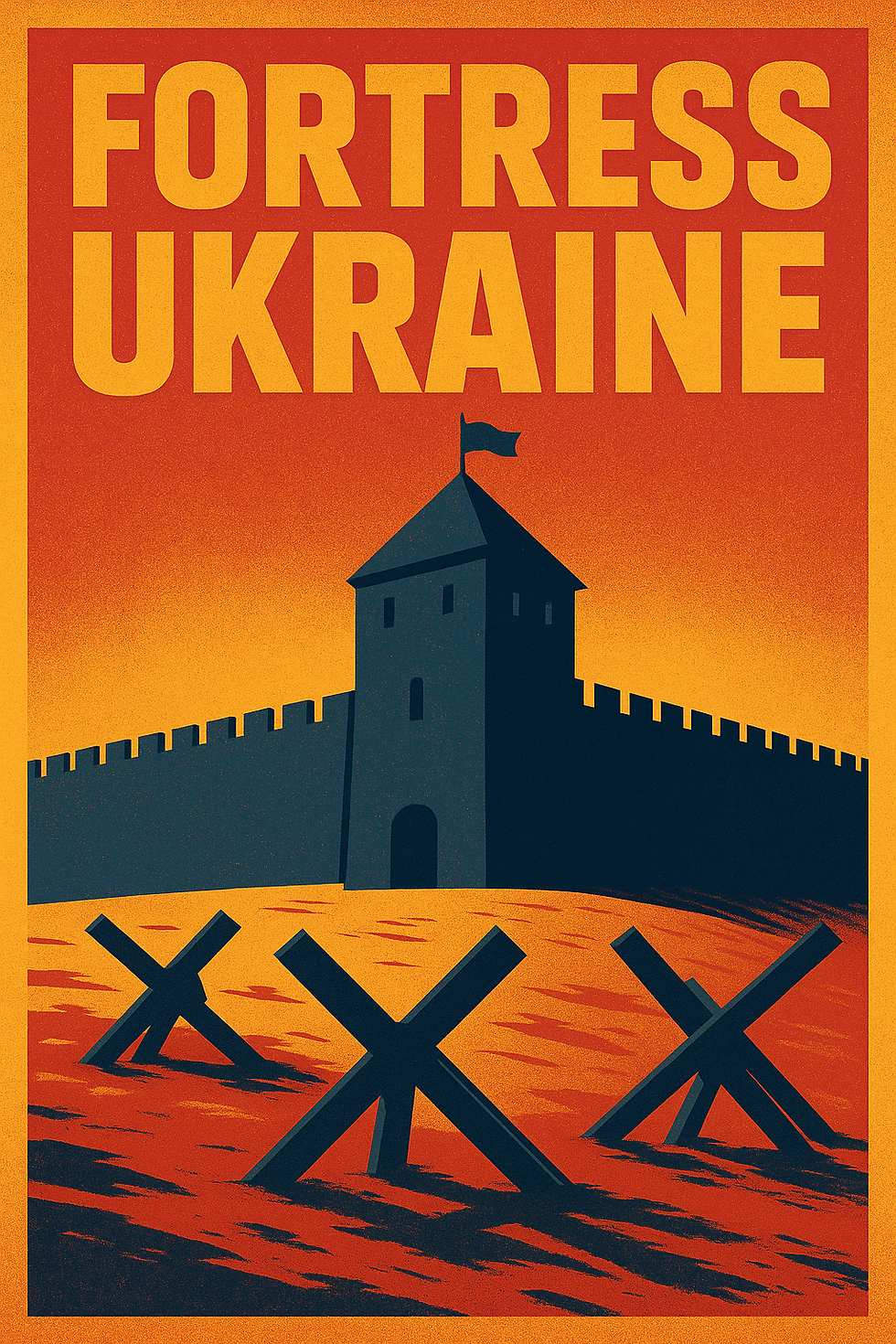
In war, a state must decide whether to bend, to break, or to harden. Ukraine has chosen the latter. As Russian forces continue their brutal assault on Ukrainian sovereignty, the Ukrainian state has undergone a rapid metamorphosis—from a struggling post-Soviet republic into a hardened defensive bulwark, girded not only by trenches and missiles, but also by civic mobilisation, digital ingenuity and strategic doctrine. This essay explores the emergence of “Fortress Ukraine”: not as a metaphor, but as a systemic transformation of national identity, infrastructure, and governance in service of self-preservation and ultimate victory.
In doing so, Ukraine has become a new model for wartime resilience in the 21st century—a defensive state embedded within the democratic tradition, yet reshaped by the existential demands of total war. This is a story of concrete and code, of drones and doctrine, of a people building their own ramparts from the ashes of invasion.
From Neglect to Vigilance: Ukraine’s Pre-War Vulnerabilities
Before 2014, Ukraine was poorly defended. Her armed forces were underfunded, her command structures compromised by corruption and Russian infiltration, and her military-industrial base languishing in post-Soviet decay. Conscription was symbolic. National defence policy was reactive at best. The Russian annexation of Crimea and subsequent occupation of parts of Donetsk and Luhansk Oblasts shattered the illusion that peace could be sustained through ambiguity. Ukraine, long hesitant to provoke Moscow, had to reckon with the price of unpreparedness.
The eight years between 2014 and 2022 were formative. Ukrainian forces professionalised, territorial defence units emerged, and NATO-standard training became widespread. Yet it was only after Russia’s full-scale invasion in February 2022 that the concept of a “defensive state” became totalising—extending beyond military formations to encompass society, economy, and psyche.
A Nation of Soldiers and Citizens
The foundation of Fortress Ukraine is the principle of total defence. This is not militarism in the traditional sense. Ukraine has not embraced a culture of conquest. Rather she has reimagined her democratic institutions to prioritise resilience and readiness, with civilian and military spheres deeply intertwined.
Territorial Defence Forces, initially dismissed by sceptics, have become essential actors in Ukraine’s survival. Drawn from local communities, these units operate with intimate knowledge of terrain and society, forming a living buffer between civilians and enemy incursion. Meanwhile, mass training programmes, digital mobilisation through the Diia app (an online digital identity platform for individual interaction with the government), and universal wartime education have created a new civic ethos: defence is everyone’s responsibility.
The Ukrainian state no longer draws a clean line between rear and front. The entire country is front line.
Defensive Infrastructure: Trenches, Technology, and Terrain
The physical embodiment of Fortress Ukraine is visible in satellite images and military maps. Tens of thousands of kilometres of defensive lines—trenches, anti-tank obstacles, minefields, bunkers—stretch across eastern and southern Ukraine. From Kharkiv to Kherson, from Zaporizhzhia to Sumy, Ukraine is being reshaped into a fortress in the literal sense.
But this is not the Maginot Line reborn. Ukrainian defensive planning is dynamic. It blends classical fortification with digital reconnaissance, battlefield AI and real-time drone surveillance. Trenches are not static: they are flexible nodes in a networked battlespace, supported by software-defined artillery fire and rapidly mobile units.
Civil infrastructure has also been retrofitted for defence. Metro stations in Kyiv and Kharkiv serve as bomb shelters. Civilian vehicles are repurposed as drone carriers. Bridges are rigged for demolition, and hospitals are shielded with hardened glass and sandbags. Even architecture is politicised: windows are taped not for aesthetics, but for blast protection.
Cyber Fortifications and the Digital State
Perhaps nowhere is the idea of Fortress Ukraine more radical than in cyberspace. Even as physical landscapes are scarred by war, the Ukrainian state has become one of the world’s most advanced digital democracies. With secure data cloud migration to servers in NATO countries, Ukraine has protected her bureaucratic backbone against decapitation strikes. Public services, taxation, conscription, and communication all persist online—even in war zones.
The state’s use of open-source intelligence, facial recognition, battlefield mesh networks and decentralised drone fleets has given her asymmetric advantages against a numerically superior foe. Meanwhile Ukrainian tech volunteers and state-aligned hackers have mounted a formidable cyber-defensive campaign against Russian digital aggression.
Fortress Ukraine is not only built in trenches and steel. It is also encoded in encryption keys, cloud infrastructure, and the resilience of state data under siege.
The Psychological Fortress: National Will as Strategic Asset
All fortresses ultimately depend upon morale. In Ukraine, national will is not imposed from above—it has been cultivated through tragedy, myth, memory and shared trauma.
The Russian strategy of terror—bombing civilian energy infrastructure, flattening entire towns, abducting children—has had the opposite of its intended effect. Rather than break the Ukrainian will, it has forged it into steel. Each power outage, each funeral, each school rebuilt after a missile strike becomes another stone in the mental ramparts of Ukrainian society.
Public polling continues to show overwhelming support for resistance. There is no meaningful constituency for surrender. Ukrainians have internalised the notion that peace without victory is merely delayed annihilation. Fortress Ukraine is thus not a prison, but a declaration: we will endure, not because we love war, but because we love liberty.
Challenges and Dangers of the Defensive State
Yet the construction of Fortress Ukraine is not without peril. A society on a permanent war footing can breed centralisation, illiberalism and militarised governance. Corruption, already a challenge before the war, can metastasise when oversight is suspended for security’s sake. War economy incentives may delay the pivot to reconstruction.
The task, then, is to build a fortress that defends democracy without smothering it. The goals are to resist not only Russian missiles, but also the temptations of emergency authoritarianism. Ukraine must navigate the paradox of building a martial society in service of liberal ends.
Here, the comparison to Israel is instructive—but not prescriptive. Ukraine’s path must remain Ukrainian. Her identity must not be securitised out of recognition.
Fortress Europe Begins Here
For decades, Europe outsourced its security to the United States, neglected its military capacity, and imagined war as something that happened elsewhere. Ukraine has awakened the continent. Fortress Ukraine is not a walled-off bastion, but the cornerstone of a broader European defensive renaissance.
Whether through shared arms production, integrated command structures, or cross-border civil defence planning, Ukraine is not only defending herself. She is shaping what a defensible Europe might look like. The fortress, in other words, is both national and continental.
A Fortress With Open Gates
Fortress Ukraine does not close her borders in fear. She invites the world to witness what determination looks like. This fortress is not built to exclude, but to endure. Not to dominate, but to inspire.
In the rubble of Mykolaiv and the forests of Chernihiv, in the trenches of Avdiivka and the code written in Lviv cafés, Ukraine is laying the foundations of a new kind of state: one that defends democracy without abandoning it, that wears its scars as symbols of purpose, and that shows the world what it means to build, not just fight, for freedom.
The battlements are high. The people are ready. The fortress holds.


