


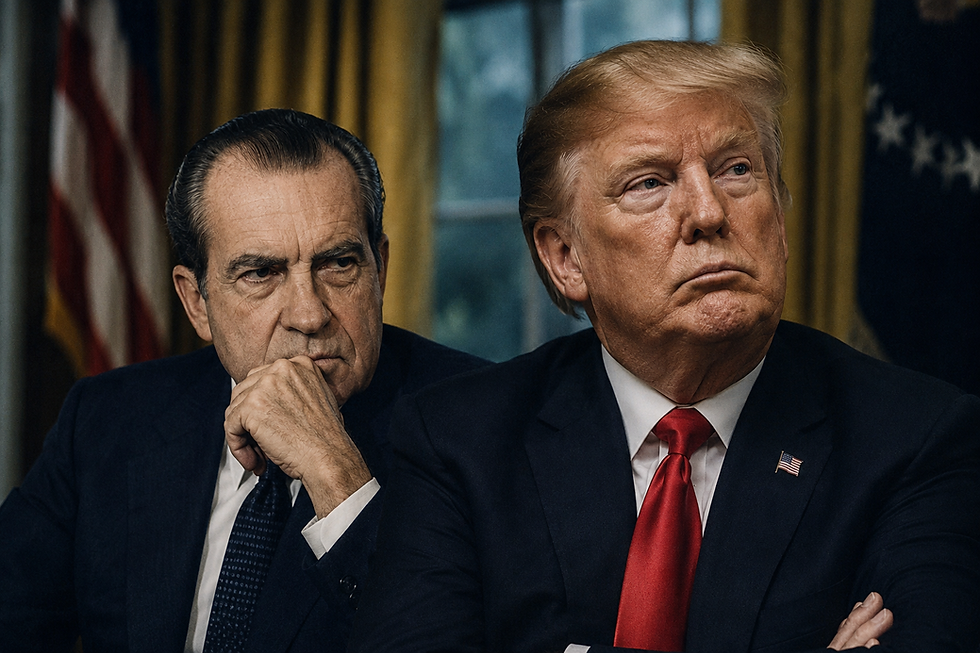
What would Richard Nixon have thought about Donald Trump?
- May 9
- 5 min read
Saturday 9 May 2026
The ghost of Richard Nixon hangs heavily over modern American conservatism. Amongst all the twentieth century presidents of the United States, perhaps none would have regarded the political rise of Donald Trump with such a mixture of fascination, envy, alarm and grim recognition. Nixon was a politician forged in the disciplines of the Cold War, bureaucracy and ideological combat. Trump emerged instead from television, celebrity culture and the collapse of public trust in institutions. Yet despite their immense personal differences, the two men shared a common instinct: both understood that vast numbers of Americans believed themselves betrayed by the governing elite of Washington.
To understand what Nixon might have thought about Trump’s two presidencies, one must first understand Nixon himself. Nixon was not fundamentally a conservative ideologue. He was a tactician. His politics were transactional, adaptive and deeply psychological. He viewed politics as permanent warfare conducted through institutions, media narratives and coalition management. His resentments were personal, but his methods were systematic. He believed in the state, in diplomacy and in strategic planning, even whilst attacking the liberal establishment that staffed those institutions.
Trump represents something profoundly different. Where Nixon sought mastery over institutions, Trump often seeks domination over personalities. Nixon admired expertise, even when he distrusted the people who possessed it. Trump frequently regards expertise itself as suspect. Nixon filled his administrations with intellectuals, strategists and policy professionals. Trump often prefers loyalists, media performers and political combatants.
Nevertheless Nixon would almost certainly have recognised Trump as the culmination of forces Nixon himself helped unleash.
Nixon’s famous appeal to the “silent majority” in 1969 was not merely rhetoric. It marked a transformation in Republican politics whereby cultural grievance became a central organising principle of electoral coalition-building. Nixon understood that millions of Americans believed the media, universities and urban elites regarded them with contempt. Trump elevated this sentiment into the defining ideology of his political movement.
Nixon would likely have admired Trump’s instinctive understanding of mass communication. Nixon’s own bitter relationship with television shaped his political career. He believed the media class despised him, distorted him and ultimately destroyed him. Trump bypasses traditional media structures altogether through social media, direct rallies and constant spectacle. Nixon, who spent years obsessing over newspaper coverage and television framing, might have marvelled at Trump’s capacity to dominate the attention economy without regard for conventional norms of presidential behaviour.
Nixon would probably have regarded Trump as strategically undisciplined. Nixon’s political career was built upon calculation, secrecy and long-term geopolitical thinking. He cultivated ambiguity deliberately. Trump often acts impulsively, publicly and emotionally. Nixon spent years preparing the opening to China. Trump can alter foreign policy direction through a late-night social media post.
On foreign affairs the contrasts become particularly sharp. Nixon was a committed realist in the tradition of Henry Kissinger. He viewed international politics through balances of power, spheres of influence and strategic equilibrium. Ideology mattered less to Nixon than leverage. He sought triangular diplomacy between the Soviet Union and China, not moral confrontation. Trump by contrast approaches foreign policy less as grand strategy than as personalised negotiation. Alliances are judged through perceived financial fairness rather than geopolitical architecture.
Yet Nixon might also have sympathised with aspects of Trump’s critique of post-Cold War American foreign policy. Nixon feared strategic overextension. He distrusted moralistic liberal interventionism. He believed American power should be used selectively and pragmatically. The exhaustion produced by Iraq, Afghanistan and decades of costly global commitments might have led Nixon to view Trump’s “America First” rhetoric as crude but politically understandable.
Regarding Russia, Nixon’s views would likely have been particularly complicated. Nixon was among the fiercest anti-communists of his generation. His political identity emerged from the battles of the late 1940s, including the Alger Hiss affair and the rise of Cold War containment. He regarded Soviet expansionism as a permanent strategic threat. Yet Nixon was also a realist who understood negotiation with adversaries as essential statecraft.
He would probably have viewed Trump’s ambiguous posture towards Vladimir Putin with unease. Nixon respected strong adversaries, but he also believed American presidents must never appear psychologically subordinate to them. Nixon’s conception of presidential authority depended heavily upon projection of control and strategic clarity. Trump’s sometimes admiring language regarding authoritarian leaders might have disturbed Nixon profoundly, particularly because Nixon himself spent immense effort cultivating the image of toughness against Moscow.
Domestically, Nixon might have been astonished by the degree to which Trump transformed the Republican Party into a personality-centred movement. Nixon was ruthless, but he remained fundamentally a party man. He believed institutions mattered because they preserved power over time. Trump has demonstrated that a modern political movement can become attached less to ideology or party structure than to a single individual identity.
The events surrounding the 2020 election and the assault upon the United States Capitol on 6 January 2021 would almost certainly have horrified Nixon. Whatever Nixon’s abuses of power during Watergate scandal, he ultimately resigned because he concluded that institutional collapse would damage the presidency permanently. Nixon possessed a tragic awareness of constitutional fragility. He believed the office of the presidency must survive even if the president himself could not.
Indeed Nixon’s final years were marked by efforts to rehabilitate himself as an elder statesman precisely because he still revered the machinery of the American state. Trump’s willingness to contest electoral legitimacy itself might have struck Nixon as politically catastrophic. Nixon accepted defeat in the razor-thin 1960 presidential election against John F. Kennedy despite widespread allegations of electoral irregularities in Illinois and Texas. He did so, he later claimed, because he feared the country could not endure a prolonged constitutional crisis during the Cold War.
This difference may represent the deepest divide between the two men. Nixon’s paranoia existed alongside institutional reverence. Trump’s politics often flourish through institutional delegitimisation.
Yet Nixon might also have envied Trump. Nixon spent his life craving acceptance from the American elite whilst simultaneously despising it. Trump has dispensed with the need for elite approval altogether. Nixon remained psychologically wounded by ridicule from journalists, intellectuals and socialites. Trump has converted elite hostility into political fuel.
There is also a generational dimension to consider. Nixon emerged from an America defined by scarcity, war mobilisation and industrial discipline. Trump emerged from an America of branding, entertainment and post-industrial fragmentation. Nixon believed politics was fundamentally about control of government. Trump often treated politics as an extension of media combat. Nixon built coalitions through careful strategic engineering. Trump built movements through emotional identification.
Had Nixon lived to witness Trump’s return to the presidency in 2025, he might have interpreted it as evidence that American political instability had entered a new historical phase. Nixon believed strongly in cyclical political realignments, but he also believed institutions ultimately reasserted equilibrium. Trump’s survival through impeachment, criminal investigations, political exile and eventual electoral resurrection would have appeared extraordinary even by Nixonian standards.
Perhaps Nixon’s ultimate conclusion would have been sombre. He might have recognised Trump not as an aberration but as the logical endpoint of trends long developing within American politics: collapsing trust in institutions, permanent media warfare, ideological fragmentation, celebrity populism and the replacement of party loyalty with personal identity politics.
In many ways Nixon helped create the political terrain upon which Trump later thrived. The politics of resentment, cultural division and anti-establishment mobilisation did not begin with Trump. But Trump removed the final restraints of institutional decorum that Nixon, despite all his flaws, still partially observed.
Nixon once remarked that the American people occasionally need “a little shaking up”. Trump has done far more than that. He has shaken the assumptions underlying the post-Cold War American order itself. Nixon would likely have admired the effectiveness, feared the consequences and recognised, perhaps with private discomfort, how much of the road towards Trumpian America began during his own long political shadow.


