


Versailles and the Rebirth of Poland: The Restoration of Sovereignty and the Remaking of Europe
- Jun 29
- 5 min read
Monday 29 June 2026
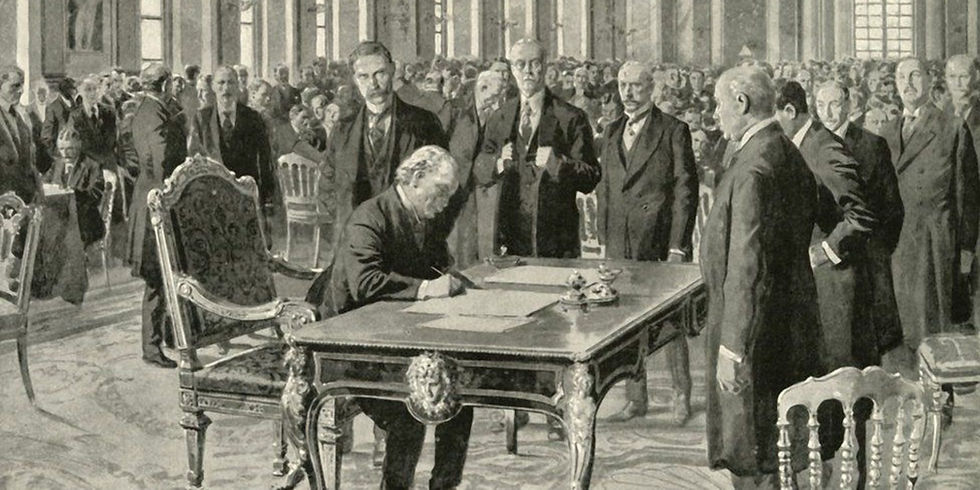
On 28 June 1919, exactly five years after the assassination of Archduke Franz Ferdinand in Sarajevo had ignited the First World War, representatives of the victorious Allied powers and defeated Germany gathered in the Hall of Mirrors at the Palace of Versailles to sign one of history’s most consequential peace treaties. Much attention has been devoted to the harsh reparations imposed upon Germany, the creation of the League of Nations and the seeds that the settlement sowed for future conflict. Yet among the treaty’s most enduring achievements was the restoration of an independent Polish state after 123 years of political extinction.
The rebirth of Poland represented far more than the reappearance of another European country on the map. It marked the reversal of one of the eighteenth century’s greatest acts of geopolitical predation and fundamentally altered the balance of power across Central and Eastern Europe. Its consequences continue to resonate more than a century later.
The Polish-Lithuanian Commonwealth had once been among Europe’s largest and most sophisticated political entities. Stretching from the Baltic almost to the Black Sea, it possessed an unusually constitutional political order for its age, albeit one weakened by aristocratic privilege and institutional paralysis. Between 1772 and 1795, however, the neighbouring empires of Russia, Prussia and Austria partitioned the Commonwealth in three successive stages until Poland disappeared entirely from the political map.
Unlike many conquered peoples, the Poles never accepted permanent extinction.
Throughout the nineteenth century they maintained their language, culture and national identity despite determined efforts by their imperial rulers to assimilate them. Uprisings in 1830 and 1863 against Russian rule were brutally crushed, while Germanisation policies in Prussian territories and varying degrees of autonomy under Austrian administration produced different experiences of occupation. Polish nationalism evolved into one of Europe’s most resilient political movements precisely because it survived without a state.
The First World War destroyed the three empires that had partitioned Poland. Imperial Russia collapsed into revolution. Austria-Hungary fragmented into successor states. Germany was defeated militarily and forced into political transformation. Suddenly the geopolitical foundations that had prevented Polish independence for more than a century disappeared almost simultaneously.
Amongst the strongest advocates of restoring Poland was United States President Woodrow Wilson. His Fourteen Points, announced in January 1918, explicitly called for the establishment of “an independent Polish state” with secure access to the sea. Although Wilson’s idealism often collided with European realities, Poland became one of the clearest practical expressions of his principle of national self-determination.
Implementing that principle proved extraordinarily difficult.
The frontiers of the new Polish Republic could not simply be drawn according to neat ethnic lines because no such lines existed. Centuries of migration, conquest and coexistence had created a mosaic of Poles, Germans, Ukrainians, Jews, Belarusians, Lithuanians and many other communities. Every proposed border produced minorities on the wrong side.
The most controversial provision of the Treaty of Versailles was the creation of the so-called Polish Corridor, providing Poland with access to the Baltic Sea while separating East Prussia from the rest of Germany. The ancient Hanseatic city of Danzig was established as a Free City under League of Nations supervision rather than being incorporated directly into Poland or Germany.
From Poland’s perspective these arrangements were essential. A modern state deprived of maritime access would remain economically vulnerable and strategically dependent upon its neighbours. From Germany’s perspective they represented national humiliation and territorial dismemberment. Adolf Hitler would later exploit precisely these grievances in his justification for dismantling the Versailles settlement.
Nor were Poland’s borders determined entirely at Versailles. Between 1919 and 1921 the new republic fought a series of wars with nearly all its neighbours. Most significant was the Polish-Soviet War, culminating in the Battle of Warsaw in August 1920, sometimes described as the “Miracle on the Vistula”. Polish forces halted the westward advance of the Red Army and arguably prevented revolutionary communism from spreading into Germany at one of Europe’s most unstable moments.
The resulting Treaty of Riga in 1921 established Poland’s eastern frontier considerably further east than many of the Western Allies had anticipated. The Second Polish Republic consequently became one of Europe’s most ethnically diverse states, with substantial Ukrainian, Belarusian, Jewish, German and Lithuanian populations.
Geopolitically, the restoration of Polish sovereignty transformed Europe.
For the first time in generations, Germany and Soviet Russia no longer shared a common frontier across much of Eastern Europe. Instead, a belt of newly independent states—including Finland, Estonia, Latvia, Lithuania, Poland and Czechoslovakia—emerged between Europe’s traditional great powers. French strategists viewed these states collectively as a cordon sanitaire, intended both to contain Bolshevism and to restrain any future German resurgence.
The concept possessed strategic logic but suffered from structural weaknesses. Many of the new states disputed their borders with one another. Minority questions remained unresolved. Economic integration proved difficult after the collapse of imperial customs unions. Military cooperation rarely matched diplomatic aspirations.
Poland itself occupied perhaps the most dangerous strategic position in Europe.
Situated between Germany and Soviet Russia, both of which regarded aspects of the Versailles settlement as illegitimate, Poland faced the perpetual challenge of preserving independence against stronger neighbours. During the interwar years Warsaw attempted a policy of balancing between Berlin and Moscow, signing non-aggression pacts with both while avoiding excessive dependence upon either.
Ultimately that strategy failed not because it was irrational but because circumstances overwhelmed it.
In August 1939 Nazi Germany and the Soviet Union secretly agreed, through the Molotov-Ribbentrop Pact, to partition Poland once again. On 1 September Germany invaded from the west. On 17 September the Soviet Union invaded from the east. The Second World War thus began with the destruction of precisely the state whose restoration had symbolised the post-First World War settlement.
Yet history did not end there.
Following the collapse of Soviet communism in 1989, Poland recovered full sovereignty for a second time within the twentieth century. Unlike the fragile republic created at Versailles, modern Poland anchored itself firmly within NATO and the European Union, institutions designed to prevent the return of the great-power rivalries that had repeatedly extinguished Polish independence.
The experience of repeated partition has profoundly shaped Polish strategic thinking. Warsaw consistently views Russian expansionism through the lens of centuries rather than years. It has become one of Ukraine’s strongest supporters not merely from sympathy but from historical calculation. Polish policymakers understand that the independence of states lying between Russia and Central Europe is essential to Poland’s own security.
The ongoing war in Ukraine has therefore revived many questions first confronted in 1919. Can durable peace be built without secure borders? How should national self-determination be reconciled with ethnically mixed territories? Can international institutions guarantee sovereignty when revisionist powers reject established settlements? These dilemmas remain strikingly familiar.
The Treaty of Versailles undoubtedly contained serious flaws. Economic burdens imposed upon Germany proved politically destabilising. Minority protections often failed. International enforcement mechanisms were weak. Nevertheless, the restoration of Polish independence stands as one of its greatest achievements.
It corrected a profound historical injustice while affirming that nations could survive even after generations of political extinction. Poland’s reappearance demonstrated that sovereignty, once lost, need not disappear forever. It also revealed that geopolitical settlements are never permanent. They require not only diplomatic signatures but sustained political commitment and credible military deterrence.
More than a century after Versailles, Poland once again stands at the centre of Europe’s strategic landscape. The map redrawn on 28 June 1919 has been altered many times since, yet the essential lesson endures: the independence of the nations lying between Germany and Russia remains one of the decisive questions upon which the peace and stability of the European continent ultimately depend.


