


Three Hundred Thousand More: Russia’s Next Army and Ukraine’s Answer
By Matthew Parish
Tuesday 25 August 2026
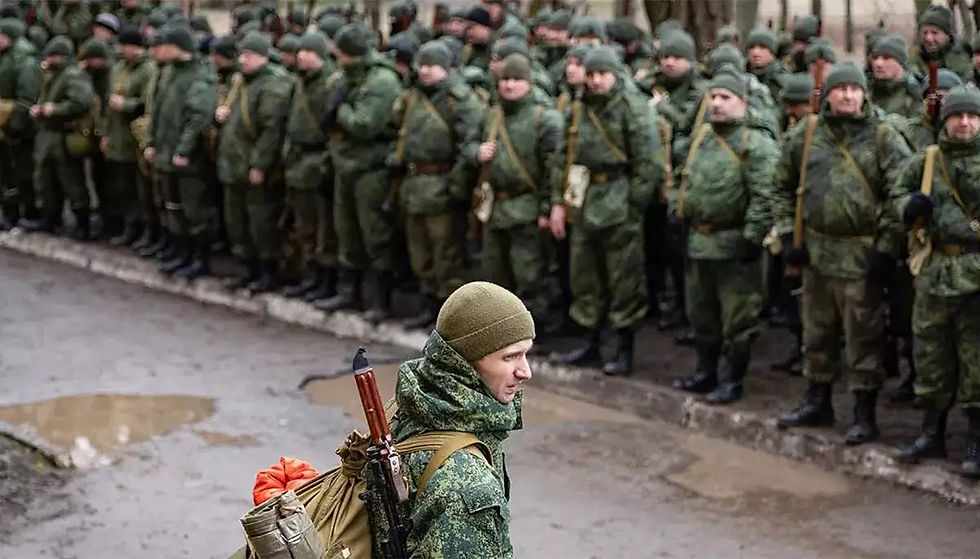
There is a dangerous temptation in wars of attrition to become hypnotised by numbers. Russia has lost an extraordinary number of soldiers since February 2022 and yet the Russian state continues to discover more men whom it is prepared to send towards Ukrainian positions. Now President Volodymyr Zelensky has warned that the Kremlin intends to mobilise another 300,000 troops after Russia’s State Duma elections in September 2026, with still larger numbers potentially following in 2027. The claim has not been independently confirmed and Moscow denies that another mobilisation is being prepared. Nevertheless there is sufficient circumstantial evidence — declining voluntary recruitment, continuing high casualties and the Kremlin’s unabated determination to conquer the remainder of Donetsk Oblast — that Ukraine must treat the possibility with the utmost seriousness.
Russia has already stretched her manpower machinery considerably. The Kremlin ordered the conscription of 261,000 men during 2026. Russia has also reportedly sought approximately 409,000 contract recruits this year, a target she appears increasingly unlikely to achieve. Ukrainian intelligence estimated in July that fewer than half the annual target had been recruited and that the daily recruitment rate had fallen below that required to meet the Kremlin’s objective.
Hence the significance of September’s parliamentary elections. The Kremlin has every incentive not to announce an unpopular mobilisation before Russians have gone through the ritual of voting. President Zelensky has described what he expects afterwards as a “peripheral mobilisation”: Moscow would attempt to extract soldiers disproportionately from poorer provinces, ethnic republics and remote regions rather than Moscow and St Petersburg, thereby insulating the politically significant metropolitan middle classes from the immediate consequences of the war. Recent reporting similarly suggests that the Kremlin has been testing mobilisation readiness while remaining wary of repeating the disruption produced by the September 2022 call-up.
This is important because mobilisation is one of the few aspects of the war that carries the conflict directly into millions of Russian homes. Inflation may be blamed upon sanctions. Petrol shortages can be explained away. Ukrainian drones can be described as terrorist attacks. But when a husband, son or father receives papers ordering him into uniform, the relationship between the citizen and the war becomes suddenly and brutally personal.
The mobilisation of September 2022 demonstrated this phenomenon. The Kremlin announced 300,000 reservists and produced queues at borders, hurried departures and considerable administrative disorder. Four years later the reservoir of politically inexpensive manpower is shallower. Russia has spent enormous sums encouraging men to volunteer, concentrating its recruiting efforts amongst those for whom military signing bonuses represent life-changing amounts of money. Recent reporting indicates that recruiters are finding it increasingly difficult to sustain those flows, even as Russian casualties continue at a rate requiring constant replacement.
Another mobilisation would therefore represent something more significant than the acquisition of another 300,000 bodies. It would amount to an admission that the Kremlin’s attempt to wage an enormous continental war while insulating much of Russian society from personal involvement has begun to reach its limits.
That does not mean that Russia is on the verge of revolution. Predictions of imminent Russian political collapse have repeatedly proved premature. The Russian state retains immense coercive resources, control of the principal media and considerable experience in distributing pain towards those sections of society least capable of resisting it. A mobilisation concentrated upon Siberia, the North Caucasus, the Far East and economically depressed provincial towns might therefore be absorbed without threatening Vladimir Putin’s hold upon power.
Nevertheless it would generate friction.
Every additional mobilisation notice produces another family wondering why its son must fight while affluent Muscovites continue drinking cocktails around Patriarch’s Ponds. Every village that loses another generation of working-age men suffers another economic wound. Every factory whose machinists disappear into the army discovers that soldiers cannot simultaneously manufacture artillery shells, repair locomotives or operate industrial machinery. Russia possesses a large population but it does not possess an unlimited supply of young, medically fit, economically expendable men.
The social geography of mobilisation is consequently part of the battlefield.
Ukraine should understand this — and exploit it strategically. The objective should not merely be to defeat another Russian offensive once hundreds of thousands of newly mobilised soldiers have reached Ukrainian trenches. It should be to make the entire process by which Russia converts civilians into effective combat formations as inefficient, expensive and demoralising as possible.
This requires a refinement of Ukraine’s battlefield strategy.
The traditional conception of attritional warfare concentrates upon destroying soldiers at the front. Yet the Russian military machine is a system rather than merely an infantry mass. A mobilised soldier must be registered, transported, equipped, trained, organised, commanded, supplied and continuously sustained. He requires ammunition, food, fuel, communications equipment, vehicles, medical support and replacement equipment. Hundreds of thousands of additional soldiers multiply these requirements enormously.
Ukraine’s most valuable targets are therefore not necessarily individual infantrymen. They are the military capabilities that make large infantry formations useful.
A poorly trained Russian recruit without transport, artillery support, reliable communications or adequate logistics is of limited military value. The same recruit integrated into a functioning combined-arms formation becomes substantially more dangerous. Ukraine’s task must therefore be to break the machinery of integration.
That means continuing to place extraordinary emphasis upon Russian logistics, command structures, ammunition supply, military transport and the infrastructure supporting them — within the bounds of international humanitarian law and with careful distinction between military objectives and civilian infrastructure. Ukraine’s expanding long-range drone campaign already illustrates the broader logic: relatively inexpensive unmanned systems can impose disproportionate economic, logistical and defensive costs upon Russia far behind the immediate front. Recent Ukrainian operations have increasingly targeted military, industrial and logistical facilities deep inside Russian territory.
The same principle applies tactically.
Ukraine should resist any temptation to answer Russian mass with Ukrainian mass. Russia possesses the larger population and can therefore tolerate that competition for longer. Ukraine’s comparative advantages lie elsewhere — in drones, battlefield transparency, decentralised initiative, precision fires, electronic warfare, artificial intelligence-assisted reconnaissance and the increasingly sophisticated integration of unmanned systems with artillery and infantry.
The battlefield must become progressively more hostile to concentrations of Russian manpower.
This does not mean seeking casualties as an end in themselves. War is not an accounting competition in which the side accumulating the larger enemy casualty figure automatically wins. The proper military objective is to render Russia’s newly generated formations incapable of achieving their operational purposes while minimising Ukrainian casualties. Sometimes that entails destroying personnel. More often it means disrupting movement, isolating assault groups, degrading their supporting systems and preventing Russian commanders from concentrating sufficient combat power at decisive points.
The distinction matters enormously.
Three hundred thousand newly mobilised Russians cannot simply be deposited upon the battlefield. They must pass through training areas and replacement systems before being distributed amongst existing formations or assembled into new ones. Their effectiveness will depend disproportionately upon experienced officers, non-commissioned officers, specialists and veterans capable of transforming civilians into functioning military units. Those scarce professional cadres are much harder for Russia to replace than raw manpower.
Ukraine should therefore think in terms of destroying organisational competence rather than merely consuming manpower.
Russian tactical methods have already evolved towards repeated small-unit assaults supported by drones, artillery and glide bombs. Pouring additional recruits into this system may permit Moscow to increase the frequency and geographical breadth of those attacks. Ukraine consequently needs deeper defensive systems in which the destruction of one position does not permit immediate exploitation. Fortifications, mines where lawful and operationally appropriate, drones, remotely operated systems, mobile reserves and overlapping surveillance should turn Russian advances into a succession of increasingly expensive problems.
Above all, Ukraine must preserve its own infantry.
This is perhaps the central strategic lesson. Russia may be able to mobilise another 300,000 men. Ukraine cannot casually match that number. Ukrainian soldiers are therefore a scarcer strategic resource than Russian soldiers. Every tactical doctrine should be judged partly according to how effectively it preserves Ukrainian lives while denying Russian objectives.
That means abandoning positions when their tactical value no longer justifies their defence. Territory matters enormously — this is, after all, a war about Ukrainian territory — but individual tree lines, villages and ruined industrial districts cannot become objects of prestige. A Ukrainian withdrawal of two kilometres that draws Russian forces into an exposed area covered by drones and precision fires may represent tactical success rather than defeat. The objective is not to defend every metre indefinitely. It is to ensure that Russia pays an unsustainable military price for every operational objective while Ukraine preserves the forces necessary to continue fighting.
There is also an economic dimension. If Russia mobilises another 300,000 people, those men must be financed. Their families must receive payments. Equipment must be manufactured. Training facilities must operate. Railways must transport personnel and matériel. Fuel must move towards depots and vehicles. Russia’s military expansion therefore creates additional pressure points throughout an economy already distorted by years of wartime expenditure.
Ukraine and her allies should make mobilisation expensive in every possible lawful sense.
Western sanctions should concentrate increasingly upon the technological and financial inputs sustaining Russian military production. Ukrainian long-range operations should continue degrading legitimate military and war-supporting infrastructure where feasible and lawful. European governments should accelerate the supply of air defence, artillery ammunition, drones and industrial capacity. Russia must be denied the expectation that another mobilisation automatically translates into another year of territorial advances.
There is a psychological dimension as well.
The Kremlin has constructed an implicit bargain with much of Russian society: ordinary citizens remain politically passive and the state keeps the war distant from their everyday lives. Another mobilisation damages that bargain. Ukraine should understand that the political consequences of Russian military losses are not distributed evenly. Losses amongst professional soldiers or impoverished volunteers can be concealed or socially compartmentalised. Mobilisation penetrates families that never intended to participate.
The Kremlin appears to understand this perfectly well. That is precisely why the reported mobilisation would occur after elections rather than before them and why, according to Zelensky, it would be concentrated away from the principal cities.
There is an irony here. Russia’s enormous population has always been considered one of its principal military advantages. Yet manpower becomes an advantage only if the state can politically extract it, economically sustain it and militarily employ it. Every additional mobilisation makes each of those tasks harder.
Ukraine’s strategic purpose should be to widen the gap between mobilisation and military effectiveness.
If Russia mobilises 300,000 men, Ukraine should seek to ensure that they arrive late, train poorly, suffer from shortages, operate under degraded command systems and discover a battlefield saturated with reconnaissance drones before they can achieve meaningful operational concentration. The ideal Ukrainian victory is not one in which 300,000 Russian soldiers must literally be killed. It is one in which Moscow discovers that mobilising another 300,000 soldiers has failed to alter the strategic balance.
That outcome would carry consequences far beyond the battlefield.
Vladimir Putin has repeatedly wagered that Russia can outlast Ukraine — that Russian population, industrial depth and political authoritarianism will eventually overwhelm Ukrainian resistance and Western patience. Another mass mobilisation would be an expression of precisely that theory. Russia would once again be converting demographic scale into military pressure.
Ukraine must demonstrate that the equation no longer works.
Modern warfare increasingly rewards the side capable of finding, identifying and disabling military systems faster than its opponent can regenerate them. Cheap drones can destroy expensive equipment. Precision weapons can interrupt supply networks. Persistent surveillance makes concentrations dangerous. Electronic warfare can paralyse units without physically destroying every soldier within them. The industrial arithmetic of twenty-first-century warfare is therefore different from that of 1943.
Russia may still believe that quantity has a quality all of its own. Ukraine’s task is to prove that quality, information and technological adaptation can impose a devastating price upon quantity.
The coming mobilisation, if it occurs, should therefore not be regarded principally with fear. It should be regarded as both a formidable military challenge and evidence of Russian weakness. A state confident that its existing recruitment system was adequate would have no reason to contemplate another politically hazardous call-up. Indeed the Kremlin continues publicly to deny that mobilisation is necessary, while independent assessments suggest voluntary recruitment is struggling to keep pace with losses.
Three hundred thousand additional Russians in uniform would unquestionably be dangerous. They could sustain offensives, replenish depleted formations and permit Moscow to maintain pressure across a vast front. Ukraine must prepare for that possibility now rather than after the first mobilisation notices are issued.
But Russia’s ability to summon men is not the same thing as its ability to convert them into victory.
Ukraine’s answer must therefore be asymmetric: preserve Ukrainian soldiers, deepen defensive systems, expand unmanned warfare, attack military logistics and supporting infrastructure lawfully, degrade scarce Russian specialists and command capacity and force Moscow continually to expend more resources for diminishing territorial returns.
Then the question asked inside Russia may slowly change.
It will cease to be: How many more men can Russia mobilise?
It will become: How many more men must Russia mobilise before Russians begin to ask why none of them is bringing victory?


