


The Zero Line: Life and Death on Ukraine’s Eastern Front
- Jul 27, 2025
- 5 min read
On Ukraine’s eastern front, where forests have turned to moonscapes and villages into burnt-out skeletons, lies the “Zero Line” — the thin, volatile boundary separating Ukrainian defensive trenches from Russian positions. It is a line not marked on civilian maps, not fixed on any official coordinates, but known viscerally to the soldiers who hold it: a place where death can arrive in an instant, from above, from afar, or from a trench-length away.
The Zero Line is the cutting edge of Europe’s largest land war since 1945. It is the crucible in which Ukraine’s sovereignty is tested daily, not through speeches or negotiations but through relentless attrition. It is a place where the war is neither abstract nor strategic, but a matter of minute-by-minute survival — a grinding contest of artillery, drones, mud, silence and fire.
A Landscape of Nothingness
From Kupiansk in the north to Pokrovsk and Kherson in the south, the Zero Line snakes its way through the Donbas like a festering wound. The terrain is lunar: craters the size of swimming pools, shattered trees, collapsed dachas and power lines lying in tangled clumps across muddy roads. Where once there were schools, factories and farms, there are now only forward observation posts, minefields and charred vehicles abandoned mid-flight.
Much of the combat takes place in or near these destroyed settlements. For the soldiers, the Zero Line is often defined by a trench dug just a few hundred metres from enemy lines, in which they live for days or weeks, enduring cold, heat, insects, and the constant threat of attack. Between Ukrainian and Russian positions stretch “grey zones” of no-man’s-land — often under drone surveillance, covered with tripwires, and traversable only at night by reconnaissance teams. Each side knows the other’s layout intimately: through aerial surveillance, signal interception and captured documents. Yet nothing fully prepares a soldier for crossing that line — whether as attacker or defender.
Soldiers of the Edge
The men and women stationed on the Zero Line are a mix of veterans and volunteers, career officers and schoolteachers turned platoon commanders, international volunteers and raw recruits. What unites them is their closeness to death — and to one another. Camaraderie is not optional here; it is as necessary as water or ammunition.
Rotation cycles are irregular. Some units are rotated every few weeks, others not for months, depending on the intensity of combat and the state of the terrain. Sleep is shallow and fragmentary. Meals consist of reheated tins, energy bars, and hot tea poured into soot-blackened mugs. Every soldier sleeps with a weapon at arm’s length. Helmets are never out of reach. One learns quickly how to distinguish outgoing fire from incoming, the whine of an FPV drone from the buzz of a reconnaissance quadcopter, the crack of a sniper’s shot from the mechanical thump of an automatic grenade launcher.
The psychological strain is immense. Shell shock is no longer called by that name, but its symptoms remain: trembling hands, delayed reactions, panic attacks triggered by loud sounds. Soldiers speak quietly of comrades who simply refused to speak anymore, or who disappeared in the grey zone, leaving only shredded equipment behind.
Yet for all this, the front-line spirit is not defeatist. Morale on the Zero Line is built not on abstract notions of victory, but on survival, solidarity and stubborn resistance. The war is personal here — not an ideological confrontation, but a defence of home, language, and memory.
Technology and Terror
The Zero Line is also the testing ground of twenty-first century warfare. Russia, with her immense arsenal, dominates in sheer quantity of firepower: glide bombs, heavy artillery, thermobaric munitions and tanks. Ukraine, by contrast, compensates with ingenuity and technology. Drone warfare, in particular, has transformed the front. FPV drones — cheap, fast and lethal — strike trenches, bunkers, and even moving infantry. The hum of these machines overhead haunts the front like the growl of airborne predators. Soldiers lie flat in their trenches when the whir is heard, waiting for the explosion that may or may not come.
Electronic warfare plays an increasingly important role. Both sides jam each other’s communications, spoof GPS coordinates, and attempt to disable drone guidance systems. This electronic arms race has created new dangers — and new jobs: every Ukrainian battalion now relies on drone operators, signal interceptors, coders, and technicians, often just teenagers with laptops and field antennas.
Despite the prevalence of technology, many aspects of life on the Zero Line remain primitive. Latrines are dug with shovels. Heat in winter comes from wood fires, when smoke discipline permits. First aid is often improvised, and evacuating the wounded is an operation fraught with risk. Russian forces frequently target ambulances and casualty extraction routes, forcing medical teams to travel in civilian cars, unmarked and exposed.
Civilians in the Blast Radius
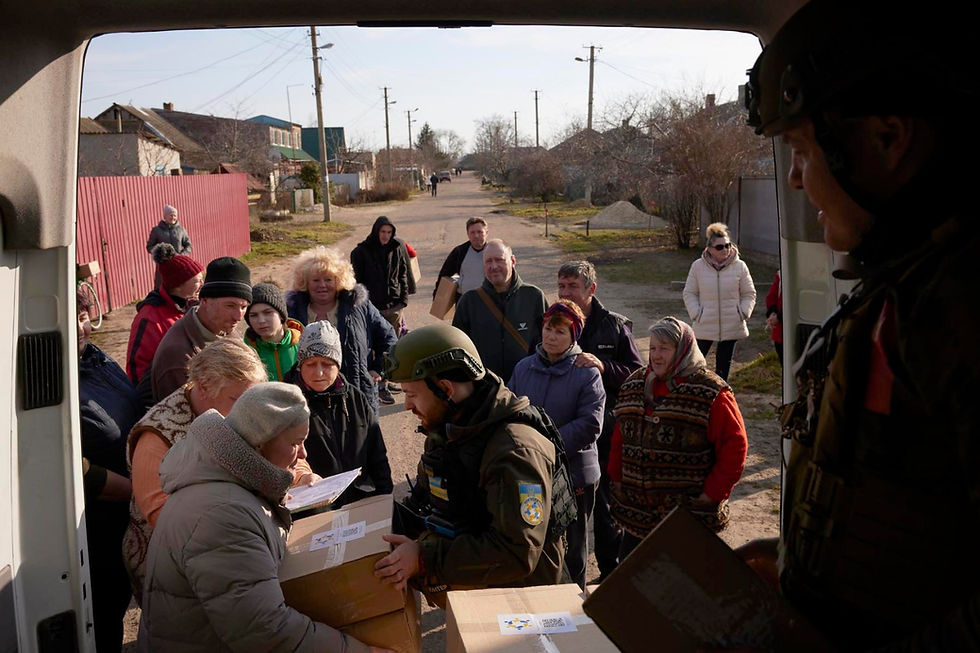
Though most civilians have long since fled the Zero Line, some remain — often the elderly, or those too poor or stubborn to leave. They live in cellars, cook over open fires, and collect water from wells under artillery fire. Ukrainian troops frequently assist them with rations, medicine and battery packs. In some cases, civilians provide intelligence: the location of a new Russian position, the time of troop movements, the arrival of new tanks. But the risks are immense. Civilians are caught between two armies — mistrusted by both, exposed to shelling, and deprived of everything.
Entire towns — Bakhmut, Avdiivka, Siversk — have become ghost cities. Others, like Chasiv Yar and Kostiantynivka, are in the process of dying. Every new Russian offensive reduces more of the Donbas to rubble. Yet even in this devastation, local identity persists: a grandmother flying a Ukrainian flag from her window; a priest celebrating liturgy in a church missing half its roof; children playing in trenches after a brief lull in fighting.
Death Without Glory
There is little romanticism to death on the Zero Line. It comes in sudden bursts — an artillery fragment to the neck, a drone strike to a trench, a mine under a vehicle. Often bodies are unreachable for hours or days, especially under fire. Burial is delayed; ceremonies are brief. The Zero Line produces not battlefield epics but silences — families waiting for a call, comrades writing final letters, empty bunks and burnt uniforms.
And yet the soldiers return. Again and again, Ukrainians volunteer for the front — not for pay, nor for glory, which is rare, but because the alternative is to surrender home, language and history. They return because the Zero Line, as dreadful as it is, remains the first line of defence between the free parts of Ukraine and the brutal occupation that lies beyond.
The Weight of the Line
The Zero Line is not merely a military front. It is a psychological and political frontier — a place where the cost of liberty is measured in bodies, blood and time. It is where Ukraine’s war for independence, identity, and democratic future is being waged not by diplomats or economists, but by men and women in boots caked with clay and uniforms stained with sweat and smoke.
From afar, the war is often reduced to maps, arrows and policy statements. But for those at the Zero Line, the war is tactile: it is the damp trench wall, the flicker of a cigarette before dawn, the crack of distant fire, the silence after a friend falls. To understand Ukraine’s future, one must understand this line — its brutality, its resilience, and its unyielding importance. For while diplomats speak of borders, it is here, on the Zero Line, that the country’s fate is truly being decided.


