


The Wind as a Weapon: Ukraine’s Return to the Oldest Form of Air Power
- Jul 1
- 4 min read
Wednesday 1 July 2026
Modern warfare has become synonymous with extraordinary technological sophistication. Artificial intelligence selects targets, satellites guide missiles across continents and autonomous drones now dominate much of the battlefield. Yet one of the most intriguing developments in Ukraine’s long struggle against Russia has been the revival of an idea that would have been instantly recognisable to military engineers of the nineteenth century: the balloon.
At first sight, the notion appears almost absurd. Balloons belong to museums, children’s celebrations and the earliest days of aviation. They evoke memories of observation balloons drifting above the trenches of the First World War, not precision warfare in the twenty-first century. Yet history has a habit of returning to forgotten technologies whenever they solve contemporary problems more efficiently than expensive alternatives.
Ukraine’s newest balloon-based strike systems demonstrate precisely this phenomenon. Rather than competing directly with sophisticated Russian air-defence networks, Ukrainian engineers have begun exploiting one of nature’s oldest and most reliable forces: the prevailing winds.
The concept embodies the central principle that has characterised Ukrainian military innovation since the full-scale invasion began. Instead of attempting to match Russia weapon for weapon or aircraft for aircraft, Ukraine continually searches for asymmetries. Every Russian advantage becomes an invitation to identify an unexpected weakness.
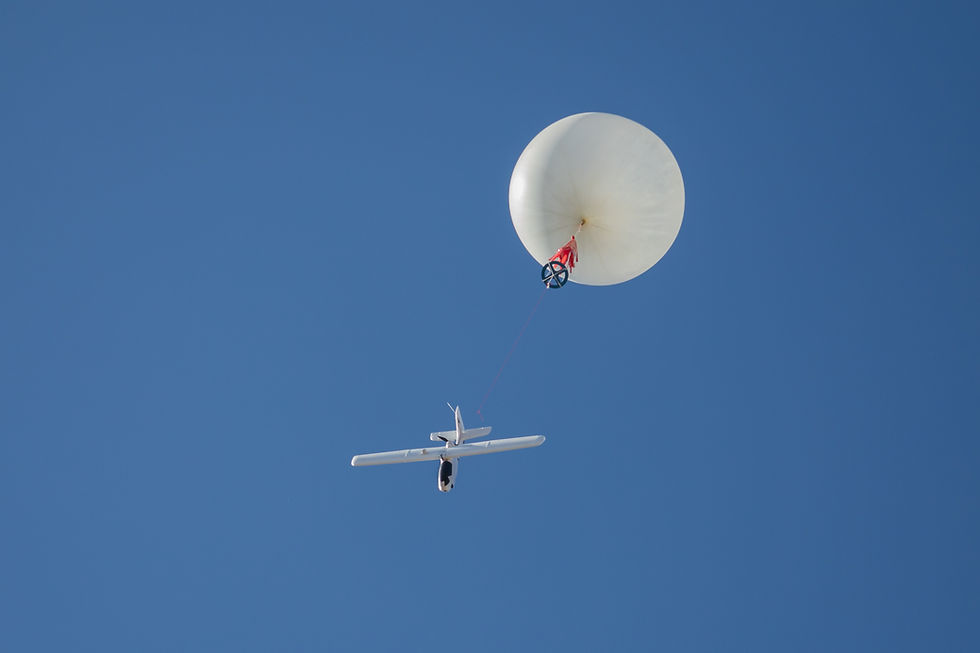
For much of eastern Europe, prevailing atmospheric conditions carry high-altitude balloons eastwards. Unlike powered aircraft, balloons require almost no fuel, produce virtually no thermal signature and cost only a fraction of even the cheapest long-range drone. They drift silently across enormous distances, often at altitudes where conventional radar coverage becomes patchy or where interception becomes disproportionately expensive. Recent Ukrainian systems reportedly combine these balloon platforms with precision-guided payloads that separate during the terminal phase of flight, limiting the effectiveness of electronic jamming against them.
This transformation is significant because it changes the economics of strategic attack.
Throughout history, military competition has often become an economic contest disguised as combat. If one side spends millions of dollars firing sophisticated interceptor missiles against targets costing only a few thousand dollars, the mathematics gradually becomes unsustainable. Even successful interceptions represent financial losses.
Ukraine has repeatedly demonstrated this principle with long-range drones. Balloons extend it further still.
An air-defence commander confronted by unidentified slow-moving objects faces an uncomfortable dilemma. Ignore them and risk allowing a genuine strike system to pass. Destroy them and consume expensive missiles against what may ultimately prove to be inexpensive decoys. Neither option is particularly attractive.
This uncertainty may become more valuable than the weapons themselves.
Psychological warfare has always accompanied military operations. Sirens sounding across large areas of Russia, repeated temporary airport closures, interruptions to rail transport, refinery shutdowns and the constant requirement to maintain alert status all impose cumulative costs that cannot easily be measured merely in destroyed infrastructure. Even attacks that inflict modest physical damage force an adversary to disperse scarce air-defence assets across an enormous territory, reducing concentration around other strategic objectives.
Equally important is what these systems reveal about the remarkable adaptability of Ukraine’s defence industry.
Before 2022, relatively few observers would have imagined Ukraine emerging as one of the world’s foremost laboratories for unmanned warfare. Necessity has accelerated innovation at extraordinary speed. Naval drones have challenged the Russian Black Sea Fleet. Long-range strike drones have reached targets more than a thousand kilometres from the front.
Electronic warfare has evolved continuously in response to Russian countermeasures. Artificial intelligence increasingly assists navigation, targeting and route optimisation.
Balloon weapons form part of this broader ecosystem rather than replacing existing technologies. Their greatest value lies not in isolation but in combination with missiles, drones, electronic deception and intelligence gathering. Modern warfare increasingly resembles orchestration rather than individual combat systems operating independently.
One should also avoid exaggerating their capabilities.
Balloons remain prisoners of meteorology. Weather forecasting becomes as important as engineering. Strong wind shifts can alter trajectories dramatically. Seasonal atmospheric conditions vary considerably. Balloons generally travel slowly and therefore cannot respond rapidly to emerging battlefield developments. Their payloads inevitably remain smaller than those carried by conventional cruise missiles.
No serious military planner would imagine balloons replacing more sophisticated strike capabilities.
Nevertheless, they exemplify an increasingly important characteristic of contemporary conflict: technological regression can sometimes produce strategic progress.
Throughout military history, supposedly obsolete technologies have repeatedly returned when changing circumstances restored their utility. Trench warfare, naval mines, artillery barrages and mass-produced unmanned aircraft all illustrate that innovation is not always about inventing something entirely new. Sometimes it involves rediscovering neglected ideas while combining them with modern electronics, communications and computing.
Ukraine’s balloon programme therefore represents something much larger than an ingenious engineering curiosity.
It reflects a military culture willing to challenge assumptions that wealthier and larger armed forces sometimes accept unquestioningly. Instead of asking how to build a cheaper cruise missile, Ukrainian engineers asked whether the missile needed to fly under its own power for its entire journey at all. Instead of competing directly against Russian strengths, they allowed geography, meteorology and economics to fight alongside them.
There is an important lesson here extending far beyond Ukraine.
Future armed forces may increasingly judge weapons not by their complexity but by their efficiency. A system costing hundreds or thousands of times less than the interceptor designed to destroy it may possess strategic value entirely disproportionate to its technological sophistication. Military planners accustomed to equating advanced capability with greater expense may find themselves confronting opponents whose greatest innovations consist not of building ever more elaborate machines but of combining simplicity with intelligence.
The wind itself has become an operational domain.
For centuries it carried sailing ships across oceans and observation balloons above battlefields. Today it may once again carry weapons, deception and uncertainty across international frontiers.
Sometimes the future of warfare arrives not through revolutionary invention but through remembering what previous generations already knew—and applying it with twenty-first-century imagination.


