


The Spanish-speaking soldiers fighting for Ukraine
By Matthew Parish
Saturday 7 November 2026
The extraordinary story of the Latin Americans and Spaniards who have travelled thousands of miles to fight Russia's invasion, and what their presence reveals about the changing character of Ukraine's war.
In June 2026, a Colombian family travelled to Ukraine to bury their son. Jhan Sebastian Restrepo Mazo, a Colombian volunteer who had served in Ukraine's 413th Unmanned Systems Regiment, had been killed fighting for a country extraordinarily distant from his own. At his funeral, members of his family wept beside Ukrainian soldiers, while the blue and yellow of Ukraine mingled with the yellow, blue and red of Colombia. His mother had placed a ribbon in the Colombian national colours upon his coffin. His father, César Restrepo, expressed the tragedy with devastating simplicity: war had come and taken his son away.
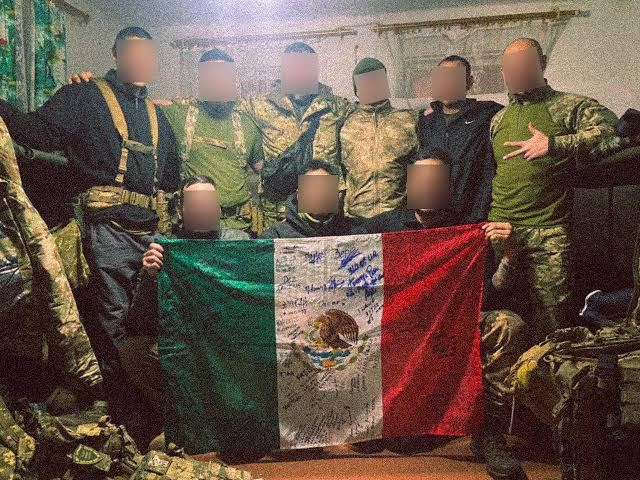
The death of this young Colombian illustrates one of the less widely appreciated dimensions of Russia's invasion of Ukraine. The Ukrainian Armed Forces, although overwhelmingly composed of Ukrainians defending their homeland, have attracted an extraordinary international community of foreign soldiers. Amongst the most significant of these are Spanish-speaking volunteers from Latin America and Spain, many of whom have abandoned their families, careers and familiar surroundings to travel halfway around the world and participate in one of the most destructive European wars since 1945. Their presence raises profound questions about patriotism, economic necessity, military professionalism and the increasingly international character of modern warfare.
When President Volodymyr Zelensky announced the creation of the International Legion for the Defence of Ukraine shortly after Russia's full-scale invasion in February 2022, Western attention initially concentrated upon British, American, Canadian and other European volunteers. These were people from countries already closely associated with Ukraine's defence, and their participation attracted considerable publicity. Yet as the war continued, the composition of Ukraine's foreign military contingent began to change. Latin American soldiers, particularly Colombians, became increasingly prominent, and Ukrainian military institutions adapted their recruitment arrangements to accommodate soldiers who spoke Spanish rather than Ukrainian or English.
Colombia deserves particular attention because of her unusual military history. For decades the Colombian Armed Forces have fought guerrilla movements, paramilitary organisations and heavily armed criminal networks across difficult terrain. This experience has produced generations of professional soldiers familiar with prolonged deployments, irregular warfare, ambushes, small-unit operations and the psychological demands of combat. Although the conditions of the Ukrainian battlefield are markedly different from those of Colombia's internal conflicts, former Colombian soldiers possess skills that can be valuable to an army struggling to sustain an exhausting war of attrition.
There are also economic explanations for the substantial Colombian presence in Ukraine. Military salaries in Colombia are relatively modest, particularly for enlisted personnel and retired soldiers without lucrative civilian careers. Ukrainian military contracts can offer considerably higher remuneration, especially when combat allowances are included. For a Colombian veteran supporting a family, financing children's education or hoping to purchase a home, such opportunities can appear attractive. It would nevertheless be a mistake to conclude that the decision to fight in Ukraine is exclusively financial. Human motivations are rarely so conveniently separated into categories, and an individual may simultaneously be attracted by professional opportunity, personal adventure, comradeship and a genuine conviction that Russia's invasion represents an injustice.
Reliable figures for the number of Colombians who have fought in Ukraine remain difficult to establish. Published estimates have varied from approximately two thousand to several thousand, with some Ukrainian reports suggesting substantially higher numbers. Such figures may refer to different periods, cumulative enlistments or soldiers serving in different formations. The Ukrainian authorities do not publish a comprehensive, independently verifiable national breakdown of their foreign combat personnel. What is beyond serious doubt is that Colombians constitute one of the most prominent contingents of foreign soldiers serving Ukraine.
They are not alone. Argentine, Peruvian, Chilean, Ecuadorian, Venezuelan, Uruguayan and Spanish volunteers have also travelled to Ukraine, sometimes joining predominantly Spanish-speaking formations and sometimes serving directly alongside Ukrainians. Brazilian soldiers, although Portuguese-speaking, are frequently encountered in the same international military communities. Their backgrounds vary considerably. Some have served in professional armies, others have experience in policing or security work, while a smaller number arrive with limited military experience but a determination to acquire the necessary skills.
One particularly interesting development has been the emergence of formations identifying themselves with Latin American political history. The Bolívar Battalion, established in 2023 and associated with Venezuelan volunteers, invokes the name of Simón Bolívar, the nineteenth-century liberator of much of Spanish-speaking South America from Spanish colonial rule. Its symbolism carries an obvious message. Just as Bolívar fought for the independence of Latin American nations, these soldiers conceive of themselves as contributing to the defence of Ukraine's independence from a foreign imperial power. The analogy is not precise, but the underlying idea is sufficiently powerful to explain why some Latin American volunteers regard Ukraine's struggle as part of a wider historical contest between national self-determination and authoritarian domination.
For Venezuelans in particular, the political dimension may be important. Russia has maintained close relations with Venezuela's authoritarian political establishment, and Venezuelan opponents of that establishment may see the defence of Ukraine as part of their own ideological struggle. There are nevertheless substantial political differences amongst Latin American volunteers, just as there are amongst Europeans. It would be absurd to imagine that every Colombian or Venezuelan soldier serving in Ukraine possesses the same political convictions. What they share is the decision to enlist in Ukraine's military, rather than necessarily a common interpretation of the international political order.
The integration of Spanish-speaking soldiers into Ukrainian formations has presented considerable organisational challenges. Military discipline depends upon the rapid transmission of orders and the ability of soldiers to understand instructions under conditions of extreme stress. A misunderstanding about the timing of an operation, the location of friendly forces or the evacuation of casualties can have fatal consequences. It is therefore insufficient merely to recruit soldiers with useful combat experience. They must be incorporated into a system of command and control that operates effectively across linguistic and cultural boundaries.
Ukraine has responded by developing Spanish-language recruitment and training arrangements. Her official international military recruitment resources are available in Spanish, and applicants with Spanish-language skills can be considered even if they do not speak Ukrainian or English. Ukrainian military recruitment services have advertised positions specifically for Spanish-Ukrainian interpreters, while some formations have developed predominantly Spanish-speaking companies and smaller combat groups. The intention is to preserve effective military communication while allowing foreign soldiers to contribute their professional skills without first spending years acquiring fluency in Ukrainian.
The experience of Colombian Sergeant Luis Ortiz illustrates the importance of these arrangements. Having served in combat in Ukraine, Ortiz subsequently became involved in helping Latin American recruits enter the Ukrainian military through formal procedures. His work has included explaining the requirements of military contracts, assisting with administrative formalities and helping newcomers understand the unfamiliar culture of their adopted army. He has described how his own relationship with Ukrainian soldiers changed as they came to recognise his commitment and professional competence. Such experiences suggest that military integration is not merely a matter of translating orders. It involves the gradual development of mutual trust between people whose countries, languages and histories are profoundly different.
The same process operates in the opposite direction. Ukrainian soldiers serving alongside Colombians may acquire Spanish expressions and become familiar with Latin American customs, while Latin American soldiers begin learning Ukrainian words and developing an understanding of the country they are defending. These encounters can produce friendships that would otherwise have been extraordinarily unlikely. Shared danger often creates personal bonds that transcend linguistic differences, and the recognition that another man is prepared to risk his life to save yours can dissolve cultural barriers more effectively than any formal programme of international understanding.
Yet the military experience that Colombian veterans bring to Ukraine does not necessarily prepare them for the extraordinary technological violence of the contemporary battlefield. Colombia's internal wars have involved dangerous jungle operations, guerrilla ambushes and campaigns against heavily armed irregular organisations. Ukraine's war involves mass artillery bombardment, sophisticated electronic warfare, dense minefields, precision-guided weapons and increasingly ubiquitous surveillance and attack drones. A veteran accustomed to fighting insurgents in mountainous or tropical terrain may discover that his survival skills need substantial adaptation when confronting Russian mechanised forces supported by industrial-scale military production.
The transformation wrought by drones is especially significant. Ukrainian and Russian soldiers alike increasingly operate under the threat of near-continuous aerial observation, while even apparently routine movements can attract lethal attacks. The traditional distinction between a relatively secure rear area and a dangerous front line has become blurred. Soldiers may spend prolonged periods in concealed positions, unable to move freely or receive assistance without exposing themselves and their rescuers to attack. For foreign volunteers who have imagined military service in terms of conventional infantry operations, the reality can be profoundly disorientating.
This is one reason why the romantic image of the foreign volunteer deserves careful scrutiny. There is nothing romantic about lying wounded in an exposed position, waiting for evacuation that may be impossible because Russian drones are monitoring every approach. There is little glory in suffering permanent disability, losing close friends or discovering that the psychological consequences of combat remain long after the immediate danger has passed. The experience of Latin American volunteers reminds us that the brutality of the Ukrainian war is universal. Neither nationality nor language offers protection against shrapnel, explosives or the appalling randomness of death.
There is also the controversial question of whether these foreign soldiers should be described as mercenaries. Russian propaganda frequently applies this label to foreigners serving in Ukraine, but it is legally misleading when used indiscriminately. Foreign nationals who formally enlist in the Ukrainian Armed Forces become members of those armed forces, subject to Ukrainian military discipline and entitled to the relevant rights and obligations of military service. Under international humanitarian law, membership of a state's armed forces is materially different from participation as an independent mercenary. The fact that soldiers receive salaries does not in itself transform them into mercenaries, any more than payment transforms Ukrainian professional soldiers into mercenaries.
The distinction does not mean that all foreign military recruitment arrangements are beyond criticism. There are legitimate questions about whether prospective recruits understand their contractual obligations, whether recruitment intermediaries provide accurate information and whether families receive the compensation and assistance to which they may be entitled after death or serious injury. Ukraine has been progressively reforming its arrangements for foreign personnel, including allowing foreign nationals to enlist directly in regular combat brigades rather than necessarily passing through separate international formations. Such reforms reflect the growing importance of foreign soldiers within the Ukrainian military establishment, but they also impose corresponding responsibilities upon the Ukrainian state.
Those responsibilities have become increasingly urgent. On 29 October 2026, Colombia's Ministry of Foreign Affairs reported 256 deaths and 973 reports of disappearance involving Colombian citizens in the context of the Russia-Ukraine war. These figures relate to consular reports received through both Ukraine and Russia and cannot simply be treated as a verified casualty total for Colombians serving in the Ukrainian Armed Forces. Nevertheless, they illustrate the extraordinary human consequences of Colombian involvement in the conflict. Colombia has formally called upon both Ukraine and Russia to stop recruiting Colombian citizens, while emphasising that the Colombian government neither promotes nor sponsors participation in foreign wars.
Accounts from the families of dead and missing Colombian soldiers have revealed particularly troubling problems. Some families have struggled for months to establish whether their relatives are alive, dead or being held captive. Others have complained about difficulties obtaining official documentation, recovering bodies or securing promised compensation. These experiences are not necessarily evidence of deliberate wrongdoing. The extraordinary conditions of the Ukrainian battlefield, including the difficulty of recovering remains from contested territory, create immense administrative and humanitarian problems. Nevertheless, the fact that a soldier has voluntarily accepted the risks of war does not absolve the state employing him of its obligations towards his family.
The ethical questions are uncomfortable because they resist simple answers. A wealthy European volunteer who comes to Ukraine out of ideological conviction may be regarded as a romantic defender of liberty, while a comparatively poor Colombian veteran who undertakes precisely the same risks partly to provide for his family may be dismissed as a soldier of fortune. Such distinctions reveal more about the prejudices of observers than about the moral worth of the soldiers themselves. Economic necessity does not extinguish courage, just as ideological conviction does not guarantee wisdom. The motivations of individuals who voluntarily enter a foreign war should be assessed with sympathy and seriousness rather than reduced to crude stereotypes.
There is also a broader issue concerning the responsibilities of wealthy countries that support Ukraine. Western governments have provided financial assistance, weapons, training and political support, but the political consequences of sending their own citizens to fight Russia have remained considerable. The participation of soldiers from poorer countries highlights an uncomfortable international inequality. Men from Colombia may risk their lives in circumstances in which the governments of far wealthier countries are unwilling to place their own professional soldiers. That does not render their participation illegitimate, but it should discourage complacency about the distribution of sacrifice in a war that Western leaders routinely describe as being fought in defence of the international order.
The presence of Spanish-speaking soldiers also has implications for the future of Ukraine herself. Those who survive the war may return to their countries with extraordinary experiences of modern conflict, including familiarity with technologies and methods that are transforming military affairs internationally. Others may remain in Ukraine, marry Ukrainian citizens, establish businesses or contribute to the country's reconstruction. Their experiences could produce lasting relationships between Ukraine and Latin American societies that have historically maintained relatively limited direct contact. Ukraine may discover that its international friendships have been enlarged not merely through diplomacy but through the sacrifices of individuals who chose to share its fate.
There are risks attached to this process as well. The transfer of military skills acquired in Ukraine to countries struggling with organised crime and armed insurgencies raises legitimate security concerns. Veterans returning from high-intensity warfare may require considerable psychological and social support, while some may find reintegration into civilian life particularly difficult. These problems are not unique to Latin American volunteers, but the distance separating their homes from Ukraine and the differences between their national welfare systems make practical assistance especially complicated. A responsible system of foreign military recruitment should therefore consider not only the enlistment and deployment of soldiers but also their eventual return to civilian society.
History offers an intriguing comparison with the International Brigades that fought in the Spanish Civil War between 1936 and 1939. Then, volunteers from countries around the world travelled to Spain because they believed that the outcome of a struggle against authoritarianism would determine something fundamental about Europe's future. Today the direction of travel has been reversed. Spaniards and Latin Americans are among those travelling eastwards to defend another European country from aggression. The historical circumstances and political movements are different, and the comparison should not be pressed too far. Nevertheless, both conflicts demonstrate the capacity of war to attract individuals who believe that the boundaries of political responsibility extend beyond their own national frontiers.
Ultimately, the importance of Spanish-speaking soldiers in Ukraine cannot be measured simply by their numerical strength or their battlefield achievements. Their presence reminds Ukrainians that the defence of their country has inspired people from societies with no obvious geographical obligation to become involved. A Colombian soldier may never have heard of Kharkiv, Kupiansk or Kramatorsk before February 2022, yet he may subsequently find himself defending one of those places with the same determination as a Ukrainian who was born there. In the process, the distinction between one's native country and the country one has chosen to defend acquires a new and complicated meaning.
This is perhaps the deepest significance of the Spanish-speaking presence in Ukraine's Armed Forces. Patriotism is conventionally understood as loyalty to the country of one's birth, the community in which one's childhood memories were formed and the national traditions inherited from earlier generations. Yet the foreign volunteers fighting for Ukraine demonstrate that patriotic commitment can also be acquired through personal choice, shared danger and moral identification with the fate of another society. A Colombian does not cease to be Colombian when he puts on a Ukrainian military uniform. Rather, he may develop a second allegiance, founded upon the comrades he has come to know and the country whose survival he has undertaken to defend.
The funeral of Jhan Sebastian Restrepo Mazo brought these ideas together in a way that no political declaration could have achieved. A Colombian family had travelled across the world to mourn a young man who had given his life in Ukraine. Ukrainian soldiers attended to honour a comrade who had fought beside them, while the two countries' flags expressed the complicated loyalties of a life cut short. In his death, this Colombian soldier had become part of Ukraine's national story, although his family's grief belonged to Colombia.
The Spanish-speaking soldiers of Ukraine deserve recognition not because they are foreigners engaged in an exotic military adventure, but because they have accepted the same terrible hazards as the Ukrainians beside whom they serve. Some are motivated by money, others by conviction and many by that complicated combination of practical necessity and personal idealism that governs so much human conduct. They have travelled immense distances, endured unfamiliar conditions and in some cases made the ultimate sacrifice. Their stories remind us that, even in a world divided by national borders and conflicting political interests, human solidarity can still inspire people to undertake extraordinary acts of courage on behalf of strangers.
Ukraine's war is fought principally by Ukrainians, and it is Ukrainians who will ultimately determine the future of their country. But amongst those who stand beside them are men and women whose first language is Spanish, whose childhoods were spent beneath the sun of South America or in the cities of Spain and whose paths through life have brought them to the devastated landscapes of eastern Europe. Their participation is one of the remarkable international dimensions of this war. Whatever their individual reasons for coming, those who have served honourably have earned a place in the history of Ukraine's struggle for independence.


