


The Sanctions Game: Russia’s Economic War and the Boomerang Effect
- Aug 3, 2025
- 5 min read
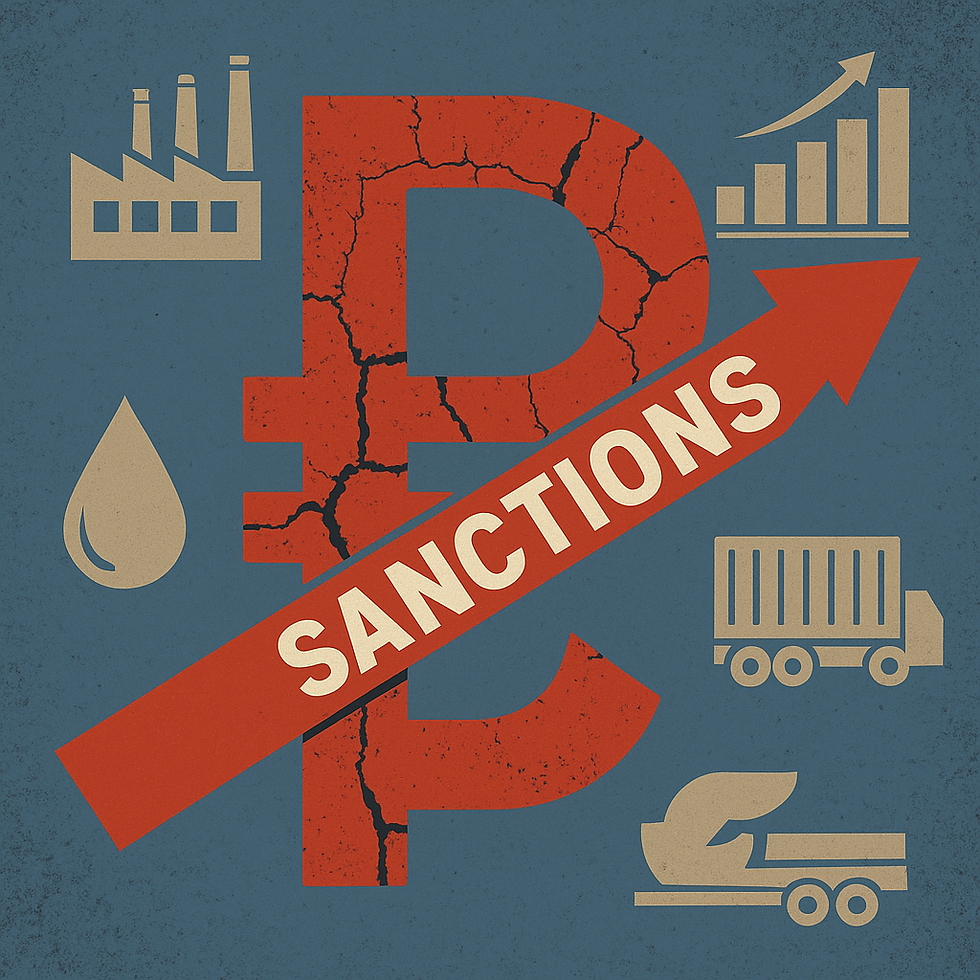
Sanctions are often sold as surgical: a policy scalpel wielded with moral precision, designed to weaken an adversary without bloodshed. In the context of Russia’s war on Ukraine, they have become something else entirely—a weaponised instrument of global economic contest, both powerful and flawed. The West has levied the most comprehensive sanctions regime ever imposed on a G20 economy. Russia has retaliated with her own countermeasures: gas blackmail, raw material bans, and currency manipulation. Yet well over three years into the full-scale war, the scoreboard is murky.
Some measures have worked. Others have not. Many have backfired. And across the Global South and the resource-hungry East, new fractures are forming in the global trading system. The economic war between Russia and the West has become a stress test not only for state resilience but for globalisation itself.
The sanctions game requires fresh analysis. We should consider how it was designed, how Russia has responded, and why the West now faces a strategic dilemma—between enforcement and fatigue, containment and inflation, moral clarity and economic blowback.
Act I: The Arsenal of Economic War
From February 2022 onwards the United States, the European Union, the United Kingdom, Canada, Japan and others unleashed a vast battery of financial, trade and personal sanctions against the Russian Federation. These included:
Asset freezes on the Central Bank of Russia and over $300 billion in sovereign reserves;
Swift de-listings for major Russian banks;
Export controls on microchips, advanced manufacturing tools, and aerospace components;
Oil and gas price caps, embargoes, and shipping restrictions;
Visa bans and asset seizures targeting over 1,500 individuals and entities;
Secondary sanctions on firms doing business with sanctioned Russian entities (accelerated since Trump’s 2025 return to office).
The goal was dual: to cripple Russia’s war machine, and to signal the costs of violating the international order.
Initially, the results were dramatic. The rouble collapsed. Capital flight surged. Foreign firms fled. By mid-2022, Russia’s GDP had contracted sharply. But the story didn’t end there.
Act II: Moscow Strikes Back
Russia did not sit idle. Her economy—largely autarkic, commodity-based, and accustomed to siege—adapted quickly.
The rouble rebounded through strict capital controls and mandatory energy payment conversions;
Gas flows were slashed, particularly to Germany, sending European energy prices soaring;
New export partners emerged, especially China, India, Turkey, and the UAE;
Parallel import networks—especially via Central Asia and the Caucasus—enabled Russia to skirt controls on sanctioned goods;
Oligarchic wealth repatriated, under the guise of “de-offshorisation,” providing short-term liquidity.
Moreover Putin leveraged the war to consolidate internal power further: freezing dissent, nationalising assets, and substituting loyalty for competence across state institutions.
By 2024, Russia’s GDP had largely stabilised at a lower but sustainable level. Her military-industrial base, cut off from Western inputs, began to “de-modernise”—producing crude but effective artillery, drones and missiles en masse. The regime did not collapse. It mutated.
Act III: The Boomerang
While Russia adapted, the sanctions campaign revealed its own contradictions. Economic pressure, once thought to be a cost-free tool for liberal democracies, began to rebound.
Inflation in energy and food markets (especially in 2022–2023) hit European and global consumers hard;
Supply chain disruptions plagued Western manufacturing sectors dependent upon titanium, rare earths, and fertilisers from Russia and Belarus;
Populist parties across Europe seized upon rising living costs, casting sanctions as elite projects that punished ordinary voters;
Global South resentment grew, with countries accusing the West of hypocrisy—caring for Ukraine, but not for famine in Sudan or energy shortages in Pakistan;
China and India leveraged discounted Russian hydrocarbons to fuel their economies and expand diplomatic clout.
In short, the West discovered what it had long feared: that economic interdependence is a double-edged sword.
The Limits of Economic Isolation
Sanctions regimes work best when the target is small, integrated and dependent. Russia is none of these. She is large, resource-rich, and politically insulated from public accountability.
More importantly, global enforcement has been patchy. Dubai, Istanbul, Tashkent and Beijing have become hubs for sanctions circumvention. Western firms, sometimes unwittingly, have continued to supply dual-use goods through intermediaries. The recent rise in “mirror trade” with Kazakhstan and Georgia—imports of German machine tools or Taiwanese chips that are immediately re-exported to Russia—has become a serious loophole.
Meanwhile the Global South resents being dragged into what it sees as a Northern war. They have been offered little incentive to cooperate, and plenty of economic pain if they do.
The West’s Strategic Dilemma
As the war grinds on into its fourth year, the West faces a difficult choice:
Double down, enforcing secondary sanctions on third countries, expanding penalties on insurers, banks, and shippers, and accelerating digital monitoring of trade flows;
or
Refocus, targeting narrower objectives (e.g. battlefield technology, arms components), while relaxing measures with limited strategic impact but high collateral damage.
Donald Trump’s 2025 executive orders on tariffs and sanctions have escalated pressure, particularly on Chinese and Indian firms. But enforcement is politically complex and diplomatically risky. For every sanctioned company, five new shell firms appear. For every enforcement success, a trade partner threatens retaliation.
The sanctions game has become a war of attrition—one that mirrors the battlefield itself.
Can Sanctions Win a War?
The short answer is no. Sanctions can weaken, isolate and destabilise. But they do not, on their own, defeat regimes. The most effective economic measures—like the Allied blockade of Germany in World War I or the oil embargo on Japan—were used in conjunction with overwhelming military pressure including the use of navies to intercept merchant shipping vessels. Likewise Serbia was throttled in the 1990's by a total economic embargo; commercial goods could not get in our out. That is a step beyond what anyone is contemplating at the moment for Russia.
In Ukraine’s case, sanctions are best understood not as an alternative to war, but as a supplement to it. They raise the cost of aggression. They degrade capacity. But they must be paired with battlefield success.
Moreover, sanctions cannot be indefinite. Their long-term effectiveness requires:
Clear goals: Regime change? Territorial withdrawal? War fatigue?
Credible exit ramps: the ability to unwind in exchange for measurable concessions;
Broad coalition support, including from non-Western states;
Flexible adaptation, as targets evolve workarounds.
Without this, sanctions become punishment for punishment’s sake—a moral gesture without material result.
A Game Without a Finish Line
The sanctions game is still being played. It is messy, incomplete, and often inconsistent. But it remains one of the few instruments available to democracies unwilling to send troops but unwilling to surrender values.
Whether it succeeds will depend not only on what is frozen—assets, economies, ambitions—but what is unfrozen: the West’s political will, its moral clarity, and its ability to outlast a regime that thrives on attrition.
Russia has turned her economy into a fortress. But fortresses, like blockades, are not immune to siege. If Ukraine’s allies sustain the pressure—economic, military, and political—then sanctions may yet play a decisive supporting role in ending the war.
Not by breaking Russia. But by ensuring she cannot win.


