


The Politics of Petrol: Has Donald Trump Really Kept American Fuel Prices Under Control?
By Matthew Parish
Monday 9 November 2026
An examination of oil prices under successive American presidents, the economic consequences of war and the increasingly misleading relationship between political rhetoric and the price of filling a motor vehicle.
American political discourse has developed a peculiar obsession with the price of petrol. In a country where the private motor vehicle remains an essential instrument of daily life, the cost of filling a tank has acquired an almost mystical political significance. Presidents are credited with cheap petrol and blamed for expensive petrol, as though the occupant of the White House personally adjusted the prices displayed outside every filling station between California and Maine. The reality is substantially more complicated, although the political appeal of reducing an entire economic philosophy to the cost of a gallon of gasoline is readily understandable.
A striking illustration of this phenomenon is a chart circulating on American social media comparing the number of trading days on which crude oil exceeded $100 a barrel under successive presidents. According to the chart, George W. Bush presided over 146 such days, Barack Obama over 308, Joe Biden over 83 and Donald Trump over none during his first presidency and just 35 during his second, as of 20 October 2026. The graphic is accompanied by unflattering caricatures of Democratic presidents and flattering comparisons with their Republican counterparts. Its underlying message is unmistakable: Republican presidents, particularly Donald Trump, are better at keeping energy affordable than Democrats.

There is a superficially persuasive argument here, and it deserves to be examined rather than dismissed simply because the presentation is partisan. Energy prices are fundamental to economic prosperity, American energy production has expanded enormously over the past two decades and the political decisions of successive administrations have influenced investment in fossil fuels. Nevertheless, the chart suffers from several serious analytical weaknesses. More importantly, the actual experience of American consumers during Trump's second presidency is considerably less reassuring than its colourful graphics suggest.
The difference between crude oil and petrol
The first difficulty is that the chart does not measure petrol or diesel prices at all. It measures the number of trading days on which West Texas Intermediate, an American benchmark for crude oil, exceeded an arbitrarily selected price of $100 a barrel. This is a legitimate economic statistic, but it is not a particularly reliable measure of what American consumers pay at the pump.
Crude oil must be transported, refined into usable fuels and distributed through an extensive commercial network before it reaches a motorist. The retail price includes refining costs, transportation, taxation, distribution expenses and commercial margins. Those components fluctuate independently of the price of crude oil, sometimes quite dramatically, particularly when refining capacity is constrained or international conflicts disrupt the availability of particular petroleum products.
Nor is West Texas Intermediate necessarily the most appropriate measure of international oil costs. Brent crude, the principal international benchmark, can trade at substantially higher prices than its American equivalent. During the Middle Eastern conflict of 2026, this difference became particularly significant because disruptions to international shipping affected the worldwide market more severely than the market for American domestically produced crude. The American Energy Information Administration reported that Brent prices rose from approximately $61 at the beginning of 2026 to $118 by the end of March, while noting that American crude prices experienced a less pronounced increase.
Consequently, a chart showing relatively few days above $100 for American crude oil can coexist with extremely high international oil prices and severe increases in American retail fuel prices. There is no contradiction. The two statistics measure different things, and a graphic that quietly substitutes one for the other is liable to mislead even when its underlying arithmetic is correct.
A second difficulty involves the duration of the presidential administrations being compared. Obama's 308 days were accumulated over eight years, whereas Trump's 35 days were accumulated over approximately 21 months. Once adjusted for the length of the respective presidencies, the difference becomes rather less dramatic. The figures correspond to approximately 39 days annually under Obama, 21 under Biden and 20 under Trump's second administration. The comparison with Biden, in particular, becomes almost indistinguishable using the chart's own methodology.
There is also something distinctly arbitrary about treating $100 as a magical dividing line. A barrel trading at $99.90 is classified as a success, while a barrel trading at $100.10 is classified as a failure. The chart ignores how far prices exceed the threshold, how long they remain just below it and how much they fluctuate. Furthermore, $100 in 2008 had considerably greater purchasing power than $100 in 2026. Without adjusting for inflation, a comparison spanning almost two decades becomes inherently distorted.
What American motorists are actually paying
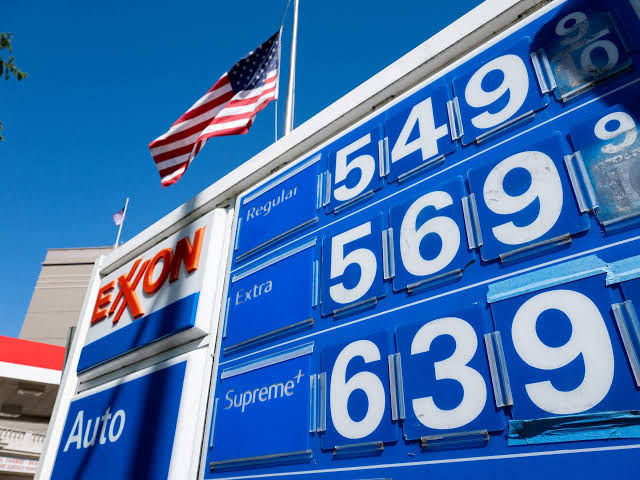
The most compelling evidence against the chart's central implication comes from examining the prices Americans are actually paying for petrol and diesel in November 2026. These figures tell a rather different story from the reassuring impression created by the graphic.
According to the United States Energy Information Administration, the national average retail price of regular petrol on 2 November 2026 was $4.153 per gallon, compared with approximately $3.019 a year earlier. That represents an increase of approximately 38 per cent in twelve months. Diesel prices tell an even more dramatic story: the national average stood at $6.292 per gallon, compared with approximately $3.753 a year earlier, an increase of nearly 68 per cent.
These are hardly trivial increases. A motorist who regularly purchases 20 gallons of petrol each week is now spending approximately $23 more each week than a year earlier. For commercial enterprises dependent upon diesel-powered transportation, the additional costs are substantially greater. Road haulage companies, agricultural enterprises, construction businesses and independent delivery operators have all faced significant increases in their operating expenses.
The consequences extend well beyond the filling station. Diesel is an essential component of modern logistics, and increases in its price ultimately affect the cost of almost everything transported by road. Food distribution becomes more expensive, construction costs rise and agricultural production becomes less profitable. These pressures filter gradually into the wider economy, contributing to inflation in goods and services that may appear entirely unrelated to petroleum.
The scale of the increase is especially striking because Donald Trump returned to office in January 2025 promising to restore American energy dominance and reduce the cost of living. During his first year back in office, petrol prices were comparatively moderate. The average price of regular petrol during 2025 was approximately $3.10 per gallon, according to the Energy Information Administration. The subsequent increases during 2026 therefore represent a substantial reversal of what had initially appeared to be a favourable trend.
Nor does comparison with the Biden administration necessarily produce the results suggested by the social media chart. An analysis of American Automobile Association statistics published in October 2026 found that average petrol prices during Trump's second term had marginally exceeded their average under Biden: $3.472 per gallon against $3.471. Diesel prices had exceeded the Biden-era average by a more meaningful margin, averaging $4.343 against $4.078 per gallon. These figures are nominal rather than inflation-adjusted and the Trump administration is still incomplete, but they provide little support for the proposition that fuel prices have been consistently lower under Trump's second presidency.
Indeed, if the subject is specifically fuel price inflation, rather than the absolute level of prices, the increases during 2026 are among the most significant developments in recent American energy history. One may debate their causes and the extent of presidential responsibility, but it is impossible to describe them credibly as insignificant.
Why petrol was expensive under Obama and Biden
The chart nevertheless identifies genuine historical episodes of exceptionally expensive crude oil under Democratic administrations. The question is why those episodes occurred, and whether Democratic energy policies provide a satisfactory explanation.
The Obama presidency coincided with an extended period of relatively high international oil prices, particularly between 2011 and 2014. This period followed the global financial crisis of 2008, when demand for petroleum had collapsed and prices had fallen precipitously. As economic activity recovered, international demand revived, particularly in emerging economies such as China and India. Political instability across the Middle East, including the consequences of the Arab Spring and sanctions affecting Iranian oil exports, contributed additional pressure.
Yet the suggestion that Obama personally created these conditions is difficult to sustain. Oil prices are determined by a global market in which the United States is an important participant but hardly the sole determining actor. During Obama's presidency, American shale oil production expanded dramatically, transforming the United States into an increasingly important producer. The technological and commercial foundations of that expansion had been laid over many years, but its consequences became especially apparent during his administration.
By late 2014, growing American production was contributing to a worldwide oil surplus. Saudi Arabia and other major producers declined to make production cuts sufficient to maintain elevated prices, and crude oil prices fell sharply. By the time Obama left office, the oil market had undergone a structural transformation that helped establish the conditions for relatively inexpensive petrol during Trump's first term.
It would therefore be misleading to attribute Obama's earlier high prices entirely to Democratic hostility towards fossil fuels while crediting Trump's subsequent low prices entirely to Republican enthusiasm for drilling. Both administrations inherited economic conditions created by investment decisions, technological developments and international market forces that substantially predated their respective presidencies.
The Biden presidency presents a different historical pattern. During 2021, oil demand recovered rapidly from the extraordinary contraction associated with the COVID-19 pandemic. Supply chains were disrupted, petroleum production had been reduced and refining capacity was struggling to accommodate the rapid recovery in consumption. The combination produced upward pressure on energy prices even before Russia launched its full-scale invasion of Ukraine in February 2022.
That invasion generated an additional and severe international energy shock. Russia was one of the world's largest exporters of petroleum products, and the introduction of Western sanctions, combined with commercial uncertainty surrounding Russian energy exports, contributed to a surge in global prices. American petrol prices briefly exceeded $5 per gallon in June 2022, although this peak subsequently subsided. The average annual price of regular petrol fell from approximately $3.95 in 2022 to $3.52 in 2023 and $3.30 in 2024.
Biden's domestic energy policies were certainly open to criticism. His administration's environmental priorities, restrictions affecting particular federal lands and occasional ambiguity about the future of the American petroleum industry may have discouraged some investment at the margins. However, petroleum production depends upon investment decisions made over periods of years, and American producers continued to expand output during his presidency.
The more substantial explanation for the 2022 price shock lies in the interaction between the recovery from the pandemic and Russia's invasion of Ukraine. Blaming the entire increase upon the identity of the American president would be to misunderstand the international character of energy markets.
The inconvenient consequences of the war with Iran
The most important development for understanding American fuel prices in 2026 is the war involving the United States, Israel and Iran. Military operations beginning on 28 February produced severe disruptions to petroleum shipments through the Strait of Hormuz, one of the world's most strategically important maritime passages.
Before the conflict, approximately one fifth of global oil and gas supplies passed through the strait. Even partial interruptions to this trade create powerful incentives for traders, refiners and governments to accumulate inventories, purchase alternative supplies and pay additional premiums to insure shipments. The result is rising prices throughout the international petroleum market, whether or not American domestic production is increasing.
This development introduces a political irony into the argument advanced by the chart. The Biden administration was confronted by an energy shock arising substantially from Russia's decision to invade Ukraine. The second Trump administration has faced an energy shock arising in significant part from a military conflict in which the United States itself chose to participate as a principal belligerent.
This does not establish that the American military intervention was unjustified. Governments sometimes undertake military operations for strategic or security reasons that they consider more important than the immediate economic consequences. Nevertheless, it makes the attribution of responsibility more complicated for those inclined to credit Trump with every reduction in energy prices while blaming his Democratic predecessors for every increase.
American military action against Iran was a political and strategic decision taken by the Trump administration. The consequences for maritime security, international petroleum supplies and global energy prices were foreseeable risks associated with that decision, even if their precise magnitude was uncertain. The resulting economic disruption cannot simply be excluded from an assessment of the administration's energy record.
The Energy Information Administration's October 2026 outlook reported that American retail petrol prices averaged $4.35 per gallon in September, while diesel averaged $6.29. It attributed the increases to higher crude oil prices and wider refining margins. The agency also anticipated that diesel prices would remain elevated as international supply constraints continued to affect available inventories.
There is a further distinction worth emphasising. Trump has frequently argued that American energy independence protects the United States against international instability. There is considerable truth in the proposition that domestic production strengthens national economic resilience. A country producing substantial quantities of its own petroleum is less vulnerable to outright supply shortages than one entirely dependent upon imported oil.
However, energy independence does not necessarily imply price independence. American producers sell petroleum into a global market, and they have commercial incentives to respond to international prices. If an international crisis substantially increases the value of crude oil, American producers can benefit from that increase even as American motorists suffer its consequences.
The existence of extensive domestic petroleum reserves therefore cannot guarantee cheap petrol. Indeed, in some circumstances, geopolitical instability can simultaneously enrich American oil producers and impoverish American consumers.
The special problem of diesel
Diesel deserves particular attention because its economic significance is often underestimated in political arguments dominated by the price of ordinary petrol.
Petrol is primarily associated with private motoring, although it is also used commercially. Diesel powers much of the heavy transportation infrastructure upon which the American economy depends. It is essential to agriculture, freight distribution, construction equipment and numerous industrial activities. When diesel becomes significantly more expensive, the consequences extend through the entire supply chain.
Furthermore, the diesel market is not identical to the petrol market. Diesel competes with heating oil and aviation fuel for particular fractions of crude oil produced during refining. Disruptions to international supplies of these products can therefore produce extraordinary price increases even when the price of crude oil itself appears comparatively stable.
The 2026 Middle Eastern conflict has generated precisely these difficulties. Disruptions to international shipments of refined petroleum products, combined with limited inventories and increased demand for alternative supplies, have produced especially severe pressures in diesel markets.
This helps explain why American diesel prices have increased considerably more rapidly than petrol prices during 2026. The increase is not merely a political embarrassment for an administration promising inexpensive energy. It is a potentially significant source of broader economic inflation because transportation costs influence the prices of so many other products.
A government seeking to reduce inflation therefore has reasons to pay at least as much attention to diesel as to ordinary petrol. Indeed, the dramatic increase in diesel prices may ultimately be more important to the wider economy than the highly visible prices displayed outside suburban petrol stations.
What about inflation-adjusted prices?
There is nevertheless an important qualification to the foregoing analysis. Comparing fuel prices over different presidencies without adjusting for inflation can exaggerate the apparent burden imposed by more recent prices.
A dollar in 2026 purchases considerably less than a dollar did in 2008 or 2012. Consequently, an American motorist paying $4 for a gallon of petrol in 2012 was sacrificing more purchasing power than a motorist paying the same nominal amount in 2026.
Inflation-adjusted comparisons suggest that the years between 2011 and 2014 were particularly expensive for American motorists. The nominal annual average petrol price of approximately $3.62 in 2012 represented substantially more in contemporary purchasing power. Indeed, some analyses place 2012 above 2022 when comparing the inflation-adjusted annual averages.
This lends some genuine substance to the contention that petrol was expensive under Obama. It also illustrates why comparisons limited to nominal prices can be misleading in the opposite direction: they may make today's prices appear more severe than earlier prices that imposed a greater burden upon household purchasing power.
A still more revealing measure is the share of disposable income required to purchase a given quantity of fuel. American incomes have generally increased over time, although unevenly across different occupations and regions. A motorist earning substantially more in nominal terms may find a $4 gallon of petrol less burdensome than an earlier generation found a $3 gallon.
By this measure, the claim that Americans are suffering unprecedented fuel costs under Trump is also open to challenge. Analysis of government data indicates that petrol purchases consumed a higher proportion of disposable income during most of Obama's presidency and much of Biden's than they did in the second quarter of 2026. However, that comparison does not capture the full effects of the renewed price increases during the latter part of 2026.
There is thus a legitimate distinction between the economic burden associated with fuel prices and their nominal monetary value. Nevertheless, this does not rescue the social media graphic. Rather, it demonstrates that the proper assessment requires several different measures, including inflation-adjusted prices, household incomes, periods of sustained price increases and the relative cost of different petroleum products.
None of these can be satisfactorily represented by counting the number of occasions on which one particular crude oil benchmark crossed an arbitrary threshold.
How much influence does an American president really possess?
The deeper problem with the chart is its implied theory of presidential economic power. American presidents undoubtedly possess substantial influence over domestic energy policy. They can regulate access to federal land, influence environmental standards, approve or obstruct infrastructure projects, impose sanctions, negotiate international agreements and establish the broader political framework within which petroleum companies invest.
However, they cannot simply command the international price of oil. Petroleum is an internationally traded commodity whose price reflects an intricate interaction between production, consumption, inventories, transportation costs, financial speculation and geopolitical uncertainty. The decisions of Saudi Arabia, Russia, China and other major producers and consumers may matter as much as decisions taken in Washington.
Nor are the economic consequences of presidential decisions necessarily immediate. Increasing domestic petroleum production requires exploration, drilling, pipelines, financing and processing infrastructure. A president who encourages investment may not see the full benefits during his own administration, while his successor may inherit the advantages of earlier policies.
The reverse is equally true. Governments can discourage long-term investment without immediately affecting current supplies, thereby creating problems that emerge only years later. Conversely, a president may benefit politically from low energy prices resulting from weak international demand rather than from particularly successful domestic economic management.
Trump's first presidency provides a useful illustration. During 2020, the COVID-19 pandemic devastated international demand for petroleum. American oil futures briefly traded at negative prices because storage capacity became constrained and market participants were desperate to avoid taking physical delivery. Petrol became exceptionally cheap, but this was hardly evidence of a flourishing economy. It was the consequence of a catastrophic collapse in economic activity.
Indeed, some of the cheapest oil prices in modern history have accompanied some of the most severe economic crises. Cheap petroleum is not automatically evidence of competent economic management, just as expensive petroleum is not invariably evidence of incompetence.
One of the fundamental weaknesses of modern political argument is its tendency to transform statistical correlations into assertions of causation. If petrol prices rise during a Democratic administration, the increase is attributed to Democratic policies. If prices fall during a Republican administration, Republicans are credited with the improvement. This reasoning may be emotionally satisfying, but it is not serious economic analysis.
The political seduction of simple numbers
The chart illustrates a wider phenomenon in contemporary political communications: the replacement of complex economic relationships with visually appealing comparisons that convey a conclusion more forcefully than the underlying evidence warrants.
Its figures may be accurate within their narrowly defined parameters, although the individual counts have not been independently reconstructed here from the complete daily price series. Yet even if every number is correct, the political conclusion does not follow. The figures compare administrations of different lengths, use a fixed nominal threshold over nearly two decades and measure crude oil rather than the retail prices principally relevant to consumers.
They also ignore the severity of price increases, the purchasing power of money, the international circumstances affecting petroleum markets and the difference between the prices of petrol and diesel. The result is not necessarily a false statistic but something potentially more insidious: a true statistic used to encourage an inadequately supported conclusion.
This is hardly a practice confined to supporters of Donald Trump. Democratic politicians have been equally willing to claim credit for favourable economic developments while attributing unfavourable ones to their predecessors or to circumstances beyond their control. Political argument has always involved selective presentation, and the emergence of instantly shareable statistical graphics has merely made the practice more efficient.
The most effective misleading statistics are frequently not fabricated. They are carefully selected fragments of reality from which inconvenient context has been removed. A graph can be mathematically accurate while being intellectually dishonest, just as a political speech can contain nothing but individually defensible statements while nevertheless communicating a fundamentally distorted interpretation of events.
The verdict on Trump's energy record
The evidence available in November 2026 supports several conclusions, none of which can be compressed into a simplistic contest between Republican and Democratic presidents.
Petrol and diesel were exceptionally expensive during important periods of the Obama and Biden administrations. Some of those episodes, particularly under Obama, imposed a greater inflation-adjusted burden upon American motorists than contemporary nominal prices might suggest. The first Trump administration did indeed coincide with comparatively inexpensive fuel, although international market conditions and the extraordinary economic disruption of 2020 explain much of that experience.
Trump's second administration began with comparatively moderate energy prices, but the situation changed dramatically following the outbreak of war with Iran in February 2026. Petrol prices rose substantially, while diesel prices increased by considerably more. By early November, American motorists were paying nearly 38 per cent more for regular petrol than a year earlier, while diesel consumers were paying almost 68 per cent more.
These increases cannot reasonably be described as insignificant. Nor can they be attributed exclusively to the domestic energy policies of the Trump administration. They arise from a combination of geopolitical conflict, international supply disruption, refining constraints and commercial responses to uncertainty. Nevertheless, because the United States is directly involved in the Iranian conflict, the administration cannot entirely distance itself from the economic consequences of its own foreign policy decisions.
The original chart therefore establishes something considerably narrower than its promoters appear to imagine. It suggests that American crude oil has spent fewer total days above a fixed nominal threshold during Trump's presidencies than during some earlier administrations. It does not establish that petrol and diesel have been consistently cheaper under Trump, that he has managed energy prices more effectively than his Democratic predecessors or that American consumers have been protected from severe energy inflation.
The broader lesson is that energy prices are determined by forces considerably more complicated than the political affiliation of the occupant of the White House. American presidents influence those forces, sometimes profoundly, but they cannot abolish the laws of supply and demand, insulate their economies entirely from international conflicts or guarantee that domestic petroleum abundance will translate into inexpensive fuel.
For a European audience accustomed to the economic consequences of Russia's war against Ukraine, this ought to be particularly evident. Energy prices are inseparable from geopolitics, military strategy and international interdependence. The same forces that have disrupted European energy markets since February 2022 are now interacting with renewed instability in the Middle East to create substantial costs for American households.
The final irony is that a president who has built much of his political identity around the promise of inexpensive American energy now finds himself confronting precisely the international vulnerability that his rhetoric of energy dominance was supposed to overcome. The United States may possess extraordinary petroleum resources, but it remains a participant in a global economy whose prices cannot be dictated from Washington.
And the laws of economics, unlike the American electorate, are entirely indifferent to the identity of the president.


