


The Octopus and the Jet-Powered Shahed: When the Mathematics of Air Defence No Longer Works

By Matthew Parish
Sunday 1 November 2026
There is a fundamental problem confronting Ukraine's increasingly sophisticated system of inexpensive drone interceptors, and it is not one that can be resolved simply by manufacturing more drones, training additional operators or improving the artificial intelligence that guides them towards their targets. The problem is that Russian attack drones are becoming faster than the Ukrainian machines designed to destroy them. In particular, the introduction of jet-powered Shahed variants has exposed serious limitations in Ukraine's Octopus interceptor programme, one of the most promising technological achievements of the country's domestic defence industry.
The Octopus represents an ingenious response to the extraordinary economics of modern aerial warfare. Rather than expending surface-to-air missiles costing hundreds of thousands or even millions of dollars to destroy relatively inexpensive Russian attack drones, Ukraine has developed small, rapidly manufactured interceptor aircraft that can hunt down approaching Shaheds and destroy them at a fraction of the cost. The concept has proved successful against conventional propeller-driven drones, whose relatively low speeds permit a small electrically powered aircraft to overtake or intercept them. Yet Russia has responded with a technological innovation that threatens to undermine this achievement: the replacement of piston engines and propellers with miniature turbojet engines.
The consequence is not that Octopus interceptors are incapable of ever destroying jet-powered Shaheds. Some versions may be able to do so under favourable circumstances, and improvements to the original design have already increased their performance. The more troubling conclusion is that there is no publicly demonstrated basis for believing the existing Octopus family can reliably intercept the full range of modern Russian jet-powered attack drones, particularly when the targets are travelling at their higher operating speeds.
This distinction between an occasional successful interception and a dependable air defence system is essential. In defending a city against hundreds of incoming weapons, the occasional success is not enough. What matters is the probability of destroying each attacking aircraft before it reaches its intended target, and the physical limitations of an interceptor determine how high that probability can realistically become.
A successful solution to yesterday's problem
The Octopus is a Ukrainian invention developed within the Armed Forces of Ukraine and subsequently taken into industrial production by Ukrainian manufacturers and their British partners. The British government has made the programme a prominent element of its technological cooperation with Ukraine, with manufacturing arrangements intended to produce thousands of interceptor drones each month. In April 2026 Ukraine's Ministry of Defence announced the procurement of 8,000 Octopus interceptors, involving a network of licensed manufacturers and four companies already holding government supply contracts.
The original principle was straightforward. A conventional Shahed-136, designated the Geran-2 in Russian service, typically flies at less than 200 kilometres per hour. This is fast compared with an ordinary road vehicle, but slow by the standards of military aviation. A small electric aircraft capable of travelling considerably faster, equipped with suitable sensors and guidance mechanisms, can become an effective and relatively inexpensive defensive weapon.
The Octopus-100 manufactured by TAF Industries has publicly advertised a maximum speed exceeding 300 kilometres per hour, automatic targeting, a flight duration of approximately 15 minutes and an operating altitude of up to 4,500 metres. More importantly, the manufacturer announced in June 2026 that its improved version had demonstrated a maximum speed of 360 kilometres per hour, compared with the original approximately 300-kilometre-per-hour design. This represented a substantial engineering achievement, achieved without abandoning the basic Octopus architecture.
Against an ordinary Shahed, these characteristics are formidable. The interceptor has the physical capability to move substantially faster than the aircraft it is pursuing, while automated guidance reduces the burden upon its human operator. This combination of favourable aerodynamics, inexpensive propulsion and increasingly sophisticated machine vision explains why Ukraine's interceptor-drone programme has become such an important component of the country's layered air defences.
But the appearance of Russian jet-powered Shaheds has changed the problem almost beyond recognition.
The arrival of the jet-powered Shahed
Russia's increasingly sophisticated Geran family now includes several jet-powered variants, including the Geran-3, derived from the Iranian Shahed-238, and the more recent Geran-4 and Geran-5. These aircraft are not simply conventional Shaheds with more powerful engines. The adoption of jet propulsion permits substantially higher operating speeds and, in some models, significantly greater operating altitudes.
Publicly reported performance figures vary according to the model and flight conditions. The Geran-3 has been associated with speeds ranging from approximately 300 to 600 kilometres per hour, although some Russian versions appear substantially slower than the Iranian original. Ukrainian Air Force reporting has described the Geran-5 as capable of approximately 450 to 600 kilometres per hour, with an operating altitude reaching 6,000 metres. These figures place significant parts of the Russian jet-powered fleet outside the assured performance envelope of the original Octopus design.
This is a revolutionary development in the economics of Russia's aerial campaign. According to figures obtained by Reuters, Russian launches of drones travelling between 240 and 500 kilometres per hour increased from approximately 450 in June 2026 to 2,850 in August. Russia has not merely introduced an experimental weapon in small numbers. She has begun transforming the technological characteristics of its mass-produced aerial strike capability.
A defender who has invested in inexpensive propeller-driven interceptors now confronts aircraft that may be substantially faster, capable of operating at greater altitudes and considerably more demanding to engage. This is a classic example of the technological contest between offensive weapons and defensive countermeasures, in which success against one generation of weapons encourages the adversary to develop another.
The mathematics of speed
The fundamental problem can be expressed using elementary Newtonian mechanics. In the simplest case, consider two aircraft travelling in the same direction, one pursuing the other at constant velocity. Their relative velocity is the difference between their respective speeds:

If the interceptor is travelling more slowly than the target, the separation between them will increase rather than diminish. No amount of artificial intelligence can overcome this elementary physical constraint in a sustained pursuit.
Consider the published figure of 360 kilometres per hour for the improved Octopus and an illustrative jet-powered Shahed travelling at 500 kilometres per hour. The difference is 140 kilometres per hour in the Shahed's favour. In that particular pursuit geometry, the interceptor cannot overtake the target while both maintain those speeds.
It would nevertheless be a mistake to conclude that a slower interceptor can never destroy a faster aircraft. Interception does not necessarily require pursuit from behind. Two aircraft travelling towards one another have a combined closing speed, and an interceptor can also meet a target along its flight path. But such encounters make accurate tracking, prediction and terminal guidance particularly important, while reducing the time available for correcting errors.
The greater the difference between the maximum speeds of the two aircraft, the more limited the circumstances under which successful interception becomes possible. A system that can destroy a target under a favourable combination of circumstances is not necessarily capable of providing consistent defensive coverage against that class of targets.
The limitations become more pronounced when one remembers that maximum speed is not the same as sustainable operational speed. An aircraft's published maximum may be achievable only briefly, under particular aerodynamic conditions and with a consequent reduction in endurance. Reliable interception requires not merely the ability to attain a headline speed, but the ability to sustain the overall flight and guidance performance necessary to complete an engagement.
Why making Octopus faster is so difficult
The second scientific problem is aerodynamic drag. As an aircraft moves through the atmosphere, it must expend energy overcoming the resistance of the air. A simplified expression for aerodynamic drag is:

Here,

represents drag force,

is air density,

is the aerodynamic drag coefficient,

is the reference area and
v
is the aircraft's velocity relative to the surrounding air.
The important feature is that drag increases approximately with the square of velocity, assuming the other variables remain constant. This means that even modest increases in speed can produce disproportionately large increases in the resistance that an aircraft must overcome.
The power required merely to overcome this drag is the drag force multiplied by velocity:

In this simplified model, aerodynamic power demand rises with the cube of velocity. Increasing an aircraft's speed by 20 per cent can therefore increase the power required to overcome drag by approximately 73 per cent, provided the aerodynamic configuration remains otherwise unchanged.
This is an important observation when considering the improvements already achieved by TAF Industries. Raising the Octopus's maximum speed from approximately 300 to 360 kilometres per hour was not simply a matter of fitting a marginally more powerful electric motor. In June 2026 the company described improvements involving batteries, motors, propellers and aerodynamics, illustrating the interdependence of these engineering problems.
Now consider the more ambitious objective of increasing the speed of an otherwise comparable aircraft from 300 to 500 kilometres per hour. The simplified aerodynamic power relationship gives:
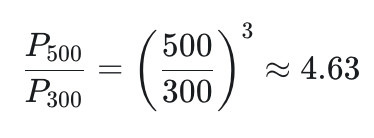
This does not mean that an actual redesigned Octopus would necessarily consume precisely 4.63 times as much total power. Its aerodynamic characteristics, propulsion efficiency and operating conditions would also change. Nevertheless, the calculation illustrates why a seemingly straightforward increase in maximum speed can create an entirely new engineering problem.
Electric propeller-driven aircraft are particularly sensitive to the relationship between battery mass, available power and endurance. Batteries have substantial advantages in simplicity, responsiveness and manufacturing costs, but their energy storage capacity per kilogram is much lower than that of liquid hydrocarbon fuels. Turbojet engines exploit the high energy density of aviation fuel and operate according to a very different propulsion principle.
The practical consequence is that an interceptor designed principally around electric motors and propellers cannot necessarily be transformed into an effective high-speed interceptor merely by installing stronger motors. Above a certain performance threshold, the entire aircraft may require reconsideration.
The problem of altitude
Speed is only one component of the difficulty. Altitude introduces another.
The publicly advertised Octopus-100 has a flight ceiling of approximately 4,500 metres, whereas the Geran-5 has been reported operating at altitudes reaching 6,000 metres. These are published specifications rather than independently verified limits for every aircraft and configuration, but the distinction is potentially significant.
Climbing requires an aircraft to acquire gravitational potential energy. The simplest expression is:

Here,
m
is the mass of the aircraft,

is gravitational acceleration and

is the gain in altitude. For every kilogram of aircraft mass, climbing an additional 1,000 metres requires approximately 9,810 joules of gravitational potential energy, before accounting for propulsion losses or aerodynamic resistance.
Moreover, the atmosphere becomes less dense with altitude. This affects both aerodynamic lift and the operation of propellers, and it can alter the available thrust and efficiency of an aircraft's propulsion system. An electric interceptor's performance at its nominal maximum altitude may therefore be substantially different from its performance nearer the ground.
A manufacturer cannot necessarily increase the operating altitude of an interceptor without introducing consequences for its battery endurance, stability and aerodynamic performance. The same aircraft may consequently face simultaneous difficulties involving speed, altitude and remaining energy.
The result is not a single design defect that can be corrected by a minor modification. It is a complicated interaction between fundamental physical limitations.
Artificial intelligence cannot repeal the laws of physics
The Octopus programme has placed considerable emphasis upon automated terminal guidance and machine vision. This is understandable, because human operators cannot consistently make the rapid and precise decisions required during very high-speed aerial encounters. Automated systems can analyse incoming sensor information and adjust an aircraft's course far more rapidly than a human pilot manually observing a video feed.
Nevertheless, the effectiveness of such systems remains constrained by the quality of the information available to them and by the physical capabilities of the aircraft they control. A machine-learning system may estimate the trajectory of an approaching target with considerable sophistication, but its predictions remain probabilistic. Sensor errors, uncertain target motion and communication limitations all contribute to the uncertainty of a predicted encounter.
There is also a distinction between calculating the appropriate action and possessing the mechanical capability to execute it. An aircraft has finite acceleration, limited available thrust and constraints upon the aerodynamic forces its structure can tolerate. Software cannot command an aircraft to achieve a velocity, acceleration or altitude beyond its physical capabilities.
This is precisely why increasingly fast interceptor prototypes have encountered practical difficulties during testing. Reuters reported in September that some experimental Ukrainian interceptors proved difficult to control at speeds exceeding 400 kilometres per hour, with several aircraft crashing during trials. Such incidents are evidence not of Ukrainian technological incompetence, but of the inherent difficulty of developing aircraft that combine extremely high speed, inexpensive manufacture and reliable autonomous guidance.
Artificial intelligence can make an effective interceptor more effective. It cannot turn a fundamentally unsuitable aircraft into a universally capable one.
The difference between occasional success and statistical reliability
There is another mathematical distinction that deserves particular attention. Military equipment is often evaluated by the number of successful engagements it has completed, whereas the more important measure of an air defence system is its probability of successful interception under specified operating conditions.
Suppose, purely for illustration, that a particular defensive system had a probability of destroying a target of 60 per cent in any individual engagement. If multiple engagements were statistically independent, the probability of at least one success after n attempts could be expressed as:

In this expression, P is the probability of success in one engagement. With three independent attempts and an individual success probability of 60 per cent, the resulting overall probability would be approximately 93.6 per cent.
Real-world air defence is more complicated because failures are not necessarily independent. Poor weather, limited sensor visibility, inadequate aircraft performance or communications interference may affect multiple engagements simultaneously. These factors can produce correlated failures, making the simplified mathematical calculation unduly optimistic.
The economic implications are nevertheless considerable. If a defensive system requires several interceptors against each incoming aircraft, the costs of defending against mass attacks increase substantially. Even if each individual interceptor is inexpensive, the number of aircraft, operators, sensors and supporting systems required may become considerable.
This raises an important qualification concerning reported success rates. In September, Ukrainian officials described interception rates of approximately 60 per cent against jet-powered drones, compared with more than 90 per cent against conventional piston-engine Shaheds. By late October, however, the Institute for the Study of War assessed that Ukraine's overall interception or suppression rate against jet-powered drones had risen to approximately 77 per cent, declining to about 74 per cent during a period of satellite communications disruption. These figures reflect Ukraine's combined defensive efforts, not the success rate of Octopus specifically.
Indeed, Ukraine reported destroying or suppressing 56 of 70 jet-powered drones launched during the attack of 26 October, equivalent to 80 per cent. This represents meaningful progress and demonstrates that the Russian jet-powered Shahed is far from invulnerable. It does not establish that existing Octopus interceptors can independently reproduce those results, because Ukraine employs fighter aircraft, surface-to-air missiles, electronic warfare and other interceptor designs alongside them.
There is presently insufficient publicly available performance data to assign an independently verified probability of interception to the Octopus against each of the Geran-3, Geran-4 and Geran-5 variants. We should therefore resist the temptation to present a numerical Octopus failure rate as an established fact. The scientific evidence supports a narrower but important conclusion: the published performance envelope of existing Octopus models leaves significant portions of the jet-powered threat beyond their reliable reach, and successful individual engagements do not demonstrate comprehensive defensive capability.
The danger of confusing industrial success with military success
Ukraine has achieved something remarkable by developing sophisticated military aircraft in conditions of extraordinary national adversity. The Ukrainian armed forces and their industrial partners have demonstrated a capacity to devise, test and manufacture new weapons at a speed that many established Western defence contractors would find difficult to match.
The Octopus is a particularly striking example. It has moved from development into industrial production, attracted international support and created a manufacturing ecosystem capable of supplying large quantities of relatively inexpensive interceptor drones. These are genuine achievements that should not be diminished by the emergence of a new technological challenge.
Yet industrial success and military effectiveness are not identical. Manufacturing 8,000 interceptors is an important accomplishment, but the significance of that accomplishment depends upon the types of aircraft those interceptors can destroy. If their effectiveness is concentrated against slower propeller-driven targets, they remain valuable weapons, but they cannot be considered a complete answer to Russia's newer jet-powered fleet.
This distinction is particularly important in a war in which technological optimism frequently competes with the unforgiving realities of the battlefield. Impressive manufacturing statistics, successful demonstration videos and ambitious official announcements are not substitutes for independently assessed operational performance.
The political temptation is to present technological innovation as a sequence of definitive solutions. A new weapon is developed, its successful deployment is announced and a difficult military problem appears to have been resolved. Yet the adversary is simultaneously developing countermeasures, and by the time one solution has reached industrial maturity the nature of the problem may already have changed.
What comes after Octopus?
Ukraine's engineers are certainly not ignoring the new challenge. During 2026 a number of manufacturers have introduced or tested faster interceptor designs, including improved electric aircraft and miniature jet-powered systems intended specifically to address the limitations of earlier Shahed interceptors.
For example, the Ukrainian Zorelit v5 interceptor was reported in September to have completed internal testing with a stated maximum speed of 416 kilometres per hour. Other projects have pursued turbojet propulsion, while Ukraine's Ministry of Defence has authorised increasingly capable high-speed defensive aircraft. These developments demonstrate that Ukrainian engineering is responding to the changing nature of the threat, although advertised maximum speeds and successful prototypes do not automatically establish mass-production readiness or battlefield reliability.
The broader technological challenge is to preserve the economic advantage that made inexpensive interceptors attractive in the first place. Ukraine cannot afford to expend expensive missiles against every relatively inexpensive incoming drone, particularly when its stocks of sophisticated Western air defence weapons remain limited and their primary purpose includes defeating much more dangerous missile threats.
There is therefore no single technological solution to Russia's development of faster Shaheds. Future defensive systems will require combinations of improved propulsion, increasingly sophisticated sensors and guidance, greater automation and integration into broader air defence networks. Jet-powered interceptors and relatively inexpensive guided missiles may assume more important roles, but each will involve its own compromises in manufacturing cost, reliability and availability.
The object should not be to replace every existing Octopus with a substantially more expensive aircraft. It should be to ensure that Ukraine possesses an economically sustainable collection of defensive capabilities suitable for the different generations of aerial threats confronting it.
The uncomfortable lesson of the Octopus
There is something profoundly instructive about the present technological contest. Modern military innovation is frequently presented as a triumph of software over machinery, in which artificial intelligence, autonomous systems and inexpensive electronics threaten to make traditional weapons obsolete. Ukraine's extraordinary achievements in drone warfare have provided powerful evidence in support of this proposition.
But the development of jet-powered Shaheds reminds us that the underlying laws of physics have not changed. Atmospheric drag continues to increase with the square of velocity. The energy required to reach greater altitudes remains governed by gravity. Aircraft remain constrained by the thrust, endurance and aerodynamic characteristics of their propulsion systems, however sophisticated the computers guiding them may become.
The Octopus was developed principally to solve the problem of relatively slow, inexpensive Russian attack drones. It has been improved and may continue to demonstrate useful capabilities against some faster aircraft. But there is a substantial difference between improving a weapon beyond its original design requirements and establishing that it can reliably defeat an entire new generation of threats.
Ukraine should celebrate the Octopus programme while recognising its limitations. Its engineers deserve admiration for what they have achieved, but they also deserve realistic assessments of the difficulties they now confront. The country cannot defend its cities through technological enthusiasm alone.
Ultimately, the lesson is that modern air defence must remain a continually evolving contest of scientific knowledge, engineering ingenuity and economic sustainability. Russia's transition to jet-powered Shaheds has deprived some of Ukraine's existing inexpensive interceptors of the comfortable speed advantage upon which their original success depended. Ukraine must now undertake the considerably more difficult task of developing defensive systems that remain effective against aircraft whose performance approaches that of miniature cruise missiles.
The Octopus was an important victory in the first stage of Ukraine's inexpensive drone-interception revolution. The jet-powered Shahed demonstrates why that victory cannot be regarded as permanent, and why the next generation of Ukrainian air defence must be judged not by the number of interceptors produced, but by the reliability with which they protect the people and cities beneath them.
That is the distinction between the promise of military technology and the unforgiving mathematics of war.


