


The new Russian conscripts: central Asian women
- Feb 26
- 5 min read
Thursday 26 February 2026
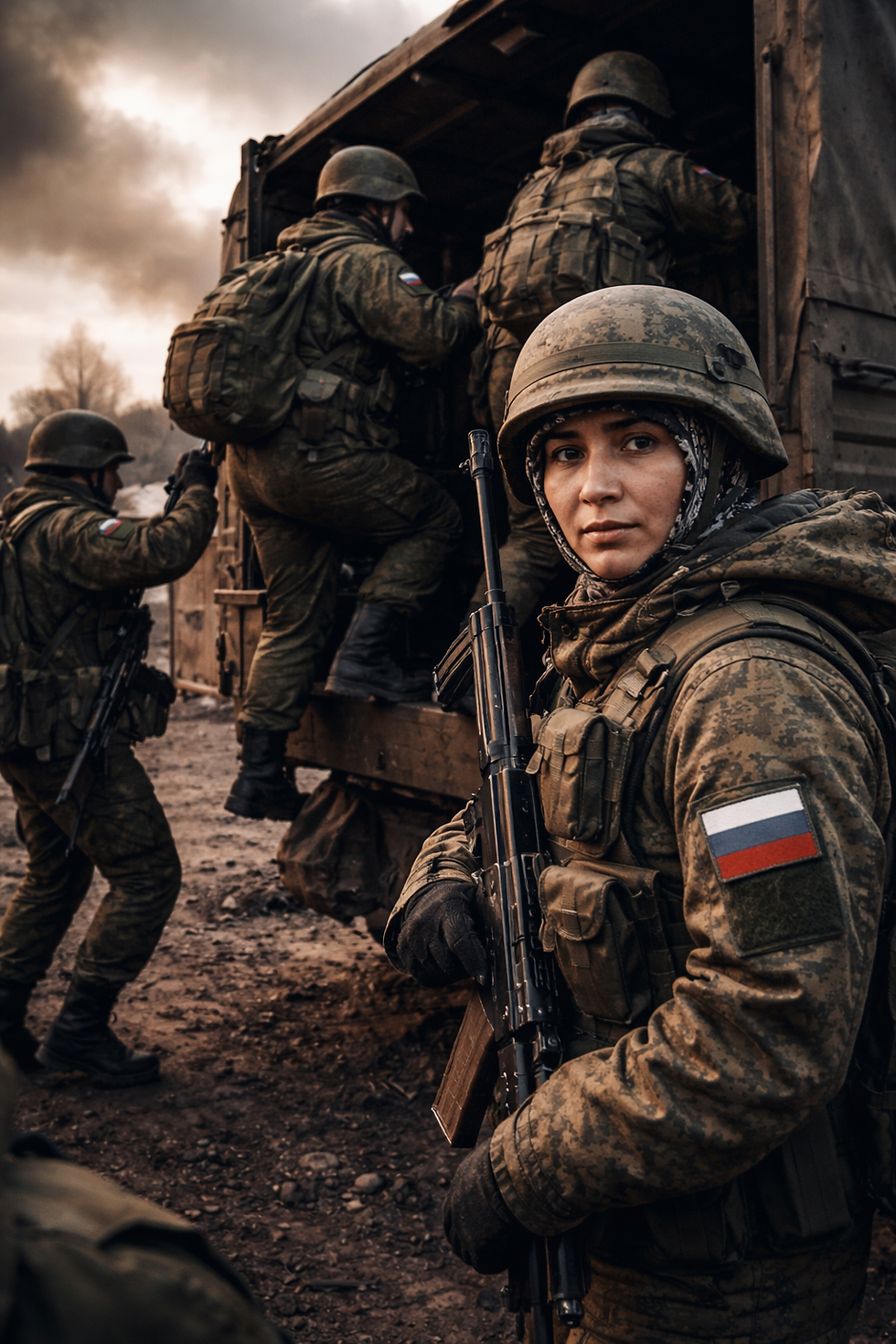
There was a time, not so long ago, when the story of Russia’s prison recruitment for her war in Ukraine seemed already shocking enough. In 2022 the spectacle of convicts being promised freedom in exchange for six months at the front line was widely reported, first under the auspices of the Wagner Group and its late founder Yevgeny Prigozhin, and later under the more formal structures of the Russian Ministry of Defence. Yet as the war has ground on and manpower pressures have intensified, a further, darker chapter has begun to emerge — the recruitment of Central Asian women from Russian prisons to fight in her invasion.
To understand this phenomenon, one must begin with the social geography of the Russian penal system. For decades, the Russian Federation has been a magnet for migrant labour from Tajikistan, Uzbekistan and Kyrgyzstan. Millions have travelled north in search of work in construction, cleaning, agriculture and domestic service. Many are women — often supporting extended families at home. They live precariously, frequently without secure residency status, vulnerable to exploitation and to arbitrary enforcement of the law.
When such women fall foul of Russia’s legal system — whether for petty theft, visa violations, drug offences or simply by being caught in a sweep — they can find themselves in a prison network notorious for its harshness. They are doubly marginalised — as foreigners and as women. In this context, the offer of military service in exchange for reduced sentences, financial compensation or even Russian citizenship exerts a powerful pull.
The recruitment of women from prisons represents both continuity and escalation. It is continuous because it reflects the Kremlin’s instrumental view of its incarcerated population — as a reservoir of expendable manpower. It is escalatory because it signals the depth of Russia’s demographic and political constraints. She cannot easily declare a full national mobilisation without risking domestic unrest. Nor can she rely indefinitely upon volunteers from impoverished rural regions. Thus the net is cast wider — to migrants, to prisoners, and now to female convicts.
The presence of Central Asian women in Russian penal institutions is itself a legacy of empire. The Soviet Union knitted together disparate peoples under a single administrative and economic system. After its collapse, economic gravity continued to pull south-to-north migration. Yet the post-Soviet order has been far less egalitarian than its predecessor proclaimed itself to be. Migrants are often treated as disposable labour — essential yet socially stigmatised. When war comes, such populations are among the first to be pressed into service.
From Moscow’s perspective, the recruitment of imprisoned migrant women offers several advantages. First, it avoids the politically sensitive step of conscripting large numbers of Russian middle-class citizens. Secondly, it externalises the human cost of war — losses among foreign-born convicts are less likely to provoke public outrage. Thirdly, it allows the state to present itself, at least rhetorically, as offering redemption — the chance to atone through patriotic sacrifice.
Yet this rhetoric sits uneasily with reality. These women are not volunteering from a position of freedom. They are choosing between continued incarceration in a punitive system and deployment to a brutal conflict. Consent under such circumstances is at best ambiguous. Moreover language barriers and limited access to legal representation mean that many may not fully understand the contracts they sign.
The military role envisaged for such recruits also deserves scrutiny. While propaganda may depict them as medics, cooks or rear-area support personnel, modern warfare is fluid. The distinction between combat and non-combat roles blurs rapidly in a theatre saturated with artillery, drones and long-range missiles. Women recruited from prison may find themselves far closer to danger than any recruitment brochure would suggest.
There are also complex diplomatic implications. Central Asian governments have sought to balance their historical ties to Moscow with an increasing wariness of entanglement in her conflict with Ukraine. They have, in some cases, criminalised participation in foreign wars. Reports of their citizens — particularly women — being recruited from Russian prisons create diplomatic embarrassment and domestic unease. Families at home may discover that daughters or mothers who left to clean apartments in Moscow are now in uniform on a distant front.
For Ukraine the presence of such fighters underscores the multinational character of the force arrayed against her. Russia’s war effort has drawn upon ethnic minorities from the Caucasus, Siberia and Central Asia in disproportionate numbers. This pattern reflects long-standing inequalities within the Russian Federation — peripheral regions and migrant communities bearing the brunt of casualties. It also complicates simplistic narratives of a purely Slavic confrontation. The war has become, in effect, an imperial mobilisation.
There is a gendered dimension too. The Russian state has historically cultivated a masculine image of war — the soldier as a symbol of virility and sacrifice. The recruitment of women from prisons disrupts this imagery. It suggests that the reservoir of willing male recruits has been strained. It also reveals the utilitarian logic driving policy — ideology yields to necessity.
One must also consider the psychological burden placed upon these women. Many come from conservative societies where military service by women is rare and socially fraught. Returning home — if they survive — may carry stigma as well as trauma. The promise of Russian citizenship may appear attractive, yet integration into Russian society remains uncertain for Central Asian migrants even in peacetime.
At a broader level, this development speaks to the character of Russia’s war effort. She has framed her invasion as a civilisational struggle, a defence of historical destiny. Yet the practical mechanics of sustaining that struggle reveal a more prosaic calculus — bodies must be found, contracts signed, units filled. When ideological fervour is insufficient, coercion and inducement step in.
The Kremlin — as an institution rather than a person — has long demonstrated a capacity to absorb social cost in pursuit of strategic objectives. But the recruitment of foreign-born female prisoners raises questions about sustainability. Wars fought on the backs of the marginalised can continue for some time, yet they corrode the social fabric. They entrench cynicism among those who see that loyalty and citizenship are unevenly valued.
In the end, the image of Central Asian women in Russian uniforms encapsulates the contradictions of this war. It is at once imperial and improvised — grand in rhetoric yet reliant upon the most vulnerable. It reveals a state determined to persist, yet constrained by demography, politics and international isolation.
For observers in Ukraine — and for those of us who write from her cities as sirens sound in the night — this phenomenon is a reminder that the war’s human geography is vast and tragic. It stretches from the steppes of Central Asia to the prisons of Siberia, and from there to the shattered fields of the Donbas. It is a chain of coercion and necessity — one that binds together women who may never have imagined themselves soldiers, yet who now find their fates intertwined with a conflict not of their making.
Such recruitment may provide Moscow with incremental manpower. But it also testifies to the attritional logic that now governs the war — a logic in which the margins of empire are consumed first, and in which the boundary between punishment and service becomes perilously thin.


