The House at 37 Sumska: A Kharkiv Building That Has Seen Almost Everything

By Matthew Parish
Wednesday 30 September 2026
There are buildings in Kharkiv that one passes repeatedly without quite appreciating how much history is contained behind their walls. Number 37 Sumska Street, immediately beside Shevchenko Garden and a few minutes’ walk from Freedom Square, is one of them. Its restrained nineteenth-century façade is familiar to generations of Kharkiv residents as the home of the Kharkiv Regional Palace of Children and Youth Creativity. Yet the bronze plaque beside its entrance tells an older story. This was once the Kharkiv Veterinary Institute, one of the most important centres of veterinary science in the Russian Empire and subsequently Soviet Ukraine.
I recently had the unusual privilege of being shown around the building while it remains closed to ordinary visitors during wartime. Walking through an empty educational institution is always slightly uncanny. A building designed for young people acquires a different character when its corridors are silent. In Kharkiv today, however, silence has another meaning. It is one of the peculiar consequences of war that buildings devoted to education, culture and childhood can remain standing and functioning institutionally while the ordinary human life for which they were constructed has temporarily retreated from their rooms.
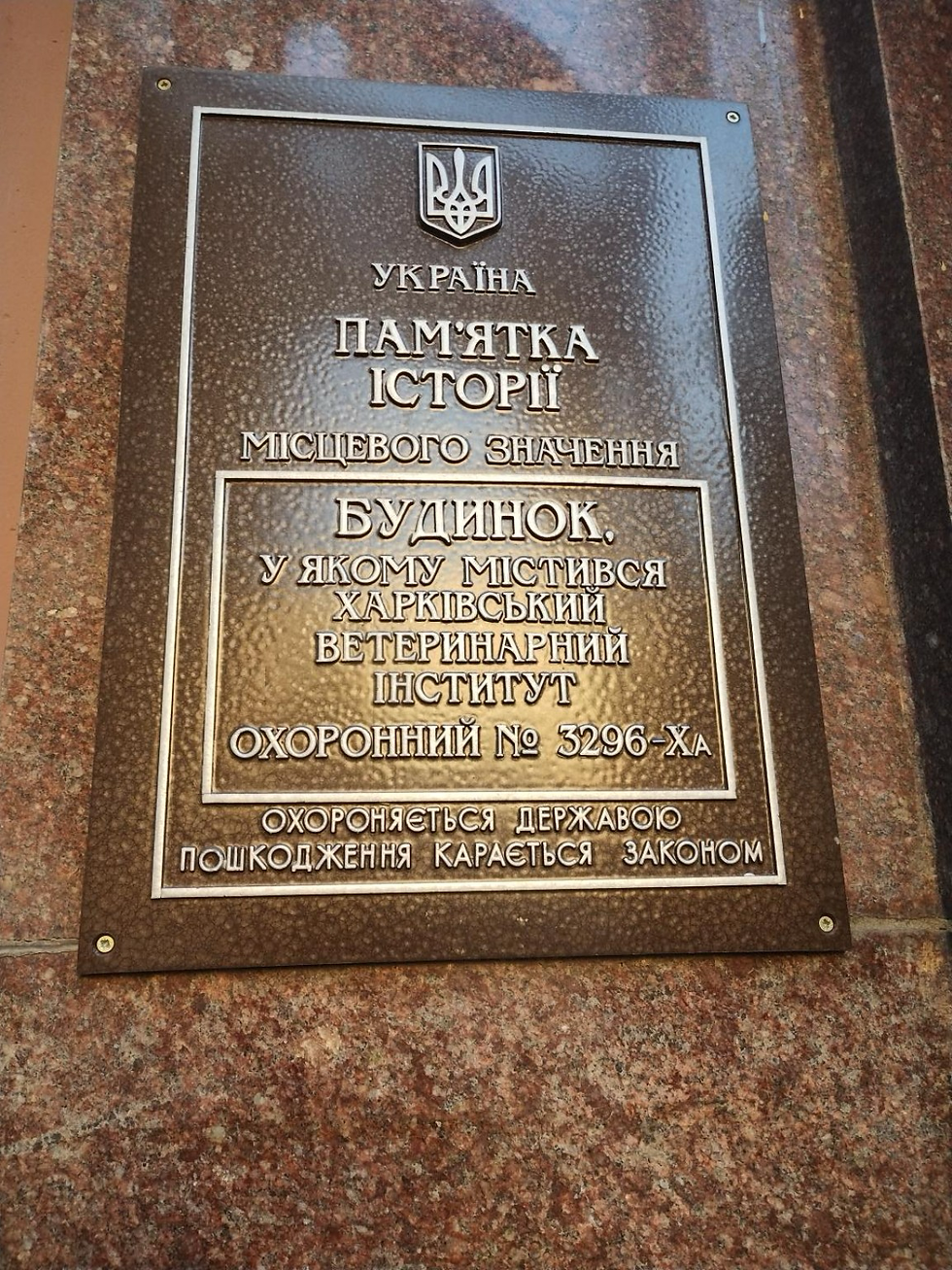
The plaque photographed during my visit describes the building simply as a “Пам’ятка історії місцевого значення”— a historical monument of local significance — and records its protected status as monument number 3296-Ха. The official Ukrainian register identifies it more precisely as the “Building in which the Kharkiv Veterinary Institute was located”, dates it to 1851–1853 and gives its address as 37 Sumska Street. That bureaucratic description scarcely conveys the extraordinary succession of intellectual, political and educational histories that have passed through the place.
From veterinary school to scientific institute
The history of veterinary education in Kharkiv is almost as old as the city’s modern university tradition. When Kharkiv University opened in 1805, a chair of veterinary medicine — then commonly described as animal healing — was established within its medical sciences. The German physician and scholar Ferdinand Pilger took charge of it in 1806 and the following year proposed the creation of a dedicated veterinary institute. The scheme proved premature, but the idea survived. In 1839 a Practical Veterinary School was established under the university, providing a three-year course of instruction.
In 1851 the school became the Kharkiv Veterinary College, a separate higher educational institution with its own staff and budget and, remarkably for the period, authority to confer advanced qualifications in veterinary science. This separation also made it the first higher educational institution to emerge from Kharkiv University as an independent establishment.
It needed a home worthy of its new status. The building on Sumska was consequently constructed in the early 1850s, when this portion of what is now central Kharkiv still stood close to the edge of the developed city. Contemporary historical sources give slightly differing construction dates, generally between 1851 and 1855. The official heritage register dates the building to 1851–1853, while the institution’s own history records that the premises were completed for the veterinary college in 1855.
This was a different Sumska from the avenue we know today. Development northwards had been slow. The veterinary building rose beyond the University Garden — today’s Shevchenko Garden — before the surrounding district had acquired the dense urban character that would later make Sumska Kharkiv’s principal ceremonial street. Historical accounts describe the building as having been erected to the design of architect Mykhailo Lvov, in the late classical style.
The choice of location therefore tells us something about nineteenth-century Kharkiv. Universities, laboratories and specialist institutes were helping to push the boundaries of the city outwards. What today seems emphatically central was then part of Kharkiv’s intellectual frontier.
Science behind the classical façade
The Veterinary College was transformed into the Kharkiv Veterinary Institute in 1873. From 1891 its professors enjoyed rights equivalent to those of university teaching staff and in 1914, shortly before the destruction of the imperial order that had created it, the institution received the title of the Imperial Nicholas I Veterinary Institute.
Its scientific importance was considerable. Kharkiv’s veterinary scientists worked on some of the most destructive animal diseases of the nineteenth and early twentieth centuries, including anthrax, glanders, foot-and-mouth disease and rinderpest. Lev Tsenkovsky and colleagues Ivan Sadovsky and O. P. Shalashnikov developed methods associated with anthrax vaccination. The institution’s history also connects its scientific community with some of the most distinguished names in the biological sciences, including Nobel laureates Ilya Mechnikov and Ivan Pavlov. The Palace’s own institutional history records that Mechnikov worked in this building.
That scientific tradition is worth remembering because veterinary medicine in the nineteenth century was not some peripheral academic curiosity. Horses powered armies and transport systems. Cattle were essential components of food supply and agricultural wealth. Epidemics among animals could destroy livelihoods and produce human hunger. Veterinary medicine sat at the intersection of biology, public health, agriculture, commerce and military power. A building dedicated to studying animal disease was consequently an important component of the infrastructure of a modernising state.
The physical building developed with the institution. A scholarly study of nineteenth-century Kharkiv records clinics on the ground floor, teaching rooms and academic offices above and an anatomical theatre in a separate wing. Around the main building there gradually emerged an entire complex associated with veterinary teaching and research. One can therefore imagine Sumska 37 not merely as a collection of lecture rooms but as a working scientific establishment in which animals, students, professors, specimens and experimental medicine occupied the same urban campus.
Students, revolution and the Ukrainian twentieth century
Yet universities seldom remain insulated from politics and the Veterinary Institute was no exception. The heritage description associated with the building records another aspect of its significance: it became one of the centres of the Kharkiv student movement at the beginning of the twentieth century.
That fact places Sumska 37 within the turbulence that eventually destroyed Imperial Russia. Students throughout the empire were an increasingly politicised population. Universities became places in which arguments about constitutionalism, socialism, nationalism, workers’ rights and the authority of the Tsarist state collided. The veterinary students of Kharkiv were therefore participating in a phenomenon much larger than their own profession.
Then came revolution, civil war and the emergence of Soviet Ukraine. The building survived them all.
Sumska itself temporarily lost its name: between 1924 and 1941 the street was renamed after the German revolutionary Karl Liebknecht. In May 1925 another revealing event took place inside the former imperial institute. The First All-Ukrainian Conference of Local Studies was held there, attended by 75 delegates from across Ukraine, among them prominent scholars including Dmytro Bahalii and Dmytro Yavornytsky. The conference established a Ukrainian committee for the study of local history and culture.
The irony is characteristic of Kharkiv. A building conceived under Nicholas I’s empire became a centre of scientific life, survived revolutionary agitation, acquired an imperial title under Nicholas II and then hosted scholars attempting to understand Ukraine’s distinctive regions under an entirely different political order.
It survived another catastrophe as well: the Second World War and the savage struggles for Kharkiv. The Veterinary Institute continued to use the building after the war. Indeed the old Sumska premises remained its principal educational building until 1960, more than a century after their construction.
From animals to children
In 1960 the Kharkiv Veterinary Institute was merged with the Kharkiv Zootechnical Institute to form the Kharkiv Zooveterinary Institute. That institutional reorganisation finally ended the scientific purpose for which Sumska 37 had been constructed.
But the building was not abandoned. It was reconstructed in 1961 under architect B. G. Klein and in May 1962 became the principal home of the Palace of Pioneers, today’s Kharkiv Regional Palace of Children and Youth Creativity.
There is something pleasingly continuous about this transformation. The subjects changed, the political terminology changed and eventually the country changed, but the building remained dedicated to learning. Rooms in which young veterinary scientists had once investigated infectious disease became rooms in which children studied science, engineering, art, music and innumerable other subjects.
The Palace itself has an extraordinary history. Kharkiv’s first Palace for children opened in 1935 in the former Noble Assembly building, an enormous establishment containing 234 rooms. Children there participated in everything from a symphony orchestra to an Arctic explorers’ club, a tramway laboratory, geology groups and aviation modelling. That original building was destroyed during the Second World War. After several moves, the Palace finally arrived at Sumska 37 in 1962.
By 1980 it had acquired regional status. After Ukrainian independence the Soviet Palace of Pioneers and Schoolchildren became the Kharkiv Regional Palace of Children and Youth Creativity. The ideological language disappeared but the essential idea — providing children with opportunities beyond conventional schooling — survived.
That mission continues even during the present war. As of January 2026, the Palace reported 275 groups providing extracurricular education without charge to 2,836 children. Its contemporary activities span ten fields of extracurricular education. The National Ecological and Naturalistic Centre records that the institution’s work has continued since the beginning of Russia’s full-scale invasion, even though war has radically changed the circumstances in which that work can take place.
A Palace at war
This is where visiting the building today becomes particularly affecting.
Sumska 37 stands extraordinarily close to some of the places most violently attacked in central Kharkiv. Freedom Square and the Regional State Administration building are nearby. Since February 2022 the centre of Kharkiv has repeatedly been struck by Russian missiles and other weapons. By September 2023 the Palace was reported to have suffered damage in at least six attacks on the surrounding city centre. Windows were blown out and other damage inflicted by blast effects from strikes nearby.
Yet the building survived.
There is a danger, when writing about Ukraine, of describing every surviving old building as a metaphor for national resilience. Buildings are, after all, only masonry, timber, metal and glass. But Sumska 37 makes resistance to metaphor unusually difficult because education has continued there, in one form or another, across such radically different ages.
It was constructed when Crimea had only recently become one of the principal theatres of a war between the Russian Empire and the European powers. It educated veterinary scientists under the Romanovs. Its students participated in the political ferment preceding revolution. It passed through the Ukrainian revolutionary period, Bolshevik rule, Stalinism, the Holodomor era, the battles for Kharkiv during the Second World War, post-war Soviet reconstruction, Ukrainian independence and now another war fought across Kharkiv Oblast.
The regimes changed. The street changed its name and changed it back. The Veterinary College became an Institute, the Institute disappeared into another academic institution, the building became a Soviet Palace of Pioneers and that Palace became a Ukrainian centre for children’s education.
But people kept learning inside it.
The silence of Sumska 37
That is what makes walking through it during wartime such an unusual experience. Outside is Sumska, the great north-south artery of central Kharkiv, still full of the unmistakable energy of a city that refuses to behave as though it has been defeated. Inside is a nineteenth-century institution temporarily deprived of the ordinary sounds that justify its existence.
One notices details differently in an empty building. Staircases become monumental. Corridors seem longer. Doors invite speculation about all the people who have passed through them. Architectural features that would disappear behind the noise of hundreds of children suddenly become visible. Somewhere beneath the modern alterations remains the building into which veterinary students walked when Queen Victoria was on the British throne, Nicholas I ruled the Russian Empire and modern Ukraine existed principally as a cultural and historical idea struggling to acquire political expression.
The bronze plaque outside therefore deserves more than a passing glance. It is not commemorating a vanished institution so much as recording one layer of an extraordinary palimpsest.
Kharkiv is full of such layers. It has always been a city of science and engineering, of universities, laboratories, factories and arguments. Its history cannot be reduced either to its period within the Russian Empire or to its decades as a Soviet industrial metropolis. Nor can the city’s present identity be understood without appreciating the extraordinary accumulation of institutions that generations of Kharkiv residents built, inherited, transformed and sometimes rescued from catastrophe.
Sumska 37 embodies that process particularly well. An imperial veterinary college became a great scientific institute. A scientific institute became a children’s palace. A Soviet children’s palace became a Ukrainian educational institution. Now an old building waits through another war while the organisation inhabiting it continues educating children by whatever means circumstances permit.
I was fortunate to see it in this strange interval of silence. One hopes that the privilege will soon become unnecessary: that the doors will again be open, that its corridors will again be noisy and that a building erected for students more than 170 years ago will resume the purpose that, beneath all its transformations, it has never really abandoned.
That purpose is learning.
And in Kharkiv, after everything the city has endured, learning is itself a form of continuity.