


The Faceless Monks of Lviv and Tallinn: A European History of Ghosts
By Matthew Parish
Sunday 15 November 2026
Why a mysterious black-robed figure in Rynok Square reveals something about medieval Christianity, the invention of tradition and the European fascination with the invisible past.
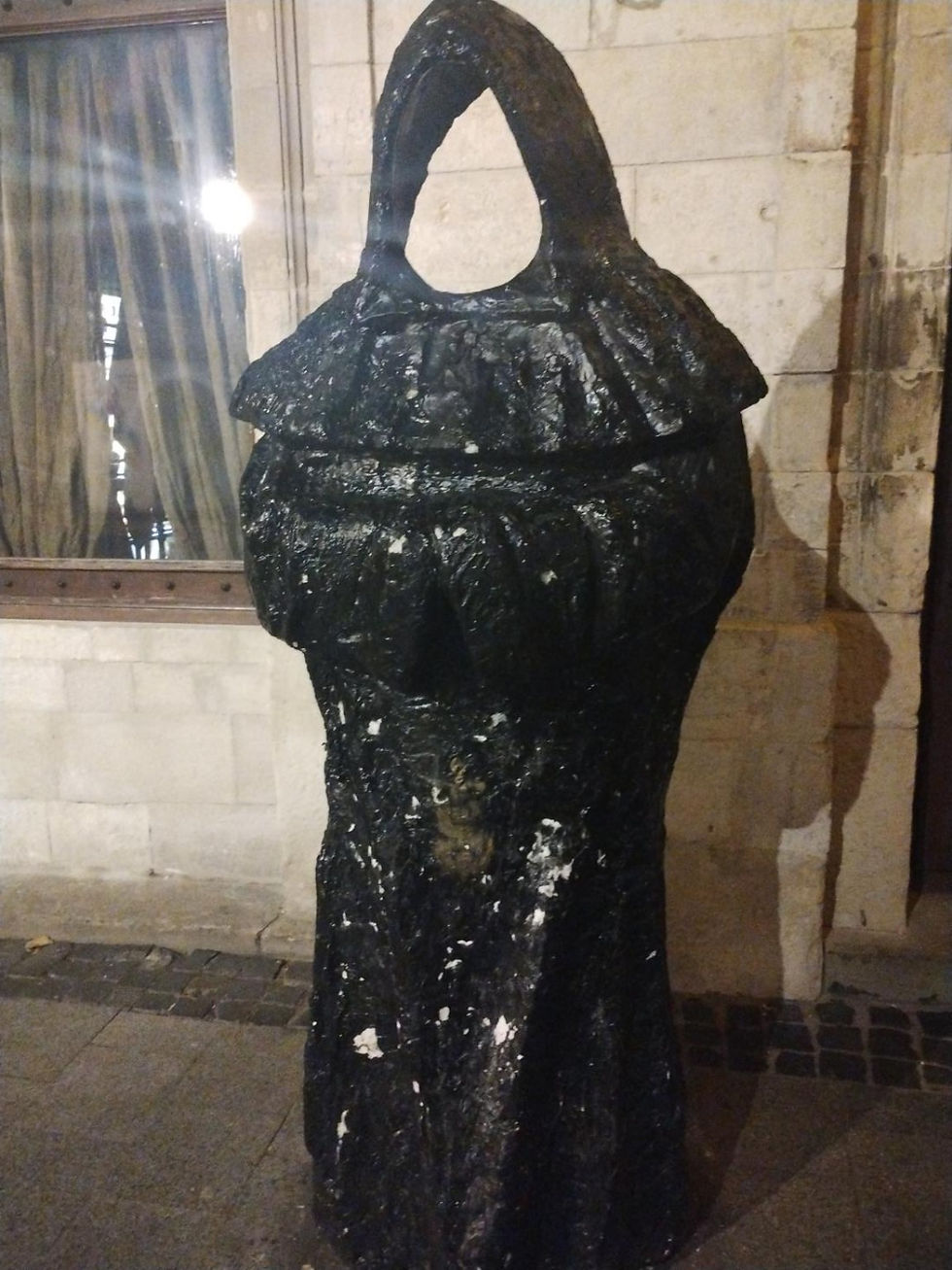
There is a strange figure standing outside an ancient building on the eastern side of Rynok Square in Lviv. He wears the heavy black robes of a medieval monk, his shoulders enveloped in a voluminous cloak and his head concealed beneath an enormous hood. His arms appear to be folded together beneath his garments, as though he has taken a vow of eternal silence and intends to maintain it. Yet the most disturbing feature of this mysterious individual is that he has no face. Where his eyes, nose and mouth ought to be, there is simply an empty space.
At night, particularly during the darker months of the year, the figure can be rather unnerving. Lviv is accustomed to its ghosts, both real and imagined, and one might easily mistake this peculiar apparition for some medieval cleric condemned to wander the streets until the Day of Judgment. The statue has none of the reassuring qualities of conventional religious sculpture. It offers neither a kindly expression nor an identifiable saint whose intercession might be invoked in moments of difficulty. Instead, it presents the observer with the uncomfortable prospect of a human form from which the human being has been removed.
The sculpture is situated outside a restaurant called The Fifth Dungeon, at number 5 Rynok Square. The establishment opened in June 2019, presenting itself as a recreation of the medieval world of Lviv's underground chambers, with costumed attendants, candles, ancient-looking furnishings and food served in deliberately archaic fashion. Its owners have associated the building with the city's earliest Jesuit community, which established itself in Lviv during the closing decades of the sixteenth century. The figure outside is therefore an appropriate introduction to the restaurant's theatrical understanding of history, even if the sculpture itself is a modern creation rather than a relic of the Middle Ages.
But the story becomes much more interesting when we discover that this apparently eccentric Lviv attraction has close counterparts in another medieval European city some 1,000 kilometres to the north. In Tallinn, the capital of Estonia, three enormous faceless monks stand in the Danish King's Garden, overlooking the narrow streets and fortified walls of one of the best-preserved medieval urban landscapes in Europe. Their similarity to the figure in Lviv raises a fascinating question about the relationship between religious architecture, supernatural folklore and the modern European appetite for recreating the mysteries of the past.
The historical foundations of the Lviv sculpture are more substantial than its theatrical appearance might suggest. Number 5 Rynok Square was originally the home of the Hanl family, prosperous merchants and butchers whose property was badly damaged in the great fire of 1571. The house was reconstructed between 1571 and 1577 under the patronage of Zofia Hanlowa, a wealthy and devout widow who engaged the architect Petrus Italus, also known as Petro Krasovskyi, originally from Lugano in what is now Switzerland. The reconstructed building was among the first three-storey houses on the square, an impressive architectural achievement in a city whose merchants were becoming increasingly wealthy through international trade.
Zofia Hanlowa was also an important religious benefactor. When the first Jesuits arrived in Lviv following an invitation from Archbishop Jan Dymitr Solikowski, she provided accommodation for them in her house. The hospitality is recorded in Jesuit chronicles, according to research published by Lviv's Centre for Urban History. The connection between the property and the Society of Jesus is therefore not merely an invention of contemporary restaurant marketing. The building really did accommodate some of the earliest representatives of one of the most influential religious orders in European history.
It is worth remembering just how extraordinary the Jesuits were when they first appeared in sixteenth-century Europe. Founded by Ignatius of Loyola and his companions, and formally approved by Pope Paul III in 1540, the Society of Jesus represented a new kind of Catholic religious organisation. Its members were not traditional cloistered monks who spent their lives contemplating eternity behind monastery walls. They were missionaries, educators, intellectuals and advisers, committed to travelling throughout the world and defending Catholic teaching in an era of intense religious and political upheaval. Their influence eventually extended from the courts of European monarchs to China, Japan and the Americas.
Indeed, there is a minor historical irony in the appearance of the black-robed figure outside the restaurant. The Jesuits did not originally adopt the traditional hooded monastic habit depicted in the sculpture. Their customary dress developed around the black clerical cassock, and their institutional identity was based upon an active vocation in the world rather than seclusion within a monastery. The statue is consequently better understood as a romantic modern representation of a medieval religious figure than an accurate portrait of a sixteenth-century Jesuit. Historical authenticity, after all, can be an inconvenient restriction upon the artistic imagination, particularly when the objective is to persuade visitors to descend into a cellar and order dinner.
Nevertheless, the religious association of the building is unusually appropriate because Lviv has its own famous story about a Black Monk. The legend belongs principally to the Jesuit Church of Saints Peter and Paul, now the Garrison Church, a short distance from Rynok Square. According to the tale, a wealthy man entered the Jesuit order but proved too proud to accept the equality and discipline demanded of religious life. His fellow Jesuits eventually confined him in an underground chamber. One day a mysterious visitor dressed in black appeared, offering to reason with the troublesome novice. After a prolonged argument, both men vanished, leaving behind a parchment supposedly recording the sale of the monk's soul to the Devil.
The unfortunate cleric was thereafter condemned, according to the story, to haunt the underground chambers of the church. Although no credible evidence establishes that the supernatural events actually occurred, versions of the story were circulating long before the modern restaurant opened. An account published by Ukrainska Pravda in 2011 describes the Black Monk and his infernal bargain, while reporting from Lviv in 2007 describes the legend being dramatised for visitors to the Jesuit underground complex. The latter report is particularly revealing because it demonstrates that Lviv's supernatural traditions were already being transformed into theatrical experiences for contemporary audiences.
There is no documented basis for claiming that the statue at number 5 Rynok Square was specifically commissioned to commemorate this particular legend. Yet the relationship between the two is compelling. The statue stands outside a building with a genuine historical connection to the Jesuits, while a short walk away another Jesuit building possesses a longstanding tradition involving a mysterious black-robed apparition. The modern sculpture seems almost designed to unite these two strands of Lviv's identity: the historical city of religious scholarship and the imaginary city of ghosts, mysterious disappearances and bargains with supernatural powers.
Tallinn offers a remarkably close parallel. In the Danish King's Garden, immediately below the old fortified hill of Toompea, three monumental bronze figures stand silently among the medieval walls. They were designed by Estonian sculptors Aivar Simson, also known as Seaküla Simson, and Paul Mänd, following a municipal design competition organised in 2011. The sculptures were installed in 2015 and are collectively known as Three Monks. They measure approximately two and a half metres in height, making them rather more imposing than their Lviv counterpart.
Each of Tallinn's monks has a name and a particular disposition. Ambrosius is the Waiting Monk, Bartholomeus the Praying Monk and Claudius the Observing Monk. They represent different attitudes towards the passage of time and the relationship between humanity and the unknown. Yet all three share the same extraordinary feature as the sculpture in Rynok Square: beneath their heavy hoods there are no faces. The official Tallinn public-art catalogue explains that the missing faces were deliberately intended to strengthen the sculptures' ghostly appearance.
The stories behind the Tallinn sculptures are at least as entertaining as those of Lviv. The Danish King's Garden is associated with numerous accounts of supernatural occurrences dating back to the eighteenth century. The medieval towers surrounding the garden were gradually converted into dwellings, and their inhabitants reported strange figures, unexplained noises and apparent encounters with persons who could not reasonably have been present. Monks were particularly prominent among these supposed apparitions, presumably because the religious history of the area furnished an attractive explanation for mysterious figures observed in the shadows.
One of the more remarkable stories concerns an alleged sighting during the 1980s, when a resident reportedly observed four monks dancing together. Why exactly four deceased members of a religious order should have chosen to perform an impromptu dance in a medieval courtyard is not explained. Nor is it entirely clear why the sculptors subsequently reduced their number to three. Perhaps the fourth monk was considered aesthetically superfluous, or perhaps he had simply failed to observe the customary standards of monastic sobriety. In any event, the three surviving representatives of this supernatural dance have become permanent residents of Tallinn's historic centre.
The Danish King's Garden carries another layer of historical significance. Its name refers to Denmark's medieval conquest of northern Estonia, and particularly to the celebrated legend that the Danish national flag descended miraculously from heaven during the Battle of Lyndanisse in 1219. The supposed divine intervention enabled the forces of King Valdemar II to defeat their Estonian opponents, at least according to the conventional Danish account. For the Danes, the story became a national foundation myth. For the Estonians, it commemorates the arrival of foreign conquerors whose descendants would remain politically influential for more than a century.
This is where the comparison with Lviv becomes particularly intriguing. Both cities are exceptionally well-preserved medieval urban centres whose histories have been shaped by successive foreign rulers, competing religious traditions and complicated relationships between local identity and imperial power. Both possess fortified medieval districts, narrow streets, ancient churches and buildings that have acquired new purposes over the centuries. Above all, both are places in which the historical imagination is sufficiently powerful that the inhabitants continue to populate their surroundings with personalities who may never have existed.
Yet there is a fundamental difference between the sculptures in Tallinn and Lviv. The three Tallinn monks are an intentional municipal work of public art, designed to commemorate a particular body of local folklore. The Lviv figure, by contrast, is associated with a commercial establishment that has recreated aspects of the city's medieval atmosphere for the entertainment of contemporary visitors. There is no established documentary connection between the two artistic projects, and it would be unwise to assume that the Lviv sculpture was directly copied from the Estonian originals. Their visual resemblance is nevertheless extraordinary, and the possibility of artistic borrowing is an interesting question that remains unresolved.
Both works exploit a familiar psychological mechanism. Human beings are extraordinarily sensitive to the presence of faces. From infancy we learn to recognise them, distinguish emotional expressions and infer the intentions of those around us. Faces are so central to our interpretation of the world that we regularly imagine them in clouds, patterns of wood, shadows and other entirely inanimate objects. Psychologists call this tendency pareidolia, although the phenomenon hardly requires a scientific explanation. It is one of the most elementary characteristics of human perception.
Remove the face from a recognisably human figure, however, and the results can be profoundly disturbing. The mind expects to encounter another person, but the evidence necessary to establish his identity is absent. We are left contemplating the outline of humanity without the substance. The figure becomes an invitation to speculate about what might be concealed within the darkness, even though rational reflection tells us that there is nothing there.
This artistic device has a particularly effective application to religious imagery. The traditional monk is already an individual who has, to some extent, withdrawn from ordinary human society. He has abandoned some of the conventions through which people ordinarily establish their identities, including wealth, family life, fashionable clothing and social distinction. In certain religious traditions he may even surrender his original name. His existence becomes increasingly defined by his relationship with God rather than his relationships with other human beings.
The faceless monk takes this process to its logical extreme. By removing the individual personality altogether, the sculpture presents a human being who has become almost entirely spiritual. His body remains present, but his identifiable self has disappeared. He seems suspended between the material and immaterial worlds, simultaneously reminding us of the historical reality of religious life and the possibility that human existence might continue after death.
The resulting symbolism can be interpreted in several ways. To a religious believer, the monk might represent humility before the divine, the abandonment of worldly vanity and the mysterious character of eternal life. To a sceptic, he might represent the psychological consequences of submitting one's individuality to a powerful religious institution. To an existential philosopher, he might embody the fundamental uncertainty of human identity and the possibility that our outward characteristics reveal very little about the nature of consciousness.
The distinction between the Tallinn and Lviv figures becomes especially amusing when we consider their practical functions. The Tallinn sculptures encourage contemplation, and their anonymity reinforces the supernatural traditions associated with the garden. The Lviv figure, however, has an opening into which visitors can place their own faces for photographs, temporarily transforming themselves into the mysterious monk. This feature has been documented in photographs of the restaurant entrance. The mechanism is wonderfully paradoxical: visitors are invited to assume the identity of a religious individual whose most striking characteristic is that he possesses no identity at all.
There is something distinctly modern about this arrangement. Medieval monks abandoned their worldly identities in pursuit of spiritual fulfilment. Twenty-first-century visitors temporarily abandon theirs in pursuit of an amusing photograph for social media. The first activity was intended to bring the individual closer to God, while the second is intended to attract the attention of friends and acquaintances. It would be difficult to imagine a more elegant illustration of the transformation of European religious culture across the intervening centuries.
Nevertheless, one should not dismiss such sculptures as merely frivolous tourist attractions. Their popularity demonstrates that the supernatural imagination remains remarkably powerful even in technologically sophisticated societies. We inhabit a world of artificial intelligence, satellite communications, medical imaging and scientific explanations for phenomena that our ancestors attributed to divine or demonic intervention. Yet we remain attracted to ghost stories, haunted buildings and mysterious figures standing silently in the darkness. The appetite for the supernatural has survived the disappearance of many of the intellectual assumptions that originally sustained it.
Perhaps this is because ghosts provide an imaginative response to an unavoidable human difficulty: the impossibility of recovering the past in its entirety. We can reconstruct buildings, preserve documents and study archaeological remains, but we cannot restore the minds of those who once inhabited them. Their thoughts, fears, ambitions and private relationships have disappeared beyond our reach. Historical scholarship can recover certain aspects of their existence, but the overwhelming majority of human experience vanishes permanently with the death of each generation.
The ghost represents our refusal to accept this disappearance. By imagining that the dead continue to inhabit familiar places, we preserve an emotional connection with those who are otherwise irretrievably lost. The Black Monk wandering through the underground passages of a Jesuit church is, in this sense, not particularly different from the imagined presence of a deceased relative in a family home. Both represent attempts to bridge the divide between historical memory and present experience.
This interpretation acquires a particular poignancy in contemporary Ukraine. War has transformed absence into one of the central experiences of Ukrainian society. Countless families have lost husbands, wives, children and parents, while others continue to wait for news of relatives who have disappeared in the fighting. The streets of Lviv contain innumerable reminders of people who once participated in the city's daily life and will never return. Empty chairs, abandoned belongings and familiar places associated with deceased friends have acquired a significance that no formal memorial can adequately express.
The faceless monk can therefore be understood as something more than a representation of medieval superstition. He is also an image of absence, of the individual whose physical outline survives in memory while his actual presence has disappeared. The empty hood becomes a space into which the observer may imaginatively place the face of somebody he has known and lost. What began as a theatrical representation of a medieval religious figure can assume an unexpectedly serious meaning in a society confronted daily by death.
There is a final historical irony in the location of the Lviv sculpture. The building at number 5 Rynok Square has survived fires, reconstructions, changing ownership, imperial administrations and the political upheavals of the twentieth century. Its original Renaissance appearance has been substantially altered, and the building that now stands on the square incorporates architectural features from several different periods. Yet its connection with Zofia Hanlowa and the first Jesuits remains part of its documented history. The sculpture outside does not reproduce that history with scholarly precision, but it draws attention to a past that might otherwise be overlooked by pedestrians walking between the restaurants and cafés of the modern city.
Tallinn's three monks perform a comparable function. They transform a medieval courtyard into a place where visitors are encouraged to contemplate stories associated with its earlier inhabitants. Their historical foundations are not identical to those of the Lviv figure, and there is no reason to suppose that the same sculptural intention governed both projects. Nevertheless, they all demonstrate the capacity of contemporary public sculpture to restore a sense of mystery to familiar urban surroundings.
Perhaps this is the essential achievement of the faceless monk. He asks us to recognise that the city we inhabit is not exclusively the creation of the living. It is also a product of generations whose individual identities have largely disappeared, but whose collective achievements continue to shape the buildings, institutions and traditions surrounding us. The monk's missing face is a reminder that the past cannot be recovered in its entirety, however carefully we preserve its material remains.
The next time one walks through Rynok Square after dark, it may be worth pausing outside number 5 and examining the mysterious black-robed figure standing beside the entrance. He is not an ancient statue, nor do we have evidence that he represents any particular historical individual. Yet behind him stands a building that once accommodated some of Lviv's earliest Jesuits, while elsewhere in Europe three eerily similar figures keep watch over the medieval walls of Tallinn.
Together they represent a peculiarly European fascination with the relationship between religion, death and historical memory. They invite us to contemplate the possibility that the past has never entirely disappeared, but continues to inhabit the places where we live.
And if, while examining the empty hood, one experiences the uncomfortable sensation that somebody is looking back, then perhaps the sculptor has succeeded rather better than either the medieval monk or the modern restaurant proprietor could ever have imagined.


