The Arsenal Question: What Happens if America Runs Short of Missiles?
- 56 minutes ago
- 4 min read
Monday 10 August 2026
For three quarters of a century, the cornerstone of American military power has not simply been the size of its armed forces, nor even its nuclear deterrent. It has been the assumption that the United States could sustain prolonged, high-intensity conventional warfare while simultaneously deterring adversaries across multiple continents. If recent reports that America’s inventories of long-range precision missiles have been severely depleted prove substantially correct, then this assumption may be entering a period of profound uncertainty.
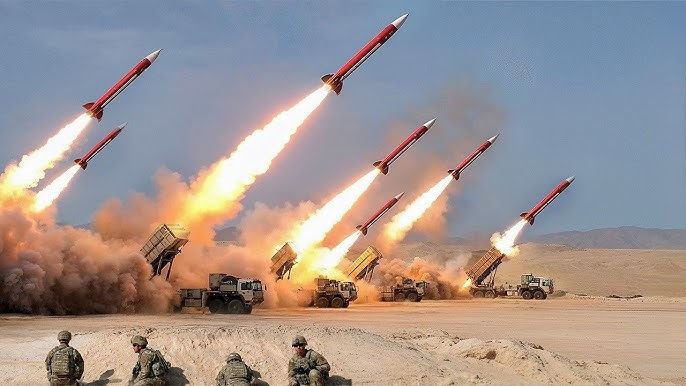
The immediate explanation is straightforward. Since early 2026 the United States has become deeply engaged in military operations against Iran, while simultaneously continuing to supply Ukraine with sophisticated weaponry and maintaining extensive commitments throughout East Asia. Precision-guided munitions are extraordinarily effective, but they are also extraordinarily expensive, technically complex and slow to manufacture. Modern wars consume them at a rate that peacetime planners have consistently underestimated.
This reflects a deeper strategic miscalculation. Throughout the decades following the Cold War, Western governments increasingly organised their defence industries according to commercial principles. Efficiency replaced redundancy. Production lines were optimised for predictable procurement schedules rather than emergency mobilisation. Inventories shrank because maintaining vast stockpiles appeared wasteful in an era when major interstate war seemed increasingly improbable.
Russia’s full-scale invasion of Ukraine in February 2022 exposed the fallacy of these assumptions. The war demonstrated that modern industrial warfare consumes ammunition at rates unseen since the Second World War. Thousands of artillery shells may be fired every day. Missile inventories measured in hundreds may disappear within months. The industrial logic of peacetime proved wholly incompatible with the realities of sustained conflict.
If the United States has indeed consumed a substantial proportion of its inventories of ATACMS, Precision Strike Missiles, Tomahawk cruise missiles and Patriot or THAAD interceptors, then the consequences extend well beyond America’s own armed forces. American military credibility rests upon its ability simultaneously to reassure allies and deter adversaries. Deterrence is psychological before it is physical. Potential opponents calculate not only what America possesses today but what it could continue deploying tomorrow.
For Ukraine the implications are immediate. Kyiv has depended heavily upon American precision weapons to strike Russian logistics, command centres and ammunition depots far behind the front lines. Equally important are Patriot air-defence systems that have become indispensable in defending Ukrainian cities against Russian ballistic missile attacks. Should Washington conclude that preserving its own strategic reserves requires reducing deliveries abroad, Ukraine would inevitably feel the consequences. Recent reporting suggests precisely these concerns are already influencing discussions within the Pentagon.
In East Asia, the implications may be even more profound. American military planning regarding Taiwan has always assumed the ability rapidly to deploy enormous quantities of precision-guided munitions against Chinese naval forces, air bases and logistical infrastructure. Yet a conflict involving China would dwarf anything experienced in the Middle East. Chinese industrial capacity is vast. It has been expanding missile production steadily for years. If Washington struggles to replenish inventories after operations against Iran, planners must inevitably ask how they would sustain a campaign lasting many months against a peer competitor.
There is also an uncomfortable economic lesson. Western democracies have become accustomed to outsourcing manufacturing while concentrating upon finance, software and high technology. Yet missiles cannot be manufactured by financial services firms. They require machine tools, metallurgical expertise, specialist electronics, rocket motors and highly trained industrial workforces. Defence production cannot simply be switched on overnight. Factories require years to build, skilled engineers require years to train and intricate supply chains cannot be improvised during wartime.
This has significant geopolitical consequences beyond military affairs. Allies may begin quietly questioning whether American security guarantees remain as robust as previously assumed. Countries throughout Europe, East Asia and the Middle East may accelerate indigenous weapons programmes, diversify suppliers or strengthen regional security arrangements independent of Washington. Strategic autonomy—once discussed primarily within the European Union—could become an increasingly global phenomenon.
America’s adversaries will reach their own conclusions. Moscow will undoubtedly argue that Western arsenals have finite limits and that prolonged conflicts favour states capable of sustaining production over many years. Beijing will study carefully the industrial bottlenecks exposed by recent conflicts. Neither Russia nor China need believe that America is weak; they need only conclude that its capacity for prolonged conventional warfare has practical limits.
Yet predictions of irreversible American decline would themselves be premature. The United States retains the world’s largest defence budget, unparalleled technological sophistication and a remarkable capacity for industrial adaptation when political consensus exists. During previous periods of national mobilisation, American industry has repeatedly demonstrated an ability to expand production at astonishing speed. Indeed, reports already indicate that the Pentagon is investing billions of dollars to expand production of Patriot, THAAD and Tomahawk missiles substantially.
The more enduring lesson concerns strategic culture rather than inventory management. Modern precision weapons encouraged the illusion that future wars would be brief, surgical and technologically elegant. Ukraine has demonstrated the opposite. Iran appears to have reinforced the same conclusion. Great-power conflict remains an industrial contest in which manufacturing capacity, logistics and economic resilience ultimately matter as much as technological sophistication.
For Europe—and particularly for Ukraine—this reality carries an unmistakable message. Security cannot permanently be outsourced, even to the world’s most powerful ally. Nations that depend entirely upon external arsenals ultimately become vulnerable to external production constraints. The future of Western security will depend not merely upon innovation but upon rediscovering something that previous generations understood instinctively: wars are won as much in factories as on battlefields.
Whether America is truly running out of missiles is therefore less important than what the debate itself reveals. It exposes a transformation in strategic thinking. The central question is no longer whether the United States possesses overwhelming military superiority. Rather, it is whether the Western alliance has retained the industrial foundations necessary to sustain that superiority through the prolonged conflicts that increasingly define the twenty-first century.