


Terrorism: The Theatre of Everyday Life Under Russian Bombardment
By Matthew Parish
Saturday 14 November 2026
There is something faintly ridiculous about receiving a notification on one's mobile telephone at three o'clock in the morning announcing that one might shortly be killed. The telephone vibrates, a disembodied voice announces an air raid alert and one is invited to make a series of decisions about whether to get out of bed, put on one's trousers, find one's shoes and descend into a cellar in the company of several other people who look equally displeased at having their sleep interrupted. Alternatively, one may decide that death is sufficiently improbable, or sleep sufficiently important, to remain where one is. Neither choice seems especially satisfactory. The first may involve spending three hours in a damp basement while nothing happens. The second may involve being converted into an item in a statistical bulletin issued the following morning.
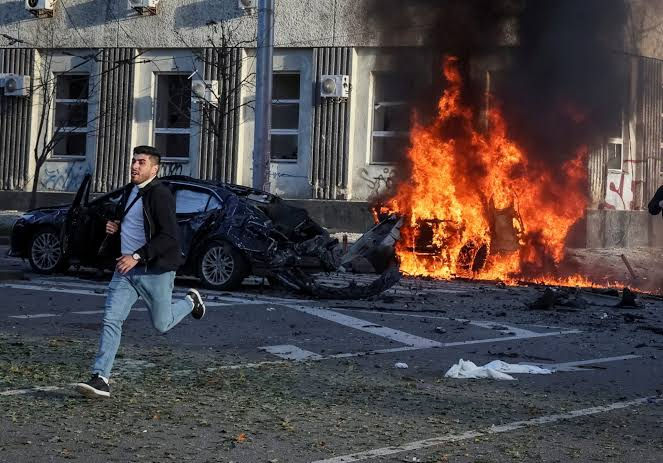
This is the peculiar theatre of everyday life in Ukraine, where millions of people are required to conduct their ordinary existence against a background of continual threats from Russian missiles, aerial bombs and increasingly sophisticated attack drones. The remarkable thing is not that people are frightened. It is that, after sufficient repetition, they become bored. The possibility of sudden violent death becomes another inconvenience, alongside rising prices, interruptions to the electricity supply and the difficulty of obtaining a satisfactory cup of coffee when the generator has broken down.
There is perhaps no more appropriate literary work through which to understand this absurdity than Terrorism, the extraordinary black comedy written by the Russian playwrights Oleg and Vladimir Presnyakov in 2002. Although conceived in a different political era, and intended as an examination of the violence permeating post-Soviet Russian society, the play has acquired an unexpectedly sinister relevance to contemporary Ukraine. Its central proposition is that terrorism is not merely an extraordinary event involving explosives, fanatics or armed men. It is a condition of existence in which the possibility of violence gradually becomes so familiar that ordinary moral and psychological responses cease to operate.
The Presnyakov Brothers came from Yekaterinburg, the great industrial city on the eastern slopes of the Ural Mountains. Oleg was born in 1969 and Vladimir in 1974, the sons of a Russian father and an Iranian mother. Both studied at Ural State University, where they pursued literary and academic interests, with Oleg specialising in philology and literary theory and Vladimir working in fields including literary theory and psychology. In 1998 they established an experimental university theatre with the splendidly incongruous name of the Theatre of Christina Orbakaite, borrowing the name of a Russian popular singer. Their work emerged from the innovative theatrical movement often described as Russia's New Drama, which rejected the solemn conventions of established theatre in favour of fractured narratives, vulgar dialogue, uncomfortable psychological realism and a distinctly post-Soviet sense of moral disintegration.
The brothers wrote collaboratively, publishing under their collective identity rather than advertising the respective contributions of each author. Their work developed an international reputation for its combination of intellectual sophistication and the language of ordinary people behaving appallingly. Their characters were not necessarily wicked in the grand theatrical tradition. More frequently they were petty, confused, selfish, sexually frustrated, incompetent or merely too exhausted to appreciate the magnitude of the disasters unfolding around them.
Terrorism was first performed at the Chekhov Moscow Art Theatre on 8 November 2002, directed by Kirill Serebrennikov. In March 2003 it arrived at London's Royal Court Theatre in a translation by Sasha Dugdale, directed by Ramin Gray, where its peculiar combination of philosophical comedy and casual horror attracted considerable critical acclaim. It subsequently travelled internationally, becoming the brothers' best-known work. Another of their plays, Playing the Victim, likewise explored the profound absurdities of violence through a young man employed to impersonate murder victims during police reconstructions of crimes. The philosophical implications of a society in which pretending to be murdered has become a profession are sufficiently obvious not to require extensive elaboration.
The origins of Terrorism are particularly revealing. In an explanation published by the Moscow Art Theatre in October 2002, the brothers described watching a television news programme in which an account of another terrorist atrocity was followed almost immediately by cheerful stories about pandas breeding in captivity and the return of historical cultural artefacts. The transition between mass murder and harmless entertainment was accomplished without apparent embarrassment. They reflected upon the extraordinary capacity of human beings to continue writing plays, preparing financial reports, teaching classes and performing domestic repairs while images of burning aircraft and shattered buildings flickered across their television screens. They wondered what guarantee existed that tomorrow the television audience might not itself become the subject of the next catastrophe.
This observation supplies the philosophical foundation of the play. Modern civilisation has developed extraordinary techniques for incorporating horror into the ordinary rhythms of existence. Catastrophe is packaged, announced, discussed, interrupted by advertising and then forgotten until the next catastrophe arrives. There is something grotesque about this process, but it is also essential to the survival of the human mind. Nobody can remain permanently horrified without eventually becoming incapable of doing anything else.
The play opens at an airport where the passengers have been prevented from boarding their flights because of a bomb threat. Armed men stand about, passengers become increasingly irritated and the familiar frustrations of international travel acquire an additional dimension of possible annihilation. The dramatic action then moves through six interconnected scenes involving sexual cruelty, family dysfunction, workplace misery, suicide and the peculiar psychological abnormalities of those employed to deal with dangerous situations. Gradually the audience discovers that the apparently disconnected incidents form part of a wider circle of violence. The boundaries between perpetrators and victims become disturbingly unstable.
One particularly memorable scene concerns an office worker who has hanged herself in the workplace relaxation room. The discovery ought, by conventional theatrical standards, to provoke horror, grief and some sort of moral reckoning. Instead, it produces irritation, bureaucratic inconvenience and an extraordinary series of conversations about practical difficulties arising from the presence of a corpse. The office psychologist becomes particularly concerned about retrieving the dog leash involved in the death. The event is treated less as a human tragedy than as an unfortunate disruption to the efficient conduct of business.
This is precisely the sort of scene that a person living in Ukraine may find both appalling and uncomfortably familiar. One becomes accustomed to learning that a residential apartment building has been destroyed during the night, that several people have been killed and that the electricity may be unavailable for the remainder of the day. The immediate question, having absorbed these facts, may be whether the nearby supermarket has a functioning generator. There is no necessary contradiction between feeling genuine sorrow for the dead and wanting to know whether one can purchase fresh bread.
The Russians have inadvertently constructed an enormous, compulsory experimental theatre across Ukraine, in which the population is required to participate without receiving either tickets or salaries. Every city has its own repertoire. In Kyiv the performances may involve substantial waves of missiles and drones, accompanied by explosions as air defences engage incoming targets. In Kharkiv the intervals between warning and impact may be terrifyingly brief. In the frontline cities of Kramatorsk and Sloviansk the distinction between military operations and everyday civilian existence has become progressively harder to sustain. In Lviv, far from the principal land battles, the performances may be less frequent and less destructive, but the actors are nevertheless obliged to remain permanently available.
The technology employed in the production is impressive. The audience receives live updates through mobile applications, Telegram channels and electronic maps showing the approximate progress of incoming drones across the Ukrainian countryside. A person may sit in a Lviv restaurant watching the movement of hostile aircraft over several distant regions, rather as an enthusiast might follow the progress of migrating birds. Instead of wondering where the creatures will nest, however, the observer considers whether they will explode somewhere nearby.
There is a peculiar psychological fascination in this process. The maps present danger as a series of moving symbols, transforming an approaching instrument of mass destruction into something resembling a game of electronic chess. One watches the trajectories, tries to anticipate the next movement and develops opinions about which regions are likely to receive the evening's attention. The fact that real people may be killed when the symbols reach their destinations becomes temporarily obscured by the intellectual satisfaction of following the action. It is only when a missile strikes an apartment building that the distinction between the map and reality reasserts itself.
The scale of this modern bombardment is extraordinary. According to the Ukrainian Armed Forces, Russia launched 3,519 attack drones of various types against Ukraine during the first ten days of November 2026 alone. Ukrainian defenders reported neutralising 3,068 of them. These figures describe an enormous continuing military effort, but for civilians they also represent an exhausting accumulation of interrupted nights, disturbed working days and decisions about shelter that must be made over and over again.
What the Presnyakov Brothers understood is that repeated exposure to threats creates a peculiar kind of moral and emotional dislocation. An individual cannot respond to the hundredth bomb scare with the same intensity as the first. The nervous system eventually objects to this unreasonable demand upon its resources. Fear becomes selective, attention becomes economical and the imagination begins to protect itself by refusing to contemplate consequences that it can do little to prevent.
Thus a peculiar hierarchy of danger emerges. A missile directed towards one's own neighbourhood may merit serious attention. A drone flying across a neighbouring region may merit a glance at the telephone. An attack upon a city several hundred kilometres away may be acknowledged with a sympathetic expression before the conversation returns to the comparative merits of Ukrainian and Georgian cuisine. This is not because the inhabitants of Ukraine have become fundamentally indifferent to one another. It is because the human mind has a limited capacity for absorbing calamity, and the war has exceeded that capacity many times over.
The depressing fatalism of Terrorism lies in the recognition that people do not necessarily become nobler in response to danger. They may become more impatient, more selfish, more sexually reckless or more obsessed with trivial matters. The possibility of sudden death does not invariably inspire profound philosophical reflection. Sometimes it inspires a determination to have another drink, begin an ill-advised relationship or quarrel with a waiter about the temperature of the soup.
Indeed, the most recognisable character in a contemporary Ukrainian version of the Presnyakov Brothers' play might be the person who complains bitterly that an air raid has interrupted an otherwise enjoyable evening. The fact that somebody in Russia is trying to kill him is treated as evidence of particularly inconsiderate behaviour. He might even express the hope that the Russians could arrange their bombardments for a more convenient hour, preferably after the restaurants have closed but before the morning commuters begin their journeys. Such a suggestion would be absurd, but only marginally more absurd than the existing arrangements.
There is nevertheless a fundamental distinction between the violence portrayed in the original play and that now imposed upon Ukraine. The brothers were concerned with the diffusion of cruelty throughout a society in which everybody appeared capable of terrorising everybody else. Their world was morally disordered, with victims and perpetrators constantly changing places. The contemporary Ukrainian experience is not characterised by the same ambiguity. Russia is conducting a war of aggression against Ukraine, and the bombardment of Ukrainian cities is the consequence of deliberate decisions by the Russian political and military leadership. The moral responsibility for those attacks does not somehow dissolve because their victims occasionally display the psychological peculiarities of the Presnyakovs' characters.
This distinction becomes particularly important when examining the effects of prolonged bombardment. There is a danger of treating the psychological adjustments of people living under attack as evidence of moral decline, when in fact they may constitute necessary mechanisms of survival. A Ukrainian who continues to operate a business, teach a class or attend a birthday party during an air raid is not necessarily demonstrating indifference to the suffering of others. He may simply be attempting to preserve some element of ordinary civilisation in circumstances designed to make ordinary civilisation impossible.
The statistics should also prevent the humour from becoming too comfortable. In September 2026, the United Nations verified at least 328 civilian deaths and 2,105 injuries in Ukraine, with long-range missiles and drones accounting for more than half of those casualties. These are not theatrical abstractions. They represent families whose lives have ended or been permanently altered while their fellow citizens continue with the unavoidable business of existence.
In this sense, Terrorism belongs to a broader tradition of the theatre of the absurd, associated with writers such as Samuel Beckett, Eugène Ionesco and Harold Pinter. Its characters inhabit a universe in which normal expectations of coherence and rational conduct have collapsed. What distinguishes the Presnyakov Brothers is their refusal to allow their characters even the consolation of recognising how ridiculous their predicament has become. They continue behaving as though everything were perfectly normal, even when they are surrounded by circumstances that ought to provoke existential despair.
There is something profoundly Beckettian about the resident of a Ukrainian apartment building who sits in the corridor during an air raid waiting for an explosion that may never occur. Time passes. He consults his telephone. He listens to the distant sounds of anti-aircraft fire. He wonders whether he ought to make some tea. Eventually the all-clear arrives, and he returns to bed, only for another alarm to sound shortly afterwards. The entire performance may then repeat itself, without any obvious improvement in the prospects for a satisfactory night's sleep.
The difference is that Beckett's characters were generally waiting for metaphysical explanations or impossible forms of salvation. Ukrainians are waiting for the Russians to stop launching missiles and drones at them. Their predicament has a perfectly identifiable human cause, which makes its absurdity more offensive rather than less. There is no mystery about why the bombardments occur. There is merely an overwhelming sense of powerlessness about the capacity of ordinary individuals to bring them to an end.
Fatalism becomes particularly seductive when the possibilities of personal choice are so limited. One can take shelter, avoid windows, observe official warnings and minimise risks, and these precautions genuinely matter. But nobody can eliminate all danger from life in a country experiencing sustained aerial bombardment. The statistical probability of death may be relatively small in a particular city on a particular night, but the mind is not especially well equipped to deal with a small probability that must be reconsidered thousands of times.
This creates another absurdity. Those who take every warning seriously may find their lives progressively consumed by attempts to avoid dangers that mostly do not materialise in their immediate surroundings. Those who disregard warnings may enjoy greater apparent freedom while accepting risks whose consequences could be irreversible. Neither group possesses perfect knowledge, and neither can claim complete control over its fate. The resulting arguments about whether it is sensible to sleep in a corridor or remain in bed might provide the Presnyakov Brothers with enough material for another six scenes.
Yet there is a further dimension to the Ukrainian experience that is largely absent from the play. In Terrorism, violence circulates through society almost as a contagious moral disease. It spreads from one person to another, corrupting relationships and institutions until the entire community appears implicated in its reproduction. In Ukraine, by contrast, the externally imposed threat has also produced remarkable forms of solidarity. Neighbours help neighbours after explosions, volunteers provide emergency accommodation, railway workers continue operating trains and medical personnel work through nights interrupted by bombardment.
This solidarity does not abolish the absurdity. It merely introduces a different kind of absurdity, in which human beings demonstrate immense courage and generosity while simultaneously maintaining passionate arguments about parking spaces, unpaid debts and the irritating habits of their acquaintances. The Ukrainian response to catastrophe is not a continuous exhibition of national heroism. It is a more recognisably human mixture of resilience, generosity, irritation, selfishness, exhaustion and occasional magnificence.
Perhaps the most disturbing feature of the Presnyakov Brothers' work is its refusal to offer reassurance. There is no suggestion that suffering necessarily ennobles its victims, that cruelty inevitably receives its just punishment or that civilisation possesses some automatic mechanism for correcting its descent into barbarism. People simply continue existing, frequently making the same mistakes, until circumstances beyond their control interrupt them. Death is not necessarily dramatic. It may arrive in the middle of an unfinished conversation about something entirely unimportant.
For those living under Russian bombardment, this is an uncomfortable but recognisable proposition. One might be killed while asleep, while preparing breakfast, while walking the dog or while looking for one's keys. The circumstances of one's death would bear no necessary relationship to one's character, achievements, moral qualities or plans for the following week. The universe has never guaranteed otherwise, but modern warfare possesses a particularly unpleasant capacity for reminding us of this omission.
There is also something grotesquely appropriate about the fact that a Russian play should illuminate the experience of living under attacks launched by the Russian state. The Presnyakov Brothers identified a world in which cruelty had become normalised, public discourse had lost its moral coherence and the distinction between spectacle and suffering had become dangerously uncertain. More than two decades later, Russia has exported a particularly destructive version of that condition into the neighbouring country whose existence its leadership has sought to subordinate. The playwrights' fictional society of casual violence has acquired an immense and terrible geopolitical extension.
The brothers' original explanation of their work concluded with a warning whose significance has become increasingly apparent. Human beings may grow accustomed to violence, but becoming accustomed to it does not mean that they have escaped it. The distinction is essential. Psychological adaptation allows people to continue functioning, but it offers no physical protection against an explosive warhead descending through the roof of an apartment building.
And this is ultimately the most depressing aspect of life under continuous aerial attack. The human mind develops elaborate arrangements for accommodating the possibility of its own destruction, while the external circumstances responsible for that possibility remain stubbornly unchanged. One becomes better at living with danger without becoming any less vulnerable to it. The adaptation itself begins to seem like a victory, although it is really only an adjustment to a predicament that ought never to have existed.
In Lviv, the restaurants remain open, the trams continue to rattle through the streets and the city's magnificent churches stand in solemn testimony to centuries of European history. People fall in love, become drunk, argue about politics and complain about the weather. Their mobile telephones periodically announce that Russian weapons may be heading in their direction. The announcement interrupts the conversation for a moment, somebody examines a map and the discussion eventually resumes.
The Presnyakov Brothers would understand this perfectly. Their characters would probably spend the next ten minutes quarrelling about whether the air raid alert had been issued at an inconvenient moment, whether the government was providing adequate information and whether the restaurant ought to offer a discount to compensate for the interruption. Somebody might suggest ordering another bottle of wine. Somebody else might remember that the electricity was about to go off.
And somewhere beyond the city, an unmanned aircraft containing a substantial quantity of explosives would continue its patient progress through the darkness, entirely indifferent to these conversations. Its machinery would have no appreciation of theatre, philosophy, irony or the human capacity to find comedy in the prospect of imminent catastrophe. That, perhaps, is the final and most depressing joke of all.
The drone does not know that it is appearing in a black comedy. Neither, until the last possible moment, do its intended victims.


