Sabotage from within: when Russian soldiers undermine their own war effort
Friday 9 January 2026
Military sabotage is usually imagined as an external act: partisans blowing up railways, commandos disabling airfields, or intelligence services corrupting supply chains. Yet one of the most persistent, and analytically revealing, forms of sabotage is internal. Soldiers themselves may deliberately undermine their own side’s operations, not necessarily out of ideological hostility but from fear, exhaustion, moral refusal, resentment of commanders, or a belief that the institution treats their lives as expendable. In the Russian military tradition, this phenomenon recurs with striking regularity. The methods evolve with technology, but the logic remains stubbornly consistent.
Here we examine intentional Russian soldiers’ sabotage across three periods: the late Imperial army, the Soviet experience and the post-Soviet wars, and the current invasion of Ukraine. We then situate the Russian case within a comparative framework, drawing parallels with other mass armies under stress, before returning to what distinguishes Russia’s experience today.
Imperial Russia: refusal beneath obedience
The Imperial Russian army during the First World War mobilised millions of men into a structure that lacked both adequate logistical capacity and a convincing moral narrative for those conscripts. Loyalty to the Tsar and the state was uneven, and the gulf between officers and enlisted men was wide. As the war dragged on, open mutinies were only the most visible manifestation of a deeper, quieter erosion of compliance.
Internal sabotage in this period rarely took dramatic form. Instead it consisted of deliberate slowness, feigned incompetence, the loss or damage of equipment, and the careful stretching of orders until they became impracticable. Such acts were not always articulated as political opposition. They were often survival strategies by soldiers who felt trapped between enemy fire and a command structure they did not trust. By 1917 the army’s operational paralysis reflected not only battlefield losses but an internal breakdown of willingness to act decisively on orders perceived as senseless or suicidal.
The Imperial experience established a pattern: when a mass army is mobilised without legitimacy, refusal migrates into the interstices of daily military life. Sabotage becomes a language of protest that does not require banners or manifestos.
Soviet continuities: ideology, coercion, and covert resistance
The Soviet state attempted to solve the Imperial problem through ideology and tighter discipline. In some respects it succeeded. The Red Army of the Second World War forged a powerful narrative of collective survival and victory. Yet even within that framework, and more clearly in later conflicts, internal resistance never disappeared. It adapted.
In the war in Afghanistan, the Soviet armed forces fought a prolonged conflict far from home, against an enemy difficult to define and a strategic purpose difficult for many soldiers to grasp. Veterans’ accounts and academic studies describe an environment of poor morale, mistrust and severe internal dysfunction. In such conditions direct mutiny was rare, but indirect resistance was common. Orders were followed minimally. Equipment maintenance degraded. Initiative withered. While not every mechanical failure or tactical hesitation was sabotage, the cumulative effect was operational drag created by a force that no longer believed in the mission.
The post-Soviet wars in Chechnya reinforced this dynamic. Brutal methods of discipline and coercion were used to compel movement and obedience. Paradoxically such methods often increased the incentive for covert resistance. Where refusal is punished harshly, soldiers learn to refuse invisibly. Sabotage, in this sense, is not the opposite of discipline but its pathological companion.
The war against Ukraine: modern forms of internal undermining
Since 2022 internal undermining of Russian military operations has taken several distinct forms, reflecting both continuity with the past and the conditions of modern warfare.
One strand is refusal. Reports from the early months of the invasion described soldiers declining to advance, attempting to terminate contracts or refusing redeployment. Over time, the Russian state’s own legal statistics have revealed large numbers of prosecutions for absence without leave and refusal to serve. Even when such cases are punished, they matter militarily because they alter the climate inside units. Commanders who expect non-compliance plan differently, relying more on coercion and less on initiative, which in turn degrades operational flexibility.
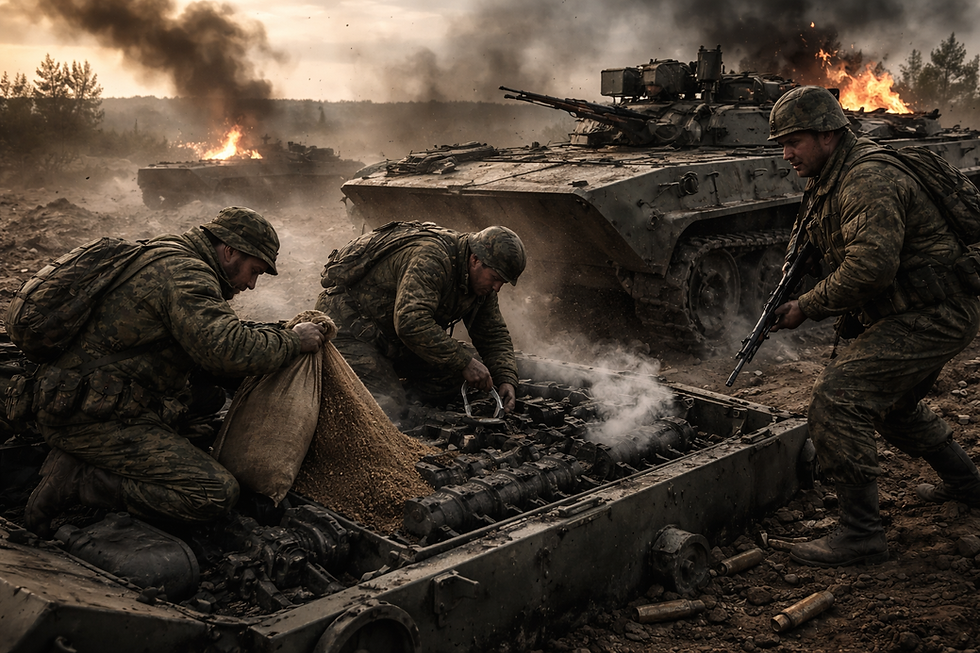
A second strand is material sabotage. Claims have circulated of soldiers deliberately disabling vehicles or weapons to avoid combat deployment. Not all such reports can be independently verified, and wartime information environments are saturated with propaganda. Nevertheless, the pattern itself is plausible and historically consistent. When a soldier cannot safely say “no”, it may be safer to make “yes” physically impossible. A broken vehicle, a missing component or an inexplicable malfunction can buy time or avert a deadly order without the explicit act of refusal.
A third strand is overtly political sabotage from within the system. Ukraine has claimed instances of Russian servicemen deliberately damaging high-value assets before defecting. Even allowing for uncertainty in specific cases, the strategic implication is clear. Loyalty within the Russian military is contested terrain. Acts of sabotage become not only personal acts of survival or protest but symbolic blows, amplified through modern media into narratives that undermine confidence far beyond their immediate tactical impact.
A final strand is the actions of Russian prisoners of war. Some Russian troops are eager to surrender if possible because life in a prisoner-of-war camp in Ukraine is better than dying on the battlefield. There are also reports of Russian commanding officers executing injured soldiers rather than evacuating them, which causes Russian soldiers to be so demoralised that upon capture they may willingly reveal Russian positions to Ukrainian security services.
A comparative perspective: sabotage in other mass armies
Internal sabotage is not uniquely Russian. It is a recurring feature of mass armies fighting unpopular or protracted wars. Comparing the Russian case with others helps to distinguish what is structural from what is culturally specific.
In France in 1917, after the catastrophic Nivelle Offensive, large parts of the French army refused to undertake further suicidal assaults. The response was a combination of repression and reform. While some units mutinied openly, many more engaged in selective compliance: they would hold defensive positions but not attack. This was not usually framed as sabotage, but the operational effect was similar. The army continued to exist, but its offensive capacity was deliberately constrained from within until conditions changed.
In the United States during the Vietnam War, internal resistance took diverse forms. There were refusals, desertions, and, in some documented cases, deliberate actions to avoid aggressive assault patrols and advances. The phenomenon known as “fragging”, attacks on officers by their own men, was an extreme manifestation of the same underlying dynamic: a breakdown of trust between command and commanded in a war perceived as futile by many participants. Even less dramatic acts, such as minimal compliance and avoidance, contributed to a decline in operational effectiveness.
In Iraq after 2003, the rapid collapse of Saddam Hussein’s army illustrated a different variant. Units dissolved rather than sabotaged from within. Yet during later phases, elements of the Iraqi security forces were plagued by internal corruption, absenteeism, and intentional non-performance, especially where loyalty to the state was weak. Again the absence of a legitimate, trusted institutional framework turned obedience into a negotiable commodity.
The common thread across these cases is not national character but institutional legitimacy. When soldiers believe the war is unjust, unwinnable, or indifferent to their survival, internal resistance emerges. Sabotage, in one form or another, becomes a rational response to an irrational environment.
What distinguishes the Russian case
Russia’s experience combines several risk factors. She relies heavily on mass mobilisation and coercive discipline. She tolerates, and sometimes encourages, a command culture in which lives are treated as expendable. She prosecutes refusal harshly, pushing dissent underground rather than resolving it. Finally, she fights a war whose stated aims have shifted and blurred, making it difficult for soldiers to anchor sacrifice to a stable purpose.
Modern technology adds a further layer. Soldiers carry phones. Stories circulate instantly. Methods of avoidance and sabotage spread horizontally across units. A single act of internal resistance can be filmed, narrated and amplified into a symbol of institutional decay.
It is important not to romanticise this phenomenon. Most internal sabotage is not heroic resistance. It is the behaviour of people trying to survive within a system they neither control nor trust. Yet precisely for that reason, it is analytically powerful. It reveals the point at which the social contract inside an army breaks down.
Russian soldiers’ sabotage of their own operations, past and present, is therefore best understood not as an aberration but as a diagnostic sign. It appears when the state asks for sacrifice without offering legitimacy, competence, or reciprocity in return. When that happens, refusal does not always shout. Often it jams a gearbox, misplaces a component, or turns an order into an impossibility.