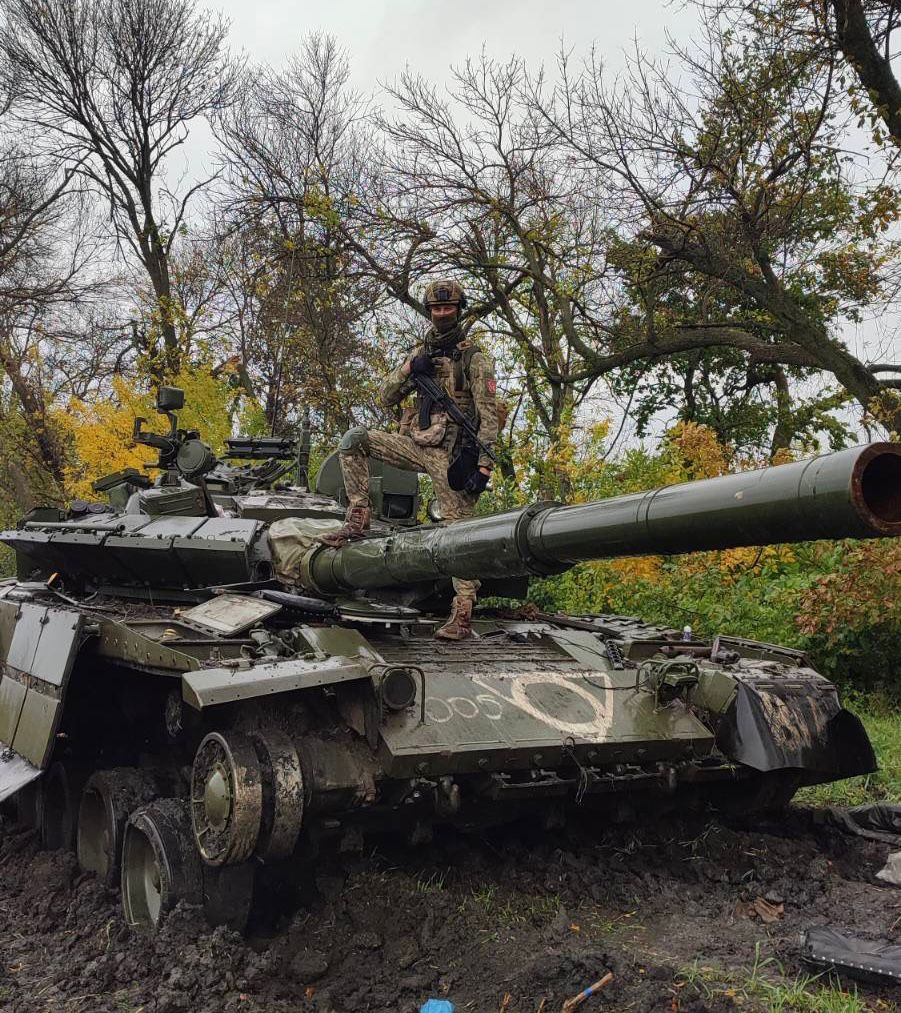
Interview with Oleksandr, Sapper with the Armed Forces of Ukraine
- Sep 23, 2025
- 6 min read

Interview undertaken via a consecutive interpreter; edited for clarity and style.
Photo gallery at the end of the interview.
Hello, this is Matthew Parish from the Lviv Herald, and it's my pleasure today to interview Oleksandr. We're just going to use his first name, who's a serving member of the Ukrainian Armed Forces, and it's our privilege and honour for him to speak to us today and tell us about his experiences fighting for Ukraine against the Russian invasion. So thank you, Oleksandr, for your time coming here today.
Thank you, it's my pleasure.
Alexander, can you tell us about your life before the war? What were you doing before you started resisting the Russian aggression?
Before the war I was working for the government of Ukraine before the war, in the Judicial Enforcement Service [that executes civil and criminal judgments of Ukrainian courts]. I was living an ordinary life. And then I was working in the Ukrainian government to register entrepreneurs and self-employed people. Then after that, I was working as the manager of a Public Service Corporation.
And when did you first become a soldier? Why did you decide to do that?
When war started, I was living in Kherson. And [after the Russian invasion of Kherson on 24 February 2022], I tried to help my family to organise life with groceries, to receive groceries with deliveries, and do other things necessary for living,
I did not expect that that war would start. I didn't believe it in it, and the first days, I tried to go to rallies to show Russians that they are not welcome in person.
In May 2022, I saw how many people were arrested and how many people left Kherson. My family was okay with everything they needed for living, and I had the possibility to go to Ukrainian territory.
Not under the Russian occupation.
Where I'm not occupied. Yeah.
So you were in Russian occupied hair song in February 2022, then the Russians arrived, and then, by May you fled, because the situation was being too difficult.
Yes.
So you went to register as a soldier. Tell me what training you went through, what what procedure was involved, and where you were assigned to fight.
I went to the ТЦК [the territorial recruitment centre]. They were deciding for two weeks what to do with me. They sent me to an army camp for training. For one month we were training in general army training, and for one month afterwards, I undertook training as a sapper.
After that, I was sent to an Airborne Assault Brigade.
The Assault Brigade is a brigade that attacks Russian positions, tries to push them back. So when was this?
It was the first day of August of 2023.
And can you tell us where on the front line you were operating? Just roughly?
In the Sloviansk and Izium directions.
You were involved in pushing the Russians out of Sloviansk and Izium in the early days of the war.
Sloviansk was clear, but in Donetsk and Kharkiv regions, there was combat attacks. This was my first fight in this area. Then we came to Izium, and then we go to Kreminna [in occupied Luhansk oblast]. It is on the Kharkiv, Luhansk and Donetsk border.
So your missions at that point were successful, and this is your was de-occupied as a result of your efforts, and you were injured at some point.
Yeah, I have a bullet in my arm in combat, during the course of an attack.Three or five soldiers [attacked us]. I have a bullet and it broke my elbow. So I had to walk [a short distance back to frontline positions], and then a tank missile was explored near by me, and a sharp piece of tank shrapnel broke my shoulder and my spine.
I was then recuperating for about four months, and then decided I'll come back to my brigade, but the Command Structure said that I can't take part in assault attacks [due to my injuries], and I need to search for another brigade which I can work in with my [medical] conditions.
I thought I had the possibility to stay in the [same] brigade, but working with papers and help other guys from our brigade with injuries. So I found another bridge I was searching for and I had permission to go for an engineer bridge, the specifics: de-mining. So I thought if my speciality is in demand, but I waited like six months for paperwork, but I working with paperwork for [logistics]. I worked with status in [my original] brigade, but I didn’t want [my guys] seeing me woth nothing to do. And then I just joined new brigade, and I worked as a sapper.
So you were rehabilitated for four months. Then you had a six, six months of a paperwork job, and then he went to be a sapper [a de-mining role]. And where was that?
That was in the Kherson region. I was assigned to another Assault Brigade in that region.
So again, you were in an Assault Brigade, which is one of the most dangerous positions to take in the army.
It is an engineer brigade. It depends. That brigade works in the front line, in the back line.
While you were demining, you suffered another injury. Tell us about that.
Well, normally there are special machines used for de-mining. Also we used dogs [to undertake de-mining activities]. We we were working on the territory with a lot of mines and they were different types. We received information from [Polish reconaissance] drones that there were a lot of stretching trip wire and we we couldn't use dogs, so I did antipersonnel mine work personally [to collect and remove mines]. The mines were very densely concentrated.
So we work in two lines, I collected 40 mines maybe by hand. A bit more, because I took only 24 of them, three energy drinks, collect mines and carry on, carry on, collect them. But they were in this land, like two years. The sun was high and it was hot, and the ground was smooth, but some mines were buried very deep.
I had mine detectors. Mine detectors, yes, but they cannot find everything, they’re not perfect because of the depth of the ground [in which the mines are buried]. They also have plastic mines; there isn’t a lot of metal inside these mines.
So the Russians had left a very heavy concentrations of anti personnel mines in the liberated areas of Kherson.
They were standing on their lines in the Kherson region [before the area was liberated], and putting all the Russians mines in this region.
So you were actually looking for these mines with your eyes and picking them up with your hands and defusing them.
Yes.
When did you step on a mine and lose your leg?
March 4, 2025.
That's recent.
Kherson has been liberated for a long time, but the problem with mines there is really, really very extreme.
This was in rural areas of Kherson oblast
In village areas. Yeah.
So many civilians in that area.
In the region of one village, there was like three or four blocks of mines.
Since then, you've been recuperating and learning to walk with a prosthetic leg. And what are your plans now?
I will return to my Brigade to work. I will go back to Kherson to do de-mining.
That's very brave of you.
It's my job. It's my obligation.
What do you think of the Russian soldiers who dropped all these mines and made such chaos and carnage in the Kherson region? Do you have hatred for the Russians; what are your emotional views of of this conflict, and particularly of the Russian soldiers?
I hate them. At this point I hate that I have the Russians in my country, creating war here.
I take my hatred for the Russian invaders and soldiers and direct my energies, and make from this courage and facilities to work de-mining and doing my best.
Where do you think this war is going now?
I think it's a heavy stage now. So we cannot go ahead. We can only stop.
The fact is that the front line hasn't moved very much in the last three years, and Chasiv Yar and Pokrovsk, and the other cities the Russians have been trying to take those cities for three years and haven't succeeded. I mean, aren't we in a stalemate?
But at what cost to us from us to our to our country? What cost of this [frozen] front line? Yeah, we paid a high price. Many people died.
What do you think the solution is? Do you think the Ukrainian people would accept a freezing of the conflict along the front line?
Yeah, I think a lot of civilians and army forces are ready to freeze the conflict.
The war may go on for some time more, because President Vladimir Putin of Russia can't stop it. He must keep fighting, because he's in a difficult position himself. Do you think Ukraine can survive for, say, two more years fighting this war?
We don't have any choice. We have to do it.
What could the West do more to help Ukraine fight this war?
We need more weapons of every kind. This is very hard for soldiers. Our soldiers sometimes take revenge. We more and more weapons. We have problems with delivery; when we receive weapons from the West, we can stabilise [the front line] and the enemy cannot go ahead.
Will you have enough men?
We have no choice.
Oleksandr, I would like to thank you for your time today. You are a true hero of Ukraine. Thank you for your sacrifices and for your ongoing work. Slava Ukraini!
Heroyam Slava. Thank you very much.