Fighting While Building: How Ukraine Keeps Modernising Her Army During Wartime
- Jun 21, 2025
- 3 min read

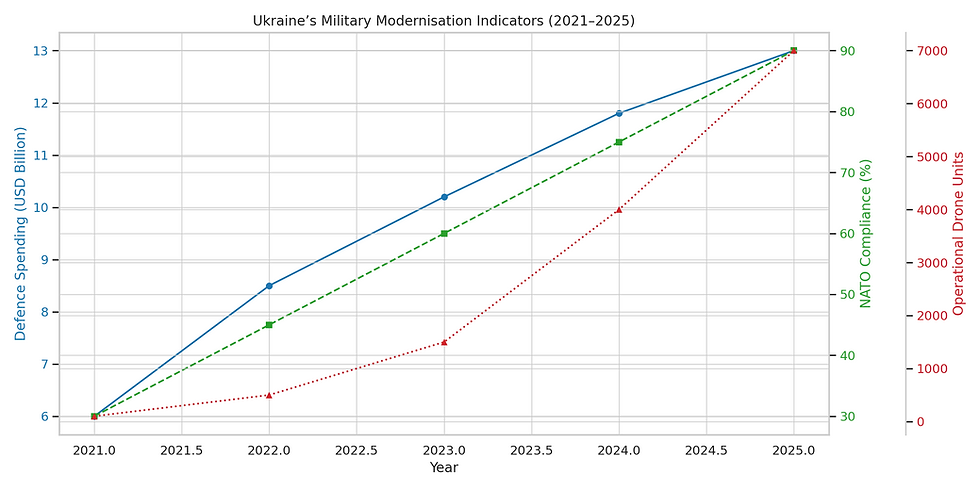
The Russian invasion of Ukraine in February 2022 marked not only the largest land war in Europe since the Second World War but also a profound test of Ukraine’s military resilience and adaptability. Faced with a vastly larger adversary, Ukraine did not collapse. Instead, she reinvented herself on the battlefield. Under constant bombardment and with limited resources, Ukraine has accomplished what few countries have achieved: modernising her armed forces amidst full-scale war. This transformation has not only defied Russian expectations but has also offered important lessons for NATO, the European Union, and democratic states around the world.
Ukraine’s modernisation under fire has unfolded on multiple levels. First is the matter of equipment and materiel. At the outset of the war, much of Ukraine’s arsenal still bore the imprint of her Soviet past: ageing T-64 tanks, legacy MiG and Sukhoi aircraft, and artillery pieces reliant on Warsaw Pact calibres. But necessity sparked ingenuity. Through creative adaptation and the influx of Western aid, the Ukrainian Armed Forces began integrating NATO-standard systems—HIMARS rocket artillery, Leopard 2 tanks, and Patriot air defences—into a military culture once defined by Soviet doctrine. Far from being overwhelmed by this transition, Ukrainian units developed innovative hybrid practices, combining local knowledge with NATO procedures.
Second, Ukraine’s war effort has been underpinned by organisational reforms. In wartime, efficiency is not optional. Ukraine streamlined her logistics and procurement processes, digitalised much of her military bureaucracy, and created more decentralised, flexible command structures. The establishment of territorial defence forces and specialised drone units, often staffed by civilians with technical skills, has blurred the lines between military and civil society. The Ministry of Defence, working in tandem with civil society watchdogs and international advisors, has made notable progress in reducing procurement corruption—a historic problem—through digital platforms like ProZorro and enhanced transparency measures.
Another critical vector of modernisation has been Ukraine’s embrace of digital warfare and artificial intelligence. From the early months of the war, systems like GIS Arta—Ukraine’s home-grown battlefield coordination tool—enabled precise artillery strikes by linking mobile phones, drones and AI-assisted targeting in real time. Ukraine has since refined these systems, incorporating foreign commercial satellite data and machine learning algorithms to anticipate Russian movements. Such capabilities allowed Ukrainian forces to launch effective counteroffensives in Kharkiv and Kherson in 2022, and to degrade Russian rear-area logistics in 2023 and 2024. Cyber warfare, too, has become a central battlefield, with Ukraine leveraging both state assets and volunteer hackers in a digital battle for infrastructure and information.
Just as critical has been training and doctrine. Ukraine’s soldiers have gone from mass conscription to increasingly professionalised units trained to NATO standards. Partnerships with countries like the United Kingdom (via Operation Interflex, a British-led multinational training programme for Ukrainian military), Poland and the United States have produced thousands of trained personnel. While full NATO integration remains politically sensitive and formally elusive, Ukraine’s interoperability with NATO standards is no longer aspirational—it is reality. Training focuses not only on weapons systems but also on leadership, non-commissioned officer development, medical evacuation protocols, and combat ethics.
Perhaps most importantly, Ukraine is modernising her armed forces through strategic culture. No longer focused solely on defending fixed positions, Ukraine’s military thinking has embraced mobility, deception and asymmetry. Commanders plan in time horizons that are both immediate and long-term, while a new generation of junior officers, many battle-hardened and well-versed in technology, is reshaping the institutional ethos of Ukraine’s defence forces.
This wartime modernisation is not without its challenges. Ukraine still faces persistent shortages in munitions, relies heavily on external military assistance, and must contend with personnel fatigue. Moreover sustaining reforms in a war economy requires careful stewardship to prevent regression after hostilities cease. Yet Ukraine’s progress offers a compelling model of how a medium-sized democracy can refashion its military under existential threat.
In summary, Ukraine is fighting while building her military resources. In doing so, she is not only defending her sovereignty but also reinventing the meaning of national defence in the twenty-first century. Her experience may well shape the future of European security for decades to come.
---
Timeline
The introduction of HIMARS and GIS Arta in 2022,
Expansion of the Territorial Defence Force (Ukraine's reservist army) and arrival of Leopard 2 tanks in 2023,
Advancements in AI-driven drone targeting in 2024,
The adoption of full NATO doctrine training by 2025.