


Britain’s Lonely Veto: Viktor Orbán, Marine Le Pen and the Future of the United Nations
By Matthew Parish
Tuesday 27 October 2026
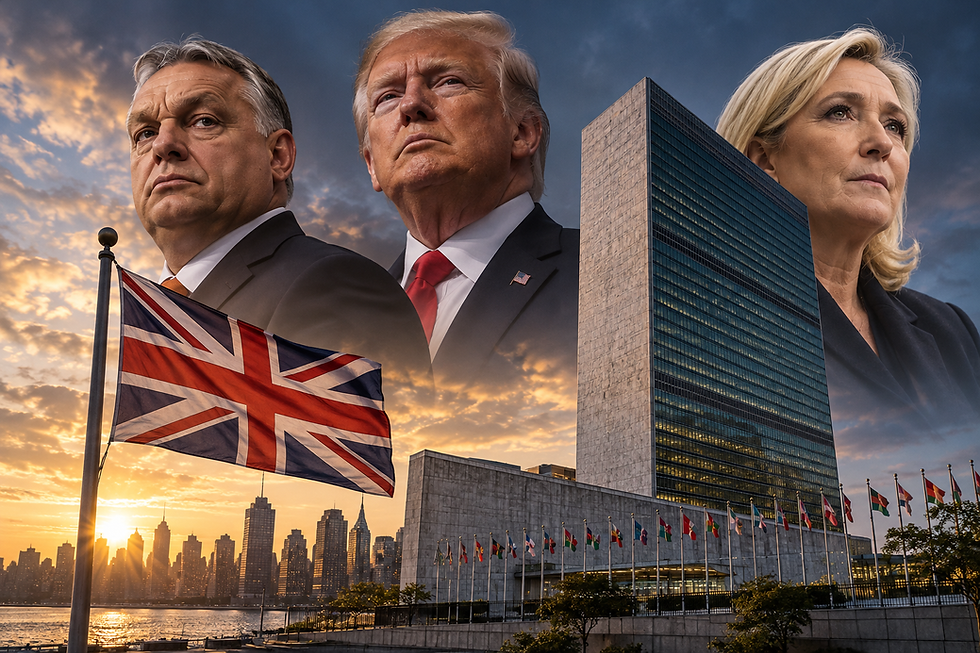
There is a peculiar historical irony in the possibility that Great Britain, a country whose international influence has been declining for decades, might find herself the final obstacle to an extraordinary attempt to transform the political character of the United Nations. The reported American proposal to install Viktor Orbán, the recently defeated former Prime Minister of Hungary, as Secretary-General of the United Nations raises precisely this possibility. If Washington, Moscow and Beijing were to unite behind his candidature, and if France were eventually to acquire a President sympathetic to Orbán’s political philosophy, Britain might find herself occupying a position of considerable diplomatic isolation. She could be left with the responsibility of exercising its Security Council veto against a candidate supported by the three most powerful geopolitical actors in the contemporary international system.
Such a confrontation would be remarkable for several reasons. Britain has traditionally regarded her special relationship with the United States as one of the foundations of her national security, while simultaneously conceiving of itself as a principal defender of the post-war international legal order. These two commitments have usually been regarded as mutually reinforcing, because the United States was the principal architect of that order and Britain her most dependable ally. Yet the convergence of American nationalist conservatism, Russian authoritarianism and Chinese geopolitical revisionism threatens to make those two commitments increasingly incompatible. Britain might eventually have to decide whether her allegiance lies principally with Washington or with the international institutions that Washington itself helped create.
Orbán is an unusually provocative candidate for the highest administrative office in the United Nations. He governed Hungary for sixteen years, during which he developed an increasingly confrontational relationship with the European Union, attracted substantial criticism for weakening institutional checks upon executive power and cultivated friendly relationships with political leaders whose values were often incompatible with liberal constitutional democracy. His defeat in Hungary’s parliamentary elections in April 2026, followed by the appointment of Péter Magyar as Prime Minister, represented a significant setback for the international nationalist movement. To elevate Orbán to the leadership of the United Nations immediately afterwards would transform an electoral defeat at home into an astonishing international promotion.
The attraction of Orbán to the Trump administration is nevertheless intelligible. He represents an ideological conception of government in which national sovereignty, cultural conservatism and executive decisiveness take precedence over the cumbersome conventions of liberal internationalism. Orbán has demonstrated considerable political skill in exploiting the procedural weaknesses of multilateral institutions, particularly the European Union, whose unanimity requirements have repeatedly allowed Hungary to obstruct collective decisions. From the perspective of the American nationalist right, these characteristics might be regarded not as disqualifications but as qualifications for leadership.
A Secretary-General sympathetic to the political instincts of Donald Trump could conceivably accelerate the transformation of the United Nations from an institution committed to universal principles into a negotiating forum dominated by powerful sovereign states.
There is a further peculiarity in the possible alignment of Washington, Moscow and Beijing behind the same candidate. These three powers have profoundly different strategic objectives, and their mutual suspicions remain substantial. Yet they share a certain dissatisfaction with the international human rights architecture and the capacity of multilateral institutions to scrutinise the internal conduct of sovereign governments. For Russia, Orbán would offer the attraction of a European politician who has repeatedly resisted attempts to isolate Moscow over its invasion of Ukraine. For China, he might represent a figure unusually sympathetic to its preference for state sovereignty over international interference. For the United States under Trump, he could embody the possibility of redirecting the United Nations away from its more liberal and humanitarian ambitions towards an organisation dominated by transactional understandings between governments.
It would be mistaken, however, to assume that such an agreement between three permanent members of the Security Council would automatically secure Orbán’s appointment. Under Article 97 of the United Nations Charter, the Secretary-General is appointed by the General Assembly upon the recommendation of the Security Council. The candidate must obtain the necessary affirmative votes in the Council without a negative vote from any permanent member, and there is no means by which a numerical majority can overcome a permanent member’s veto. The reported American calculation that Orbán might attract between eight and ten Security Council votes therefore leaves a question of exceptional constitutional significance. Even if a sufficient majority were assembled, either Britain or France could prevent the appointment.
France is the uncertain component of this arrangement. Under President Emmanuel Macron, French foreign policy has remained broadly committed to European integration and the preservation of multilateral institutions, even where French and American interests have diverged. A French veto against Orbán would be entirely conceivable, and present reporting suggests considerable opposition in both Paris and London to his possible candidacy. Nevertheless, France is approaching a presidential election in which the established assumptions of French foreign policy may be challenged by Marine Le Pen and her Rassemblement National. Should Le Pen secure the presidency in May 2027, the political balance within the Security Council could change profoundly.
The calendar presents an important complication. António Guterres leaves office on 31 December 2026, and his successor is expected to take office the following day, several months before the French presidential election. The scenario of Le Pen determining France’s vote on Orbán would therefore require an unusually prolonged deadlock over the Secretary-General’s appointment, or another extraordinary development that left the position unresolved into the following spring. Such a deadlock is not constitutionally impossible, and the United Nations has already considered what interim arrangements might be necessary if no successor can be agreed by the end of 2026. Nevertheless, Le Pen’s election cannot be treated as an immediate determinant of the present succession contest.
The possibility remains worth examining because Le Pen and Orbán have an established political relationship that extends beyond occasional diplomatic courtesies. Le Pen publicly supported Orbán during his unsuccessful 2026 election campaign and has praised his approach to national sovereignty and European institutions. Their parties belong to the same wider political movement seeking to challenge the dominance of liberal and centrist parties within Europe. A French presidency under Le Pen might therefore have considerably less enthusiasm for frustrating Orbán’s international ambitions than the existing French administration. Equally, her commitment to French sovereignty should not be confused with an unconditional commitment to American objectives. A President Le Pen could oppose Washington when French national interests demanded it, and her support for Orbán would remain a political calculation rather than a certainty.
It is nevertheless possible to imagine a situation in which a Le Pen presidency removed the French obstacle to Orbán’s appointment. Britain would then face a decision of extraordinary diplomatic significance, because she might become the sole permanent member prepared to exercise a veto. Other members of the Security Council could still deny Orbán the necessary affirmative majority, but if Washington had assembled sufficient votes, the responsibility for stopping him might fall entirely upon London. This would be a situation in which Britain’s formal constitutional powers within the United Nations considerably exceeded its relative geopolitical strength. Britain possesses precisely the same veto as the United States, Russia or China, notwithstanding the enormous differences between their economic and military capabilities.
The pressure from Washington in these circumstances could be formidable. Britain depends upon American cooperation in intelligence, nuclear technology, military procurement and the broader architecture of European security. Her relationship with the United States has acquired particular importance since Brexit, when British governments increasingly sought to compensate for their reduced influence within European institutions through the cultivation of bilateral relationships. An American administration determined to secure Orbán’s appointment could threaten to complicate trade negotiations, reduce political cooperation or make British participation in sensitive security arrangements more difficult. None of these consequences would follow automatically, but the mere possibility would weigh heavily upon any British government contemplating a confrontation with Washington.
The domestic political consequences would be equally complicated. A Labour government under Andy Burnham would have to explain why Britain was prepared to jeopardise important aspects of her relationship with the United States over the appointment of a Hungarian politician to an international organisation whose effectiveness is frequently questioned. Conservative and nationalist critics might accuse the government of sacrificing British national interests to abstract principles of international governance. Others would argue that Britain had no particular obligation to rescue a United Nations whose decisions have often been frustrated by the vetoes of other permanent members. The government would therefore require an unusually clear explanation of why Orbán’s appointment represented something more serious than an ordinary disagreement over diplomatic personnel.
That explanation would have to begin with the distinctive constitutional position of the Secretary-General. The Secretary-General is not merely the administrator of an enormous international bureaucracy, nor is the office equivalent to the presidency of a sovereign state. Its authority rests principally upon the expectation that its occupant will exercise independent judgement in the interests of the organisation as a whole, rather than acting as the political representative of the states that supported their appointment. Article 100 of the Charter expresses this principle by requiring the Secretary-General and the Secretariat to refrain from seeking or receiving instructions from any government. The danger in Orbán’s candidacy is not simply that he holds conservative or nationalist opinions, but that his political history raises legitimate questions about whether he would maintain the independence expected of the office.
These questions would acquire particular urgency in relation to Ukraine. For four and a half years, Ukrainians have been defending their sovereignty against a Russian invasion that constitutes one of the gravest challenges to the United Nations Charter in contemporary history. Orbán has repeatedly expressed positions that have complicated European attempts to support Ukraine and has maintained relationships with Moscow that distinguish him from most European leaders. Were he to become Secretary-General, his responses to further Russian military aggression, allegations of war crimes or negotiations over Ukraine’s territorial integrity would immediately be examined for evidence of partiality. Even if he sought to act independently, his previous political commitments might undermine the confidence necessary for successful mediation.
For Britain, this would make the appointment a question of national security as well as international principle. The United Kingdom has invested substantial political, financial and military resources in supporting Ukrainian resistance, and her credibility in Europe has been strengthened by her consistent opposition to Russian territorial expansion. An Orbán-led United Nations perceived as accommodating Moscow could weaken the diplomatic environment within which Ukraine seeks international recognition and support. Britain might therefore conclude that preventing the appointment was a necessary extension of its existing strategic commitments. Yet this would create the extraordinary spectacle of London confronting Washington, ostensibly its closest ally, over a matter in which Washington appeared to share Moscow’s preferences.
One should not underestimate the psychological significance of such a confrontation. British foreign policy has been constructed for generations around the assumption that the United States, whatever her occasional errors, ultimately shares Britain’s conception of international order. That assumption survived the Suez crisis, the Cold War, the Iraq War and numerous lesser disagreements. It has also survived Britain’s relative economic decline, because successive British governments believed that access to American power provided the country with influence disproportionate to her material resources. A dispute over Orbán’s appointment could reveal the limits of this historical settlement. Britain might discover that her most important alliance was no longer a reliable expression of its own understanding of international legitimacy.
There is a precedent for this sort of disagreement, although not one that precisely anticipates the circumstances being considered here. In 1996 the United States vetoed the reappointment of Boutros Boutros-Ghali as Secretary-General, despite substantial support for his continuation in office. Washington regarded his leadership as incompatible with American interests and exercised her permanent membership privilege accordingly. The episode demonstrated that the selection of a Secretary-General is ultimately a political decision, notwithstanding the constitutional language of impartiality and administrative independence. Britain would therefore be exercising no unprecedented legal authority if she chose to veto Orbán. It would simply be employing a privilege that the United States has previously considered entirely legitimate when defending its own interpretation of the organisation’s interests.
The preferable outcome would be to avoid the necessity for a formal British veto. Diplomacy often operates most effectively when governments communicate their irreducible objections privately, allowing other participants to retreat without a humiliating public confrontation. Britain could make clear during the Security Council’s confidential consultations that Orbán would not command its support, whatever the numerical strength of his candidacy. It could coordinate with European governments, particularly Germany, Poland and the Nordic states, to ensure that opposition to the appointment was presented as a defence of institutional independence rather than a personal campaign against the former Hungarian Prime Minister. It could also encourage the emergence of a credible alternative candidate acceptable to the permanent members. A formal veto should be understood as the ultimate instrument of British policy, not necessarily its first diplomatic move.
Yet there is a difficulty with this approach. If the Trump administration has invested considerable political capital in Orbán, it might not be satisfied with a discreet British objection, however diplomatically expressed. Trump has repeatedly demonstrated a preference for treating international negotiations as contests of political will in which concessions are rewarded and resistance is penalised. His administration might regard Britain’s refusal as an act of disloyalty, particularly if other permanent members had accepted its preferred candidate. In such circumstances, the traditional British instinct to find an ambiguous compromise might be counterproductive. A government seeking to preserve every element of the special relationship could eventually compromise its position to the point at which a meaningful veto became politically impossible.
This is where the potential emergence of a Le Pen presidency becomes especially consequential. Britain and France have often disagreed on matters of European politics, but their common membership of the Security Council has permitted them to defend similar principles of international institutional legitimacy. If France were to abandon that position, Britain would lose an important diplomatic partner at precisely the moment when American pressure was most intense. A nationalist French government might also seek to portray British resistance as evidence of London’s attachment to a declining liberal international consensus. Britain, having left the European Union, could find itself diplomatically isolated from both the emerging nationalist currents within Europe and the American administration that encouraged them.
Nevertheless, isolation is not necessarily the same thing as weakness. Britain retains substantial military capabilities, nuclear weapons, a permanent seat on the Security Council and a diplomatic service experienced in the management of international crises. Her alliances with European countries remain significant notwithstanding Brexit, and her reputation amongst states concerned about Russian aggression gives her considerable political influence. A principled British veto could therefore have consequences beyond the immediate appointment of the Secretary-General. It might demonstrate that the permanent membership privileges established in 1945 can still be exercised independently of the wishes of the most powerful states, and that the United Nations need not become an instrument of agreement between Washington, Moscow and Beijing.
There is also a more fundamental philosophical issue involved. The United Nations was founded upon a compromise between the sovereign equality of states and the recognition that a small number of great powers would exercise exceptional authority over international security. This compromise was always unstable, because the five permanent members were never expected to agree about every matter of global importance. Their vetoes were designed partly to ensure that the organisation could survive disagreements between them without compelling the great powers to submit to decisions they considered intolerable. Yet the institution also depended upon an assumption that its most powerful members would accept some common commitment to the principles contained in the Charter. The appointment of a Secretary-General perceived as principally representing a coalition of powerful governments would place that assumption under severe strain.
The paradox is that Britain might be called upon to defend an international order from the combined preferences of the very powers whose agreement is ordinarily considered essential to its operation. She would be exercising a privilege derived from the distribution of power at the conclusion of the Second World War in order to resist the preferences of countries that now exercise considerably greater material influence. This is not necessarily a contradiction. Constitutional institutions exist precisely because political power cannot always be entrusted to those who possess the greatest resources or command the largest coalitions. Their legitimacy depends upon the willingness of participants to respect constraints even when doing so becomes politically inconvenient.
Whether Britain would possess the political courage to exercise her veto under these circumstances remains uncertain. British governments have often demonstrated a remarkable capacity for identifying reasons why difficult decisions should be postponed, diluted or delegated to other countries. The temptation to avoid a confrontation with Washington would be immense, particularly if American officials presented the appointment as a symbolic matter without immediate practical consequences. Britain might be encouraged to accept assurances concerning Orbán’s future impartiality, administrative appointments or commitments to humanitarian principles. Yet such assurances would be difficult to enforce after the appointment had been completed, and the Secretary-General would thereafter possess substantial discretion over the political direction of the Secretariat.
Ultimately, the question is whether Britain still conceives of herself as an independent great power possessing responsibilities that cannot be subordinated to her alliances. The country’s permanent seat on the Security Council is sometimes criticised as an anachronism, an inheritance from an imperial era whose material foundations have long since disappeared. But constitutional authority does not become meaningless merely because the balance of economic and military power has changed. A British veto against an unacceptable candidate, exercised despite American opposition, might provide one of the clearest contemporary demonstrations that Britain’s permanent membership still serves a substantive purpose. It would show that British diplomacy can occasionally derive its significance from the independent exercise of judgement rather than from proximity to American power.
The most likely outcome remains that the United Nations will seek to resolve its succession before the French presidential election, preventing the precise confrontation considered here from arising. Orbán may never become a formal candidate, France may oppose him under its existing government and Britain may never be required to exercise her veto. Nevertheless, the prospect of a future alignment between American nationalism, Russian strategic interests, Chinese authoritarian governance and French national populism raises questions extending far beyond one appointment. It invites Britain to reconsider the purposes of its international influence and the principles for which it would be prepared to endure diplomatic isolation.
There are moments in international affairs when a country’s significance is measured not by the alliances it can assemble, but by the decisions it is prepared to take alone. Britain has spent much of the post-war period attempting to reconcile her moral commitment to international institutions with her strategic dependence upon American leadership. An Orbán candidacy backed by Washington, Moscow and Beijing, combined with a hypothetical French administration unwilling to oppose it, could make that reconciliation impossible. If Britain were then the only permanent member prepared to resist, its decision would illuminate a question much larger than the identity of the next Secretary-General of the United Nations. It would reveal whether one of the oldest surviving constitutional democracies still possesses the independence of political judgement necessary to defend the international order from which much of its remaining global influence derives.


