


Ankara and the New NATO: The Summit That Marked Europe’s Strategic Transition
- Jul 10
- 4 min read
Friday 10 July 2026
The NATO summit held in Ankara this week may ultimately be remembered less for dramatic declarations than for confirming a profound transformation already under way. Throughout the Cold War and the decades that followed, NATO rested upon a relatively simple geopolitical foundation: overwhelming American military predominance combined with European economic power. The Ankara summit suggested that this formula is evolving into something more complex. The United States remains indispensable, but Europe is increasingly expected to provide the bulk of the resources needed for its own conventional defence, while Ukraine has become embedded within NATO’s long-term strategic planning without yet becoming a formal member.
The summit declaration reaffirmed the Alliance’s commitment to collective defence under Article 5, continued military support for Ukraine and sustained efforts to strengthen the Alliance’s industrial and technological base. It also placed renewed emphasis upon increasing defence expenditure and accelerating defence production across Europe.
Perhaps the most immediate outcome for Ukraine was the announcement of a substantial package of military assistance for 2026, reportedly amounting to some US$80 billion, alongside expanded cooperation with Ukraine’s defence industry. Ukrainian officials also welcomed commitments to strengthen air defence and closer industrial integration between Ukraine and NATO members.
These commitments reflect an increasingly obvious strategic reality. NATO no longer treats Ukraine as merely a recipient of assistance. Rather Ukraine has become one of Europe’s principal security producers. Three years of industrial mobilisation have transformed Ukrainian defence manufacturing into one of the fastest-evolving military industries in the world. Drone technology, electronic warfare, battlefield software and rapid weapons innovation have become areas in which Ukraine increasingly contributes expertise rather than merely consumes equipment.
This represents a significant conceptual shift. During the first year of Russia’s full-scale invasion, Western governments largely perceived themselves as suppliers and Ukraine as the recipient. By mid-2026 that relationship has become considerably more reciprocal. Ukraine now provides operational experience unavailable elsewhere in the Alliance.
The summit also highlighted the changing relationship between Europe and the United States.
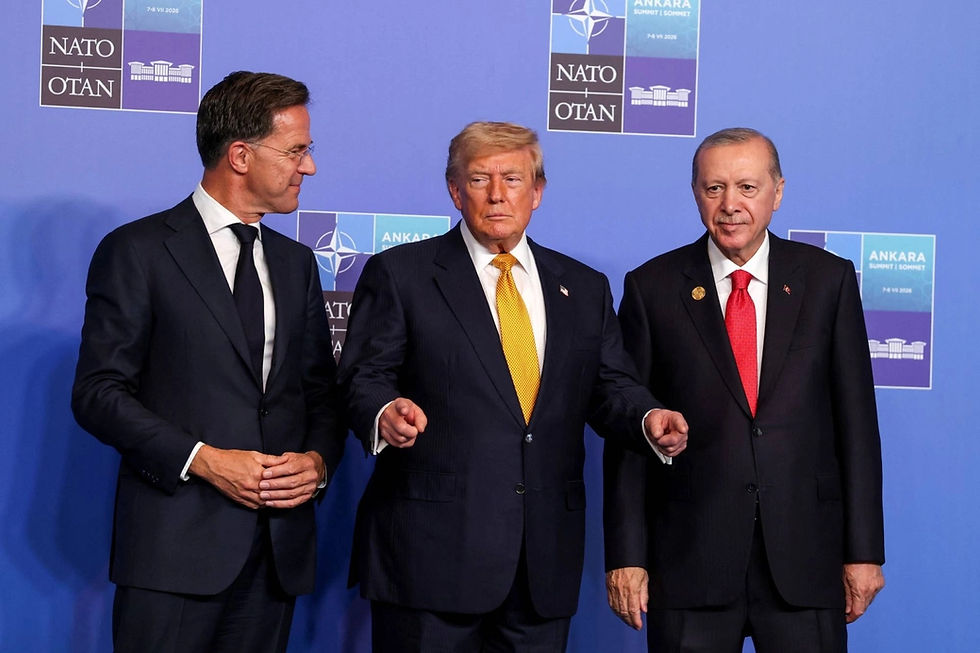
President Donald Trump again dominated much of the political discussion surrounding the summit. His criticisms of European allies, alongside renewed pressure for greater defence spending, generated familiar tensions. Yet unlike earlier years, European leaders arrived prepared. Most now accept that regardless of who occupies the White House in future administrations, the era in which Europe could rely upon overwhelmingly American military financing has ended.
Indeed, one of the paradoxes of the Ankara summit is that transatlantic disagreements may actually have strengthened NATO. European governments have accelerated defence spending not despite American pressure but partly because of it. Strategic autonomy, once regarded as a controversial French aspiration, is steadily becoming accepted policy across much of Europe.
This does not imply the emergence of a European army. NATO remains overwhelmingly the principal vehicle for collective defence. Rather it means that European governments increasingly accept responsibility for generating military capability themselves while relying upon the United States primarily for strategic deterrence, intelligence, logistics and nuclear protection.
Turkey’s role as host also deserves careful attention.
For years Ankara has occupied an ambiguous position inside the Alliance. President Recep Tayyip Erdoğan has maintained relations with Russia while simultaneously supplying critical military assistance to Ukraine, including the early provision of Bayraktar drones. Turkey has often appeared to occupy an uncomfortable middle ground between East and West.
Hosting this summit nevertheless demonstrated that NATO continues to value Turkey’s unique geopolitical position. Situated astride the Black Sea, controlling access through the Bosporus and bordering the Middle East, the Caucasus and the Eastern Mediterranean, Turkey remains geographically indispensable. At a time when NATO increasingly confronts simultaneous security challenges extending from the Arctic to the Middle East, Ankara’s importance has only increased.
The summit also reflected broader changes in NATO’s understanding of modern warfare.
Conventional armies remain essential, but industrial resilience, cyber security, artificial intelligence, space assets, missile defence and drone production now occupy equal prominence. Modern conflict is increasingly determined not solely by the size of armies but by industrial capacity, innovation cycles and the ability rapidly to adapt technology under combat conditions.
Russia’s invasion of Ukraine has accelerated these changes dramatically. NATO planning increasingly assumes that future conflicts will require sustained industrial mobilisation rather than short, decisive campaigns. European governments therefore face difficult fiscal choices. Increased defence expenditure necessarily competes with healthcare, pensions, infrastructure and social programmes. Political consensus behind such spending cannot simply be assumed indefinitely.
Nevertheless the strategic logic appears compelling.
Russia remains committed to a long-term confrontation with the West. Even if active fighting in Ukraine eventually diminishes, Moscow is unlikely fundamentally to abandon its broader geopolitical objectives. NATO therefore increasingly plans for deterrence measured not in months but decades.
The Ankara summit consequently demonstrated remarkable institutional continuity. Despite political disagreements, changing governments and occasional public disputes, NATO continues adapting to new strategic realities rather than fragmenting under pressure.
The Alliance emerging from Ankara differs substantially from the organisation that existed before February 2022. It is larger, more heavily armed, more technologically focused and considerably more dependent upon European defence investment than at any point since the end of the Cold War. Ukraine has become central to its strategic calculations, while defence industrial capacity has assumed an importance rivalled only by battlefield capability itself.
History may therefore judge Ankara not as a summit producing revolutionary decisions but as one confirming that NATO has completed its transition into a new era. The Alliance is no longer merely responding to Russia’s war against Ukraine. It is reorganising itself around the assumption that prolonged strategic competition will define European security for an entire generation.
That may ultimately prove to be the summit’s most enduring geopolitical consequence.


