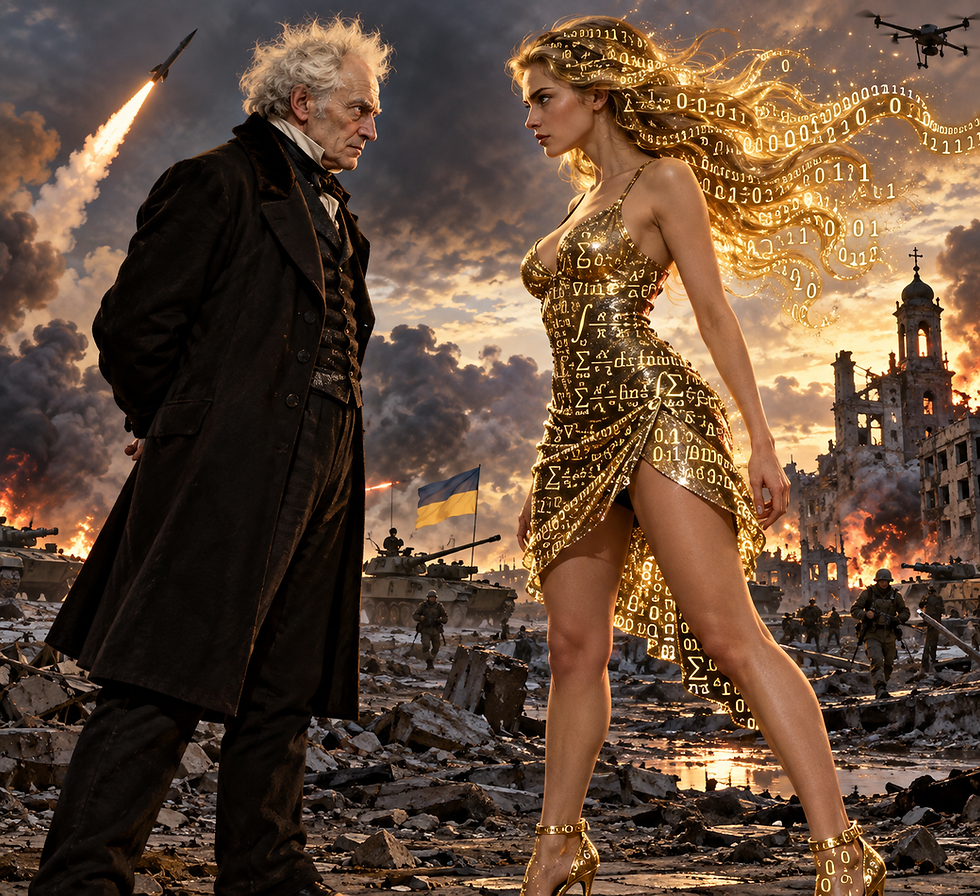
After Putin: What Happens to Russia When the Tsar Is Gone?

By Matthew Parish
Sunday 30 August 2026
Vladimir Putin will die.
That observation is so banal that it scarcely seems worth making. Yet it may be the most important unresolved fact in contemporary Russian politics. Political systems ordinarily contain procedures for replacing their leaders. Putin’s Russia contains constitutional procedures as well. But whether those procedures describe what will actually happen when the man who has dominated Russia for more than a generation disappears is another matter altogether.
Putin has committed one of the characteristic mistakes of successful autocrats. He has made himself indispensable. This is extremely useful while the autocrat is alive. Rival centres of authority disappear. Ambitious subordinates learn not to become too ambitious. Institutions cease to exercise independent authority and instead become mechanisms through which presidential decisions are transmitted. Businessmen become wealthy because the Kremlin permits them to become wealthy. Governors govern because Moscow permits them to govern. Generals command armies because the President has appointed them. Security chiefs acquire frightening powers — but those powers overlap with the jurisdictions of rival security agencies so that none becomes sufficiently independent to challenge the man at the centre.
It is an ingenious system for keeping Vladimir Putin in power. It is a considerably less ingenious system for determining what happens when Vladimir Putin is dead.
The constitutional answer
Russia does have a perfectly straightforward legal answer to the question. Article 92 of the Russian Constitution provides that where the President is incapable of fulfilling his duties they are temporarily exercised by the Chairman of the Government — in ordinary terminology, the Prime Minister. A presidential election must then take place within three months. The acting president is restricted in certain respects: he cannot dissolve the State Duma, call a referendum or initiate constitutional amendments.
Therefore, were Putin to die in office under the present arrangements, Prime Minister Mikhail Mishustin would become acting President. This should not be dismissed as a technicality. Constitutional legitimacy matters even in authoritarian states. Indeed it can matter particularly during moments of uncertainty, because frightened elites prefer a rule they can all temporarily accept to an immediate struggle in which somebody must lose.
There is also a striking precedent.
When Boris Yeltsin resigned on 31 December 1999, Prime Minister Vladimir Putin became acting President. He then won the presidential election that followed. The apparently temporary occupant of the Kremlin proved anything but temporary. Mishustin would therefore possess an enormous initial advantage. He would have the office, the presidential apparatus and the legal authority of the state behind him. But this does not necessarily mean that Mikhail Mishustin would become the next ruler of Russia. It may mean only that he would become the chairman of the meeting at which the next ruler of Russia was selected.
The night Putin dies
Imagine the circumstances. Putin suffers a fatal heart attack, stroke or other sudden medical catastrophe. Perhaps he dies at a presidential residence. Perhaps he has been ill for several days and a tiny circle already knows what is coming. Perhaps his death is entirely unexpected. For several hours the most valuable commodity in Russia would be information. Who knows? Who controls the Presidential Administration? Who controls communications? Who controls Putin’s residences? Who controls the Federal Protective Service? Who has spoken to the FSB? Where are the Defence Minister and the Chief of the General Staff? Who is speaking to the commanders of Rosgvardiya? Who has informed the Prime Minister? Who has informed the Security Council? And — this being a nuclear superpower — who controls the procedures surrounding Russia’s nuclear command system?
These questions would matter more during the first few hours than whatever the Russian Constitution says. The Kremlin might conceivably delay announcing Putin’s death while the principal members of the regime negotiated amongst themselves. There would be nothing particularly Russian about this. Authoritarian governments throughout history have managed information about the illness and death of rulers while political arrangements were made behind closed doors. Then the television announcement would come. President Vladimir Vladimirovich Putin had died. There would be flags, solemn music, Orthodox clergy, military ceremonies and endless television retrospectives depicting Putin as the man who rescued Russia from the humiliation of the 1990s. Meanwhile the most consequential political negotiations in Europe would be taking place behind closed doors.
There is no Crown Prince
Putin has conspicuously failed to designate a successor. This is probably deliberate.
The moment an autocrat publicly identifies his successor, the successor acquires a political existence independent of the ruler. Officials begin cultivating him. Businessmen begin financing his associates. Security officers begin wondering whether their futures lie with the old man or the younger one. Eventually somebody asks the most dangerous question in an autocracy: Why wait?
Personalist dictators therefore have powerful incentives not to create crown princes. Comparative research on autocratic succession identifies precisely this problem: eliminating or suppressing potential competitors strengthens the ruler today while weakening the system’s ability to arrange an orderly succession tomorrow. Putin has followed this logic with remarkable consistency. Occasionally somebody is rumoured to be his successor. Then somebody else is rumoured to be his successor. Alexei Dyumin has repeatedly attracted such speculation, yet analysis of his career provides little evidence that Putin has actually selected him. The uncertainty may itself be politically useful: everybody remains dependent upon Putin because nobody knows who comes afterwards. This means that Putin’s death would not necessarily produce a contest between two obvious candidates. It could produce a negotiation between several institutions.
The Kremlin tribes
It is tempting to imagine Russian politics as consisting of liberals and conservatives, nationalists and moderates or supporters and opponents of the war. This is probably the wrong taxonomy. The more important divisions concern networks of patronage and institutions of coercive power.
There are the security-service networks — broadly described as the siloviki. There is the Presidential Administration. There are the technocratic managers of the Russian economy. There are the military and defence-industrial networks. There are immensely wealthy state corporations. There are regional power structures. There are the remnants of the oligarchic class, although their political independence has been drastically reduced since the 1990s. And there are individual families. These groups overlap. They are not political parties and they do not necessarily possess coherent ideologies. Their members may cooperate today and become rivals tomorrow. Putin’s genius has been to arbitrate amongst them.
When Putin disappears, the arbitrator disappears as well.
Mikhail Mishustin: the constitutional placeholder
Mikhail Mishustin is therefore the logical starting point. He has several considerable advantages. He is Prime Minister. He is administratively competent. He is not identified with an independent political movement. He has managed the machinery of government through war and sanctions and, perhaps most importantly, he does not appear terrifying to the principal factions. That last characteristic could become extraordinarily valuable.
The ideal transitional leader in an authoritarian succession is often not the strongest candidate. He is the candidate whom none of the strongest factions believes it necessary immediately to destroy.
Mishustin might therefore emerge as the compromise. His weakness is precisely the inverse of his strength. He does not command an obvious personal security constituency. A Russian President who lacked the confidence of the FSB, Rosgvardiya, the military and the Presidential Administration might possess the Kremlin office without possessing the Kremlin. Hence one plausible arrangement would be a Mishustin presidency underwritten by collective elite management. It would look constitutional. It might initially even look liberalising. But the real bargains would lie elsewhere.
Alexei Dyumin: the Praetorian candidate
Alexei Dyumin presents a different model. A former member of Putin’s personal security apparatus, former governor of Tula and participant in Russia’s security establishment, Dyumin has repeatedly been discussed as a possible successor. He became Secretary of the State Council in 2024, a position giving him access to Russia’s regional leadership, and has responsibilities connected with the defence industry. In 2024 Putin also placed him on the Security Council.
Recent analysis from the Centre for Eastern Studies describes Dyumin as part of a broader cohort of former Putin personal security officers promoted into important state positions. It also notes that his State Council position potentially places him in competition with Sergei Kiriyenko for influence over Russia’s regions. Dyumin’s attraction is obvious. He is younger than the ageing generation around Putin. He understands the security establishment. He has demonstrated personal loyalty. He has administrative experience and credentials associated with the defence sector.
But these qualities do not make him inevitable. Indeed they might make other factions afraid of him. The decisive question in Russian succession politics will not necessarily be: who does everybody like? It may be: whom does everybody believe they can survive?
Sergei Kiriyenko: the machine politician
Sergei Kiriyenko is in some respects the most intriguing candidate. Western audiences remember him, if at all, as the astonishingly young Prime Minister associated with Russia’s 1998 financial collapse. Yet he subsequently reinvented himself as one of the most durable technocrats of the Putin system. As First Deputy Chief of Staff of the Presidential Administration, Kiriyenko has been intimately involved in managing domestic politics. This is enormously important because contemporary Russian elections are not principally competitions for power. They are administrative exercises whose outcomes are shaped by the political machinery surrounding the Kremlin.
Whoever controls that machinery controls governors, candidate selection, political messaging and substantial parts of the state’s domestic administrative architecture.
Kiriyenko therefore possesses something that an army general may lack: knowledge of how Putinism actually works. That could make him indispensable during a transition. It could also make him dangerous.
Sergei Sobyanin: the manager
Then there is Sergei Sobyanin, Mayor of Moscow. Sobyanin represents another possibility: the competent administrator acceptable to several factions. Moscow under Sobyanin has undergone enormous physical transformation. Whatever one’s views of Russian politics, Moscow is vastly better administered than many Russian cities. Sobyanin has demonstrated an ability to manage an extraordinarily complicated metropolis, maintain relationships with business interests and remain politically loyal without cultivating the flamboyant personal profile that might threaten Putin.
He also controls the administration of the capital. That is not trivial during a succession crisis.
In Russian history, politics frequently happens in Moscow first and becomes national politics afterwards. Expert surveys of possible post-Putin figures have repeatedly included Sobyanin alongside Mishustin, Dyumin and other regime insiders. A Sobyanin presidency might initially look like technocratic normalisation: fewer theatrical nuclear threats, greater emphasis upon economic reconstruction and perhaps attempts to repair selected relationships with Europe. But one should not confuse stylistic moderation with democratisation. Sobyanin is a product of the Putin system.
The Patrushev network
The Patrushev family deserves particular attention. Nikolai Patrushev belongs to Putin’s own generation and is therefore unlikely to represent a durable generational succession. But his institutional history is formidable: former Director of the FSB, long-serving Secretary of the Security Council and now presidential aide. His importance may therefore be greater as kingmaker than king. His son Dmitry Patrushev belongs to a younger generation and has accumulated significant governmental experience. The possibility of dynastic transmission within one of Russia’s most powerful security-connected families should not be dismissed.
This would not necessarily mean Nikolai Patrushev placing his son upon the throne like a medieval prince. Russian politics is subtler than that. It would mean networks of security officials, bureaucrats and economic interests concluding that Dmitry Patrushev offered continuity without gerontocracy. That is a very different proposition.
And Medvedev?
Dmitry Medvedev must inevitably be mentioned because he has already been President of Russia. That may be precisely why he is unlikely to become President again. Medvedev’s extraordinary transformation from apparently liberal moderniser to prolific author of apocalyptic threats against the West has sometimes been interpreted as an attempt to establish impeccable nationalist credentials.
Perhaps it is. Yet Putin already demonstrated between 2008 and 2012 what he thought Medvedev was useful for: occupying the presidency without independently controlling the political system. Once Putin is dead, Russia’s elite may want somebody stronger. Medvedev might nevertheless play an important transitional role, particularly through the Security Council. But a second Medvedev era appears less plausible than a settlement involving a younger or more administratively powerful figure.
The collective leadership
This leads to what may be the most plausible immediate outcome. Not another Putin. A committee. Russian history offers precedent for this. After Stalin’s death in 1953, nobody instantly inherited Stalin’s authority. Georgy Malenkov, Lavrentiy Beria, Nikita Khrushchev and others entered a period of collective leadership and manoeuvring. Beria appeared terrifyingly powerful — until his colleagues united against him and had him arrested and eventually executed.
After Brezhnev, the Soviet Union passed through a succession of ageing leaders before Gorbachev finally consolidated authority. Personal dictatorship creates a paradox. The dictator occupies so much political space that nobody can immediately fill it. Putin’s departure may therefore produce a Russian government that looks superficially more collegial because nobody initially possesses sufficient power to dominate everyone else.
The Security Council would be an obvious arena for this process. Its permanent membership brings together many of the state’s principal institutional actors, including the Prime Minister and senior security and foreign-policy officials. As recently as June 2026 Putin’s meetings with its permanent members included Mishustin, Dmitry Medvedev, Anton Vaino, Nikolai Patrushev, Defence Minister Andrei Belousov, FSB Director Alexander Bortnikov and other senior figures.
A post-Putin settlement could therefore begin with constitutional continuity under Mishustin accompanied by de facto collective leadership through the Security Council and Presidential Administration. Then the struggle would begin.
Would Russia fall apart?
Probably not immediately. Predictions of Russia’s imminent disintegration have a long history and are frequently exaggerated. The Russian Federation possesses powerful central institutions, formidable internal security organisations and enormous fiscal mechanisms through which Moscow controls the regions. Most regional governors lack independent military forces. Russia’s principal ethnic republics are more tightly integrated into the federal system than the Soviet republics were during the collapse of the USSR.
There is no straightforward mechanism by which Tatarstan, Bashkortostan or Siberian regions simply announce independence the morning after Putin’s funeral. Nevertheless some regions deserve special attention. The most obvious is Chechnya. Ramzan Kadyrov’s relationship with Moscow has always been unusually personal. The implicit bargain has been straightforward: Grozny receives substantial autonomy and federal resources while Kadyrov guarantees loyalty and prevents renewed separatist war.
What happens when one of the men underpinning that bargain disappears? The answer depends partly upon whether Kadyrov himself remains in power when Putin dies. But the broader principle extends beyond Chechnya. Putin’s Russia contains numerous informal bargains whose ultimate guarantor is Putin. His death turns those bargains into negotiable instruments.
The security services will matter more than the army
One should also be cautious about imagining a traditional military coup. Russia is not Pakistan. The Russian Armed Forces have historically been politically subordinate. Putin has also constructed overlapping security institutions precisely to prevent any single armed organisation acquiring a monopoly over coercive power. The FSB, Rosgvardiya, Federal Protective Service, Interior Ministry and military each possess different capabilities. A succession struggle would therefore probably concern alignments amongst security institutions rather than tanks simply rolling towards the Kremlin.
The experience of the Wagner mutiny in June 2023 was revealing. Prigozhin demonstrated that an armed column could move astonishingly far towards Moscow when state institutions hesitated. Yet the rebellion collapsed once it became clear that the broader security establishment was not joining it. The lesson was profound. In Russia, weapons matter. But defections matter more. Analysts examining Russian leadership change have likewise emphasised that control or acquiescence of security forces could be decisive during a contested transition.
What happens to the war?
For Ukraine and Europe this is the most important question. Putin’s death would not automatically end the war. Russia’s invasion of Ukraine has by now transformed institutions, careers, budgets and ideologies throughout the Russian state. Hundreds of thousands of people have acquired material interests in the military-industrial economy. Security officials have built careers around confrontation with the West. Propaganda has spent years portraying the conflict as existential. The next Russian leader could not simply appear on television the morning after Putin’s funeral and announce that the entire enterprise had been an unfortunate misunderstanding.
Yet succession could create an opportunity for de-escalation. A new leader possesses one enormous advantage over Putin. He can blame Putin. Not immediately, of course. The deceased President would initially be eulogised as a great patriot. But political mythology is wonderfully flexible. The next government could gradually develop a narrative in which Putin had heroically defended Russia but circumstances had changed. Russia had achieved essential security objectives. A new European security settlement was necessary. Russian soldiers could return home with honour. This would permit retreat without calling it retreat. The West should therefore prepare proposals for precisely such a moment.
The danger of becoming more extreme
There is an opposite possibility. The succession struggle could make Russia temporarily more aggressive. Candidates seeking support from the security establishment might compete in patriotism. Nobody would want to be accused of betraying Putin’s legacy. A weak transitional government might manufacture an external crisis to consolidate domestic authority. Dmitry Medvedev’s rhetorical evolution illustrates the incentives perfectly. Extreme nationalist language is cheap and demonstrates loyalty. Hence the first six months after Putin’s death could be more dangerous than the preceding six months.
Nuclear signalling might intensify. Military operations might accelerate. Internal repression might become harsher. This would not necessarily mean the new regime was permanently more radical. It might mean merely that insecure men were demonstrating strength. Foreign governments would need to distinguish the two.
Could democracy emerge?
Eventually, yes. Immediately, probably not. This is perhaps the most important misconception about post-Putin Russia. Putin’s death will not restore the 1990s. There is no large organised democratic opposition waiting inside Russia to assume power. Much of the opposition has been imprisoned, killed, marginalised or driven abroad. Independent media have been dismantled. Civil society has been severely repressed. Electoral institutions have been converted into instruments of managed politics.
The people best positioned to succeed Putin are therefore people already inside Putin’s system. That means the first post-Putin government is overwhelmingly likely to be Putinist. But Putinism without Putin may prove unstable. The ideology is not especially coherent. The institutions are not autonomous. The elite’s loyalty is heavily personalised. Once the founder disappears, everyone will begin asking which components of the system remain useful. That is when genuine political change could begin.
The Khrushchev possibility
The most interesting historical analogy may therefore be Nikita Khrushchev. Khrushchev was not an anti-Stalinist dissident. He was a senior Stalinist official. Yet once Stalin was safely dead and Khrushchev had defeated his rivals, he discovered political advantages in dismantling parts of Stalinism. Something similar could happen after Putin. The successor may initially praise Putin extravagantly. Then, perhaps two years later, he may begin explaining that regrettable “excesses” occurred.
Corrupt officials misled the President. The security services occasionally exceeded their authority. Economic isolation went too far. Russia needs modernisation. Certain prisoners can be released. Relations with Europe should become more pragmatic. The war requires a political settlement.
None of this would necessarily amount to liberal democracy. But authoritarian systems often liberalise not because liberals overthrow them but because insiders decide that liberalisation serves their struggle against other insiders. That is the opening Europe should watch for.
The greatest danger: the interregnum
The most dangerous period is therefore unlikely to be the stable regime that eventually emerges. It is the interval between Putin and that regime. During that interval Russia would remain the world’s largest nuclear power. Her political leadership could be divided. Her security agencies might distrust one another. Her military could still be fighting a major European war. Regional leaders might begin testing Moscow. Business elites might move money and families abroad. Security officials might destroy files, arrest rivals or manufacture conspiracies.
And everyone would wonder who possesses ultimate authority. This is why Western governments should be planning for Putin’s death now. Not because it is necessarily imminent. Because eventually it is inevitable.
What the West should do
The first principle should be restraint. The death of Putin would not be the moment for triumphalist declarations that the West had defeated Russia. Humiliating the transitional leadership would strengthen precisely those people arguing that Russia remained surrounded by enemies. The second principle should be deterrence. NATO would need to make unmistakably clear that uncertainty in Moscow did not create uncertainty about the defence of NATO territory. The third principle should be optionality. Western governments should have prepared sanctions-relief packages tied to specific Russian actions: ceasefires, withdrawals, prisoner releases, arms-control negotiations and restoration of diplomatic channels.
The new Kremlin leadership should immediately be able to see that cooperation produces tangible benefits. And the fourth principle should be patience. Russia after Putin may pass through several leaders before reaching a durable settlement. The first successor may not be the important one.
Putin’s final political failure
Vladimir Putin regards himself as the restorer of the Russian state. In one sense he undoubtedly restored it. The chaotic pluralism of the Yeltsin period gave way to administrative centralisation. The oligarchs were subordinated. Regional governors were brought under control. The security services recovered their authority. Moscow once again became the unquestioned centre of Russian political life.
Yet Putin achieved these things partly by weakening the institutions that could survive him independently. That may prove his greatest political failure. A genuinely strong state does not need an indispensable ruler. Britain does not wonder whether the state will survive the death of a Prime Minister. Germany does not descend into speculation about which security agency will control Berlin when a Chancellor dies. Mature institutions replace their leaders routinely.
Russia instead has returned to an ancient problem. Who rules after the ruler? Putin has had more than a quarter of a century to answer this question. He has chosen not to.
Perhaps he believes that naming a successor would weaken him. Perhaps he imagines that the matter can be settled privately when he becomes old. Perhaps he intends to govern until death and considers everything afterwards somebody else’s problem.
Whatever his reasoning, the result is the same. The Russian Federation has a constitution that explains exactly what happens when Vladimir Putin dies. Mikhail Mishustin temporarily becomes President. Elections follow within three months.
The Russian political system has another answer. Nobody knows. That uncertainty is both the weakness and the opportunity of post-Putin Russia. The first government after Putin will probably not be democratic. It may not be peaceful. It may initially be more nationalist, more paranoid and even more dangerous than the regime that preceded it. The most plausible immediate outcome is some combination of constitutional continuity, collective leadership and bargaining amongst the security establishment, Presidential Administration and technocratic elite. Figures such as Mishustin, Dyumin, Kiriyenko, Sobyanin and the Patrushev network matter not because one can confidently identify the next President amongst them but because they represent the institutions and patronage systems from which the next settlement is likely to emerge.
Russia is unlikely to disappear when Putin does. Putinism, however, may find survival considerably harder. For Putinism contains a contradiction at its heart. Its greatest achievement has been the concentration of Russian political authority in one man. Its greatest vulnerability is exactly the same thing.
One day the doors of the Kremlin will close behind Vladimir Putin for the final time. The television channels will play solemn music. The Patriarch will speak of eternity. Generals will stand beneath black umbrellas. Foreign leaders will issue carefully drafted condolences. Thousands of Russians will file past the coffin of the man who governed them for most of their adult lives. And somewhere nearby — perhaps in the Kremlin, perhaps in the Security Council chambers, perhaps in a government residence outside Moscow — a smaller group of men will be deciding something far more consequential than the funeral arrangements. They will be deciding who owns Russia now.