


A Night Out in Kyiv: The Empty Capital
By Matthew Parish
Thursday 17 September 2026
There is something peculiar about going out for an evening in Kyiv now. It is not merely that the city is at war. Kyiv has been at war for years, and human beings possess a remarkable capacity to convert even extraordinary circumstances into routine. Rather, the Ukrainian capital increasingly gives the impression, particularly after darkness has fallen, of a great European city whose inhabitants have quietly departed, leaving behind the architecture, the street lights, the restaurants and the immense boulevards, but taking much of the human life with them.
Go out for dinner at seven o’clock and everything can initially seem almost normal. Restaurants are open in the centre. Waiters carry plates between tables, couples sit opposite one another over glasses of wine, taxis circulate and the illuminated façades of central Kyiv retain the monumental confidence of a capital city. Khreshchatyk remains Khreshchatyk. The great buildings stand where they always stood, the golden domes remain visible above the hills and the Dnipro continues silently beneath its bridges. Yet there is something provisional about this normality, as though everyone participating in it understands that the performance has a closing time considerably earlier than the clock might suggest.
By nine in the evening, a strange transformation has taken place. Tables are being cleared, people begin looking at their telephones, calculating journeys home and considering whether tonight will be another night of alarms. Cars disappear and pavements that ought, in a European capital of several million people, to be crowded with young people become remarkably quiet. A restaurant may still technically be open, and there is no legal requirement that everybody be home at this hour, but the atmosphere has changed. The evening is already drawing towards its premature conclusion.
Kyiv’s formal curfew does not by itself explain this phenomenon. The more important curfew is psychological, and it begins long before the legal one. Years of war have created their own timetable in which darkness represents not merely the end of the working day but the beginning of another period of uncertainty. The night is when drones and missiles are expected, when telephones may begin issuing warnings and when the practical question of where one happens to be in the city can abruptly become important.
This changes the psychology of an evening out. One does not simply ask where to have dinner but notices where the nearest metro station is. One observes whether the restaurant has a basement, checks the battery on one’s telephone and calculates how long it will take to get home should an air-raid alert interrupt the evening. Ordinary logistical calculations have acquired an additional column: what happens if Russia attacks tonight?
There is an important distinction between danger and the anticipation of danger. Kyiv is not being physically struck every minute of every day, and this is precisely why descriptions of the capital as though it were a permanently burning battlefield are misleading. Cafés operate, children attend school, people go to work and the complicated machinery of ordinary domestic life continues. Yet the possibility of aerial attack is sufficiently persistent that it has become incorporated into the habits by which people organise their lives. The remarkable feature of wartime Kyiv is not that normality has disappeared but that normality and the expectation of catastrophe have learned to occupy the same physical space.
That produces the extraordinary sensation of central Kyiv after dark. A city designed for crowds frequently seems to have too few people in it, and the contrast is particularly striking because Kyiv is not naturally a quiet city. Before the full-scale invasion she possessed the chaotic nocturnal energy characteristic of eastern European capitals: late restaurants, bars, clubs, taxis, students, businessmen, tourists and people wandering without any particular destination. Summer evenings could continue indefinitely and the distinction between dinner and nightlife was pleasantly uncertain. War has not abolished this culture altogether, but it has disciplined its spontaneity.
A night out therefore develops a curious rhythm. Dinner begins earlier and conversations become compressed by an awareness of time. People who once might have ordered another bottle of wine begin thinking about the journey home. Friends check Telegram channels between courses, somebody’s telephone announces an air alert and everyone glances at everyone else for a fraction of a second. Then comes the familiar calculation: drones or ballistic missiles, which direction are they travelling and how seriously should tonight’s warning be taken?
The terrifying achievement of prolonged aerial warfare is that questions of this kind eventually become mundane. Civilians learn a vocabulary that civilians ought never to need. People distinguish the sounds of explosions from air defence, understand that the absence of an immediate explosion does not mean that nothing is coming, learn not to stand beside windows and develop opinions about which metro stations provide the best shelter. The extraordinary becomes integrated into the ordinary until a waiter can bring the bill while an air-raid application issues warnings and nobody considers the juxtaposition especially remarkable.
This is not heroism in the cinematic sense. There is no stirring music and nobody delivers speeches. There is simply adaptation, which may be one of the strangest characteristics of human beings. Someone finishes a cigarette outside, somebody else orders a taxi and the restaurant staff start preparing to go home because they have families and anxieties of their own. The mechanics of hospitality continue while everyone silently performs the same calculation about the night ahead.
Then the centre empties further. Kyiv’s wartime human geography has changed, and the distinction between the capital’s centre and her surrounding residential districts, satellite towns and suburbs has become increasingly important to the way people organise their lives. Some families prefer houses where they can maintain generators, store supplies, keep cars nearby and exercise greater control over their domestic circumstances. Others commute into the centre for work and leave again afterwards. Some of the people who once contributed to Kyiv’s dense nocturnal life are abroad, while others have changed their habits so radically that central Kyiv can occasionally feel less like a permanently inhabited metropolis than the daytime centre of a much wider urban region.
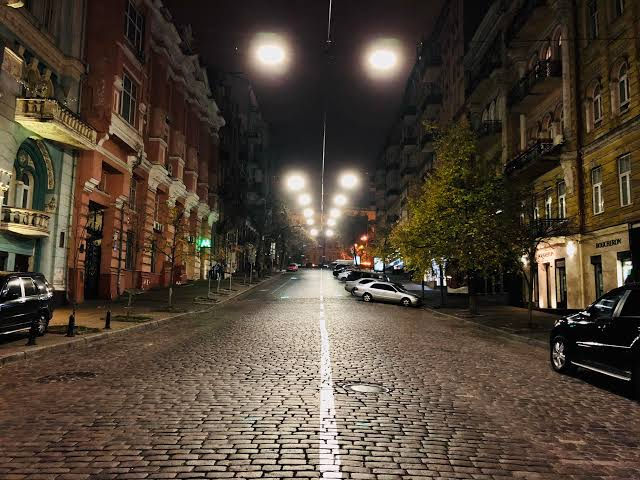
This should not be exaggerated into the claim that Kyiv has literally emptied or that her inhabitants have universally abandoned the centre. Millions of people remain in and around the capital, and ordinary life continues with extraordinary persistence. Indeed, that persistence is precisely what makes the contrast so unsettling. Kyiv can appear intensely alive at lunchtime and strangely abandoned only hours later. There are lights in apartment windows but fewer pedestrians beneath them, illuminated restaurants with too many empty tables and enormous roads constructed to carry the traffic of a metropolis along which, late at night, surprisingly little may be moving. The city has not died; much of her life has simply withdrawn indoors.
The atmosphere is different from that of Ukrainian cities closer to the front. In Kherson, Kramatorsk and other settlements within easier range of Russian artillery, glide bombs and short-range drones, danger can be immediate, local and brutally visible. Kyiv’s peculiar psychological burden is different. The capital retains nearly all the physical attributes of ordinary European metropolitan life while existing beneath the expectation that, on any particular night, machines carrying explosives may arrive from hundreds or even thousands of kilometres away. The streets may therefore look peaceful at precisely the moment when people inside their apartments are following maps showing airborne objects travelling towards them.
The enemy at such moments is usually invisible. Somewhere beyond the horizon, aircraft take off, missiles are launched and drones begin their long journeys. Ukrainian monitoring channels follow their progress across the country, telephones illuminate beside beds, air-defence crews wait and families decide whether to move into corridors, bathrooms, underground car parks or metro stations. Meanwhile central Kyiv becomes quieter, as though the city instinctively understands that darkness is no longer entirely her own.
Perhaps the strangest part of a night out in the Ukrainian capital is therefore the journey home. There is a moment when one steps out of the warmth of a restaurant and onto an almost empty street. Kyiv remains one of Europe’s great capitals, with her hills, churches, boulevards and monumental buildings, and at night she can be exceptionally beautiful. Yet there may be remarkably few people around to see it. The magnificence remains while the audience has gone elsewhere.
The silence can become oppressive because one knows that it may not last. A taxi passes, somewhere a dog barks and a few people hurry towards a metro entrance. Traffic lights continue changing for cars that are not there, while the electronic infrastructure of the metropolis carries on performing its peacetime rituals for largely empty streets. Then a telephone may vibrate with the notification that has become one of the defining sounds of Ukrainian life: an air-raid alert. The words are so familiar that they can almost cease to mean anything, although their literal meaning remains extraordinary. Somewhere in the darkness, something may be travelling towards the city for the purpose of exploding in it.
This is what perpetual siege does to urban civilisation. It does not necessarily destroy the city and it does not prevent people from continuing their lives. Instead it changes the relationship between the city and time. Morning becomes the safest approximation of normality, afternoon is busy, early evening remains sociable and night belongs increasingly to uncertainty. The city continues to function, but the rhythm according to which human beings inhabit her has been altered by machines travelling invisibly through the darkness.
The great paradox is that Kyiv remains unmistakably alive. People fall in love, restaurants open, children go to school, businesses trade, soldiers return home on leave, couples marry and everybody continues complaining about prices, traffic and one another. These ordinary activities are not peripheral to wartime existence; they are its substance. A society cannot spend every hour consciously contemplating the possibility of death, because no human mind can function indefinitely in such a state. Normal life therefore reasserts itself with tremendous force even as the conditions surrounding it become increasingly abnormal.
Yet something has changed that statistics cannot adequately describe. A capital city ought to possess nights, because night is when a metropolis becomes unnecessary and therefore human. Daytime cities exist for work, administration, education and commerce. Night-time cities exist because people want to see one another. Restaurants, theatres, bars, music, romance and aimless wandering are among the luxuries by which civilisation demonstrates that existence consists of something more than survival. To wander through a city after midnight for no particular reason is, in its own small way, an expression of freedom.
War progressively confiscates these luxuries. Russia has not emptied Kyiv, nor has she extinguished her social life, but years of aerial attack have imposed a tax upon every ordinary pleasure. Dinner requires calculation, a drink requires attention to the clock, sleep requires listening and going home requires thinking about missiles. These are tiny compromises when considered individually, but accumulated across millions of people and thousands of nights they represent an enormous transformation in the texture of urban existence.
There is also something particularly cruel about the fact that the physical city remains so beautiful. Kyiv has not become some monochrome landscape of ruins of the sort imagined in films about war. Much of the centre remains magnificent. The façades are illuminated, churches rise above the hills and restaurants serve excellent food. One may spend an entirely pleasant evening with friends and for several hours almost forget that anything is wrong. Then one steps outside and discovers an avenue that should be filled with people but is virtually empty, and the war reappears not as an explosion but as an absence.
That absence may ultimately be one of the most memorable characteristics of Kyiv under prolonged aerial siege. War is commonly represented by noise: artillery, sirens, explosions, collapsing buildings and shouting. Yet prolonged war also has a sound of its own, and sometimes that sound is silence. It is the silence of a boulevard without traffic, of restaurant terraces being cleared too early and of metro entrances towards which the remaining pedestrians walk with slightly more purpose than they once did.
By nine o’clock the chairs begin disappearing from the terraces and the pavements become still. Cars head towards the outer districts and behind thousands of windows people look at their telephones, speak to their families, charge batteries, draw curtains and prepare for sleep while waiting to discover what sort of night it will be. Nobody knows whether there will be explosions or whether dawn will arrive uneventfully, and after enough years of war both possibilities have acquired the quality of routine.
Above them lies the enormous Ukrainian sky, apparently empty and peaceful. The great city beneath it is illuminated, subdued, magnificent and anxious, continuing stubbornly to live while learning every evening how to disappear. The most disturbing thing about a night out in Kyiv is therefore not necessarily what one sees, but what one does not: the crowds that ought to be there, the carefree hours that ought still to lie ahead and the ordinary urban night that war has taken away.


